

Thank Roosevelt for Football Weekends
December 20, 2013
By Rob Kaminski
MHSAA benchmarks editor
The next time you find yourself immersed in a tense crosstown football rivalry on a Friday night followed by a Saturday pilgrimage to the nearest college campus and a Sunday afternoon with a remote and your favorite snacks and beverages, take a moment to consider what the weekend would be like if it weren’t for Teddy Roosevelt.
The man who became our 26th President shortly after the turn of the 20th Century following the assassination of William McKinley in 1901 was a football fan like you. Maybe more so.
Today’s game of football has reached a critical crossroads. Player size and speed have increased across the board. Savage use of equipment as weapons rather than protective gear has been glorified on television networks and social media. Leaders of the game at all levels have recognized the need for change, employing new rules and widespread educational efforts to aid in preserving the sport.
History, as they say, is repeating itself.
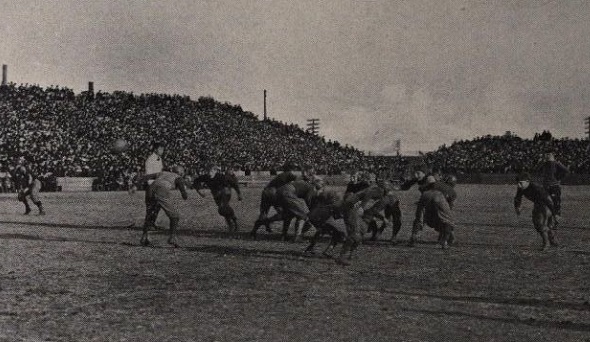
In an ironic twist, it was Roosevelt who saved the then-brutally violent game of football from itself more than 100 years ago. Yes, the same “Rough and Ready Teddy” who led the charge up San Juan Hill during the Spanish-American War and often sparred in the boxing ring while in office from 1901-09 opined that football was becoming so gruesome that he delivered an ultimatum: clean up the game or it would be outlawed.
The Chicago Tribune reported that in 1904 alone, there were 18 football deaths and 159 serious injuries, mostly among prep school players. Football deaths suffered by younger players were reported on a nearly weekly basis, as outraged citizens called on colleges and high schools to banish football outright.
In stepped Roosevelt, who called head coaches and representatives from Harvard, Yale and Princeton – college powers at the time – to the White House in 1905 urging them to eliminate excessive violence and set an example of fair play for the rest of the country. When the casualties actually rose by one during the ensuing season, Roosevelt reacted with greater resolve and convened leading football authorities for the purpose of authoring drastic rules changes. What emerged was an intercollegiate conference which was the predecessor of the NCAA.
Among the most effective changes for the 1906 season were the legalization of the forward pass, the elimination of mass formations, and the creation of a neutral zone. Football fatalities fell to 11 in each of the next two seasons, and severe injuries fell drastically.
Thanks to the introduction of protective equipment and ever-evolving rules changes, football during the 100-plus years to follow has become an exponentially safer game. Yet, the game’s leaders always will need to adjust and react to scrutiny that comes with the territory.
So, as the game once again undergoes rules modifications in the name of safety, give a tip of the cap to President Roosevelt while you enjoy college bowl season and the NFL playoffs and begin to think ahead to the first high school practice of 2014.
Grinding Ground Game Has White Pigeon Eyeing Memorable Run
By
Wes Morgan
Special for MHSAA.com
September 8, 2021
With just a cursory glance at the 2020 results for the White Pigeon varsity football team, the Chiefs’ 4-3 record might not seem all that impressive.
 Their opponents this year, however, know not to discount a program that has the potential to both reshape the Southwest 10 Conference standings by the end of the fall, but also to shake things up once the Michigan High School Athletic Association Division 8 playoffs get rolling.
Losing two of those contests to eventual D8 champion Centreville — a 14-8 defeat in Week 2 and a 16-0 loss in the District championship game — White Pigeon’s only other misstep was a 26-24 loss to Mendon in what was the Hornets’ final season before moving to the 8-player ranks. White Pigeon’s District opener win over Saugatuck was the school’s first postseason victory since 2009.
The Chiefs are rolling so far this year with sizable wins over Saugatuck (48-6) and Galesburg-Augusta (38-7) to set up a conference opener this Friday against Decatur (1-1). Comstock is White Pigeon’s Week 4 opponent before the anticipated matchup with Centreville on Sept. 24.
"It definitely was a misleading (record) last year,” fourth-year head coach Shawn Strawser said. “(Centreville) was just a little better than us and ended up being state champs. Knowing that we were right there and that’s how close we could have been to having a nice run and being one of the better teams in the state … we watched those teams play and there wasn’t anybody that scared us. We would have loved to have chances against some of those schools last year.
 "I think our guys seeing a team from our conference won a state title, it gives them some confidence that they can do that too if they work hard.”
Perhaps that wish will come true this year as Strawser’s Wing-T offense is pounding opposing defenses thus far despite the graduation of 12 seniors, only 17 players on the varsity roster and several underclassmen in starting roles. If so, it will be because of heart and not size.
At a preseason scrimmage, Strawser instituted a new rule as a result.
"The boys come walking down the sideline and they don’t have their pads on,” he said. “I said, ‘Dang it; what are you guys doing? Don’t you ever walk out here with your pads off. We ain’t intimidating nobody with our pads off, so go get them back on. Some people might see us with our pads off and they think we’re a JV team. But I’ll tell you what, we don’t play like a JV team.”
Seniors Jack Davidson and Dylan Carper so far have amassed staggering rushing production for the Chiefs, who have thrown the ball just three times. Davidson, a 5-foot-10, 170-pound fullback, ran for 299 yards and three touchdowns against Saugatuck and he added 137 yards and three more TDs vs. the Rams in Week 2. Carper, a 5-9, 165-pound back, piled up 130 yards and two scores in Week 1 and added 99 yards and a pair of touchdowns last week. The two also line up at linebacker — a position of strength for the White Pigeon defense
"Carper is a football player,” Strawser said. “You can play him anywhere. He’s the hardest hitter on the team. He could have had 300 yards the first night had I been giving him the ball more. Jack Davidson is not the type of fullback we had the first couple years. He sees holes really well and is a really strong runner.”
Of course, success begins up front with junior tight ends Jordan Stamper and Chris Jackson, left tackle Chaz Underwood (freshman), left guard Esteban Castro (junior), center Wyatt Carunchia (junior), right guard Luke Gropp (senior) and right tackle Seth Miller (sophomore).
 "Our line has probably been the best it has been in a few years, so that’s a big reason why we get so many yards per carry and so many touchdowns,” Carper said. “Them doing their job consistently helps us a lot. It makes it really easy for us to just run through the big hole they made.
"It’s really fun watching Jack go for all these yards. And then the next thing you know, I get to carry and go for a big touchdown. We just get to go back and forth with each other. It’s fun to play and fun to watch. I’m faster than Jack, so I hit the hole quicker. But he’s more powerful and patient than I am. He waits for the hole to develop while I go right through it.”
Davidson has a unique perspective on how the front seven should operate having spent last season at left guard to shore up the offensive line.
"Yeah, I got yelled at a few times,” Davidson joked. “It made me understand how tough it is. I get now why they ask a lot of questions and that I have to be more patient in the backfield.”
"We knew it was going to be a one-year deal,” Strawser added of Davidson’s line days. “We were a little thin on the line last year and he stepped up and did a nice job. But we knew he’d be moving back this year.”
With the meat of the schedule ahead, the Chiefs believe they have what it takes to get to the next level.
"I just think we work really good as a team. And with us all working together, I think we can cause them some trouble,” Carper said. “Every year I think we’re in the mix for (a conference championship), but this year there is a good team at Centreville and at Comstock, so it should be a close race.”
 Wes Morgan has reported for the Kalamazoo Gazette, ESPN and ESPNChicago.com, 247Sports and Blue & Gold Illustrated over the last 12 years and is the publisher of JoeInsider.com. He can be reached at [email protected] with story ideas for Berrien, Cass, St. Joseph and Branch counties.
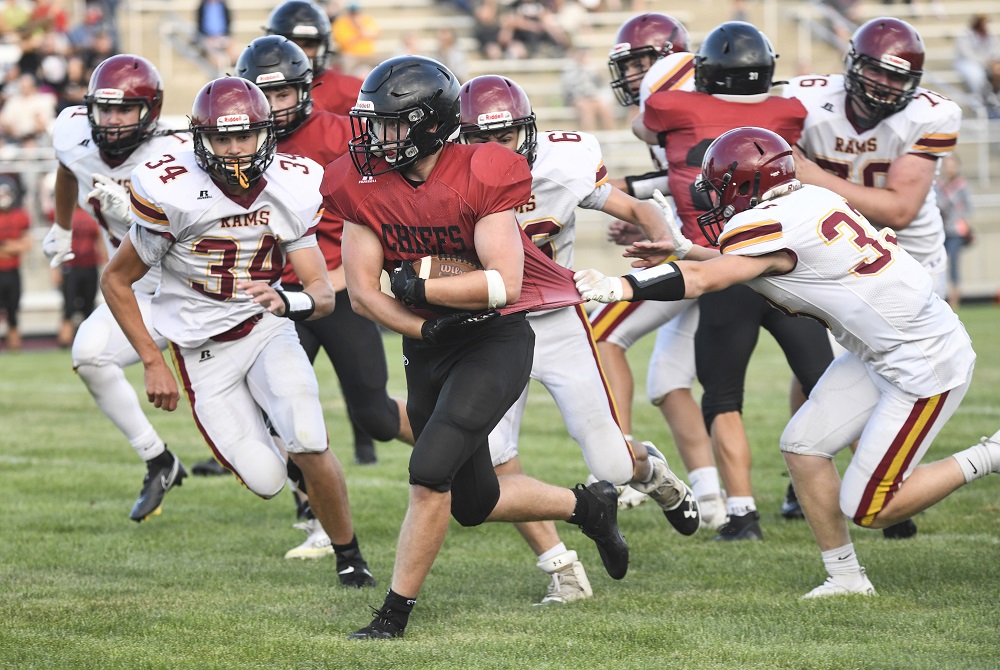
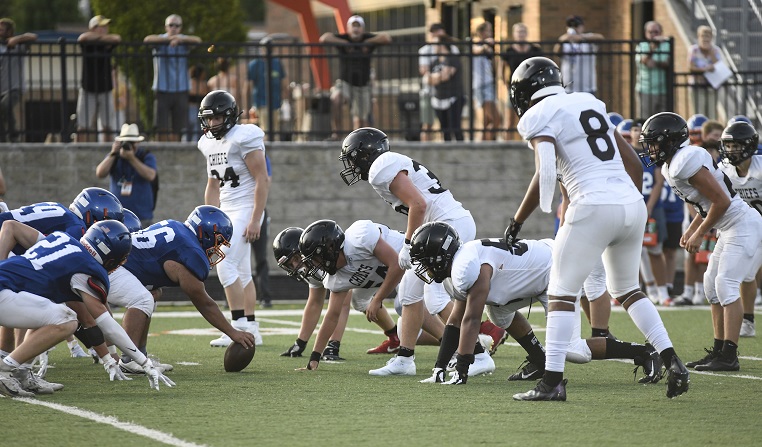
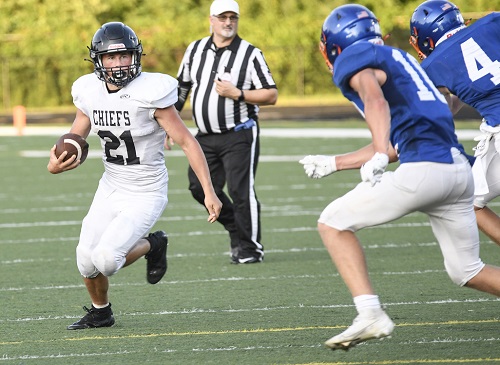
PHOTOS: (Top) White Pigeon’s Jack Davidson pulls away from a potential tackler last week against Galesburg-Augusta. (Middle) White Pigeon’s defensive front seven – including Davidson (30), Luke Gropp (54), Chris Jackson (8) and Jordan Stamper (84) – loads the box against Saugatuck during Week 1. (Below) Dylan Carper (21) gets to the edge against Saugatuck. (Photos courtesy of the White Pigeon football program.)