

Thank Roosevelt for Football Weekends
December 20, 2013
By Rob Kaminski
MHSAA benchmarks editor
The next time you find yourself immersed in a tense crosstown football rivalry on a Friday night followed by a Saturday pilgrimage to the nearest college campus and a Sunday afternoon with a remote and your favorite snacks and beverages, take a moment to consider what the weekend would be like if it weren’t for Teddy Roosevelt.
The man who became our 26th President shortly after the turn of the 20th Century following the assassination of William McKinley in 1901 was a football fan like you. Maybe more so.
Today’s game of football has reached a critical crossroads. Player size and speed have increased across the board. Savage use of equipment as weapons rather than protective gear has been glorified on television networks and social media. Leaders of the game at all levels have recognized the need for change, employing new rules and widespread educational efforts to aid in preserving the sport.
History, as they say, is repeating itself.
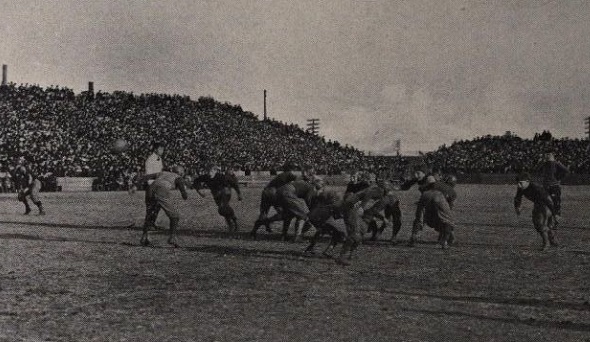
In an ironic twist, it was Roosevelt who saved the then-brutally violent game of football from itself more than 100 years ago. Yes, the same “Rough and Ready Teddy” who led the charge up San Juan Hill during the Spanish-American War and often sparred in the boxing ring while in office from 1901-09 opined that football was becoming so gruesome that he delivered an ultimatum: clean up the game or it would be outlawed.
The Chicago Tribune reported that in 1904 alone, there were 18 football deaths and 159 serious injuries, mostly among prep school players. Football deaths suffered by younger players were reported on a nearly weekly basis, as outraged citizens called on colleges and high schools to banish football outright.
In stepped Roosevelt, who called head coaches and representatives from Harvard, Yale and Princeton – college powers at the time – to the White House in 1905 urging them to eliminate excessive violence and set an example of fair play for the rest of the country. When the casualties actually rose by one during the ensuing season, Roosevelt reacted with greater resolve and convened leading football authorities for the purpose of authoring drastic rules changes. What emerged was an intercollegiate conference which was the predecessor of the NCAA.
Among the most effective changes for the 1906 season were the legalization of the forward pass, the elimination of mass formations, and the creation of a neutral zone. Football fatalities fell to 11 in each of the next two seasons, and severe injuries fell drastically.
Thanks to the introduction of protective equipment and ever-evolving rules changes, football during the 100-plus years to follow has become an exponentially safer game. Yet, the game’s leaders always will need to adjust and react to scrutiny that comes with the territory.
So, as the game once again undergoes rules modifications in the name of safety, give a tip of the cap to President Roosevelt while you enjoy college bowl season and the NFL playoffs and begin to think ahead to the first high school practice of 2014.
1st & Goal: Playoff Week 3 Preview
November 12, 2020
By Geoff Kimmerly
Second Half editor
There inevitably will be big scores put up this weekend as we roll into the third round of the 11 and 8-player football playoffs.
But it’s fair to anticipate those games will be down to a few as 96 of 144 teams remaining on the bracket are undefeated or have only one loss this season.
We’ve switched things up for this week’s preview, looking first at our 8-Player Regional Finals, where 15 of 16 remaining teams are 8-0 or 7-1, and the 16th team’s only defeats were to schools too big to qualify for the tournament. Our 11-Player District Finals are loaded as well, with six games matching undefeated opponents and many more featuring one-loss teams squaring off or attempting to tackle an unbeaten foe. See the full schedule on MHSAA.com.
Spectator limits remain in effect (check with your local school for purchasing information), but 28 games will be broadcast on MHSAA.tv or FOX Sports Detroit. Games below are Friday unless noted. Historical context is based in part on data at Michigan-football.com.
8-Player
Division 1
Adrian Lenawee Christian (8-0) at Morrice (8-0), Saturday
The Cougars put up a season-high 78 points against an also-unbeaten opponent last week, handing rising Mayville its only loss of a memorable run. But Lenawee Christian now runs into a more established 8-player power – Morrice is a combined 31-2 over the last three seasons, won Division 1 in 2018 and made the Semifinals a year ago. It’s tough to say how much past years’ experience will make a difference, but the Orioles definitely are familiar with this caliber of opponent – and scoring 52 points per game, they are outpacing the 2018 championship-winning offense by nearly 10 on average.
Other Regional Finals FRIDAY Pickford (7-1) at Indian River Inland Lakes (7-1), Gaylord St. Mary (7-1) at Suttons Bay (8-0), Marcellus (5-2) at Martin (7-1).
Division 2
Colon (7-1) at Portland St. Patrick (8-0), Saturday
Last season’s Division 1 champion, Colon is playing in Division 2 this fall with its only loss to Lenawee Christian (see above). The Magi stand in the way of a St. Patrick program that was Division 2 runner-up last season and in 2017 as well. The Shamrocks have played only one single-digit game this season, a four-point win over Merrill. Both are continuing to steam-roll opponents offensively as during their 2019 runs – but the key might be St. Patrick solving Colon’s defense, which is giving up eight points a game this fall.
Other Regional Finals FRIDAY Cedarville (7-1) at Powers North Central (8-0), Hale (7-1) at Marion (7-1). SATURDAY Mount Pleasant Sacred Heart (7-1) at Kinde North Huron (7-1).
11-Player
Division 1
Belleville (8-0) at Canton (8-0)
Although both of these teams are undefeated, Belleville certainly has gotten more attention this fall with an offense scoring more than 50 points per game and a defense that’s given up 43 all season. Only Livonia Stevenson on opening night has come within 21 points of the Tigers. The Chiefs meanwhile have won three one-possession games – including against Stevenson last week. All in all, this is lining up very similarly to when these teams last met, in a 2017 District Final won by Canton 28-25 over an unbeaten Belleville team – and surely both teams are recalling that last matchup this week.
Keep an eye on these FRIDAY Grandville (7-1) at Rockford (6-0), Grand Blanc (7-1) at Davison (8-0). SATURDAY Detroit Catholic Central (8-0) at White Lake Lakeland (7-0), West Bloomfield (7-1) at Sterling Heights Stevenson (7-1).
Division 2
Portage Northern (7-1) at East Lansing (7-0)
The Trojans have won pretty even matchups against Northern the last two seasons, by 10 in 2018 and 35-28 a year ago. There’s only one shared opponent between the two this fall – East Lansing beat Holt 63-0, and Northern lost to the Rams 26-0 – but it’s hard to say that will play much into this matchup. What will more is how the Huskies attack one of the most successful defenses in the state this fall, as East Lansing is giving up only three points per game.
Keep an eye on these FRIDAY Traverse City Central (7-1) at Midland, North Farmington (5-3) at South Lyon (6-2), Livonia Franklin (5-3) at Livonia Churchill (5-2), Oak Park (2-6) at Wyandotte Roosevelt (6-1).
Division 3
Mason (8-0) at DeWitt (8-0)
This is the second time in a month Mason will be facing an undefeated team with a championship on the line. The first, in Week 9, Mason downed Williamston 40-10 to clinch the Capital Area Activities Conference Red title. DeWitt meanwhile has outscored its two playoff opponents by a combined 107-0 with a defense that has given up 50 points total this season (and 38 of those game in a Week 5 win over Grand Ledge). The Bulldogs also have been impressive on that side of the ball, giving up just more than 10 points per game – and their defense will need to play a significant role as DeWitt needs to score only 31 more points this week to equal last year’s 13-game total from a Semifinal run.
Keep an eye on these FRIDAY Bloomfield Hills Brother Rice (7-1) at Chelsea (8-0), Detroit Martin Luther King (5-3) at Eastpointe (8-0). SATURDAY Marquette (7-1) at Muskegon (7-1), Stevensville Lakeshore (6-2) at St. Joseph (7-1).
Division 4
Ortonville Brandon (7-1) at North Branch (8-0)
Last week saw these league champions both defeat their strongest regular-season challengers for the second time, Brandon over Goodrich and North Branch over Croswell-Lexington. Both also are making a run this weekend at history, as neither has won a District title since that round of the tournament was introduced in 1999. The only loss between them this season was Brandon’s to Division 2 Fenton in a Flint Metro League crossover of first-place teams.
Keep an eye on these FRIDAY Sault Ste. Marie (6-2) at Cadillac (5-2), Detroit Country Day (5-2) at Madison Heights Lamphere (8-0), Battle Creek Pennfield (5-3) at Williamston (7-1). SATURDAY Milan (7-1) at Redford Union (7-1).
Division 5
Kingsley (8-0) at Reed City (8-0)
These two are crossing paths for the second straight season, but with different circumstances than what led up to last year’s 48-36 Stags first-round playoff win. The Coyotes were only 6-4 in 2019, compared to this fall when they secured their fourth perfect regular season over the last six years. But Kingsley also is coming off a second-straight perfect regular season plus a Semifinal run a year ago, and this Stags team has been arguably better – they’re scoring just as much but giving up nearly a touchdown less than last season.
Keep an eye on these FRIDAY Olivet (7-1) at Lansing Catholic (6-2), Grosse Ile (5-3) at Romulus Summit Academy North (7-1), Essexville Garber (7-1) at Freeland (7-1), Detroit Denby (5-3) at Marine City (7-1).
Division 6
Montague (8-0) at Muskegon Catholic Central (8-0)
Over the illustrious history of Muskegon-area football, these two have met only once before – in a 2017 regular-season finale, won by the Wildcats. MCC was strong that season but this will be an even better test of their mutual powers. The Crusaders put together their first perfect regular season since 2016 and haven’t allowed a point in five weeks (and 18 total this fall). Montague is coming off a 43-point win over another league champ in Clare and averaging 51 points per game.
Keep an eye on these FRIDAY Millington (7-1) at Montrose (7-1), Constantine (7-1) at Buchanan (8-0), Michigan Center (5-1) at Jonesville (7-1), Clinton (7-1) at Blissfield (8-0).
Division 7
Cass City (8-0) at Hemlock (8-0)
After a series of successful seasons, Cass City took the next playoff step last fall making the Semifinals, and the Red Hawks haven’t slowed pushing their combined record over the last two years to 19-2. Arguably their best win this fall was their closest, 14-12 over also-undefeated Sandusky a week ago, while Hemlock also won close –20-17 over Bad Axe, a Cass City league foe. That was a good test for the Huskies, who also are in position to take another step as they’ve won eight games for the third season in a row and are seeking their first District title since 2011.
Keep an eye on these FRIDAY Lawton (7-1) at Schoolcraft (7-1), Jackson Lumen Christi (4-4) at Monroe St. Mary Catholic Central (6-2), Traverse City St. Francis (6-2) at Charlevoix (8-0). SATURDAY Madison Heights Bishop Foley (7-1) at Detroit Loyola (7-1).
Division 8
Reading (7-1) at Centreville (7-0)
Centreville has followed a path similar to Reading’s of a few years ago, improving substantially the last two seasons and eliminating the close losses for a perfect run this fall. The Bulldogs, after losing four games by a combined 28 points in 2019, have given up only 15 points total this season. Reading’s next step came in 2018 when it won the first of two straight Division 8 titles. A Week 6 loss to Division 6 Jonesville quieted things down for a minute this fall, but anticipation should be high again. Both teams have solid wins over Mendon, Reading’s coming last week and Centreville’s earlier to eventually clinch a league title.
Keep an eye on these FRIDAY Beal City (7-1) at Johannesburg-Lewiston (8-0), Sand Creek (7-1) at Addison (7-0), Ubly (6-2) at Flint Beecher (7-1). SATURDAY Royal Oak Shrine (6-2) at Clarkston Everest Collegiate (8-0).
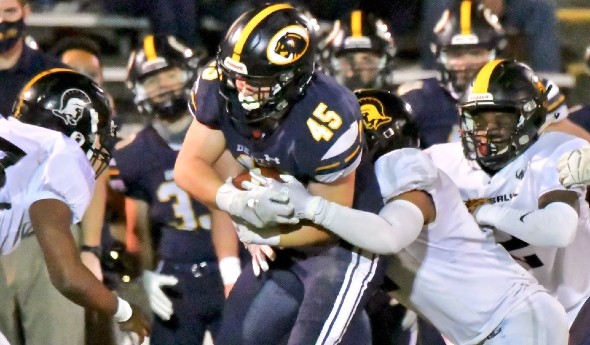
PHOTO: DeWitt earned the opportunity to play for a fifth-straight District title with last week’s win over Lansing Waverly (Photo by Terry Lyons.)