

Thank Roosevelt for Football Weekends
December 20, 2013
By Rob Kaminski
MHSAA benchmarks editor
The next time you find yourself immersed in a tense crosstown football rivalry on a Friday night followed by a Saturday pilgrimage to the nearest college campus and a Sunday afternoon with a remote and your favorite snacks and beverages, take a moment to consider what the weekend would be like if it weren’t for Teddy Roosevelt.
The man who became our 26th President shortly after the turn of the 20th Century following the assassination of William McKinley in 1901 was a football fan like you. Maybe more so.
Today’s game of football has reached a critical crossroads. Player size and speed have increased across the board. Savage use of equipment as weapons rather than protective gear has been glorified on television networks and social media. Leaders of the game at all levels have recognized the need for change, employing new rules and widespread educational efforts to aid in preserving the sport.
History, as they say, is repeating itself.
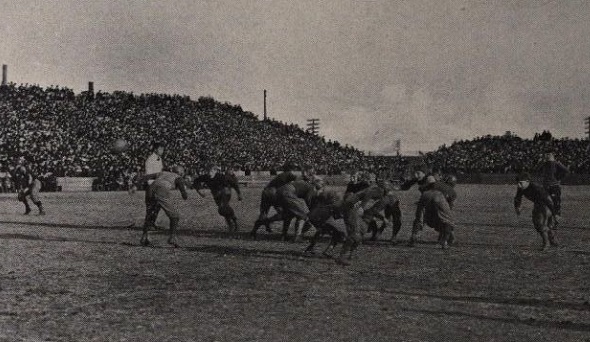
In an ironic twist, it was Roosevelt who saved the then-brutally violent game of football from itself more than 100 years ago. Yes, the same “Rough and Ready Teddy” who led the charge up San Juan Hill during the Spanish-American War and often sparred in the boxing ring while in office from 1901-09 opined that football was becoming so gruesome that he delivered an ultimatum: clean up the game or it would be outlawed.
The Chicago Tribune reported that in 1904 alone, there were 18 football deaths and 159 serious injuries, mostly among prep school players. Football deaths suffered by younger players were reported on a nearly weekly basis, as outraged citizens called on colleges and high schools to banish football outright.
In stepped Roosevelt, who called head coaches and representatives from Harvard, Yale and Princeton – college powers at the time – to the White House in 1905 urging them to eliminate excessive violence and set an example of fair play for the rest of the country. When the casualties actually rose by one during the ensuing season, Roosevelt reacted with greater resolve and convened leading football authorities for the purpose of authoring drastic rules changes. What emerged was an intercollegiate conference which was the predecessor of the NCAA.
Among the most effective changes for the 1906 season were the legalization of the forward pass, the elimination of mass formations, and the creation of a neutral zone. Football fatalities fell to 11 in each of the next two seasons, and severe injuries fell drastically.
Thanks to the introduction of protective equipment and ever-evolving rules changes, football during the 100-plus years to follow has become an exponentially safer game. Yet, the game’s leaders always will need to adjust and react to scrutiny that comes with the territory.
So, as the game once again undergoes rules modifications in the name of safety, give a tip of the cap to President Roosevelt while you enjoy college bowl season and the NFL playoffs and begin to think ahead to the first high school practice of 2014.
Drive for Detroit: Playoff Week 3 Preview
November 7, 2018
By Geoff Kimmerly
Second Half editor
The first MHSAA football finalists of this fall will celebrate this weekend, as four 8-player Semifinals will determine which teams move on to Marquette’s Superior Dome a week from Saturday.
 And 64 11-player teams have completed half of the “Drive for Detroit,” with this weekend’s Regional Finals setting up next weekend’s Semifinals and opportunities to visit Ford Field for extended Thanksgiving.
Below are the matchups in all 10 divisions this weekend, with a quick look at one from each 11-player bracket and all four 8-player Semifinals. We suggest seeing them live, of course. But we have more opportunities to watch online as well.
This week’s FOX Sports Detroit Prep Zone matchups are Dearborn Fordson at Clinton Township Chippewa Valley and Clarkston at Lapeer in Division 1, and Warren DeLaSalle at Port Huron Northern in Division 2. Those all will stream free of charge on FOXSportsDetroit.com and on the FOX Sports app. At least five more games will be viewable on MHSAA.tv, either live with subscription or free after 72 hours.
Games are Friday unless noted. “Drive for Detroit” is powered by MI Student Aid.
Division 1
Dearborn Fordson (10-1) at Clinton Township Chippewa Valley (11-0)
The Tractors showed they’re capable of beating anyone with last week’s 41-14 stunner of Detroit Cass Tech. Fordson is scoring 38 points per game while playing seven against playoff teams, and is a three-point Week 6 loss to Belleville from being undefeated. Chippewa Valley is the next giant up, coming off a 51-10 rematch win over Macomb Dakota and giving up only 15 points per game despite also playing seven against playoff qualifiers.
Other Regional Finals: FRIDAY Clarkston (9-2) at Lapeer (11-0), West Bloomfield (9-2) at Belleville (11-0). SATURDAY Rockford (7-4) at Saline (10-1).
Division 2
Portage Northern (9-2) at Muskegon Mona Shores (10-1)
The Huskies have won seven straight games and last week celebrated their first District title. The defense has shined; Northern is giving up 12 points per game and allowed more than 21 once, in a Week 4 loss to East Lansing. The Sailors beat Jenison last week for the second time this season, extending the margin from seven points in the first meeting to 39 in the rematch. Averaging 44 points per game, they may present the toughest offensive challenge the Huskies have faced.
Other Regional Finals: FRIDAY Livonia Franklin (7-4) at Birmingham Groves (9-2), Midland (8-3) at Walled Lake Western (8-3), Warren DeLaSalle (9-2) at Port Huron Northern (10-1).
Division 3
Cedar Springs (10-1) vs. Muskegon (11-0) at Grand Haven
 After eliminating Ottawa-Kent Conference Gold co-champs East Grand Rapids and Grand Rapids Christian the last two weeks, Muskegon takes on O-K White winner Cedar Springs. The Red Hawks last week won their first District title since 2000 and boast a defense giving up 10.5 points per game. The opportunity to make history in this one is even greater – the reigning Division 3 champ Big Reds have won 25 straight games and scored at least 42 points nine weeks running.
Other Regional Finals: FRIDAY Parma Western (10-1) at Zeeland East (10-1), Detroit Martin Luther King (9-2) at Allen Park (9-2). SATURDAY Farmington (8-3) vs. DeWitt (11-0) at Lansing Catholic.
Division 4
Escanaba (9-2) at Grand Rapids Catholic Central (10-1), Saturday
Grand Rapids Catholic Central has fared well against the Eskymos the last two seasons, winning their 2016 Regional Final 34-0 and last season’s Semifinal 24-0 on the way to claiming Division 4 championships both years. But Escanaba can find encouragement in a couple of places. The 24 points in last year’s meeting were the fewest GRCC scored in the playoffs. And four of the Escanaba offense’s six highest-scoring games this fall have come over the last five weeks.
Other Regional Finals: FRIDAY St. Clair (9-2) at Williamston (9-2). SATURDAY Holland Christian (8-3) at Edwardsburg (11-0), Chelsea (8-3) at Farmington Hills Harrison (8-3).
Division 5
Reed City (11-0) at Saginaw Swan Valley (11-0), Saturday
Reed City is playing in a Regional Final for the fourth time in five seasons, and as an undefeated team for the second time in three. Adding to that familiarity with the big stage is a familiar foe – Swan Valley defeated the Coyotes last year 29-14 in a Semifinal. Reed City has lost only three regular season games this decade, but there’s definitely something different this fall – notably a defense that is giving up 6.2 points per game. That unit will be key against a Vikings team scoring 43 points per and giving up only 8.9.
Other Regional Finals: FRIDAY Detroit Denby (9-2) at Marine City (9-2). SATURDAY Hudsonville Unity Christian (9-2) vs. Kalamazoo United (11-0) at Vicksburg, Frankenmuth (9-2) at Portland (11-0).
Division 6
Montague (9-2) at Schoolcraft (9-2)
The Eagles are playing for their first trip to the Semifinals since 2001, and have been in the mix making the Regional Final in 2013 and suffering their only losses of the season in District Finals in 2012 and 2016. Schoolcraft has played eight games against playoff teams this fall and still is averaging 45 points per game. Montague, playing in its second straight Regional Final, is averaging 44 points per contest with seven against playoff teams – and losses to only undefeated Division 5 contenders Reed City and Portland. Schoolcraft’s defeats also came to Division 5 playoff teams; Kalamazoo United is still alive.
Other Regional Finals: FRIDAY Kingsley at Traverse City St. Francis (11-0), Blissfield (7-4) at Jackson Lumen Christi (10-0). SATURDAY Montrose (9-2) at Flint Hamady (11-0).
Division 7
Pewamo-Westphalia (11-0) vs. New Lothrop (10-1) at Chesaning
An interesting note about P-W’s back-to-back Division 7 championship runs the last two seasons: Of six playoff games not including Semifinals, only three were played at home. The Pirates had to win District and Regional titles on the road last season, and beat the Hornets 35-14 to clinch the former. New Lothrop beat the first (Cass City) and second-place (Elkton-Pigeon-Bay Port Laker) teams from the Greater Thumb Conference West the last two weeks to set up this rematch.
Other Regional Finals: FRIDAY Roscommon (10-1) at Lake City (11-0), Riverview Gabriel Richard (7-4) at Madison Heights Madison (11-0). SATURDAY Monroe St. Mary Catholic Central (9-2) at Cassopolis (11-0).
Division 8
Breckenridge (11-0) at Ishpeming (11-0), Saturday
The Huskies will head north seeking their first Regional title and hoping a defense giving up just 4.3 points per game can lock down an Ishpeming offense scoring 42. Breckenridge also made the Regional Final last season, in Division 7, losing to Lake City by just two points. The Hematites shut out 2017 semifinalist Iron River West Iron County for the second time in five weeks to win the District title.
Other Regional Finals: FRIDAY Flint Beecher (8-3) at Harbor Beach (10-1). SATURDAY Mendon (7-4) at Holton (7-4), Detroit Southeastern (8-3) vs. Reading (11-0) at Hillsdale High School.
8-Player Division 1
SEMIFINALS
AuGres-Sims (11-0) at Pickford (11-0), Saturday
Before last week, these teams stacked up even more similarly than their records might indicate – Pickford’s six-point win over Suttons Bay in their Regional Final was its first close game since Week 3, and AuGres-Sims hasn’t allowed an opponent to get closer than 38 points all fall. Quarterback Caden Zeien has thrown for 1,928 yards and 34 touchdowns with only one interception for AuGres-Sims (plus run for 673 yards and 10 TDs), while his Pickford counterpart James Storey has thrown for 1,527 yards and 28 touchdowns and run for 782 yards and 15 scores. The Panthers also made the Semifinals the last two years and this will be their fifth time total trying to make the MHSAA Finals for the first time. For the Wolverines, this Semifinal is a first.
Colon (10-1) at Morrice (11-0)
Morrice is coming off its first Regional title since 1996 – although the Orioles did give up their first points since mid-September last week to Wyoming Tri-unity Christian in a 44-14 win. They are allowing 5.4 per game points overall while gaining nearly 360 yards in total offense. Colon’s lone defeat was to Tri-unity, 22-14 three weeks ago, but the Magi rebounded quickly to make their first Semifinal. Quarterback Hunter Nowak leads the Orioles' attack with 1,757 yards and 30 touchdowns rushing and 517 yards passing. Colon boasts a pair of 1,000 backs in Brandon Crawford (1,607 yards, 21 TDs) and quarterback Philip Alva (1,035/16 rushing, 461/8 passing).
8-Player Division 2
SEMIFINALS
Cedarville (7-4) at Rapid River (8-3)
Three of seven Great Lakes Conference East teams are still alive for MHSAA championships, and these two met in Week 7 with Rapid River claiming a 28-20 win to help lock up third place in the league. Rapid River downed reigning 8-player Division 2 champ Crystal Falls Forest Park last week and will be aware of the possibilities of a rematch disappointment – the Rockets opened these playoffs by beating Engadine by two after losing to the Eagles by 18 only two weeks prior. Cedarville is rolling again, having won its two playoff games by a combined 88-6 score, and led by quarterback Tristan Masuga (1,730 yards/21 TDs passing).
Portland St. Patrick (7-4) at Onekama (9-2), Saturday
The Shamrocks seemed all but forgotten a month ago and tied for fifth in the Southern Central Athletic Association A. But with four straight wins they’re back in the Semifinals for the second straight season and looking to get back to Superior Dome after finishing runner-up in Division 2 a year ago. Onekama, meanwhile, will be playing in its first Semifinal to continue an impressive five-year climb. The Portagers are giving up only 7.4 points per game and lost this fall only to Division 1 playoff teams Tri-unity and Suttons Bay – by a combined seven points. They've run for nearly 1,900 yards over nine games (two wins were forfeits) with Aaron Powers averaging 11.5 yards per carry and Ben Acton 8.9.
Second Half’s weekly “Drive for Detroit” previews and reviews are powered by MI Student Aid, a part of the Student Financial Services Bureau located within the Michigan Department of Treasury. MI Student Aid encourages students to pursue postsecondary education by providing access to student financial resources and information, including various student financial assistance programs to help make college more affordable for Michigan students. MI Student Aid administers the state’s 529 savings programs (MET/MESP) and eight additional aid programs within its Student Scholarships and Grants division. Click for more information and connect with MI Student Aid on Facebook and Twitter @mistudentaid.
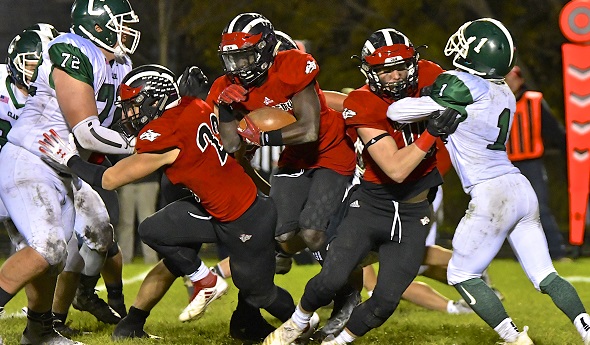
PHOTO: A Reed City ball carrier breaks through an opening during the Coyotes’ 38-7 District Final win over Clare last week. (Click to see more from HighSchoolSportsScene.com.)