

Thank Roosevelt for Football Weekends
December 20, 2013
By Rob Kaminski
MHSAA benchmarks editor
The next time you find yourself immersed in a tense crosstown football rivalry on a Friday night followed by a Saturday pilgrimage to the nearest college campus and a Sunday afternoon with a remote and your favorite snacks and beverages, take a moment to consider what the weekend would be like if it weren’t for Teddy Roosevelt.
The man who became our 26th President shortly after the turn of the 20th Century following the assassination of William McKinley in 1901 was a football fan like you. Maybe more so.
Today’s game of football has reached a critical crossroads. Player size and speed have increased across the board. Savage use of equipment as weapons rather than protective gear has been glorified on television networks and social media. Leaders of the game at all levels have recognized the need for change, employing new rules and widespread educational efforts to aid in preserving the sport.
History, as they say, is repeating itself.
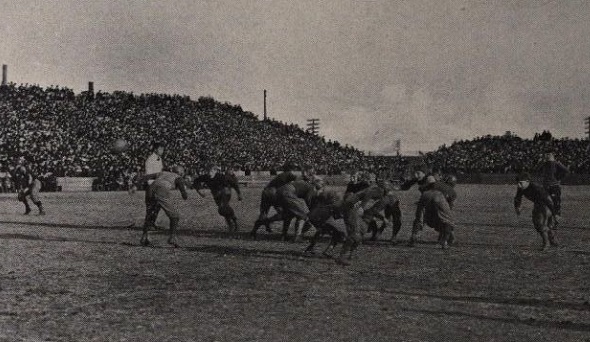
In an ironic twist, it was Roosevelt who saved the then-brutally violent game of football from itself more than 100 years ago. Yes, the same “Rough and Ready Teddy” who led the charge up San Juan Hill during the Spanish-American War and often sparred in the boxing ring while in office from 1901-09 opined that football was becoming so gruesome that he delivered an ultimatum: clean up the game or it would be outlawed.
The Chicago Tribune reported that in 1904 alone, there were 18 football deaths and 159 serious injuries, mostly among prep school players. Football deaths suffered by younger players were reported on a nearly weekly basis, as outraged citizens called on colleges and high schools to banish football outright.
In stepped Roosevelt, who called head coaches and representatives from Harvard, Yale and Princeton – college powers at the time – to the White House in 1905 urging them to eliminate excessive violence and set an example of fair play for the rest of the country. When the casualties actually rose by one during the ensuing season, Roosevelt reacted with greater resolve and convened leading football authorities for the purpose of authoring drastic rules changes. What emerged was an intercollegiate conference which was the predecessor of the NCAA.
Among the most effective changes for the 1906 season were the legalization of the forward pass, the elimination of mass formations, and the creation of a neutral zone. Football fatalities fell to 11 in each of the next two seasons, and severe injuries fell drastically.
Thanks to the introduction of protective equipment and ever-evolving rules changes, football during the 100-plus years to follow has become an exponentially safer game. Yet, the game’s leaders always will need to adjust and react to scrutiny that comes with the territory.
So, as the game once again undergoes rules modifications in the name of safety, give a tip of the cap to President Roosevelt while you enjoy college bowl season and the NFL playoffs and begin to think ahead to the first high school practice of 2014.
MHSAA Vault: Shooks a Legend as Freshman Coach
By
Geoff Kimmerly
MHSAA.com senior editor
September 4, 2026
The following originally appeared in the Lansing State Journal on Oct. 28, 2004, and was reprinted by the MHSAA that winter.
Wayne Shooks retired from coaching entirely in 2008 and died Tuesday at the age of 84.
Wayne Shooks tried the varsity football thing once. Some time during the late 1980s, longtime DeWitt coach Gail Thornton asked Shooks to be his offensive coordinator.
“I didn't sleep a night. My wife, after three weeks, said, ‘You're going back to freshmen,’” Shooks remembered.
And those three weeks were in the month of June.
But Shooks' wife must have been on to something. Because few, if any, freshman football coaches have accomplished what Shooks finished with one last win last fall.
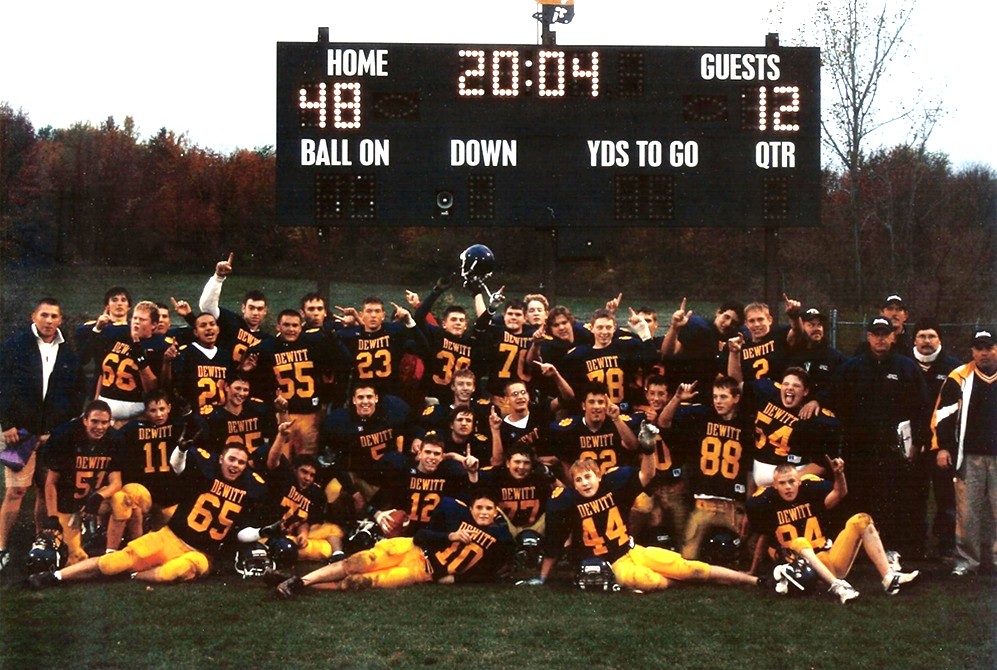
He ended his 16th and final season as freshman coach with a 135-2-1 record.
Amazing.
“You can't lose a game for him, or you'll feel bad,” DeWitt senior Mat Brynick recalled from his days as a freshman. “Coach never says it, but it's what everyone expects.
“He taught us how to win.”
 Guys like Shooks, 62, usually go unappreciated.
They get the kids fresh to high school, fresh to high school sports, and still learning things like not spiking the ball after a touchdown.
But few freshman football coaches are as legendary as Shooks is in DeWitt. They are so unappreciated that it's impossible to find out if anyone has accomplished what he's done.
Shook is not big on numbers. Never has been during his 41 years teaching in the district, or more than 20 coaching everything from football to basketball to wrestling to tennis. Oh, and track since 1980.
He also coached 8th-grade football for a few years, junior varsity for one season and was a varsity assistant. But he'll be remembered for what he did with the freshmen.
The losses came in 1993 to Mason during a terrible wind storm, and in 2002 to Greenville. That same year, the Panthers tied Haslett, meaning it was the only year during his tenure that DeWitt wasn't sure if it finished first in its league, since league titles aren't handed out at the freshmen level.
“The kids felt bad. They did their best,” Shooks remembered.
But the losses, however few, were more of a relief for Shooks than a letdown.
Don't take that to mean Shooks doesn't like to win.
Sure, he embraced the role of teacher as much as any freshman coach. But as DeWitt varsity coach Rob Zimmerman said, “If he was a 5th-grade coach, he'd be the most competitive 5th-grade coach you've ever seen.”
“I never pointed (our record) out, it was not our goal,” Shooks said. “Our goal was to win the next week. Although the kids knew it. They just assumed we were going to go 9-0, I guess.”
Guess so.
Shooks had more easily-attainable goals:
- Have fun
- Learn fundamentals
- Emphasize the logical stuff, like the importance of bringing equipment to school every day
“He does a really good job teaching expectations about being young men and being great students,” Zimmerman said. “It's gigantic.”
And it kept kids coming back to junior varsity and varsity. You could hear the fun coming out in Brynick's voice.
He was remembering his freshman football experience, remembering his time with perhaps Michigan's most successful coach at that level.
“I remember a few games, we'd find one play that works, and we ran it to death, pounding it and pounding it,” Brynick recalled. “He loves running the same play over and over. If you can do that, march 80 yards down the field, you're doing something right. No one could stop us.”
That was not all Brynick remembered, or didn't.
Shooks almost never yelled. If he did, it meant a kid messed something up over and over and over again.
He has a doctorate in zoology. Education is obviously a big deal. He loves to win, but he loves to teach. And he's hesitant to go looking for any attention for what he's done.
All made him a perfect freshmen football coach.
“Sometimes I don't think people understand about coaches. You think college level, they are coaches first, that's their job, but not at the high school level,” Shooks said.
“It's not what I've done, it's what they've done. I've always believed the focus should be on the kids. My job is a teacher. I coach because I love to coach.”
PHOTO DeWitt freshman coach Wayne Shooks, fourth from right, stands for a photo with this final football team in 2004. (Photos courtesy of the DeWitt football program.)