

Thank Roosevelt for Football Weekends
December 20, 2013
By Rob Kaminski
MHSAA benchmarks editor
The next time you find yourself immersed in a tense crosstown football rivalry on a Friday night followed by a Saturday pilgrimage to the nearest college campus and a Sunday afternoon with a remote and your favorite snacks and beverages, take a moment to consider what the weekend would be like if it weren’t for Teddy Roosevelt.
The man who became our 26th President shortly after the turn of the 20th Century following the assassination of William McKinley in 1901 was a football fan like you. Maybe more so.
Today’s game of football has reached a critical crossroads. Player size and speed have increased across the board. Savage use of equipment as weapons rather than protective gear has been glorified on television networks and social media. Leaders of the game at all levels have recognized the need for change, employing new rules and widespread educational efforts to aid in preserving the sport.
History, as they say, is repeating itself.
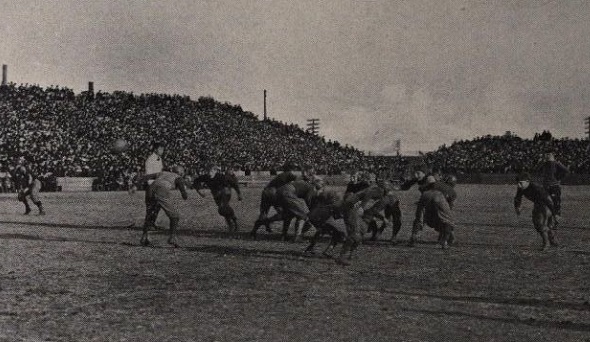
In an ironic twist, it was Roosevelt who saved the then-brutally violent game of football from itself more than 100 years ago. Yes, the same “Rough and Ready Teddy” who led the charge up San Juan Hill during the Spanish-American War and often sparred in the boxing ring while in office from 1901-09 opined that football was becoming so gruesome that he delivered an ultimatum: clean up the game or it would be outlawed.
The Chicago Tribune reported that in 1904 alone, there were 18 football deaths and 159 serious injuries, mostly among prep school players. Football deaths suffered by younger players were reported on a nearly weekly basis, as outraged citizens called on colleges and high schools to banish football outright.
In stepped Roosevelt, who called head coaches and representatives from Harvard, Yale and Princeton – college powers at the time – to the White House in 1905 urging them to eliminate excessive violence and set an example of fair play for the rest of the country. When the casualties actually rose by one during the ensuing season, Roosevelt reacted with greater resolve and convened leading football authorities for the purpose of authoring drastic rules changes. What emerged was an intercollegiate conference which was the predecessor of the NCAA.
Among the most effective changes for the 1906 season were the legalization of the forward pass, the elimination of mass formations, and the creation of a neutral zone. Football fatalities fell to 11 in each of the next two seasons, and severe injuries fell drastically.
Thanks to the introduction of protective equipment and ever-evolving rules changes, football during the 100-plus years to follow has become an exponentially safer game. Yet, the game’s leaders always will need to adjust and react to scrutiny that comes with the territory.
So, as the game once again undergoes rules modifications in the name of safety, give a tip of the cap to President Roosevelt while you enjoy college bowl season and the NFL playoffs and begin to think ahead to the first high school practice of 2014.

Sand Creek's Muck Making His Move
August 16, 2018
By Doug Donnelly
Special for Second Half
SAND CREEK – Alec Muck doesn’t take for granted that he’s one of the fastest athletes in the state.
 It just makes him want to become faster.
“I’ve always had speed,” said the Sand Creek senior. “I guess you could say I was blessed with speed. But I train hard, too. I do a lot of stuff on my own, I work with a personal trainer and I lift. It motivates me.”
Muck is a five-time MHSAA Finals track champion and has rushed for more than 2,600 career yards for the Aggies’ varsity football team. As he prepares for his senior season on the football field, he said he’s healthy and ready to go out a winner.
“I just want to go out and play hard and give it my all,” he said. “I’m going to do whatever it takes for my team. High school football is so different than anything else. I want to leave it all out there.”
Muck has a future as a college athlete. He’s just not sure in which sport. This summer, he went on a multi-state, multi-campus recruiting tour during which he blazed to a 4.3-second 40-yard time in Columbus, Ohio.
“That definitely caught the attention of a few coaches,” he said. “I kept my time around that 4.3 all summer.”
Other stops on the tour included Louisville, Cincinnati, Findlay and Western Michigan University. The 5-foot-10, 175-pound speedster doesn’t have any formal offers to play college football, but he expects that to change this season.
“I have a passion for both track and football,” he said. “But, I love the grind of football and everything about the game. If I could choose, I’d probably say football. I’ve always wanted to play at the Division I level.”
Muck was part of the Sand Creek varsity football team as a freshman. He blossomed into a weapon as a sophomore. In the third game that season, against Whitmore Lake, he carried the ball 11 times for 277 yards and five touchdowns. It remains his most productive game of his career. In all seven Tri-County Conference games that year, he rushed for at least 100 yards. He went on to rush for 1,505 yards as a sophomore, racking up nearly 2,000 all-purpose yards and 26 touchdowns.
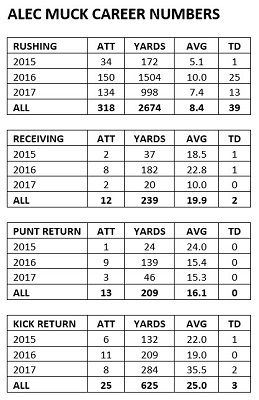 His junior season saw a slight dip in his carries, but he still averaged more than seven yards per rush and came up two yards short of 1,000. He started the season spending some time at quarterback. That experiment ended early in the season, however, and he expects to line up at several different spots on the field this year – but not quarterback.
“I like running back,” he said. “That’s where I’ve played since my Pop Warner days. I like to run and see the whole field. Running with the football is way different than running the track. You have to know when to go only 50 percent, so you know where to make your cut, then explode. You have to have more lateral movement.”
Sand Creek coach Scott Gallagher said the Aggies need to find more and creative ways to get Muck the football.
“He’s explosive,” said Gallagher, in his second season leading the program. “We have to put him in different positions and get him the football in a lot of different ways. He’s had the best camp he’s had since I’ve coached him.”
Muck causes headaches for opposing coaches. He is a threat to score every time he touches the ball.
“Obviously Alec has tremendous speed; however, his ability to take over and change a game is underrated,” said Ottawa Lake Whiteford coach Jason Mensing. “His imprint on the TCC will be lasting.”
Gallagher said Muck sets high expectations for himself.
“He’s hard on himself,” Gallagher said. “He is very driven to be successful, and he wants to that success to rub off on his teammates.”
Muck’s training has involved a lot of speed drills – often on his own. His weightlifting is for strength and maintaining speed, not bulking up.
“My normal warm-ups are low sprints, not long-distance running,” he said. “When I run the short sprints, I set a goal for each sprint and try and beat that time. I run for time.”
Prior to the Regional track meet this spring, Muck injured his hamstring. He took a week off running before the Lower Peninsula Division 4 Finals, but the break didn’t slow him as he won both the 100 and 200 dashes. He won the same events as a sophomore and won the 200 as a freshman. His championship winning times this spring were 10.98 seconds in the 100 and 22.02 in the 200.
“I was really careful warming up at the state meet and, in the preliminaries, I ran easy, just so I could get to the final,” he said. “Once I got there, I knew I could do it.”
Throughout a summer of football camps and 7-on-7s, Muck also attended physical therapy for the hamstring. He said he’s now at 100 percent and ready to start football – and go out with a bang.
“This is the most dedicated the team has been since I’ve been playing,” he said. “The offseason training, the commitment to the weight room, it’s all there. I’m just ready to go out there and lead by example. It’s time to play football.”
 Doug Donnelly has served as a sports and news reporter and city editor over 25 years, writing for the Daily Chief-Union in Upper Sandusky, Ohio from 1992-1995, the Monroe Evening News from 1995-2012 and the Adrian Daily Telegram since 2013. He's also written a book on high school basketball in Monroe County and compiles record books for various schools in southeast Michigan. E-mail him at [email protected] with story ideas for Lenawee and Monroe counties.
PHOTO: Sand Creek running back Alec Muck is a five-time MHSAA Finals track champion with more than 2,600 career rushing yards. He's healthy and ready for a breakout senior year of football. (Photo by Mike Dickie.)