

Thank Roosevelt for Football Weekends
December 20, 2013
By Rob Kaminski
MHSAA benchmarks editor
The next time you find yourself immersed in a tense crosstown football rivalry on a Friday night followed by a Saturday pilgrimage to the nearest college campus and a Sunday afternoon with a remote and your favorite snacks and beverages, take a moment to consider what the weekend would be like if it weren’t for Teddy Roosevelt.
The man who became our 26th President shortly after the turn of the 20th Century following the assassination of William McKinley in 1901 was a football fan like you. Maybe more so.
Today’s game of football has reached a critical crossroads. Player size and speed have increased across the board. Savage use of equipment as weapons rather than protective gear has been glorified on television networks and social media. Leaders of the game at all levels have recognized the need for change, employing new rules and widespread educational efforts to aid in preserving the sport.
History, as they say, is repeating itself.
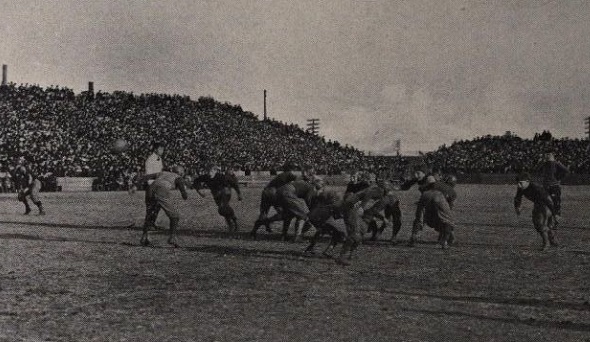
In an ironic twist, it was Roosevelt who saved the then-brutally violent game of football from itself more than 100 years ago. Yes, the same “Rough and Ready Teddy” who led the charge up San Juan Hill during the Spanish-American War and often sparred in the boxing ring while in office from 1901-09 opined that football was becoming so gruesome that he delivered an ultimatum: clean up the game or it would be outlawed.
The Chicago Tribune reported that in 1904 alone, there were 18 football deaths and 159 serious injuries, mostly among prep school players. Football deaths suffered by younger players were reported on a nearly weekly basis, as outraged citizens called on colleges and high schools to banish football outright.
In stepped Roosevelt, who called head coaches and representatives from Harvard, Yale and Princeton – college powers at the time – to the White House in 1905 urging them to eliminate excessive violence and set an example of fair play for the rest of the country. When the casualties actually rose by one during the ensuing season, Roosevelt reacted with greater resolve and convened leading football authorities for the purpose of authoring drastic rules changes. What emerged was an intercollegiate conference which was the predecessor of the NCAA.
Among the most effective changes for the 1906 season were the legalization of the forward pass, the elimination of mass formations, and the creation of a neutral zone. Football fatalities fell to 11 in each of the next two seasons, and severe injuries fell drastically.
Thanks to the introduction of protective equipment and ever-evolving rules changes, football during the 100-plus years to follow has become an exponentially safer game. Yet, the game’s leaders always will need to adjust and react to scrutiny that comes with the territory.
So, as the game once again undergoes rules modifications in the name of safety, give a tip of the cap to President Roosevelt while you enjoy college bowl season and the NFL playoffs and begin to think ahead to the first high school practice of 2014.
Drive for Detroit: Week 2 Preview
August 30, 2017
By Geoff Kimmerly
Second Half editor
The break was short for many teams heading into Week 2 of this football season.
 While last week’s openers were mostly split between Thursday and Friday, nearly all of Michigan’s teams will play this week’s games tonight in advance of the Labor Day holiday and start of school for many next Tuesday.
Below is our weekly look – powered by MI Student Aid – at some of the games to see no matter your neighborhood (relatively and regionally speaking) and includes games that will be played on Thursday, Friday and Saturday.
Remember, check out the MHSAA Score Center for the full schedule plus scores all three nights as they games are completed. A number of games also will be broadcast again this weekend, live, on MHSAA.tv.
Bay & Thumb
Almont (1-0) at Algonac (0-1), Thursday
After a couple of seasons at or near the top of Port Huron-area football, Algonac opened last week with a 42-6 loss to Marine City – its first non-Richmond regular-season defeat since 2014. Up next is Blue Water Area Conference rival Almont, no doubt aching to win big as well after taking four losses (two in the playoffs) from the Muskrats over the last two seasons. The Raiders are coming off a big win over 2016 playoff team Grosse Ile.
Others that caught my eye: THURSDAY Freeland (1-0) at Chesaning (1-0), Saginaw Heritage (1-0) at Flint Powers Catholic (1-0), Beaverton (1-0) at Harbor Beach (1-0), Lake Fenton (0-1) at Montrose (1-0).
Greater Detroit
Southfield Arts & Technology (0-1) at Clarkston (1-0), Friday
Southfield A&T came out on the losing end of arguably the most exciting game of opening weekend. But if its 56-54 triple-overtime defeat to powerful Davison told us anything, it’s that last year’s 8-4 finish could be just a start for the second-year program built from the former Southfield and Southfield-Lathrup. The Warriors beat Clarkston 24-18 a year ago, actually, but the Wolves appear in form already as well coming off a 42-7 win over Lapeer (27-5 over the last three seasons with two of those losses to Clarkston).
Others that caught my eye: THURSDAY Romeo (1-0) at Clinton Township Chippewa Valley (1-0), FRIDAY Toledo Whitmer, Ohio (1-0) at Detroit Catholic Central (1-0), East Kentwood (1-0) at Orchard Lake St. Mary's (0-1), Macomb Dakota (1-0) at Utica Eisenhower (1-0).
Mid-Michigan
Grand Ledge (1-0) at DeWitt (0-1), Thursday
The is the second year in a row the Lansing area’s most successful programs of the last decade have matched up (and the series will continue with DeWitt moving into the Capital Area Activities Conference Blue with Grand Ledge next fall). The Comets won last year’s meeting 28-21. Senior-dominated Grand Ledge impressed last week with a 41-14 win over Hudsonville, but a DeWitt team that put a number of new starters on the field last week also impressed coming back to nearly catch Grand Rapids Christian, on the road, before falling 38-30.
Others that caught my eye: THURSDAY Dearborn Divine Child (1-0) at East Lansing (1-0), Portland (1-0) at Lansing Sexton (1-0), Fulton (1-0) at Laingsburg (0-1), FRIDAY Beal City (1-0) at Clare (0-1).
Northern Lower Peninsula
Muskegon Catholic Central (0-0) at Frankfort (1-0), Friday
The anticipation for this one has been boiling over. Muskegon Catholic Central handed Frankfort its first and only loss last season, 35-0 in a Division 8 Regional Final at MCC on the way to winning a fourth straight MHSAA championship. The Panthers also got within 22-12 of MCC in a 2015 Regional Final, so there’s a nice build-up of history behind this meeting of small-school contenders. The Crusaders couldn’t lock down a Week 1 game this fall, so this is their season opener and the sophomore debut for heavily-followed quarterback Cameron Martinez. Frankfort did have a game in Week 1 and put up 70 points – its most in a game since 2004 – to down Manton by 30.
Others that caught my eye: THURSDAY St. Johns (0-1) at Cadillac (1-0), FRIDAY Newberry (1-0) at Gaylord St. Mary (1-0), Traverse City St. Francis (1-0) at Maple City Glen Lake (1-0), Escanaba (1-0) at Petoskey (0-1).
Southeast & Border
Pinckney (1-0) at Chelsea (1-0), Friday
Chelsea is 32-6 over its last three seasons and won all of its Southeastern Conference White games last season by at least 22 points. The Bulldogs will welcome Pinckney to the league Friday after the Pirates went 8-3 last season (their most wins since 1989) before coming over from the Kensington Lakes Activities Association West. Pinckney also had a coaching change in the offseason with defensive coordinator Rod Beaton getting a promotion, and his expertise will be especially handy this week. Chelsea 27 points last week on a Milan defense that gave up only 16 per game in 2016.
Others that caught my eye: THURSDAY New Haven (1-0) at Ida (1-0), Homer (1-0) at Concord (0-1), Petersburg-Summerfield (1-0) at Pittsford (1-0), FRIDAY Detroit Mumford (1-0) at Saline (0-1).
Southwest Corridor
Schoolcraft (1-0) at Berrien Springs (1-0), Thursday
Berrien Springs has been right on the verge of a big season over the last few, with three straight playoff appearances and a 17-5 record since the start of 2015. The Shamrocks looked ready to make this the year opening with a 53-0 win over Buchanan last week. But giving Schoolcraft its first regular season loss since 2014 would really make a statement. The Eagles are 20-2 going back to the start of 2015 and downed Fennville 41-0 to start this year’s campaign. If Schoolcraft comes through this one on top too, Berrien Springs still will have a few more opportunities to make noise – see Week 4 against Benton Harbor and Week 9 against Muskegon Oakridge.
Others that caught my eye: THURSDAY Coldwater (1-0) at Marshall (1-0), Battle Creek Central (0-1) at Portage Central (1-0), Paw Paw (1-0) at Sturgis (1-0), FRIDAY Grand Rapids South Christian (1-0) at Benton Harbor (0-1).
Upper Peninsula
Ishpeming (1-0) at Norway (1-0), Friday
The Hematites seem to be getting most of the tough ones out of the way early as they work back from last year’s 3-5 finish. Ishpeming started this fall by avenging a 2016 loss to Iron Mountain 34-7, and now comes Norway, which shut out the Hematites 14-0 last year. The slight difference this time is these teams are no longer in the same league, literally; the Knights left the Mid-Peninsula Conference for the Mid-Eastern Conference this season. They opened with a 34-7 nonleague win over Niagara (Wis.) after ending last fall as a District champ.
Others that caught my eye: THURSDAY Iron Mountain (0-1) at Gwinn (0-1), Calumet (1-0) at Negaunee (0-1), FRIDAY Traverse City Central (1-0) at Marquette (0-1), SATURDAY Munising (0-1) at St. Ignace (0-1).
West Michigan
Lowell (1-0) at Rockford (1-0), Friday
One of the best scheduling moves in the state in 2016 was the re-introduction of this matchup between two of the elite programs in all of the Grand Rapids area and statewide. Lowell won that first matchup since the end of a two-year series in 2011-12, 21-10, but it also was Rockford’s opener as it had to miss its Week 1 game last fall with a team-wide sickness. This time both teams have a win out of the way, and impressive ones on both sides. The Rams shut out Saline 14-0 to start, while the Red Arrows downed Warren DeLaSalle 36-6.
Others that caught my eye: THURSDAY Grand Rapids Christian (1-0) at Caledonia (1-0), Detroit Loyola (0-1) at Grand Rapids Catholic Central (1-0), Warren DeLaSalle (0-1) at Grandville (1-0), FRIDAY Muskegon Mona Shores (1-0) at Zeeland West (1-0).
8-Player
Crystal Falls Forest Park (0-1) at Powers North Central (1-0), Friday
At least the faces will look mostly different from those who more or less decided which was the best team in the Upper Peninsula (and arguably statewide) last season. Reigning two-time MHSAA champion North Central graduated the majority of its stars from the last two seasons including quarterback Jason Whitens, and Forest Park’s record-setting back Dan Nocerini is now playing at Michigan Tech. After losing only to North Central (twice) last season, the Trojans opened last week with a 38-36 defeat to Rapid River. But some of the same success could be brewing again for the Jets, who made it 27 straight victories with a 66-0 shutdown of Felch North Dickinson.
Others that caught my eye: THURSDAY Lawrence (1-0) at Deckerville (1-0), Mayville (1-0) at Morrice (1-0), North Adams-Jerome (1-0) at Battle Creek St. Philip (1-0), Wyoming Tri-unity Christian (0-1) at Suttons Bay (1-0).
Second Half’s weekly “Drive for Detroit” previews are powered by MI Student Aid, a part of the Student Financial Services Bureau located within the Michigan Department of Treasury. MI Student Aid encourages students to pursue postsecondary education by providing access to student financial resources and information, including various student financial assistance programs to help make college more affordable for Michigan students. MI Student Aid administers the state’s 529 savings programs (MET/MESP) and eight additional aid programs within its Student Scholarships and Grants division. Click for more information and connect with MI Student Aid on Facebook and Twitter @mistudentaid.
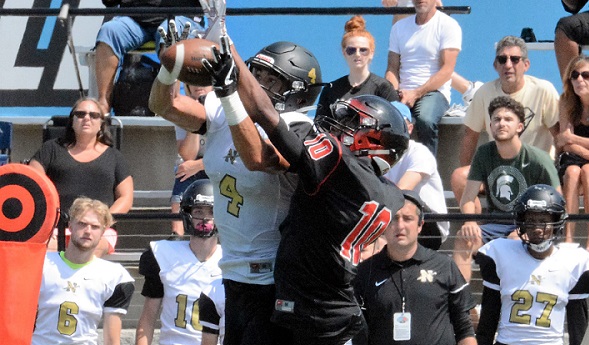
PHOTO: East Kentwood (with red trim) faces Orchard Lake St. Mary's this week after opening with a win against Harrison Township L'Anse Creuse. (Photo by John Johnson).