

Thank Roosevelt for Football Weekends
December 20, 2013
By Rob Kaminski
MHSAA benchmarks editor
The next time you find yourself immersed in a tense crosstown football rivalry on a Friday night followed by a Saturday pilgrimage to the nearest college campus and a Sunday afternoon with a remote and your favorite snacks and beverages, take a moment to consider what the weekend would be like if it weren’t for Teddy Roosevelt.
The man who became our 26th President shortly after the turn of the 20th Century following the assassination of William McKinley in 1901 was a football fan like you. Maybe more so.
Today’s game of football has reached a critical crossroads. Player size and speed have increased across the board. Savage use of equipment as weapons rather than protective gear has been glorified on television networks and social media. Leaders of the game at all levels have recognized the need for change, employing new rules and widespread educational efforts to aid in preserving the sport.
History, as they say, is repeating itself.
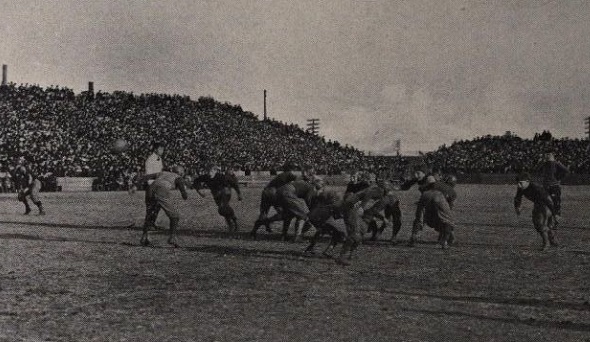
In an ironic twist, it was Roosevelt who saved the then-brutally violent game of football from itself more than 100 years ago. Yes, the same “Rough and Ready Teddy” who led the charge up San Juan Hill during the Spanish-American War and often sparred in the boxing ring while in office from 1901-09 opined that football was becoming so gruesome that he delivered an ultimatum: clean up the game or it would be outlawed.
The Chicago Tribune reported that in 1904 alone, there were 18 football deaths and 159 serious injuries, mostly among prep school players. Football deaths suffered by younger players were reported on a nearly weekly basis, as outraged citizens called on colleges and high schools to banish football outright.
In stepped Roosevelt, who called head coaches and representatives from Harvard, Yale and Princeton – college powers at the time – to the White House in 1905 urging them to eliminate excessive violence and set an example of fair play for the rest of the country. When the casualties actually rose by one during the ensuing season, Roosevelt reacted with greater resolve and convened leading football authorities for the purpose of authoring drastic rules changes. What emerged was an intercollegiate conference which was the predecessor of the NCAA.
Among the most effective changes for the 1906 season were the legalization of the forward pass, the elimination of mass formations, and the creation of a neutral zone. Football fatalities fell to 11 in each of the next two seasons, and severe injuries fell drastically.
Thanks to the introduction of protective equipment and ever-evolving rules changes, football during the 100-plus years to follow has become an exponentially safer game. Yet, the game’s leaders always will need to adjust and react to scrutiny that comes with the territory.
So, as the game once again undergoes rules modifications in the name of safety, give a tip of the cap to President Roosevelt while you enjoy college bowl season and the NFL playoffs and begin to think ahead to the first high school practice of 2014.
Perry Eager to Begin Playoff Chase Again
By
Geoff Kimmerly
MHSAA.com senior editor
August 7, 2017
By Geoff Kimmerly
Second Half editor
PERRY – Swirling around in the back of his mind, Tanner Orweller sees what the most historic moment in Perry football history will look like.
The Ramblers, after coming so close so many seasons before, will make the playoffs for the first time. The entire town will turn out for the game – so many fans the bleachers won’t hold them all.
A motivating memory also replays frequently: Orweller, playing safety last fall as a sophomore on the varsity, biting on a pitch to the halfback against Maple Valley although his responsibility was to cover a receiver heading downfield.
That halfback threw a pass to the uncovered receiver, who ended up on the ground just short of the goalline. The Lions went on to defeat Perry by a point – 28-27 – and two weeks later the Rambers ended the season 5-4 and just short again of that elusive postseason berth.
“I know championships are not made in a matter of a year, or two years even,” said Orweller, also a Regional-qualifying wrestler during the winter. “You’ve got to train your whole life in order to be the best at what you do.
“There’s going to be failure in what you do, and you’ve got to know it’s not, ‘Oh no, I’m done.’ It’s, ‘Look, I’ve learned something from this. I know what I can do better. I’m going to practice those things I did wrong and make those mistakes go away so I can succeed next year.’”
Orweller and 19 teammates have been training most of their lives for the opportunity that began again Monday all over the state with the first practices of the 2017 football season.
Not counting schools playing varsity football for the first time this fall, there are 17 programs statewide that have never made the MHSAA Playoffs.
Of those 17, nine schools have existed since at least 1975, the first year football playoffs were conducted by the MHSAA.
And of those nine, Perry is one – and can make a great argument that none of the other 16 has come closer to earning another game more often.
From 1975-98, when playoff qualifiers were determined regionally by playoff-point average (based on success and strength of schedule), Perry enjoyed eight seasons of at least six wins – which would have been plenty under the current playoff format, which set an automatic qualifier at six victories when the 11-player field was expanded to 256 teams in 1999. The Ramblers had at least six wins four straight seasons from 1983-86, finishing the regular season 9-0 in 1984 but getting left out of the postseason. They then went 7-2 three times over four seasons from 1990-93, but couldn’t break through.
Perry entered the 2006 regular-season finale 5-3 and needing a win over Williamston to qualify for the first time – but lost 14-0. And then came last season and another 5-4 finish, the Ramblers’ best since that just-miss season a decade before but with a five-point loss to eventual Greater Lansing Activities Conference champion Lake Odessa Lakewood in Week 3 and then the one-point heartbreaker against the Lions a month later.
Telling that senior class that it wouldn’t have enough playoff points to make history was painful for then second-year coach Jeff Bott. And it was followed by a long offseason.
But Bott also saw the roots of a winner sinking in. An assistant at Perry for two years before taking over the program in 2015, Bott grew up in Haslett and never made the playoffs as a player – but was on the coaching staff as the program made the playoffs 12 times over 17 years with two trips to the MHSAA Finals.
 He’s seen what it takes to become an annual playoff team. And he’s seen those steps taken, especially from an offseason training point of view, as the Ramblers have climbed back into the conversation.
“They playoffs weren’t something we talked about until we earned (it). I feel last year we earned the right to talk about it,” Bott said. “We aren’t there yet. But now, it’s time to finish. We just have to finish this year.”
Those finishing will mostly be new players. The roster has three seniors plus Orweller and two more juniors who were sophomores on varsity last season. The rest of their teammates are new to the top level.
But the other 13 juniors played together on junior varsity and led a team that finished 7-2, the latest strong run for a class that Orweller recalled finishing 6-1 in fourth grade – when he started having those playoff dreams for the first time.
If the Ramblers succeed in making the playoffs this season or next (or both), junior Drew Crim would be the first of his family including his dad Todd (a 1990 grad) and two uncles who preceded him to play in the postseason in a Perry uniform.
He’s seen success from a distance, cheering on cousin D.J. Zezula, who quarterbacked Clarkston to Division 1 titles in 2013 and 2014 before moving on to Wayne State University. Zezula has imparted on his cousin the importance of keeping his teammates working together and making sure they are accountable to each other on the field and off. Drew was another of the then-sophomores who came up to varsity in 2016. And Todd has pumped up his son’s confidence after watching he and his classmates grow up together.
“He says this year will be the greatest of probably all. We have a very athletic group of kids, and he thinks we will do great things – Yes, I agree,” Drew Crim said.
“I work with these guys, and I know their tenacity and drive to do better things.”
Bott, who teaches in Haslett and also coaches basketball at Perry, recalled how the Ramblers used to be known for having some sizable guys, but this year’s team has more athletes. He made a point when taking over the program to push for the addition of local Spartan Performance, which trains the team year-round with a focus on improving as a complete athlete instead of just hitting the weights.
That offseason dedication and continued improvement in a wide-open spread attack all contribute to Perry looking the part of a program on the rise.
Now the Ramblers hope to look the part of playoff team.
“This town loves football. Every Friday night there are 2,000 people here, three deep on the fence,” he said. “(Our players) are focused on giving something back here – for us, for them, but for this town. This program has been looked down on at times, and it hasn’t always been successful, but there have been great athletes and teams that came through in the 90s and we’re trying to get back to where it was.
“I’ve had a lot of people tell me in town that this is the way it used to look.”
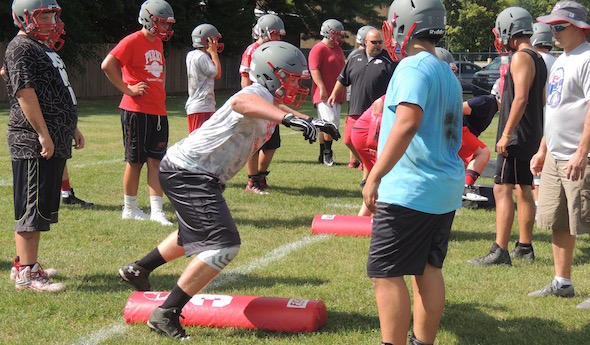
PHOTOS: (Top) Perry linemen work through a defensive drill during Monday's opening practice. (Middle) Ramblers coach Jeff Bott addresses his varsity and junior varsity players before those first drills of the 2017 season.