

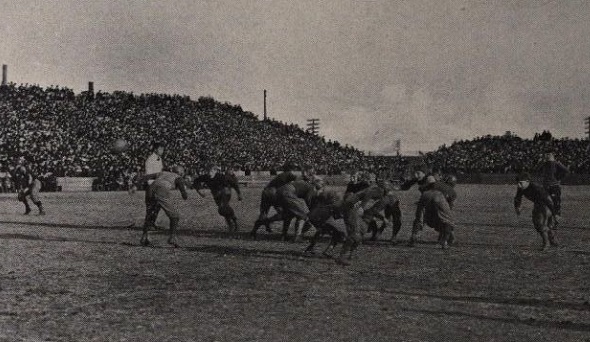
Thank Roosevelt for Football Weekends
December 20, 2013
By Rob Kaminski
MHSAA benchmarks editor
The next time you find yourself immersed in a tense crosstown football rivalry on a Friday night followed by a Saturday pilgrimage to the nearest college campus and a Sunday afternoon with a remote and your favorite snacks and beverages, take a moment to consider what the weekend would be like if it weren’t for Teddy Roosevelt.
The man who became our 26th President shortly after the turn of the 20th Century following the assassination of William McKinley in 1901 was a football fan like you. Maybe more so.
Today’s game of football has reached a critical crossroads. Player size and speed have increased across the board. Savage use of equipment as weapons rather than protective gear has been glorified on television networks and social media. Leaders of the game at all levels have recognized the need for change, employing new rules and widespread educational efforts to aid in preserving the sport.
History, as they say, is repeating itself.
In an ironic twist, it was Roosevelt who saved the then-brutally violent game of football from itself more than 100 years ago. Yes, the same “Rough and Ready Teddy” who led the charge up San Juan Hill during the Spanish-American War and often sparred in the boxing ring while in office from 1901-09 opined that football was becoming so gruesome that he delivered an ultimatum: clean up the game or it would be outlawed.
The Chicago Tribune reported that in 1904 alone, there were 18 football deaths and 159 serious injuries, mostly among prep school players. Football deaths suffered by younger players were reported on a nearly weekly basis, as outraged citizens called on colleges and high schools to banish football outright.
In stepped Roosevelt, who called head coaches and representatives from Harvard, Yale and Princeton – college powers at the time – to the White House in 1905 urging them to eliminate excessive violence and set an example of fair play for the rest of the country. When the casualties actually rose by one during the ensuing season, Roosevelt reacted with greater resolve and convened leading football authorities for the purpose of authoring drastic rules changes. What emerged was an intercollegiate conference which was the predecessor of the NCAA.
Among the most effective changes for the 1906 season were the legalization of the forward pass, the elimination of mass formations, and the creation of a neutral zone. Football fatalities fell to 11 in each of the next two seasons, and severe injuries fell drastically.
Thanks to the introduction of protective equipment and ever-evolving rules changes, football during the 100-plus years to follow has become an exponentially safer game. Yet, the game’s leaders always will need to adjust and react to scrutiny that comes with the territory.
So, as the game once again undergoes rules modifications in the name of safety, give a tip of the cap to President Roosevelt while you enjoy college bowl season and the NFL playoffs and begin to think ahead to the first high school practice of 2014.
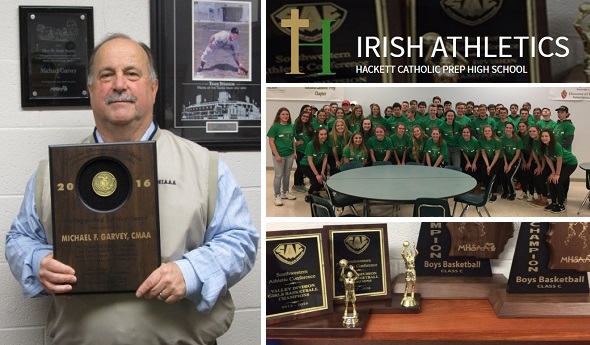
'Distinguished' Garvey Serves Hackett Well
By
Pam Shebest
Special for MHSAA.com
March 28, 2017
KALAMAZOO — Mike Garvey’s high school sports career took him to Switzerland, England, West Germany, Belgium and France.
 As unorthodox as that was, it set the foundation for his life’s work as a director of athletics, currently at Kalamazoo Hackett Catholic Prep.
For his work in high school athletics, Garvey has a collection of honors and awards, including his latest: a 2016 National Interscholastic Athletic Administrators Association Distinguished Service Award, presented at the national banquet in Nashville, Tenn., in December.
“It was pretty neat,” said Garvey, who prefers talking about his coaches and athletes instead of himself.
“I don’t have a job; I have a mission and my mission is to serve the kids, which is really why this one means so much to me, because it’s a distinguished service award.”
The award, based on service to the NIAAA and interscholastic athletics at the local, state and national levels, followed his 2015 Allen W. Bush Award from the MHSAA for “giving and serving without a lot of attention,” he said. “Mr. Quiet and Humble,” he added with a laugh.
“While Mike’s first priority is at his school and the students there, he involves himself in league, state and national organizations, sharing his knowledge and experience with others so they can become better at what they do,” said Gary Ellis, athletic director at Allegan High School for 17 years before retiring in 2013.
“His willingness to mentor others has had a positive effect on many districts within his conference and throughout the state.”
Coaches enjoy working with Garvey, said Jesse Brown, who is starting his 12th season as Hackett’s head baseball coach.
“The great thing about Mike is that he is focused on the kids first,” Brown said. “As a coach, we put kids first. It puts us on the same page immediately.
“It’s that relationship building he has, even with his coaches. I look at him as a mentor for me. He’s very, very open and is willing to help you grow. He pushes you to do that, too.”
With none of 27 varsity head coaches working in the building, Garvey has an interesting dynamic, keeping in touch with them through emails or phone calls when they are not on campus.
“We have an awesome staff here, and that makes my life easier,” Garvey said. “Our head coaches own their programs. I tell them, ‘If I wanted to be the head coach in your sport, I would have hired me. So go run it.’ I think they like that.”
Garvey recently finished his term as the liaison between the state and national associations, and he is MIAAA coordinator for leadership training.
At the national level, he teaches “Coaching for Character,” starting each class with a quip: “‘I thought this class was characters in coaching.”
New initiatives at Hackett
Garvey was instrumental in starting two initiatives for athletes at Hackett: The Captains Clinic and, this year, an award called Scholar Athletic of Distinction.
He instituted the clinic because with no varsity head coaches in the building, “I felt like throughout my career, I watched coaches and their captains but it really didn’t mean anything,” he said.
 “You’re the most popular kid, and you’re going to get one of those little captain’s bars at the end of the season. That wasn’t good enough.”
The clinic is a three-hour session and this year totaled 57 athletes. Any captains who do not attend lose that status.
“This year, we talked about what it means to be a good teammate,” he said. “They appreciated the pizza at the end. Free T-shirt and pizza; I got kids right there.”
Sophomore Natalie Toweson not only attended the clinic but helped design the T-shirts.
“His big thing is quotes,” Toweson said of Garvey. “I think I learned a lot from seeing other leaders and what they take out of certain situations. He has senior captains come in and share their experiences and how you can follow their lead because they’re really big role models to the underclassmen.
“Mr. Garvey brings a lot of energy and experience. He gives us new experiences, like playing Class A schools we’ve never played before, but is also very supportive and is at every game he can be.”
For the scholar-athlete award, Garvey has a rubric where athletes get points for years on freshman, junior varsity and varsity teams; bonus points for extra service hours, a higher GPA, all-conference, serving as captains and captains clinics attended.
Long way back to Michigan
Growing up in Detroit, Garvey attended Catholic schools, but during his first month as a freshman at Birmingham Brother Rice, his father was transferred to Geneva, Switzerland, for his work with Chrysler.
Mike’s sophomore year, his dad was transferred to the office in London, where Garvey honed his athletic skills.
“I was in an American school, so we did have sports,” he said. “In Europe the school sports aren’t that big because the parents don’t think they’re that good, so we competed with other American schools, which meant that for tournaments or competitions, we’d go to what used to be West Germany.
“We’d go to Belgium; we would go to France. It was really cool. When I moved back at the end of that last year, I had been in way more countries than I had been in states.”
Garvey competed in soccer, rugby, wrestling, baseball and swimming, which “was not my best sport,” he quickly added. “I just kind of had a jock heart and loved sports.”
After high school, he spent the next year in Europe and finally decided he had to choose a career.
“My two options in my brain were teach PE (physical education) and coach or be a dentist,” he said. “Vastly different. The year after I graduated, I stayed to help my previous coaches in London, and I was sold.”
After graduating from Western Michigan University, Garvey took a job in Illinois where he taught four hours of French, a language he learned while in Switzerland, and two hours of religion.
 He was also head coach of wrestling and baseball and a football assistant coach.
Four years later, he moved back to Michigan, teaching at Lawton High School. That led to his first job as director of athletics, spanning his last five years there.
Garvey went from Lawton to Delton Kellogg, where he spent seven years as AD.
“I really felt like I grew there because I was away from my comfort zone,” he said. “It was stand up and be the guy. That’s where I got real involved with the state AD association.”
When Delton added assistant principal duties to his job description, Garvey decided he did not want to play the good guy (AD)/bad guy (assistant principal) roles and took a job at Otsego High School.
“I got to be involved in the building process,” Garvey said. “I loved Otsego and the people I worked with, and I worked with an awesome principal (Herve Dardis).
“I was involved in all the building stuff: the stadium, the ball fields, the tennis courts, the building. It was really fun.”
In 2010, Garvey had the opportunity to return to his Catholic roots when the AD position became available at Hackett.
“I went through the interview process, and I decided I had to come home,” he said. “My kids (Erin and Kristy) went here and I knew 20 years ago I was going to finish at a Catholic school.”
As conflicted as he was at making the choice, Garvey knew he made the correct one.
“It was really hard to leave Otsego because as an administrative team we had put together the facilities, which were outstanding.
“But I just couldn’t say ‘No’ to a Catholic school. I just couldn’t do it.”
And he remains up to the two toughest challenges in his work leading Hackett’s athletic department.
“No. 1, keep all our programs strong because we don’t have that many kids, yet we offer a crazy number of opportunities for them,” he said. “To keep those programs viable, we need bodies.
“The other hard part is I’m married to my best friend (Jennifer) and it keeps me away from her. When this becomes a job, then I’m done.”
 Pam Shebest served as a sportswriter at the Kalamazoo Gazette from 1985-2009 after 11 years part-time with the Gazette while teaching French and English at White Pigeon High School. She can be reached at [email protected] with story ideas for Calhoun, Kalamazoo and Van Buren counties.
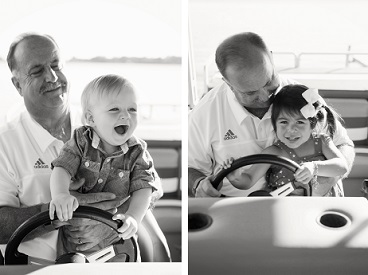
PHOTOS: (Top) Kalamazoo Hackett Catholic Prep athletic director Mike Garvey holds up his NIAAA Distinguished Service Award; adjacent, attendees of a “Captains Clinic.” (Middle) Retired Allegan athletic director Gary Ellis, Hackett baseball coach Jesse Brown, sophomore athlete Natalie Toweson. (Below) Garvey enjoys some down time with grandson Dylan Alexander (left) and granddaughter Maya Wilson. (Photos courtesy of Mike Garvey; plaque photo and head shots by Pam Shebest.)