

Thank Roosevelt for Football Weekends
December 20, 2013
By Rob Kaminski
MHSAA benchmarks editor
The next time you find yourself immersed in a tense crosstown football rivalry on a Friday night followed by a Saturday pilgrimage to the nearest college campus and a Sunday afternoon with a remote and your favorite snacks and beverages, take a moment to consider what the weekend would be like if it weren’t for Teddy Roosevelt.
The man who became our 26th President shortly after the turn of the 20th Century following the assassination of William McKinley in 1901 was a football fan like you. Maybe more so.
Today’s game of football has reached a critical crossroads. Player size and speed have increased across the board. Savage use of equipment as weapons rather than protective gear has been glorified on television networks and social media. Leaders of the game at all levels have recognized the need for change, employing new rules and widespread educational efforts to aid in preserving the sport.
History, as they say, is repeating itself.
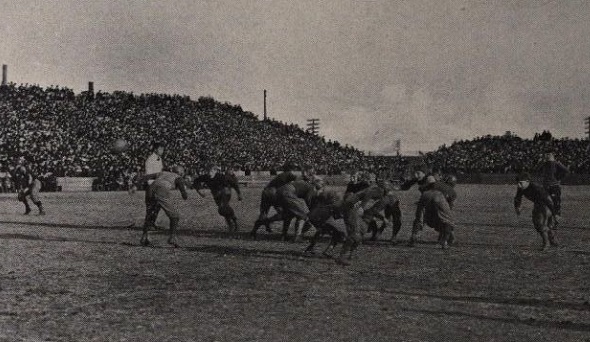
In an ironic twist, it was Roosevelt who saved the then-brutally violent game of football from itself more than 100 years ago. Yes, the same “Rough and Ready Teddy” who led the charge up San Juan Hill during the Spanish-American War and often sparred in the boxing ring while in office from 1901-09 opined that football was becoming so gruesome that he delivered an ultimatum: clean up the game or it would be outlawed.
The Chicago Tribune reported that in 1904 alone, there were 18 football deaths and 159 serious injuries, mostly among prep school players. Football deaths suffered by younger players were reported on a nearly weekly basis, as outraged citizens called on colleges and high schools to banish football outright.
In stepped Roosevelt, who called head coaches and representatives from Harvard, Yale and Princeton – college powers at the time – to the White House in 1905 urging them to eliminate excessive violence and set an example of fair play for the rest of the country. When the casualties actually rose by one during the ensuing season, Roosevelt reacted with greater resolve and convened leading football authorities for the purpose of authoring drastic rules changes. What emerged was an intercollegiate conference which was the predecessor of the NCAA.
Among the most effective changes for the 1906 season were the legalization of the forward pass, the elimination of mass formations, and the creation of a neutral zone. Football fatalities fell to 11 in each of the next two seasons, and severe injuries fell drastically.
Thanks to the introduction of protective equipment and ever-evolving rules changes, football during the 100-plus years to follow has become an exponentially safer game. Yet, the game’s leaders always will need to adjust and react to scrutiny that comes with the territory.
So, as the game once again undergoes rules modifications in the name of safety, give a tip of the cap to President Roosevelt while you enjoy college bowl season and the NFL playoffs and begin to think ahead to the first high school practice of 2014.
All Hands on Deck, P-W Earns 1st Title
November 26, 2016
By Geoff Kimmerly
Second Half editor
DETROIT – Jared Smith’s final football game in a Pewamo-Westphalia uniform ended Saturday how he’d always dreamed.
He waved his arms up and down during the final seconds, beckoning to the crowd for a final blast of cheers as he first hugged teammates, then hoisted up assistant coach Nathan Thelen and spun him around a few times for probably his longest carry of the Division 7 Final.
With that, the most successful decoy in MHSAA championship game history began celebrating the history-making event that’s always mattered most.
It was apparent by halftime Saturday there would be no career rushing record for the Pirates senior back, who will graduate atop all-time lists in five other categories. He didn’t score this time and didn’t even lead his team in rushing. But the second-most traveled rusher in more than a century of Michigan high school football ended as a champion, drawing so much attention from opponent Detroit Loyola that his teammates could do the lifting in a 28-14 win at Ford Field.
“We have so many weapons on the team this year, so many tremendous athletes. … Teams are going to key on me just because of what I’ve done, and it opens up things for everybody else,” Smith said. “When everybody steps up, we’re hard to stop.
“I’ve got no problem with how we win if we come out with the win. I said at the beginning that I don’t care about my records. I just wanted a state championship.”
That championship was the first in Pirates football history, coming in their third Finals appearance, the final victory of a perfect 14-0 run. They entered the playoffs ranked No. 2 in Division 7 and beat No. 1 Traverse City St. Francis, No. 3 Saugatuck and No. 4 Ubly on the way to Detroit before downing No. 5 Loyola.
Last season, P-W led into the final four minutes of the Division 7 championship game before falling 22-16 to Ishpeming. And the lessons from that day – plus the familiarity with this stage from that trip – clearly paid off for a team that returned nine starters on both sides of the ball and the second player to go over 8,000 yards rushing for his career.
Smith entered with 8,140 yards over four varsity seasons, only 291 yards shy of the career record set by East Grand Rapids’ Kevin Grady from 2001-04. But Saturday, Smith ran for a mere 48 on 20 carries, not even the most on his team – but enough to open up opportunities for the Pirates’ pair of quarterbacks, senior Ryan Smith and junior Jimmy Lehman. They orchestrated an attack that scored the second-most points Loyola had allowed in the playoffs over the last five seasons – second only to the 30 P-W scored against the Bulldogs in a Semifinal win last fall.
Ryan Smith led the Pirates in rushing with 81 yards and a touchdown, while Lehman was 6 of 8 passing for 127 yards and a pair of touchdowns tosses to senior Logan Hengesbach. Lehman also added a touchdown run from a yard out with 5:05 to play.
 That Lehman run score not withstanding, it’s been a little predictable which quarterback was going to do what. But with the Bulldogs keying on Jared Smith, it didn’t matter much. Lehman’s first touchdown pass came on play-action after a fake handoff to Smith. Ryan Smith’s running touchdown came after a fake dive up the middle to Jared, which drew the interior of Loyola’s defense as Ryan ran right two yards into the end zone.
“(The quarterback predictability) does speak to the play of our offensive line, which was solid today,” P-W coach Jeremy Miller said. “When Ryan comes in, we’re reading some stuff, and we want to get him going with his legs, but Ryan can also throw the ball, hurt you through the air. When Jimmy comes in, it’s more of a passing look for us, and we use him as more of a blocker, but then today Jimmy got a big play for us at the end of the game with his legs.
“To both of their credits, for the last two years they didn’t care who was in, they didn’t care who was carrying the ball, what we were doing. They supported each other, and that’s an example of the brotherhood we had on this team.”
Loyola, a three-time finalist this decade and the champion in 2014, pushed to the end despite facing a three-score deficit with just under nine minutes to play.
The Bulldogs (11-3) got on the board with an 18-yard touchdown pass from senior Price Watkins to junior tight end Keith Johnson, followed by a two-point run by Watkins that made the score 21-8. After Lehman’s run touchdown, Loyola drew to the final deficit on sophomore D’Vaun Bently’s scoring run with 2:04 to play.
The Bulldogs’ late offensive start surely wasn’t helped by the absence of senior Malcolm Mayes, who didn’t play (and was reported earlier in the week to be injured). The usually run-heavy veer offense gained only 123 yards on 38 carries and 186 yards of total offense.
“They attack with the D ends. They really were crashing them,” Watkins said. “So it was hard to make those outside runs. We run a veer, and it’s outside – so they crashed down with the D ends, and basically stopped us from running our plays.”
Senior linebackers Nathan Smith and Devon Pung led the Pirates’ defensive effort with nine and seven tackles, respectively. The most impressive individual defensive performance, however, came from Loyola senior linebacker Kailen Abrams – he had 16 tackles, including 4.5 for losses, at one point taking down Ryan Smith two plays in a row to help force a field goal attempt that ended up no good.
Total, the Bulldogs had nine tackles for losses and a sack. But the Pirates just kept coming.
“Our plan going in there was more concerned with that quarterback read (by Ryan Smith) than Jared. I thought with our speed, I thought we could contain Jared, but we were concerned with the read with the quarterback,” Loyola coach John Callahan said. “And he did an outstanding job on the read. He rode that until the very end, tucked it and took it.
“We watched enough film on them to know they had some receivers, had some guys. Early on that first half, the kids made some big-time plays. … (But) they aren’t just Jared, and obviously you saw that.”
The MHSAA Football Finals are sponsored by the Michigan National Guard.
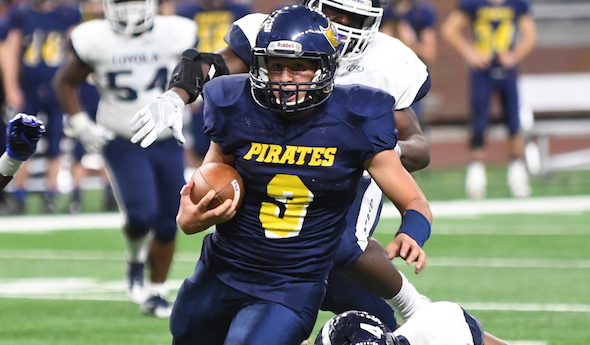
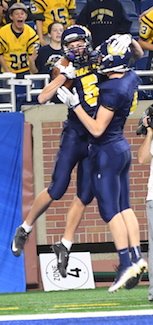
PHOTOS: (Top) P-W quarterback Ryan Smith breaks a Detroit Loyola tackle during Saturday’s Division 7 Final. (Middle) Logan Hengesbach (5) and Garrett Trierweiler celebrate one of Hengesbach’s two touchdown catches.