

Three Rivers Takes Run at District Together
October 31, 2017
By Wes Morgan
Special for Second Half
J.J. Wagner is economical with his words, stoic on the sideline, and not preoccupied with statistical trends. All he really asks of his Three Rivers football players is to play and sacrifice for one another.
 It’s been a pretty good recipe throughout his 13-year tenure as the head varsity coach of the Wildcats, at least in the years when the players truly held up their end of the bargain. With an 82-50 career record since 2005, Wagner has seen what can happen when everyone is pulling in the same direction, like a 13-0 run that ended with a loss in the 2009 Division 4 Final.
He’s also witnessed how complacency can cut a program right back down, as was the case in 2010 when an experienced Three Rivers squad went 4-5 and missed the postseason.
The Wildcats have been noticeably hungrier the last two years, with a 7-3 mark in 2016 and an 8-2 record this year as they prepare for Friday’s Division 4 District championship game against Edwardsburg.
Eleven games into the year, Three Rivers has been unable to break out of a Wolverine Conference bubble. The Wildcats went 7-2 in the league, with losses to Dowagiac (Week 2) and Vicksburg (Week 9). Revenge was sweet last Friday as Three Rivers beat Vicksburg in the Pre-District game (20-10).
Now, the difficult task of beating the league’s most dominant team for the second time in one year is what’s required to move on in the playoffs. If Three Rivers can beat the Eddies (after also doing so 21-18 in Week 7), there’s a chance they’ll face Wolverine Conference member Plainwell in the Regional Round.
“You get through the Wolverine (schedule) and then you’re suddenly in a mini Wolverine tournament,” Wagner joked.
There are no secrets in terms of playoff prep against such familiar foes, so it’s all about the basics.
“Our offense has been moving the sticks, our defense has been playing well, our special teams have played well and we play well when we don’t turn the ball over,” he said.
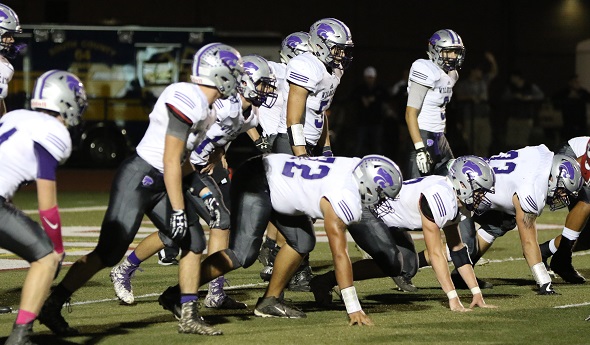
Having played for perennial power Mendon, where he registered 253 tackles as an outside linebacker during the 1987-89 seasons, Wagners’ emphasis on that side of the ball has been a hallmark of the 2017 campaign. Three Rivers has only allowed 11.7 points and 203 yards per game. The Wildcats have stopped opponents on third down 79.8 percent of the time.
A lot of that has to do with big and athletic senior defensive end Tirrell Hausmanis (6-foot-4, 245 pounds), senior defensive tackle Tyler Moore (5-11, 235) and the linebacker duo of senior Chris Morrill (5-10, 160) and Traven Van Oss (6-1, 165). That group alone has accounted for 34.5 tackles for loss this season. Morrill and Van Oss are tied for a team-best 61 tackles.
“Anytime you’re playing good defense, you can take a few more chances on offense,” Wagner said. “I don’t know how many times we’ve gone for it on fourth down this year, but it’s probably more than most (years). You can take a chance at midfield or the 40 that maybe you wouldn’t normally.”
Perhaps no player has embraced Wagner’s rule of doing what’s best for the team more than Hausmanis, who likely would have garnered a lot more attention from college coaches had he stayed at tight end. Instead, he’s anchored both lines the past two seasons.
“We all just do our jobs,” he said. “This happened and we weren’t big enough (on the offensive line) for me to play tight end. They needed me at tackle. At first I didn’t really like it, but I had to get used to it because it was what was best for the team. It helped us succeed and win, so I had to do it.”
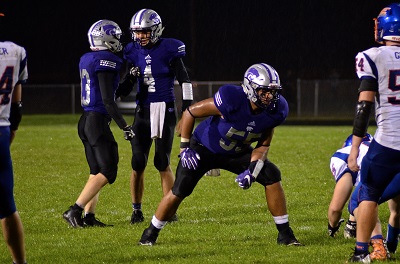 His defensive stats might not seem that impressive — 30 tackles with two sacks — but it’s what he’s capable of that impacts the game so severely.
“It helps when you know people are going to run away from (Hausmanis), so you can stunt and play games on the other side that can mess with their protections and blocking schemes,” Wagner said.
Wagner admitted he’s not big on stats, but for those who were wondering about how many times the offense has felt comfortable gambling on fourth down because of a belief in the defense, it’s 27. The Wildcats have converted 15 times (55.6 percent).
Other than knowing the defense could likely bail it out if needed, there’s been plenty of confidence in the offense under the leadership of junior quarterback Jalen Heivilin.
With a 22-6 touchdown-to-interception ratio, an average of 214.6 passing yards per game and a completion rate of 61 percent, the first-year starter has settled in nicely. Classmate Gavin Charvat has been Heivilin’s favorite target as the two have connected 42 times for 562 yards and six touchdowns. Bryce Morlan was next in line with 32 receptions for 549 yards and a team-high 11 TDs, but the senior went down in Week 9 with a torn anterior cruciate ligament. Fortunately for the Wildcats they also have reliable receivers in Jett Haifley and Zac Meyer; each has hauled in 23 passes for around 400 yards.
“When we play mistake-free, which is what we harp on, and eliminate pre- and post-snap penalties, you can win a lot of games,” Wagner said. “That’s what we focus on every week. If you can do that, you’re going to keep yourself in a lot of games.”
That was exactly the difference in Three Rivers’ home win against Edwardsburg on Oct. 6, which snapped a 34-game Wolverine Conference winning streak by the Eddies.
“We have to play with that same energy and effort (against Edwardsburg),” Wagner added. “In both of our losses, we came out kind of flat. If I knew why, we wouldn’t do it. We think we can go in there (at Edwardsburg) and play them tough again. It boiled down to mistakes in that (first meeting). We made our extra points, and we held them on all theirs. If we go in there with the same discipline, there’s no reason we can’t beat them again.”
 Wes Morgan has reported for the Kalamazoo Gazette, ESPN and ESPNChicago.com, 247Sports and Blue & Gold Illustrated over the last 12 years and is the publisher of JoeInsider.com. He can be reached at [email protected] with story ideas for Berrien, Cass, St. Joseph and Branch counties.
PHOTOS: (Top) Three Rivers’ defense lines up for a play; it’s been stifling this season giving up only 11.7 points per game. (Middle) Receiver Nolan Mark and quarterback Jalen Heivilin (4) talk things over against Edwardsburg. (Photos courtesy of JoeInsider.com.)
Drive for Detroit: Playoff Week 3 Review
November 18, 2019
By Geoff Kimmerly
Second Half editor
Only 36 teams remain from the original 602 that opened this fall with hopes of reaching the biggest stages in Michigan high school football.
 Suttons Bay, Colon, Pickford and Portland St. Patrick earned the first championship opportunities with 8-Player Semifinal wins over the weekend. And 32 more 11-player teams are one more victory from booking Thanksgiving trips to Detroit.
Below is a glance at all 36 games played during the third round of the MHSAA Playoffs. There’s plenty coming up on Second Half later this week as well as we’ll preview both 8-Player Finals and all 16 11-Player Semifinals, followed by coverage of both Saturday championship games from The Superior Dome.
"Drive for Detroit" is sponsored by MI Student Aid.
8-Player
Division 1
HEADLINER Suttons Bay 45, Kingston 14 The Norsemen (12-0) earned their first trip to the MHSAA Finals since 2004, putting up their most points since Week 6 while holding the Cardinals (9-3) to their fewest since Week 1. Suttons Bay scored 33 unanswered points to close the game, while holding Kingston scoreless during the second half. Click for more from the Traverse City Record-Eagle and see below for highlights from MI Sports Now.
Suttons Bay Defeats Kingston, Heading To State Finals https://t.co/9tZZ82gSyT pic.twitter.com/YVCPxejZOW
— MISportsNow (@MISportsNow) November 16, 2019
HEADLINER Colon 27, Morrice 8 The Magi (12-0) are headed to the MHSAA Finals for the first time. As expected, Colon got its toughest challenge this season from the reigning Division 1 champion Orioles – but still managed to extend its season-long streak of all 12 wins by double digits while holding Morrice (10-2) to its fewest points since the 2017 Regional Final. Click for more from the Battle Creek Enquirer and see below for highlights from JoeInsider.com.
Recap/audio from Colon's 27-8 semifinal win vs Morricehttps://t.co/xdtAVuedfo@JoeInsider #MHSAAFB @ColonFootball @Snooze2you
— Jordan Slocum (@JordanSlocum) November 16, 2019
Division 2
HEADLINER Pickford 40, Hillman 8 The 2018 Division 1 runner-up Panthers (11-1) earned another chance to play for a first championship with one of their best defensive showings of the fall. Quarterback Jimmy Storey ran for two touchdowns and threw for another score, and the Panthers held Hillman (10-2) to its fewest points since Week 2 of its final season of 11-player in 2017. Click for more from the Sault Ste. Marie Evening News and see highlights below from State Champs Sports Network.
Check out the highlights of Pickford High School vs. Hillman Community Jr/Sr High School from Friday Night's State Semifinal.
Presented by @HungryHowies pic.twitter.com/MNWNuSyYNk— STATE CHAMPS! Michigan (@statechampsnet) November 16, 2019
HEADLINER Portland St. Patrick 49, Climax-Scotts 6 The Shamrocks (12-0) have put up at least 42 points in every game this season. But the story Saturday may have been the defense, which gave one of its best showings of the fall in locking down a Climax-Scotts offense averaging 34 points per game. The Panthers finished their first season of 8-player 9-3. Click for more from the Lansing State Journal.
VIDEO: Check out the highlights of the Portland St. Patrick (@PortlandStPats) vs. Climax-Scotts | Division 2 @MHSAA 8-Player Football Semifinal. @WLNSAlexSims reporting.
Brought to you by @MHSAA pic.twitter.com/JAE91yZtAM— STATE CHAMPS! Michigan (@statechampsnet) November 17, 2019
11-Player
Division 1
HEADLINER Belleville 27, West Bloomfield 22 These two were seen as Division 1 favorites before the first kickoff this fall, and as anticipated the Lakers gave Belleville one of only two single-digit games of an otherwise dominating run this season. West Bloomfield (10-2) scored the game’s first 15 points and led into the third quarter, but the Tigers (12-0) came back and then held off a final rally to advance to the Semifinals for the second straight season. Click for more from State Champs Sports Network.
VIDEO: Check out the highlights of the Belleville (@BHS_Sec1) vs. West Bloomfield - Division 1 @MHSAA Football Regional Final from this afternoon. @JermainCrowell.
Brought to you by @hungryhowies pic.twitter.com/GTDcCud9ze— STATE CHAMPS! Michigan (@statechampsnet) November 17, 2019
Regional Roundup Brighton 35, Hudsonville 20 The Bulldogs (10-2) are headed to the Semifinals for the first time since 2005. Brighton got up 21-0 early, and the Eagles (8-4) were unable to catch up. Davison 35, Utica Eisenhower 7 The Cardinals (10-2) will play in their first Semifinal since 2008 after holding Eisenhower (9-3) to its first single-digit scoring output since Week 1. Sterling Heights Stevenson 9, Detroit Cass Tech 7 Both entered the playoffs as additional qualifiers, but Stevenson (8-4) is carrying a five-game winning streak into its first Semifinal since 2009 after ending a five-game winning streak for the Technicians (7-5).
Division 2
HEADLINER Muskegon Mona Shores 28, Portage Northern 23 The Sailors (10-2) have had to defeat three league champions to get within another win of returning to Ford Field after finishing Division 2 runners-up a year ago. Portage Northern (10-2) led into the third quarter before a Mona Shores comeback brought the Huskies’ first double-digit wins season to a close. Click for more from the Muskegon Chronicle and see highlights below from WZZM.
13 On Your Sidelines Game of the Week: Mona Shores vs. Portage Northern https://t.co/P9EzE7Qe0C
— 13 On Your Side (@wzzm13) November 16, 2019
Regional Roundup Walled Lake Western 21, Livonia Churchill 14 A Warriors defense giving up only 14 points per game held on through a late rally to end a six-game winning streak for Churchill (7-5) and get Western back to the Semifinals for the third time in five seasons. Detroit Martin Luther King 49, Detroit U-D Jesuit 21 This matchup of league champions went to the Detroit Public School League’s Crusaders (10-2), who won their fifth straight Regional title in ending the winningest season for Jesuit (8-4) since 2001. Birmingham Seaholm 44, Port Huron 28 The Maples (9-3) are headed back to the Semifinals for the first time since 1997 after jumping out to a big lead and holding off the Big Reds (8-4), who closed their winningest season and longest playoff run since 2011.
11-Player
Division 3
HEADLINER DeWitt 35, Edwardsburg 14 As a set, Division 3 might have had the most captivating games in the state this weekend. DeWitt (10-2) earns the “headliner” by ending a 25-game winning streak for the Eddies (11-1), who won Division 4 a year ago. Edwardsburg had given up only 69 points over its first 10 games on the field (not counting a 2-0 forfeit win Week 5), but DeWitt’s defense also earned some of the spotlight holding the Eddies to their fewest points since a 2016 Semifinal. Click for more from the Lansing State Journal.
See video highlights from DeWitt's regional championship win over Edwardsburg.https://t.co/QClZDZlmr5 via @LSJNews
— Brian Calloway (@brian_calloway) November 17, 2019
Regional Roundup Muskegon 49, East Grand Rapids 10 After getting past East Grand Rapids just 28-23 in Week 3, the Big Reds (12-0) held the Pioneers to their season-low points total and scored the most that EGR (8-4) gave up this fall. Chelsea 28, Allen Park 27 A blocked extra point followed by a late score and conversion sent Chelsea to 12-0 for the first time and the Semifinals for the second-straight season, while Allen Park ended 9-3 for the second-straight year. River Rouge 49, Orchard Lake St. Mary’s 14 The Panthers (11-1) are headed to the Semifinals for the fourth time in five seasons after scoring the most points the Eaglets (10-2) had given up since Week 2 of 2018.
Division 4
HEADLINER Detroit Country Day 24, Milan 6 The Yellowjackets (12-0) won this matchup of undefeated contenders on the strength of a defense that has held every opponent this season to 12 points or fewer and lowered its average with this win to 5.6 points allowed per game. Milan (11-1) hadn’t been held to single-digit scoring since Week 5 of 2017. Click for more from the Oakland Press.
VIDEO: Check out the highlights of the Detroit Country Day (@DCDSAthletics) vs. Milan - Division 4 @MHSAA Football Regional Final from this afternoon. @DCDSchool
Brought to you by @MHSAA pic.twitter.com/pa4HDy3Mf2— STATE CHAMPS! Michigan (@statechampsnet) November 17, 2019
Regional Roundup Grand Rapids Catholic Central 42, Cadillac 7 The Cougars (11-1) are in the Semifinals for the fourth-straight season after a fifth-straight game giving up seven points or fewer, as Cadillac (7-5) closed its longest playoff run since 2013. Hudsonville Unity Christian 38, Paw Paw 17 Last season’s Division 5 champion Unity (9-3) is one more win from playing for the Division 4 title this time after putting up the second-most points Paw Paw (10-2) had surrendered this fall while giving up only 11.9 per game. Flint Powers Catholic 12, Pontiac Notre Dame Prep 9 The Chargers (10-2) won their first Regional title since 2015 with the go-ahead touchdown midway through the fourth quarter, ending Notre Dame Prep’s first 10-win season since 2011 at 10-2.
Division 5
HEADLINER Detroit Denby 40, Dearborn Heights Robichaud 18 The Tars (10-2) reached double-digit wins and won a Regional title both for the first time, continuing a run that has seen them lose this season only to Division 2 contender King (twice). Robichaud (9-3) closed its winningest season since 2012. Click for more from the Dearborn Press & Guide.
VIDEO: Check out the highlights of the Denby vs. Robichaud - Division 5 @MHSAA Regional Final from tonight. Brought to you by @hungryhowies pic.twitter.com/aZ0fljemc7
— STATE CHAMPS! Michigan (@statechampsnet) November 16, 2019
Regional Roundup Kingsley 43, Freeland 21 The Stags (12-0) are headed to the Semifinals for the first time since 2005 after scoring the most Freeland (9-3) gave up in a game this fall. Kingsley has won all of its games by 12 or more points. Lansing Catholic 40, Kalamazoo United 13 The Zac Gillespie-to-Alex Watters connection played a major part in getting the Cougars (11-1) back to the Semifinals for the first time since 2015, as they connected for three of Gillespie’s four touchdown passes. The 40 points tied the most United (7-5) had given up this season. Almont 25, Saginaw Swan Valley 14 After opening the playoffs with two road games, Almont (12-0) came home to earn its first Regional title since 2014 as Swan Valley (8-4) was seeking to make the Semifinals for the third-straight season.
Division 6
HEADLINER Onsted 12, Hillsdale 0 This no doubt was the biggest stunner statewide of the weekend, as Onsted (10-2) – which three weeks ago won a playoff game for the first time since 2008 – avenged a Week 4 loss to unbeaten Hillsdale to claim its first Regional title since 1993. The Hornets (11-1) hadn’t been shut out since Week 2 of 2016 and won that first meeting with Onsted this fall 28-19. Click for more from the Adrian Daily Telegram.
Check out the highlights of Friday night's Regional Final game between Onsted (@OnstedAth) and Hillsdale (@HillsdaleHornet).
Presented by the @MHSAA pic.twitter.com/xGVMN5iFML— STATE CHAMPS! Michigan (@statechampsnet) November 16, 2019
Regional Roundup Maple City Glen Lake 15, Calumet 14 The Lakers (11-1) are headed to the Semifinals for the second time in four seasons after winning by the slimmest of margins, with a second-quarter 2-point conversion run the eventual decider. Calumet (10-2) suffered its two defeats this season both by 15-14 scores against teams still alive in the playoffs. Montague 48, Sanford Meridian 14 The reigning Division 6 runner-up Wildcats (10-2) have won six straight since back-to-back close league defeats, and the 14 points scored by Meridian (8-4) tied the most given up during Montague’s current run. Monroe St. Mary Catholic Central 36, Montrose 7 After Regional Finals losses the last two years by a combined three points, St. Mary (10-1) is headed back to the Semifinals for the first time since 2014 after handing Montrose (10-2) its first loss since Week 4.
Division 7
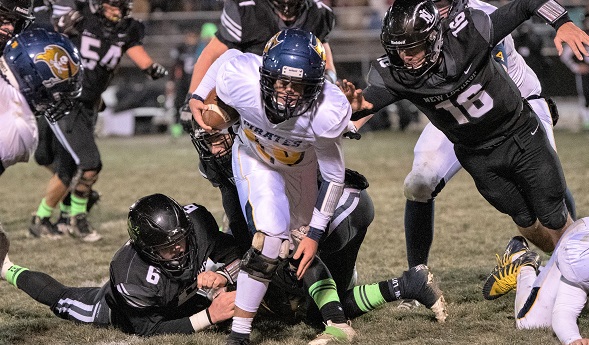
HEADLINER Pewamo-Westphalia 36, New Lothrop 35 In what might be remembered as the top non-Finals matchup of these playoffs, the Pirates (12-0) – Division 7 champions in 2016 and 2017 – got out to a three-touchdown lead and held on to edge last season’s champion New Lothrop (11-1). The Hornets had won 11 straight games and defeated P-W 26-14 in last year’s Regional Final. Click for more from the Lansing State Journal and see below for highlights from FOX 17.
"I'm proud of our guys for weathering through the adversity and the storm," head coach Jeremy Miller said after the win. The Pirates advance to face the winner of Iron Mountain and Traverse City St. Francis. https://t.co/UzPh02yVcy
— FOX 17 Blitz (@FOX17Blitz) November 16, 2019
Regional Roundup Iron Mountain 21, Traverse City St. Francis 7 The Mountaineers (12-0) won their first Regional title since 2011 and reached 12 wins for the first time since 2000 by ending St. Francis’ quest for a third straight Semifinals berth. Iron Mountain held the Gladiators (8-4) scoreless into the fourth quarter. Jackson Lumen Christi 35, Schoolcraft 30 The Eagles (10-2) rallied from more than three scores down but couldn’t catch up to the reigning Division 6 champion Titans (11-0), who ran their winning streak to 24. Cass City 6, Detroit Loyola 0 The Red Hawks’ fifth shutout this season came with historic rewards as Cass City (11-1) added its first Regional title to its most successful season, with a fourth-quarter score the difference against the defensively-tough Bulldogs (6-5).
Division 8
HEADLINER Reading 26, Adrian Lenawee Christian 21 The reigning Division 8 champion Rangers were trailing into the fourth quarter before scoring the go-ahead points with just over eight minutes to play. Both teams’ defenses bent just a bit: Reading (11-1) hadn’t given up more than 14 points all season, and Lenawee (10-2) hadn’t given up more than 14 since its Week 2 loss to Sand Creek. The Cougars concluded their winningest season, which included their first playoff victory two weeks ago. Click for more from the Hillsdale Daily News.
VIDEO: Check out the highlights of the Reading vs. Lenawee Christian - Division 8 @MHSAA Regional Final from tonight.
Brought to you by @hungryhowies pic.twitter.com/6yq3nbMUdH— STATE CHAMPS! Michigan (@statechampsnet) November 16, 2019
Regional Roundup Beal City 27, Ishpeming 14 The Aggies (11-1) won their first Regional title since 2014, scoring all of their points before Ishpeming (9-3) got on the board. The Hematites were making a second-straight Regional Final appearance. Ubly 56, Saginaw Nouvel 36 The Bearcats (10-2) went over 50 points for the fifth time this season to win their second Regional title in four years and despite giving up a season-high point total to Nouvel (7-5). Fowler 33, Royal Oak Shrine 0 The Eagles (11-1) won their first Regional title since 2011, continuing a bounce-back run after two straight 4-5 finishes. Shrine finished 9-3, also with more wins than the last two seasons combined.
Second Half’s weekly “Drive for Detroit” previews are powered by MI Student Aid, a part of the Office of Postsecondary Financial Planning located within the Michigan Department of Treasury. MI Student Aid encourages students to pursue postsecondary education by providing access to student financial resources and information. MI Student Aid administers the state’s 529 college savings programs (MET/MESP), as well as scholarship and grant programs that help make college Accessible, Affordable and Attainable for you. Connect with MI Student Aid at www.michigan.gov/mistudentaid and find more information on Facebook and Twitter @mistudentaid.
PHOTO: Pewamo-Westphalia's Ethan Thelen (10) breaks multiple New Lothrop tackles during Friday's Division 7 Regional Final win. (Click to see more from HighSchoolSportsScene.com.)