

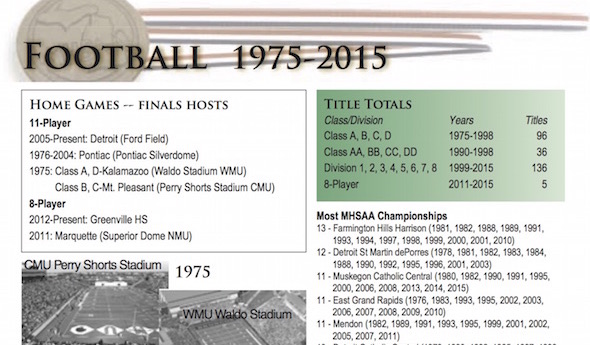
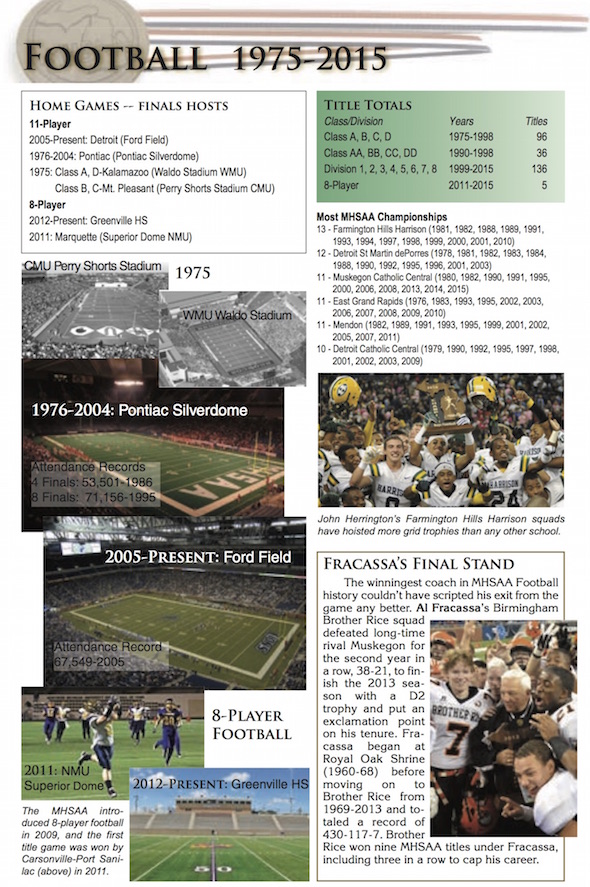
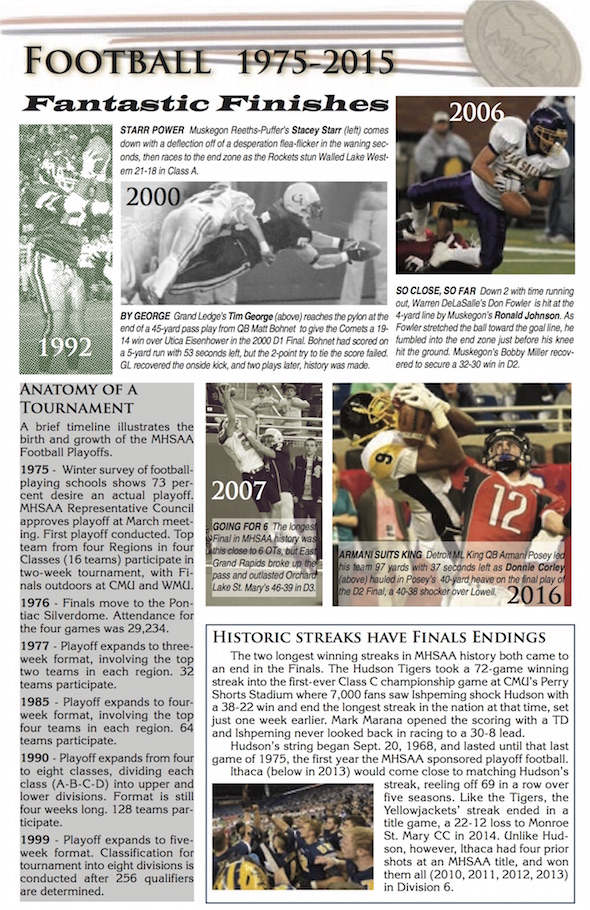
Through the Years: Football 1975-2015
By
Geoff Kimmerly
MHSAA.com senior editor
August 9, 2016
Another football season kicked off Monday with first practices across the state, so it's a perfect time to take a look back at what is annually our most attended MHSAA tournament series.
High schools in this state have played football for more than a century. The first MHSAA champions were awarded in 1975, and the playoffs have continued to evolve to now recognize a total of nine champions over two formats, 11 and 8-player.
This feature is from the spring issue of benchmarks, built and written by Rob Kaminski. Scroll to the bottom of the page for a link to our previous installments. We'll continue to look at more MHSAA postseason events every Tuesday and Friday this fall.
Previous installments
August 5: Girls Volleyball - Read
August 2: Boys Soccer - Read
July 30: Boys Cross Country - Read
July 26: Girls Cross Country - Read
July 22: Boys/Girls Lacrosse - Read
July 19: Boys/Girls Tennis - Read
July 15: Boys/Girls Golf - Read
July 12: Girls Soccer - Read
July 8: Boys Track & Field - Read
July 5: Girls Track & Field - Read
July 1: Baseball - Read
June 28: Softball - Read

Summer Football Safety
June 23, 2017
Across the U.S. this summer, school-age football players are flocking to camps conducted by colleges and commercial interests. They get outfitted in full gear and launch themselves into drills and skills work.
Unlike the start of the interscholastic football season, the players usually do this without several days of acclimatization to avoid heat illness, and without limits on player-to-player contact to reduce head injuries.
Required precautions of the school season are generally ignored at non-school summer camps.
One notable exception to this foolish behavior is found in Michigan where the Michigan High School Athletic Association prohibits member schools’ student-athletes from using full equipment and participating in full-contact activities outside the high school football season. This is not a recent change; it’s been the MHSAA’s explicit policy for more than four decades.
And it’s a policy that has never been more in style and in favor than it is today.