


Travel Football
July 15, 2016
The University of Michigan will host a high school football game on Sept. 2, 2016. That would not make news, except that the game is between two out-of-state high school teams.
The teams are from New Jersey and Maryland, likely chosen to assist the Wolverines’ recruiting efforts in those states, and to help them make more waves in the college football world. Both high school teams are private schools, and each comes with heavy baggage.
Some public schools in New Jersey have boycotted playing the New Jersey school in football; the Maryland school is not a member of the MHSAA’s counterpart association in that state. One school is flaunting the rules; the other school has no rules to follow.
That major college football has been in an uncontrolled spiral of excess is not news; but its insidious damage to high school sports is finally making headlines.
NCAA rules have recently been robbing schools of winter and spring sports athletes as college coaches entice high school seniors to graduate at the end of their seventh semester and start practicing football with their future college teammates several months early. We are grateful to see Big 12 Commissioner Bob Bowlsby question the practice of enrolling players before their scheduled high school graduation.
Now, NCAA rules appear to invite universities to select high school football teams from anywhere there’s a great prospect or two, and transport the teams across the U.S. to compete in a nearly empty stadium, save for recruiting “gurus,” athletic apparel reps and a few media. We are hoping to see some college sports leaders step up to question this practice.
All of this leads to the rich getting richer – on both the college and school levels. All of which induces another updraft to the spiral of excess in what are supposed to be education-based programs.
A Game for Every Fan: Week 3
September 11, 2014
By Geoff Kimmerly
Second Half editor
Gone is the rain (at least, apparently, for this week). But here comes the storm of league play.
By the end of this weekend, all but a handful of conferences schedules will be underway.
Some of the best league openers highlight the most significant games in the state this week:
West Michigan
Lowell (2-0) at East Grand Rapids (2-0)
After two uncharacteristic seasons of finishing a combined 9-9, East Grand Rapids looks on the way back up with wins over two teams – Grand Rapids Catholic Central and Ottawa Hills – that finished above .500 in 2013. The Pioneers played another strong Lowell team to within three points just a year ago, and the Red Arrows again look like favorites in the ultra-competitive Ottawa-Kent White after two wins against out-of-state opponents to open this fall.
Others that caught my eye: Grand Rapids West Catholic (2-0) at Ada Forest Hills Eastern (2-0), Muskegon Reeths-Puffer (2-0) at Grand Haven (2-0), Grand Rapids South Christian (0-2) at Hudsonville Unity Christian (2-0), Muskegon Mona Shores (2-0) at Rockford (2-0).
Mid-Michigan
Lansing Sexton (2-0) at Grand Ledge (1-1)
Although the Capital Area Activities Conference Blue looks like a possibility for up to four playoff teams, the league title could be decided tonight. Sexton has continued to build an impressive argument as an MHSAA title favorite with road wins over Detroit East English and Monroe, while Grand Ledge might be the league’s other top contender after a win over Forest Hills Central and then a loss last week to Holland West Ottawa after the Comets led by two scores.
Others that caught my eye: Jackson Lumen Christi (2-0) at Battle Creek Harper Creek (1-1), St. Johns (2-0) at Haslett (1-1), DeWitt (2-0) at Mason (1-1), Lansing Catholic (2-0) at Portland (2-0).
Upper Peninsula
Hurley, Wis. (3-0) at Crystal Falls Forest Park (2-0)
The Great Western Conference is one of only two during football season that includes both MHSAA and Wisconsin teams, and this continues to be the game that ends up deciding the champion. This is the fourth straight season these two have opened the league schedule against each other, with Forest Park coming off two straight victories in the series. The Trojans have a new coach after the retirement of Bill Santilli, one of the most highly-respected in either peninsula, but opened with a pair of wins of at least 27 points apiece.
Others that caught my eye: Iron Mountain (1-1) at Iron River West Iron County (2-0), Felch North Dickinson (2-0) at Munising (1-1), Gladstone (2-0) at Negaunee (2-0), L'Anse (1-1) at Lake Linden-Hubbell (1-1).
Greater Detroit
Oak Park (1-1) at Farmington Hills Harrison (2-0)
Harrison was second and Oak Park tied for third in the Oakland Activities Association White last season, and they’re contenders again if not favorites. They played one of the most exciting games in the entire OAA in 2013, a 60-52 Harrison win after Oak Park edged the Hawks 26-21 in 2012. The Knights enter with the lone loss between the two so far this fall – but it’s a 27-26 defeat to Detroit Cass Tech in arguably the best game of opening weekend.
Others that caught my eye: Warren Mott (2-0) at Macomb Dakota (1-1), New Boston Huron (2-0) at Monroe St. Mary Catholic Central (2-0), Detroit Country Day (1-1) at Detroit Loyola (2-0), Clinton (2-0) at Ottawa Lake Whiteford (2-0).
Southwest and Border
Stevensville Lakeshore (2-0) at Portage Central (1-0)
Beating Lakeshore 38-28 in Week 4 last season was the biggest early win on Portage Central’s way to its best finish ever – 12-1. The Mustangs are coming off an unexpected off week, as they were not able to reschedule against Battle Creek Lakeview after storms prevented the game Friday night. Lakeshore’s start is anything but a typical 2-0 , as last week’s 35-7 win over Kalamazoo Loy Norrix was preceded by a 2-0 victory by a safety over Battle Creek Central on opening night.
Others that caught my eye: Portage Northern (2-0) at St. Joseph (2-0), Kalamazoo Central (0-2) at Kalamazoo Loy Norrix (0-2), Mendon (2-0) at Watervliet (1-1), Battle Creek Central (1-1) at Battle Creek Lakeview (0-1).
Lower Up North
Traverse City West (1-1) at Traverse City Central (2-0)
These rivals emerged from the former Traverse City High in 1997, and West owns a 12-5 advantage in the series although they have split the last two match-ups. West's 17-14 win in Week 3 last season helped get the Titans into the playoffs and helped keep Central out with the same record. They play to open the Big North Conference season at neutral Thirlby Field, and it should be packed again.
Others that caught my eye: Cadillac (2-0) at Petoskey (2-0), Traverse City St. Francis (1-1) at Elk Rapids (1-1), Rogers City (2-0) at Lincoln Alcona (2-0), Manton (2-0) at Evart (1-1).
Bay and Thumb
Montrose (2-0) at Lake Fenton (1-1)
Montrose hasn't lost a Genesee Area Conference Red game since Week 3 of 2010. But last week's one-score victory over Corunna made the Rams look at least a little less invincible, and Lake Fenton is sure to try to pounce. The Blue Devils finished second to Montrose the last two seasons and bounced back from a bad opening-night loss to Freeland with a similarly big win over Durand.
Others that caught my eye: Davison (1-1) at Flint Carman-Ainsworth (1-1), Reese (1-1) at Marlette (1-1), Elkton-Pigeon-Bay Port (2-0) at Ubly (1-1), Croswell-Lexington (1-1) at Richmond (2-0).
8-player
Carsonville-Port Sanilac (0-2) at Deckerville (2-0)
Carsonville-Port Sanilac has never found itself in this position during the short history of 8-player football, or at all since 2008. But a win over rival Deckerville – 4-0 against the Tigers since moving to 8-player in 2012 – would certainly be a jumpstart to CPS's season. Carsonville-Port Sanilac was the inaugural MHSAA 8-player champion in 2011, and Deckerville kept the title in the Thumb by winning in 2012.
Others that caught my eye: Akron-Fairgrove (1-1) at Owendale-Gagetown (2-0), Waldron (2-0) at Portland St. Patrick (2-0).
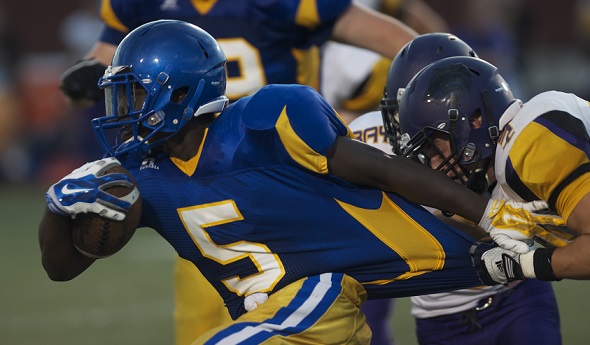
PHOTO: Midland (blue helmet) is 1-1 after a 31-15 victory last week over Bay City Central. (Click to see more from HighSchoolSportsScene.com.)