

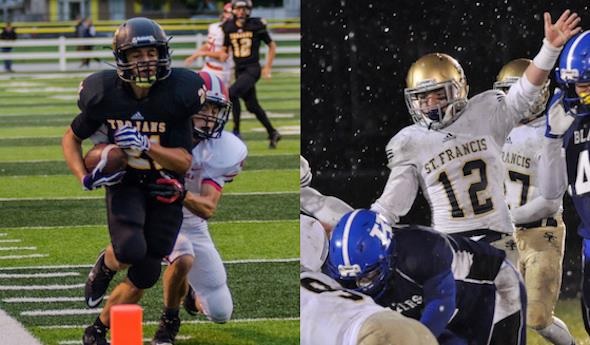
Traverse City Neighbors Chase 9-0
October 21, 2015
By Dennis Chase
Special for Second Half
TRAVERSE CITY – It hasn’t happened here in 30 years.
But this weekend Traverse City Central and St. Francis can put the wraps on 9-0 regular seasons, marking the first time two Traverse City football teams have accomplished that feat in the same season since 1985. Traverse City Senior High – before the school was split – won the Class A state championship that year.
 "We know both our programs have a good thing going," Central athletic director Mark Mattson said. "Regardless of what school you're at, you want the other Traverse City programs to be successful, too. Right now we appreciate where we are. We're enjoying the ride."
So is St. Francis, where coach Josh Sellers, back for his second stint, is hoping an amazing trend continues. The Gladiators have made just four coaching changes in the last 42 years. In the first year after each coaching change, St. Francis is a combined 44-1 with three MHSAA Finals championships – and now the possibility of a fourth.
It all started in 1974 – the year before the playoffs began – when Larry Sellers took over an 8-1 program from Waldo Keating and finished 9-0 en route to a Class D mythical state championship. The beat continued in 2003 when Josh Sellers inherited a 10-2 team from his Hall of Fame father and went 14-0 in capturing the Division 7 crown. When Sellers moved to Tennessee after a 12-2 season in 2007, Greg Vaughan came aboard and led the Gladiators to a 13-1 mark and another Division 7 title.
Now, Sellers is back as head coach and St. Francis is riding high with an 8-0 record and a No. 1 ranking in The Associated Press’ Division 7 poll.
"This team is very workmanlike, very similar to the 2003 team," Sellers said. "We don't have a lot of vocal leaders, but we have kids who like to play for each other and that's half the battle."
Across town, another change is producing impressive results. First-year head coach Eric Schugars’ Traverse City Central Trojans are 8-0 and ranked No. 7 in this week's Associated Press Division 2 poll. Schugars served as defensive coordinator for four years under Tom Passinault, who stepped down after a successful eight-year run.
"Going 9-0 is hard to do, but we're pretty excited about having that opportunity," Schugars said.
There are links between the St. Francis and Central programs. Former Gladiators standout and assistant coach Greg Sherwin is now the offensive line coach at Central. His two sons are the starting tackles. Two former Central head coaches, Joe Forlenza and Passinault, are assistants at St. Francis. Forlenza is the long-time defensive coordinator for the Gladiators while Passinault joined the staff this season as defensive line coach.
In addition, 16 players from the two teams – including the starting quarterbacks, St. Francis' Joe Coates and Central's Reagan Cotton – were teammates on a Pop Warner squad coached by Sherwin and Rick Coates. Joe Coates and Cotton also trained together in the Popp Quarterback Tutor Camp for seven years.
The two seniors direct entirely different offenses. St. Francis relies on a potent ground game, Central likes to air the ball out in its wide-open spread attack.
Sellers added some new wrinkles to the Gladiators’ offense, but he's not deviating from what's been the program's staple.
"It's still old fashioned St. Francis smashmouth football," Sellers said. "We're going to run the football, control the line of scrimmage and control the clock."
The Gladiators average 327 rushing yards a game. Joe Trucco and Jacob Klingelsmith are picking up nearly 11 yards per carry. Trucco has a team-high 835 yards, Klingelsmith 686.
Coates is efficient when the Gladiators take to the air. Of his 20 completions, nine are for touchdowns.
"Joe does a great job making decisions, getting the ball to the right receiver," Sellers said.
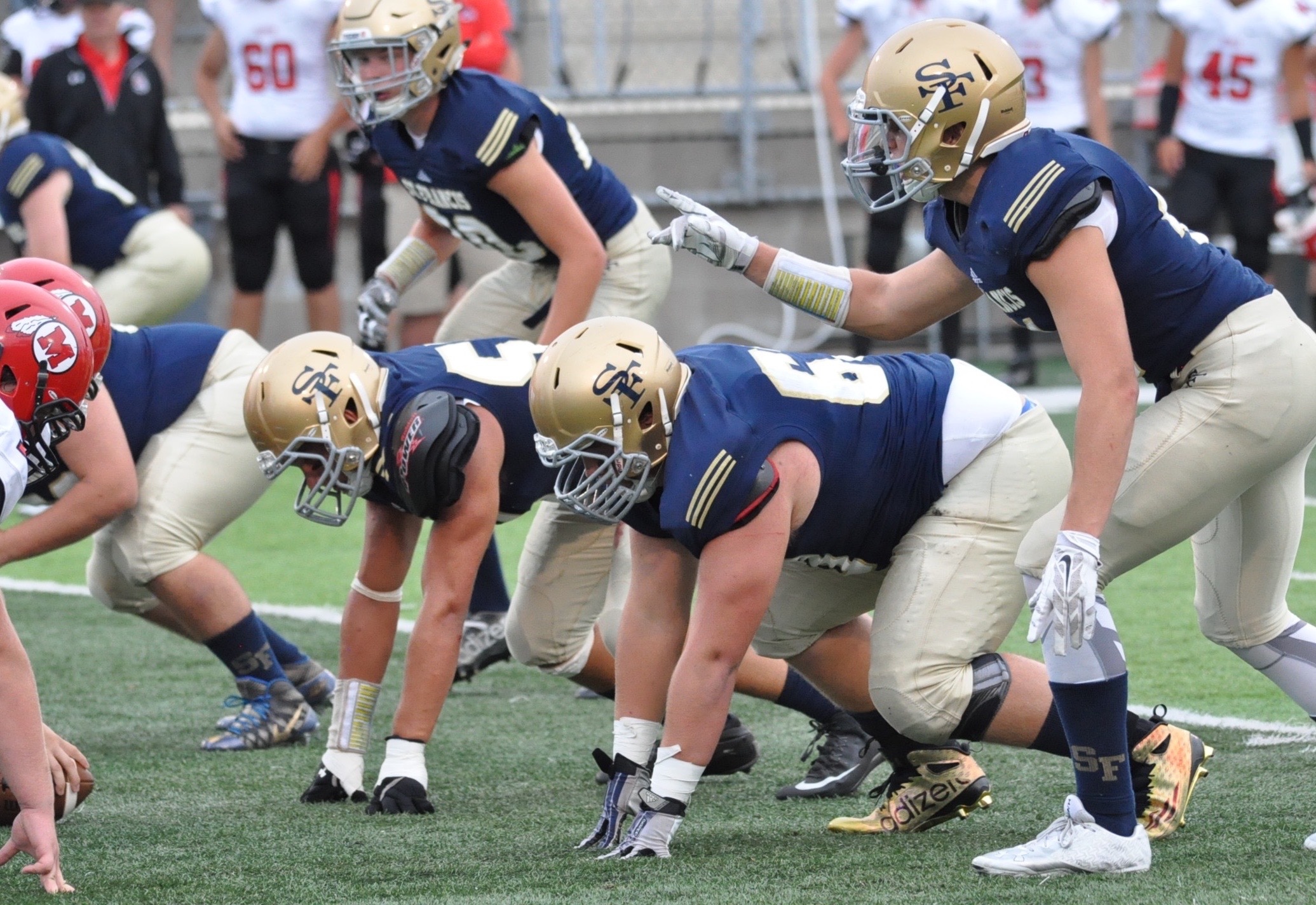 St. Francis is averaging nearly 50 points a game. The defense, led by Gabe Callery and Tyler Picardat, is surrendering just 7.5 points a contest. The team's signature win is a 32-13 triumph over 7-1 Boyne City, which snapped the Ramblers 13-game regular-season win streak. The score was 7-7 at the half.
"That was such a battle," Coates said. "Both teams played hard. That (second half) was probably the one moment where I've seen our team reach a level of greatness. But I don't think we've reached our full potential just yet."
Sellers agreed. He said his team is improving every week.
St. Francis returned a strong nucleus from a team that went 9-3 last season, so the 8-0 start is not a surprise.
"The team expected it," Sellers said. "A lot of people around the team expected it after having made a push into the third round of the playoffs (last season) and having only two regular-season losses, both in overtime. I think the kids were hungry to work hard this summer and come back and try to prove those losses were flukes. These kids have high expectations."
Those high expectations come based on the long-term success of the program, Coates said. St. Francis has won 76 percent of its games since it started playing football in 1951. In the last 13 years, the Gladiators have reached the MHSAA Finals five times, winning four titles.
"It's crazy to look back at it," Coates, a one-time waterboy for the team, said. "You're brought up in an atmosphere where success is almost the only option. When you think of St. Francis football, you think of winning (games) and winning state championships."
It's been a rather seamless transition for Sellers, thanks in part to a veteran coaching staff that includes Jim Carroll, who’s been with the Gladiators 51 years. In his first stint, Sellers was 57-7 with two MHSAA crowns in five years.
"The biggest hurdle was I didn't know the kids and they didn't know me," he said.
Sellers, 41, was hired in March to replace Vaughan, who had coached the Gladiators the last seven years and had also won two titles.
"Greg (Vaughan) did such a great job for us the time he was here," St. Francis athletic director Tom Hardy said. "To our seniors, Greg Vaughan was St. Francis football. It did take some time for Josh to get to know the kids and for the kids to understand who he is and what he believes in. That was done very quickly. From my perspective, it was like Josh had never left. He's done a fantastic job. There is a sense of calm, a sense of determination and a sense of pride that he brings (to the program)."
St. Francis hosts 5-3 Kingsley on Saturday. The last time the Gladiators went undefeated in the regular season was 2009. Coates was at Ford Field that year when the Gladiators captured the championship. In fact, he was there in 2008 and 2005, too.
"I'm hoping to make my own trip this year," he said.
An 8-0 start might not raise eyebrows at St. Francis, but it has come as a mild surprise at Central. Petoskey and Traverse City West were considered the favorites in the Big North Conference, but the youthful Trojans rallied to win both those showdowns in overtime. Central was down 21-0 at halftime at Petoskey.
Schugars said one of his first objectives as head coach was to develop the character of his team and get the players to believe in themselves. He said that was a key in creating a winning mentality.
"There's a certain edge you have to play with," he said. "You don't want to go out there and see what happens. You want to go out there expecting to win. It's about creating high expectations amongst our players. We're trying to set standards of excellence. Our kids have certainly done a good job buying in."
 Schugars said the players worked hard, starting in the winter, to prepare for this season. Cotton, who took over as the starting quarterback late last season, became the catalyst as Central made changes in its offense, implementing a fast-paced no-huddle system.
"He's steady, he's poised," Schugars said of Cotton. "He has a calming influence on our team."
He's accurate, too. Cotton's completed 96 of 147 passes (65 percent) for 1,337 yards and 16 touchdowns. He's thrown just three interceptions.
He's also spread the ball around. Playmaker Devante Walker leads the team with 28 receptions, five for touchdowns. Walker's averaging nearly 17 yards a catch. Griffin Cencer's pulled in 22 receptions and Terrell Solberg 19.
John Pupel and Walker lead the ground game. Pupel's rushed for 612 yards and 13 touchdowns, Walker 474 yards and seven scores.
Schugars credits the offensive line of tackles Ben and Sam Sherwin, guards Jacob Steelman and Brendan Arnold and center Alex Windholz for giving Cotton time to pass and the backs room to roam.
"We're riding them and they know it," he said.
The defense is anchored by Pupel at strong safety, Fitz Doud at inside linebacker and senior ends Zach Mayo and Max Franz.
The two overtime wins were milestones in the season and showed the team’s resolve, especially the comeback win at Petoskey when the outcome looked dire with Central down 21 points.
 "We challenged the kids at halftime," Schugars said. "We needed a break in that game and we got one, a turnover and we scored quickly after that. Right then you could feel the momentum changing. It was like this is our game. That's all it took. It goes back into believing in each other."
"We were disappointed in ourselves (the first half)," Cotton added. "We knew we could play better. Coach told us to take it one play at a time, go out and give 100 percent each play."
Never looking too far ahead has been a theme with this team.
"Going into a season every team wants to go 9-0," Cotton said. "The biggest thing for us is that we've taken it one game at a time."
Central is a young team that relies heavily on a talented junior class. Although Pupel, Walker and Ben Sherwin were mainstays on the varsity as sophomores, Schugars didn't know how long it would take for the team to jell.
Turns out, it didn't take long. Now the Trojans, if they can beat Cadillac on Friday, are on the brink of accomplishing something that hasn't been done since 1988 – a perfect regular season.
"And we all know what happened that year (a state championship)," Schugars said.
It's been quite a start for the 38-year-old Schugars, whose father Jack is in the Michigan High School Football Coaches Association Hall of Fame.
Even his father didn't go 9-0 his first year. He went 6-3 at Muskegon Oakridge.
"That's about all (I have on him)," Eric Schugars said, laughing. "I'm a proud son, proud of what he's done. If I can (achieve) half of what he's done, it will be a success."
Mattson said the players instantly took to Schugars.
"We brought the football players into the cafeteria when we made the announcement," he said. "They roared (with approval). That indicated he had their support.
"The kids and his staff have worked hard for him and that's a sign of a good coach, a good leader. It's been extremely fun to watch."
Mattson said Schugars' character has had a positive impact on the players.
"Eric is such a good person and family man, and a fantastic teacher," he said. "It's who Eric is as a person, even more so than a coach, that's impressive. They (players) know him as a person. They know he cares."
Central honored the 1975 and 1985 teams at last Friday’s game with West Branch Ogemaw Heights. Now, that 1985 season could come up again this weekend.
"9-0 would be a big deal for us," Cotton said.
It would be for St. Francis, too.
 Dennis Chase worked 32 years as a sportswriter at the Traverse City Record-Eagle, including as sports editor from 2000-14. He can be reached at [email protected] with story ideas for Manistee, Wexford, Missaukee, Roscommon, Ogemaw, Iosco, Alcona, Oscoda, Crawford, Kalkaska, Grand Traverse, Benzie, Leelanau, Antrim, Otsego, Montmorency, Alpena, Presque Isle, Cheboygan, Charlevoix and Emmet counties.
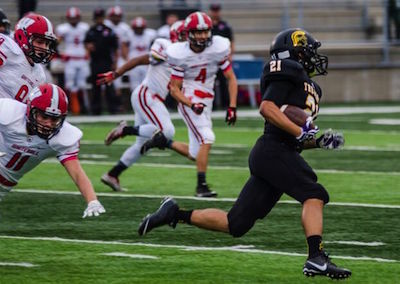
PHOTOS: (Top) A Traverse City Central ball-carrier drags a defender toward the goalline, left, and a St. Francis player appears to signal his team's possession of the ball. (Middle) The St. Francis defense lines up during a game this season. (Below) A Central ball-carrier runs away from would-be tacklers. (Photos courtesy of Traverse City Central and Traverse City St. Francis.)
MCC Extends Streak, Hands Off Legacy
November 25, 2016
By Geoff Kimmerly
Second Half editor
DETROIT – A trio of running backs who played major roles in Muskegon Catholic Central’s last three MHSAA championships closed their high school careers celebrating the school’s fourth straight title Friday.
Along the way, they also handed off the program’s future.
Seniors LaTommy Scott, Logan Helton and Walker Christofferson had become Ford Field fixtures the last few seasons, and each contributed to their combined four touchdowns in this Division 8 Final. But the fifth score of MCC’s 35-6 victory over Ottawa Lake Whiteford was scored by a freshman who will take over from here – and showed the promise that makes the Crusaders look good to continue these annual trips to Detroit.
Splitting time at quarterback with senior Trenton Bordeaux, freshman Cameron Martinez ran for a team-high 154 yards and a touchdown and threw for 61 yards and a score to help MCC pull into a tie for second all-time with its 12th MHSAA football title.
Although a freshman, the scene wasn’t entirely unfamiliar for Martinez; his brother Christian had quarterbacked the team to its 11th title last year as a senior.
“Every time we made it, I was watching from the crowd. I couldn’t wait to put on the gold helmet and bring this team back again,” Cameron Martinez said. “I love this group of seniors. I’m going to miss them, and that’s what I wanted to do – give them their fourth straight title.”
With four straight, the Crusaders (14-0) are now one shy of the MHSAA record of five consecutive titles shared by the Farmington Hills Harrison teams from 1997-2001 and East Grand Rapids’ teams from 2006-10. With 12 championships total, MCC is tied with now-closed Detroit St. Martin dePorres for second most in the sport, one behind Harrison’s record 13 football titles.
Martinez entered the Final third on the team with 614 rushing yards, tallying 12 touchdowns on the ground, and second to Bordeaux with 540 passing yards plus nine scoring passes. Also a starting linebacker, he didn’t play offense in MCC’s 35-0 Semifinal win over St. Ignace last week. But he was impacting the Crusaders’ offense by the end of Friday’s first quarter.
Martinez’ first carry came on the final play of that quarter, for three yards, and he opened the second with a 26-yard run. He also had a 19-yard run and 23-yard pass to set up Helton’s five-yard scoring run that put the first points on the board with 9:05 to go in the first half.
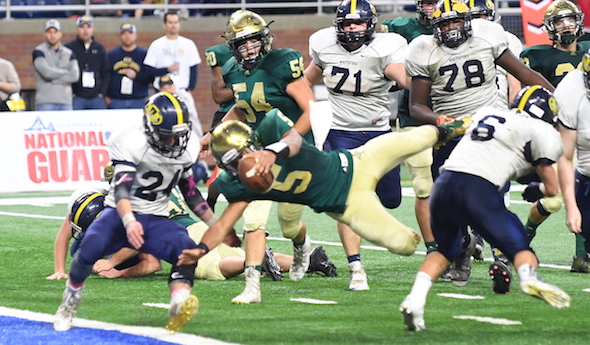
After coming up shy on another drive late in the half and then pushing the score to 14-6 on a 35-yard Helton run to cap its first possession of the second, MCC made it 21-6 with 3:08 to play in the third quarter with a drive that included 55 rush yards on five Martinez carries, including the final one for three yards into the end zone.
“Anytime you have a running quarterback, you have to defend 11 and not 10; it’s just simple math sometimes,” MCC coach Steve Czerwon said. “Having somebody in the backfield as dynamic as Cameron, with the ability to make plays … people are like, ‘He’s a freshman.’ Well, he’s a freshman, fine. But he doesn’t play like a freshman.”
 MCC welcomed its captains from the last three seasons to Thursday’s practice, and after, Czerwon asked Christian Martinez if he was nervous for his brother. Christian’s response to Czerwon: “Nah, he’s made for these big moments.”
“After he said that – and he knows him a heck of a lot better than I do – I felt good about using him today,” Czerwon added. “And I thought he performed very well.”
So did those seniors. Helton ran seven times for 67 yards and those two scores, and Scott ran eight times for 69 yards and scored on the 25-yard touchdown “pass” which was more of a front pitch on a sweep around the left side. Christofferson, who ran for 200 yards and three touchdowns in the Semifinal win, added the day’s final score with 1:04 to play.
Helton, also a linebacker, had 10 tackles and Christofferson, a defensive back, had seven to follow up all-state senior linebacker Andrew Schulte's team-leading 13. The Crusaders never trailed this season, and the defense was a big reason why; including 13 points surrendered over five playoff games, MCC allowed only 77 points this fall (5.5 per game).
But Friday’s score didn’t tell well how close this matchup was for most of it. Whiteford had six turnovers on downs, falling short of first downs by only a yard four times. Twice, MCC sophomore defensive back Dawson Steigman made rally-ending stops. Three of the fourth-down misses came in Crusaders territory.
Whiteford junior quarterback Thomas Eitniear was especially impressive, completing 7 of 10 passes for 96 yards and running nine times for 111 yards including the team’s lone score, an 81-yard sprint around the left end that made it 7-6 with 2:37 to go in the first half.
“Coming into halftime, that was the exact kind of game we were looking to play – to chew clock, and we just didn’t articulate a couple of our possessions into scores,” Whiteford coach Jason Mensing said. “Second half, they found some things offensively against us and took advantage. And on top of that, we didn’t articulate our drives as well.
“Overall, I’m pleased with the effort and passion, and probably the thing I’m most proud of was I didn’t feel like the moment was too big for our kids, which oftentimes you get into this type of stage, the moment can be a little large. I thought our kids handled themselves with great composure, and that’s one of those attributes for life that really matters.”
Whiteford made its first appearance in an MHSAA Final, following up its second straight – and second ever – Semifinal appearance. The Bobcats finished 13-1.
“Me and a bunch of the senior guys, we dreamed about this since freshman year,” said senior running back Jesse Kiefer, who finished as the school’s career record holder in rushing yards, points and total offense. “Coming in and being able to play on this field, it’s just not real to me. Obviously, we wanted it to come out a different way than this, but it’s still an experience I’ll never forget.”
Kiefer had seven tackles at linebacker, following senior safety Herbie Bertz’ 13 and junior tackle Jared Atherton’s eight. Kiefer also broke up three passes.
With it being their last, MCC’s seniors asked to not come out of this game early as they have most of this season with the Crusaders beating all of their opponents by at least two touchdowns.
But as they left Ford Field once more, surrounded by 13 underclassmen, they were confident with who might lead MCC back next time.
“Handing it off the Cameron, our program is in good hands,” Helton said. “I don’t expect anything less than what we’ve been doing.”
The MHSAA Football Finals are sponsored by the Michigan National Guard.
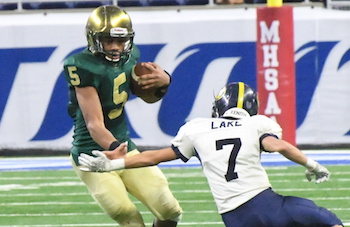
PHOTOS: (Top) Muskegon Catholic Central’s Cameron Martinez stretches toward the goal line for a score late in the third quarter. (Middle) Martinez works to elude Whiteford’s Hunter Lake.