

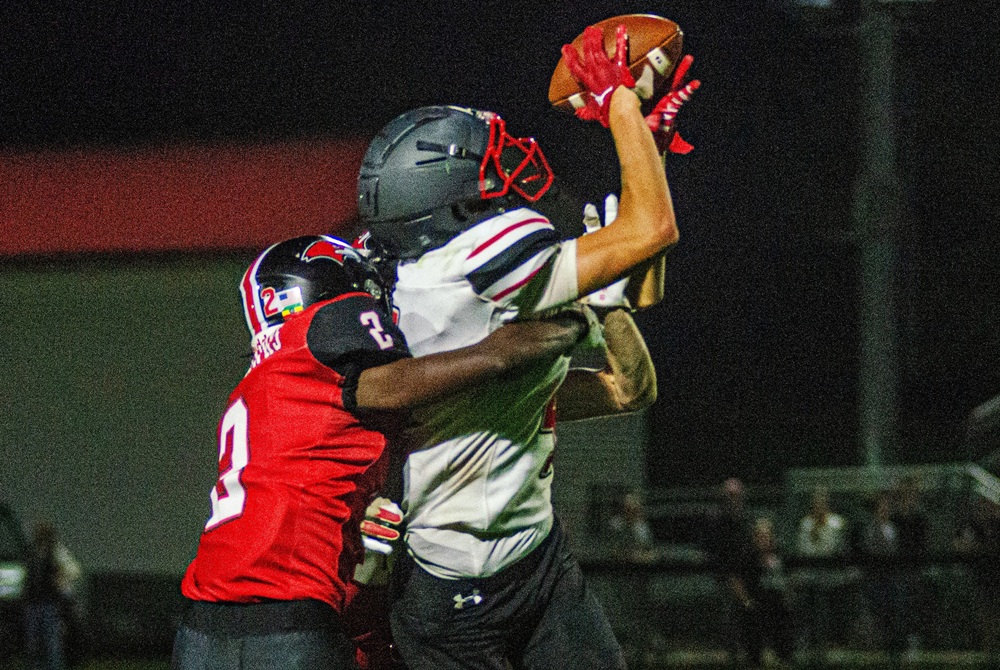
Usually Called On to Contain Buzz, Rockafellow Ready to Make More Noise as Perry's Top Target
By
Geoff Kimmerly
MHSAA.com senior editor
August 21, 2026
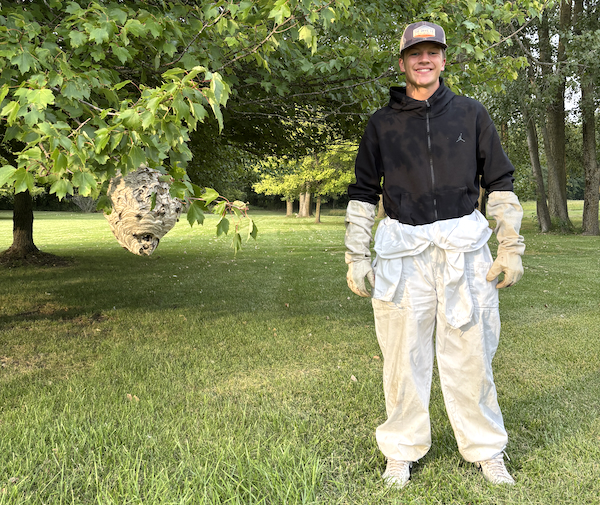
PERRY – Two nests already were packed away in the back of his vehicle when Alex Rockafellow rolled up at 9:45 p.m. under an impressive find – a basketball-sized sphere hanging from a single thin branch over a driveway and filled with black and white-lined bald-faced hornets.
 While most of us surely would have considered removing the nest daunting, the Perry senior saw an easy task compared to his usual searching around in the dark for a nest of insects he doesn’t want to startle. With the nest out in the open, all he had to do was snap the branch, drop the nest and its hundreds or hornets into an open pillowcase, and move on to the next collection.
Rockafellow spent five or six nights a week this summer driving around mid-Michigan working for the family business, Rock’s Free Yellow Jacket & Hornet Removal, which contains and takes away yellow jacket and hornet nests for free and sends the insects off to laboratories in Washington and Idaho where their venom is extracted to create immunotherapies to treat allergy patients.
That’s obviously not the typical high schooler summer job – and surely it’s unique among all-state football receivers and MHSAA record-holders. But he enters this season as all three, having earned all-state honorable mention from the Detroit News last fall and after tying the record for longest reception with a 99-yarder from teammate Zach Miller.
“I’ve taken some of my teammates on a few (nest) runs before. They think it’s a great time, and it’s really great getting to know each other,” said Rockafellow, a 6-foot-1, 170-pound pass catcher who reeled in 47 total for 882 yards and seven touchdowns as a junior. “Just looking for the nests, it’s really fun, (and) it’s cool to have two people looking for it. One time I took my buddy Miles, and he was the one who found the nest, and he was pretty surprised. He was like two feet from the nest when he found it.”
Opening night is a week away for 600 football teams across Michigan, and preseason practice the last few weeks has allowed Rockafellow to step away from his nighttime insect runs. Tales from his summer vacation are fascinating on their own, but the story of his climb the last five years from being uninterested in football to becoming a college prospect has its share of riveting details as well.
 Rockafellow was an eighth grader during the fall of 2022, a quiet kid mostly hanging out at home “probably solving Rubik’s Cubes or reading books” and not nearly physically active enough for his dad Travis’ liking.
Alex had no interest in playing football, but Travis – who with wife Amy teaches in the Perry district – decided to reach out to a past student who was now serving as a middle school football coach. The middle school team at the time had 11 players – seventh and eighth graders combined – so Alex joined, giving the Ramblers 12 and some of his teammates a chance to take a breath.
He enjoyed that season enough to play again, entering high school a notable 6-foot tall but also just 123 pounds. He liked catching passes, didn’t love tackling, and so football remained just something to do during the fall – until the end of his sophomore season, when he moved up to varsity, and it was like he’d been stung (in a good way).
“I got a little taste of what it was like to play varsity, and I loved it,” Rockafellow recalled. “After that … (I) was just wanting more of it.
“(Football is) like an art. It’s just beautiful to watch it and see the plays unfold. Just understanding how to run routes against different defenders, where they are, and utilizing their leverage, how to attack that off the ball and how I’m going to break down.”
Intensely pursuing his role as artist, Rockafellow became a tireless worker, often found on Perry’s football field during the offseasons running routes by himself, even during breaks in winter weather. Despite suffering a broken collarbone at the end of that sophomore season, and then a busted wrist during basketball that winter, Rockafellow dedicated himself. It was during one of those football field training sessions before last spring when football coach Steve Bentley – also the school’s longtime and successful track & field coach – proposed Rockafellow give that sport a try. Over April and May, Rockafellow cut nearly two seconds off his 200 time, added four inches to his high jump and ran on the Ramblers’ 800 relay.
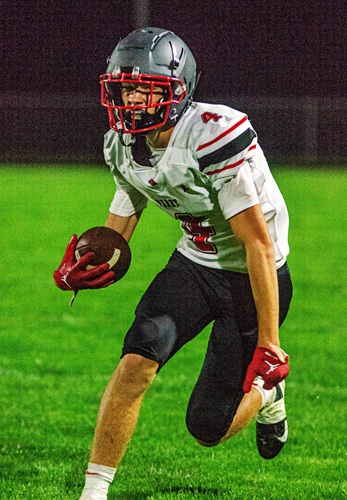
He’s hoping the improvements he picked up in running mechanics pay off on the football field. Another bonus: His big numbers from last fall – piled up almost entirely against double teams – came mostly on passes from now-senior quarterback Tyger Whitbeck.
They are two of only 16 players on the Perry varsity. But there are 25 players on the Ramblers’ JV, and Rockafellow’s commitment provides an example that may continue to pay off after he’s moved on.
 “He’s the sort of kid who is setting the foundation. He doesn’t care about any of the individual stuff or whatever. The only time he cares about that is when it can help him get to the next level,” Bentley said.
Rockafellow has been generating interest among Division II football programs and been offered 2027 roster spots by four Division III teams. “Courtney (Hawkins) is a friend of mine, at Michigan State, and we went and did some hand-to-hand stuff off the line of scrimmage with him, and (Alex) absorbs everything,” Bentley noted. “It’s almost to the point where it looks like he’s not paying attention to you, and he’s thinking of five different things on how he can apply what you just told him.”
Rockafellow also carries a 3.9 grade-point average, so maybe entomology is in his future?
Actually, he’s hoping to follow in the footsteps of his dad, a physical education teacher at Perry’s upper elementary school who Alex has watched impact students in a way he’d like to continue – like when Travis secured a grant to purchase mountain bikes and taught kids how to ride them.
“We’ve never been those parents to say ‘you’re going to do this, we want you to do this.’ He’s gone above and beyond what we’ve expected from him,” Travis Rockafellow said. “The best way to describe Alex is he gets himself in the right place in the right time. He puts himself out there. I was never that confident and outgoing, but to watch him make the transformation from a shy kid to this, he’s exceeded my expectations, and I’m really proud of him.”
Alex said his future could also include permanently adding a third generation to Rock's removal service. As a sweat bee darted around his helmet Monday, he didn’t seem to notice. He’s been helping out his dad and grandfather since he was 5, and the eight or so stings he received this year haven’t hurt like they used to when he was younger.
Rockafellow also will leave his mark as one of the all-time top receivers at Perry, but would love to be remembered in a less measurable way. Despite being few in numbers, the Ramblers this season are a close-knit group, and he’s plenty confident they’ll improve on their one win from a year ago.
“I would love to be just a different kind of team, one that hates losing more than they love winning,” Rockafellow said. “Just trying to be our best and fighting for everything we can get.”
 Geoff Kimmerly joined the MHSAA in Sept. 2011 after 12 years as Prep Sports Editor of the Lansing State Journal. He is a senior editor of MHSAA.com's editorial content and has served as MHSAA Communications Director since January 2021. Contact him at [email protected] with story ideas for the Barry, Eaton, Ingham, Livingston, Ionia, Clinton, Shiawassee, Gratiot, Isabella, Clare and Montcalm counties.
PHOTOS (Top) Perry’s Alex Rockafellow hauls in a pass last season while closely covered. (Middle) Rockafellow prepares to collect a nest Friday, despite nearly being stung. (Below) Rockafellow makes a move up field, also last season. (Photos courtesy of the Rockafellow family.)
Football Fridays: Welcome to Our House
October 27, 2017
The latest issue of "benchmarks" focused on the nation's most participated in and attended high school sport, football, and efforts to keep Fridays reserved for games at the high school level. Below is an opening editorial by MHSAA Executive Director Jack Roberts, followed by the magazine's cover story published earlier this fall.
By John E. “Jack” Roberts
MHSAA Executive Director
There is no less opportunity to help student-athletes mature into positive people in one sport than another or on one day or night of the week compared to others. That is an unshakable truth of educational athletics.
But that truth has not diminished the efforts of the Michigan High School Athletic Association, time and again for decades, to protest encroachment on Friday night high school football by both professional and college sports. The reasons go far beyond football and Friday nights.
Done right, as it very often is in very many Michigan communities, Friday night is a festival that engages far more than the football team and its fans. It is a forum for showcasing a variety of school activities:
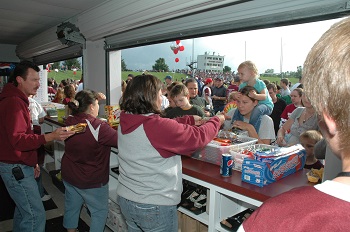
• A volleyball-football doubleheader with a community barbeque in between.
• A cross country run starting and/or ending at the football stadium with the roar of the crowd.
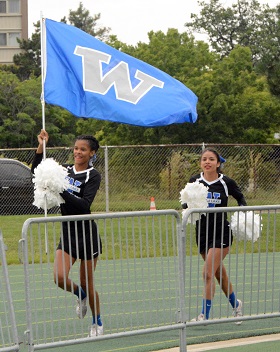
• A showcase for the marching band and a variety of other musical groups to perform, as well as cheerleaders and pompon squads.
• An opportunity for all school groups to provide information booths so students and parents may become aware of these student programs and initiatives.
• An opportunity to announce results of golf, tennis and swimming meets and provide the upcoming schedule of events, both athletic and non-athletic.
Done right, 30 to 70 percent or more of a school’s student body has an active part at most Friday night football games.
It has been said that the interscholastic athletic program provides a window to the entire school – to what it stands for and how it operates. If so, then Friday night football games are the front porch – a place for the entire school body and surrounding community to feel welcomed and to become more engaged.
By Rob Kaminski
MHSAA benchmarks editor
At a time when so many everyday distractions, mediums and changing ideals tear at the fabric of a cohesive society, school sports still offers a huge slice of Americana that continues to bond neighbors and promote community like few others can: high school football on Friday nights.
And now, that, too, is being threatened. Once “the only game in town,” prep football lights shone brightest on local kids playing on nearby fields while generating business for merchants on Main Street and providing inexpensive family entertainment. Friday nights were reserved for high schools.
 In recent years, however, the lure of TV dollars led to a wave of universities which could not compete with the perennial powerhouses for exposure on Saturdays, shifting games to all nights of the week. For the most part, they steered clear of Fridays, respecting the hand that feeds their programs.
Not so anymore.
ESPN began to schedule and televise NCAA Friday night games in 2002, and last November things really hit home when the Big Ten announced a slate of games for Friday nights this fall.
Protecting Friday nights is paramount, and as the following illustrates, the MHSAA is not alone in its fight.
It’s difficult to project the effect that such scheduling will have on MHSAA football games, but to borrow an axiom from the go-to book of coaches quotes, it will be prudent to take things one play at a time, one week at a time.
“The Big Ten Conference and other collegiate leagues enjoy high school football within their shadows; but the foray into Friday nights can be problematic,” said MHSAA Executive Director Jack Roberts.
“With lengthier seasons which now reach 12 games – and 13 weeks if there is a bye week – the collegiate seasons extend well into postseason play for the MHSAA and other state associations. Clearly there is a concern when some traditional collegiate rivalries occupy the same dates as high school championships.”
It looked like things would become much worse this year. Originally, Michigan State was scheduled to play at Northwestern on Oct. 27, potentially keeping countless Green and White enthusiasts in front of their televisions during the most pivotal financial weekend of the fall for the MHSAA: the first Friday of the Football Playoffs.
That game was moved to Saturday due to “unintended consequences” had the game remained on Friday. Northwestern also had a Friday tilt against Maryland moved to a Saturday.
So, already things have changed since the first announcement of Friday games by the Big Ten last November.
While there are six Friday games on the Big Ten docket for this Fall, five were in September, including two on Labor Day weekend.
Labor Day Friday games have played out in the MHSAA’s back yard for quite some time, as MSU often hosted such season-opening contests. Those games, however, seldom created conflicts due to most high schools playing on Thursdays leading into the holiday weekend.
This year was no different, with 215 games involving MHSAA schools being played on Thursday, Aug. 31, compared to 58 on Friday, Sept. 1, and five on Saturday, Sept. 2.
Further, it should be noted that neither the University of Michigan nor MSU has a Friday night game this fall, largely because administrators at those schools voiced strong objections to hosting any of the Friday night contests.
Similar sentiments are shared throughout the league.
“I'm very concerned about (Friday night games),” said first-year Indiana University Head Coach Tom Allen at the Big Ten preseason media gathering this summer. “I'm not going to sit here and try and make a big issue in terms of what I think. My history as a high school coach for 15 years is strong. It's who I am, it's how I started, and it's been so many years.
"I think that's a special night. I don't like playing games on Friday night. I think that's high school night. It's not always my decision. But I'm not going to just not tell you what I believe.”
During a May conference involving administrators from Midwest high school associations and the Big Ten, several collegiate stakeholders voiced opinions favoring the high school spotlight on Friday nights.
 MSU Athletic Director Mark Hollis made it known that his school would agree to Friday nights only on Labor Day or Thanksgiving weekends. Michigan Head Coach Jim Harbaugh proclaimed to local radio stations that day that, “I'm for traditional Saturdays. Friday is for high school games.”
Decades ago, a million dollar offer by the NCAA to the National Federation of State High School Associations (NFHS) which would have allowed for televised collegiate games on Friday nights was turned down.
Additionally, the NFL is barred by law from televising games on Fridays and Saturdays from mid-September through mid-December to avoid conflict with high school or NCAA games.
The landscape began to change with the formation of the College Football Association, a group formed by many of the American colleges with top-level college football programs in order to negotiate contracts with TV networks to televise football games. It was formed in 1977 by 63 schools from most of the major college football conferences and also select schools whose football programs were independent of any conference.
By 1982, a CFA legal challenge led to a 1984 Federal court decision that dissolved the NCAA’s exclusive control over television rights, allowing athletic conferences, independent schools and others to bargain for contracts.
As games now run rampant across TV screens and weekly calendars like tumbleweeds in the wild, wild west, could there finally be enough backlash to lasso this runaway horse?
The American Football Coaches Association – comprised of coaches from high schools to the pro ranks – unanimously opined in January at its annual convention that the NCAA should refrain from scheduling Friday night contests.
AFCA Executive Director Todd Berry issued a strong statement at the winter meeting, saying, “It was unanimous among all levels of coaches that the AFCA is in support of protecting Friday night for our high schools. We recognize the impact of having college football games on Friday night for our spectators, along with those viewing on television, can be significant. The AFCA feels very strongly that Friday night should be protected, not just for football, because the revenues generated by those high school football game ticket sales impact everything at those high schools such as other sports and organizations.”
That rings true not only from school to school, but also across state associations around the country which, like the MHSAA, depend upon football tournament attendance as one of the main sources of income from which to fund other programs throughout the year.
While the Big Ten’s announcement to increase Friday night television appearances has just recently brought glaring attention to the subject here at home, the unpopular trend has been affecting areas around the country for years.
The year 2001 was a landmark year of sorts for collegiate football telecasts, when the Mountain West Conference, Conference USA and the Mid-American Conference sought to gain exposure by scheduling Friday night contests. While it was long after the deregulation of 1984 and faced opposition from larger conferences such as the SEC, there was no legal ground to stand on for conferences then wishing to ban Friday night telecasts.
Even the larger conferences then – in certain extenuating circumstances – began to utilize Friday nights as an option.
In 2003, the Michigan-Minnesota football game was moved to Friday night to avoid a potential conflict with Major League Baseball as the Minnesota Twins could have hosted a playoff game on that particular Saturday.
At the time, Big Ten Commissioner Jim Delaney said, “The Conference and the Administrators Council regret having to reschedule football games to a Friday night. The Big Ten continues to support the protection of Friday night as a traditional high school football playing date.”
 One year later, a high-profile contest between Florida State and Miami was moved to Friday night when several storms hit the area. The problem was no one from the universities or the Atlantic Coast Conference bothered to inform the Florida High School Athletic Association ahead of time.
“In our opinion, (the decision) demonstrates their complete lack of sensitivity to our high school athletic programs, many of which are reeling financially due to the effects of hurricanes Charley and Frances,” said then-FHSAA Commissioner Robert Hughes said. “Most of our schools depend on the revenue from home football games to fund their entire athletic programs throughout the school year. Now, we find out that our schools will have to compete for an audience with the primetime telecast of arguably the biggest college football game that will played this year in this state.”
After watching an increasing number of games fill the prime Saturday slots and spill onto other days of the week, the Big Ten decided to modify its “Fridays are for high schools” stance, embarking on a path that will last until at least 2022.
The news release accompanying the decision stated that the conference “appreciates the significance of high school football within the region and has worked to minimize the impact of this initiative by limiting the number of Friday night games. Overall, these games represent approximately six percent of Big Ten home games annually, and no institution will host more than one game in any given year.”
It’s that top-down communication that doesn’t sit well with those involved in high school sports, the very level that the colleges count on to supply the talent pool. In that regard, the Friday night collegiate games don’t make sense.
“We have so many more teams in the Big Ten, that trying to find those windows that allow you to get that exposure for the whole league is important,” MSU’s Hollis has told reporters.
It’s not just the college football power conferences that have an effect on high school gridirons. Any city or town which includes a college campus shares a similar fan base.
With the MAC playing on any given night of the week for the last couple of decades, high schools in those cities have tried to adjust. After mixed results, however, some schools are simply standing their ground.
“Both (Mt. Pleasant) Sacred Heart and Mt. Pleasant High have avoided the same night as CMU Football over the years,” said Mt. Pleasant Athletic Director Jim Conway. “As of this year, though, both schools have elected to not change schedules based on the CMU schedule. Altering our schedules over the years has had a great effect on the visiting teams and their fan base coming to our sites.”
Further south, Middle Tennessee State University plays rival Western Kentucky on the same Friday as the TSSAA state high school football quarterfinals this fall. Additionally, a home game with Marshall was moved to another Friday night.
“My belief is that college coaches want to keep Fridays for high school only. But they are going to play when TV tells you to,” local high school coach Kevin Creasy, whose team plays that night, said in a story from the Murfreesboro Daily News Journal. “If TV said to us they want us to play on Saturday, we would. College coaches don’t want to play on Friday, but they do want their team to be on TV.”
Yet, it will be difficult for prep players to watch prospective colleges when they are busy playing. It also will minimize the number of live looks afforded college coaches for their recruits.
SBNATION.com writer Alex Kirshner surmised in an article last fall that, “If high school coaches are unified in opposition to something, college football programs have little choice but to listen. Taking a stand against your own state’s high school coaches is a horrible recruiting strategy.
“Friday night games in September and October mean recruits typically can’t visit for college games, because they’re busy playing.”
For those fans who prefer the college game, travel would be more difficult on Fridays, and/or would force many to take time off work to make their destinations by kickoff, versus driving just a few miles to root for the local high school team.
In that regard, logistics favor the high schools when it comes to “butts in the seats.” But, the proliferation of television provides an ample excuse for those more inclined to click remotes rather than drive to games of any level.
 “Any diversion from the traditional Friday night football has a direct impact on high school game attendance. High-profile collegiate games clearly will allow people to sit home in comfortable climate and watch football. This is not good for local games,” Conway said.
Losing any number of spectators can be felt throughout athletic departments and booster clubs which count on fall Fridays as a main source of revenue for their overall programs. With most schools having just four or five home football games per year, it’s vital to make the most of them financially.
“When CMU plays on the same night here, it takes away some fundraising opportunities for some of our teams and Booster Clubs,” Conway said. “Obviously it puts our local fan base in a position where they have to decide which game to attend, but also many people who volunteer for our Booster Club and our event staff are paid to work on crews at CMU games. The result is both the high schools and CMU trying to replace game management personnel, as many of us work the high school events and CMU Football.”
Executive Director of the Michigan High School Football Coaches Association Larry Merx believes that in many cases the prep and collegiate followings are different, but agrees with Conway for those locations which share geographic boundaries.
“I think high school football fans will stay with the high school game,” Merx said. “But, especially in and near college towns, many high school fans have work or other support responsibilities related to college games and will have to make some decisions.”
Fridays also provided a special stage for thousands of contest officials across the country. For the vast majority, working a regular schedule of high school varsity football games is the reward for countless hours and preparation.
For the select few fortunate enough to reach higher levels in the avocation, college opportunities and pay will trump Friday nights every time.
There is a vast pool of officials capable of working each week, but the absence of such veteran officials results in missed training opportunities as a new crop of officials is brought forward. In football more than most sports, there are limited chances for live officials training outside the school season.
“I’ve done college games on Saturday and high school games on the same Friday,” said NFL back judge Tony Steratore in a recent Referee magazine story. “Many officials do this, but I have to tell you something, if you’re going to do this you have to bring your ‘A-game’ to Friday night as much as you bring it to Saturday. If you don’t, you’re doing yourself and the game a disservice. When it comes down to it, if you can’t guarantee both games are getting equal attention, then you have to choose one or the other.”
When the games are both on Friday it’s a no brainer for the official faced with the choice.
For spectators, the choice often isn’t as clear-cut. That’s where school sports leaders – from the NFHS to the state high school associations to athletic administrators and coaches – must continue to promote the grand scenes that take place right down the street from their neighbors on Friday nights in the fall.
Portrayed in that light, scholastic sports leaders have an easy product to sell.
“Local high school games bring complete amateurism to the sport of football,” Conway said. “The band plays while moms and dads pop the popcorn and grill the hot dogs. Good high school games last no more than two-and-a-half hours, which is preferred to the length of collegiate games.”
It’s the perfect mix for a Friday night in the fall.
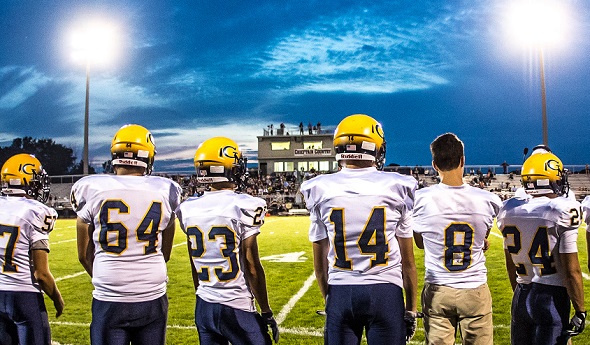
PHOTOS: (Top) Grand Ledge players man the sideline during a home game. (Top middle) The St. Johns' marching band takes the field. (Middle) Walled Lake Western cheerleaders run their flag around the stadium. (Middle below) Watervliet's concession stand feeds the crowd. (Below) Menominee's game provides the true scholastic vibe, complete with school buses parked in the background. (File photos.)