

Usually Called On to Contain Buzz, Rockafellow Ready to Make More Noise as Perry's Top Target
By
Geoff Kimmerly
MHSAA.com senior editor
August 21, 2026
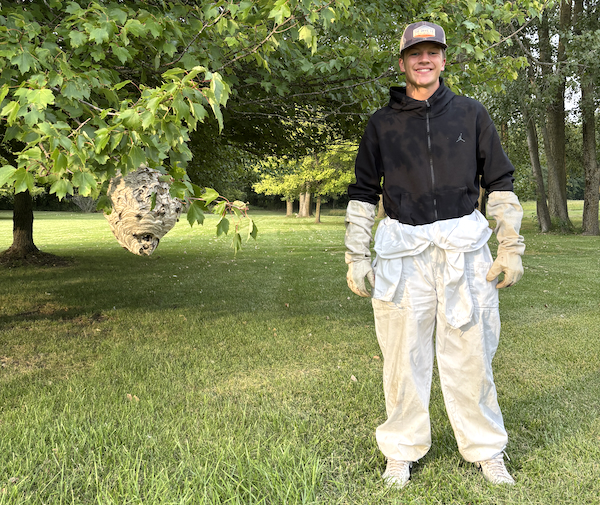
PERRY – Two nests already were packed away in the back of his vehicle when Alex Rockafellow rolled up at 9:45 p.m. under an impressive find – a basketball-sized sphere hanging from a single thin branch over a driveway and filled with black and white-lined bald-faced hornets.
 While most of us surely would have considered removing the nest daunting, the Perry senior saw an easy task compared to his usual searching around in the dark for a nest of insects he doesn’t want to startle. With the nest out in the open, all he had to do was snap the branch, drop the nest and its hundreds or hornets into an open pillowcase, and move on to the next collection.
Rockafellow spent five or six nights a week this summer driving around mid-Michigan working for the family business, Rock’s Free Yellow Jacket & Hornet Removal, which contains and takes away yellow jacket and hornet nests for free and sends the insects off to laboratories in Washington and Idaho where their venom is extracted to create immunotherapies to treat allergy patients.
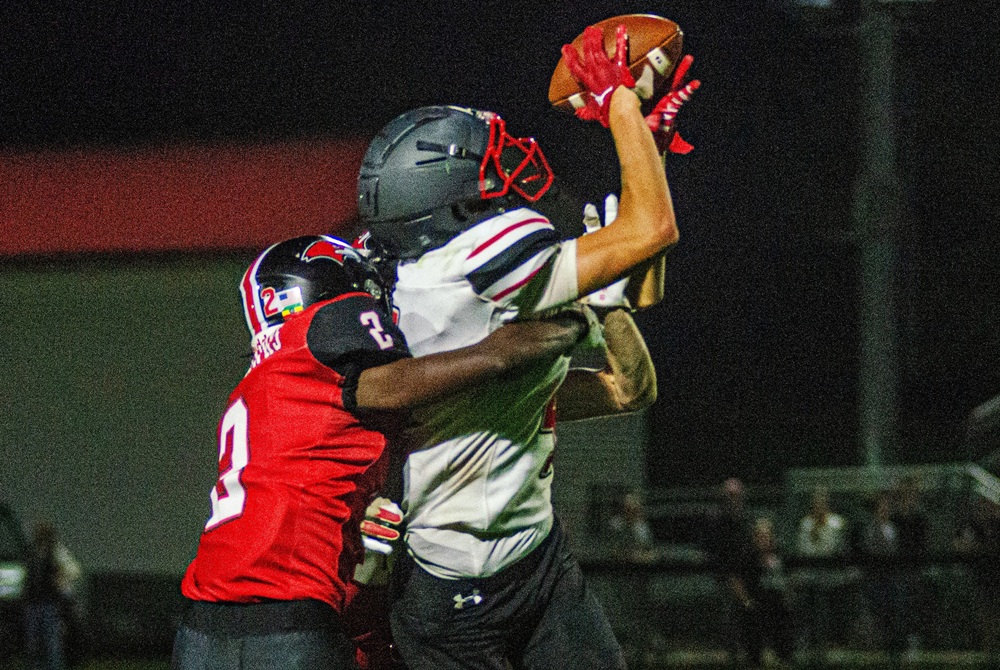
That’s obviously not the typical high schooler summer job – and surely it’s unique among all-state football receivers and MHSAA record-holders. But he enters this season as all three, having earned all-state honorable mention from the Detroit News last fall and after tying the record for longest reception with a 99-yarder from teammate Zach Miller.
“I’ve taken some of my teammates on a few (nest) runs before. They think it’s a great time, and it’s really great getting to know each other,” said Rockafellow, a 6-foot-1, 170-pound pass catcher who reeled in 47 total for 882 yards and seven touchdowns as a junior. “Just looking for the nests, it’s really fun, (and) it’s cool to have two people looking for it. One time I took my buddy Miles, and he was the one who found the nest, and he was pretty surprised. He was like two feet from the nest when he found it.”
Opening night is a week away for 600 football teams across Michigan, and preseason practice the last few weeks has allowed Rockafellow to step away from his nighttime insect runs. Tales from his summer vacation are fascinating on their own, but the story of his climb the last five years from being uninterested in football to becoming a college prospect has its share of riveting details as well.
 Rockafellow was an eighth grader during the fall of 2022, a quiet kid mostly hanging out at home “probably solving Rubik’s Cubes or reading books” and not nearly physically active enough for his dad Travis’ liking.
Alex had no interest in playing football, but Travis – who with wife Amy teaches in the Perry district – decided to reach out to a past student who was now serving as a middle school football coach. The middle school team at the time had 11 players – seventh and eighth graders combined – so Alex joined, giving the Ramblers 12 and some of his teammates a chance to take a breath.
He enjoyed that season enough to play again, entering high school a notable 6-foot tall but also just 123 pounds. He liked catching passes, didn’t love tackling, and so football remained just something to do during the fall – until the end of his sophomore season, when he moved up to varsity, and it was like he’d been stung (in a good way).
“I got a little taste of what it was like to play varsity, and I loved it,” Rockafellow recalled. “After that … (I) was just wanting more of it.
“(Football is) like an art. It’s just beautiful to watch it and see the plays unfold. Just understanding how to run routes against different defenders, where they are, and utilizing their leverage, how to attack that off the ball and how I’m going to break down.”
Intensely pursuing his role as artist, Rockafellow became a tireless worker, often found on Perry’s football field during the offseasons running routes by himself, even during breaks in winter weather. Despite suffering a broken collarbone at the end of that sophomore season, and then a busted wrist during basketball that winter, Rockafellow dedicated himself. It was during one of those football field training sessions before last spring when football coach Steve Bentley – also the school’s longtime and successful track & field coach – proposed Rockafellow give that sport a try. Over April and May, Rockafellow cut nearly two seconds off his 200 time, added four inches to his high jump and ran on the Ramblers’ 800 relay.
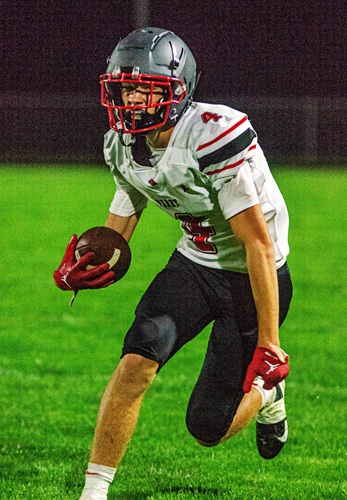
He’s hoping the improvements he picked up in running mechanics pay off on the football field. Another bonus: His big numbers from last fall – piled up almost entirely against double teams – came mostly on passes from now-senior quarterback Tyger Whitbeck.
They are two of only 16 players on the Perry varsity. But there are 25 players on the Ramblers’ JV, and Rockafellow’s commitment provides an example that may continue to pay off after he’s moved on.
 “He’s the sort of kid who is setting the foundation. He doesn’t care about any of the individual stuff or whatever. The only time he cares about that is when it can help him get to the next level,” Bentley said.
Rockafellow has been generating interest among Division II football programs and been offered 2027 roster spots by four Division III teams. “Courtney (Hawkins) is a friend of mine, at Michigan State, and we went and did some hand-to-hand stuff off the line of scrimmage with him, and (Alex) absorbs everything,” Bentley noted. “It’s almost to the point where it looks like he’s not paying attention to you, and he’s thinking of five different things on how he can apply what you just told him.”
Rockafellow also carries a 3.9 grade-point average, so maybe entomology is in his future?
Actually, he’s hoping to follow in the footsteps of his dad, a physical education teacher at Perry’s upper elementary school who Alex has watched impact students in a way he’d like to continue – like when Travis secured a grant to purchase mountain bikes and taught kids how to ride them.
“We’ve never been those parents to say ‘you’re going to do this, we want you to do this.’ He’s gone above and beyond what we’ve expected from him,” Travis Rockafellow said. “The best way to describe Alex is he gets himself in the right place in the right time. He puts himself out there. I was never that confident and outgoing, but to watch him make the transformation from a shy kid to this, he’s exceeded my expectations, and I’m really proud of him.”
Alex said his future could also include permanently adding a third generation to Rock's removal service. As a sweat bee darted around his helmet Monday, he didn’t seem to notice. He’s been helping out his dad and grandfather since he was 5, and the eight or so stings he received this year haven’t hurt like they used to when he was younger.
Rockafellow also will leave his mark as one of the all-time top receivers at Perry, but would love to be remembered in a less measurable way. Despite being few in numbers, the Ramblers this season are a close-knit group, and he’s plenty confident they’ll improve on their one win from a year ago.
“I would love to be just a different kind of team, one that hates losing more than they love winning,” Rockafellow said. “Just trying to be our best and fighting for everything we can get.”
 Geoff Kimmerly joined the MHSAA in Sept. 2011 after 12 years as Prep Sports Editor of the Lansing State Journal. He is a senior editor of MHSAA.com's editorial content and has served as MHSAA Communications Director since January 2021. Contact him at [email protected] with story ideas for the Barry, Eaton, Ingham, Livingston, Ionia, Clinton, Shiawassee, Gratiot, Isabella, Clare and Montcalm counties.
PHOTOS (Top) Perry’s Alex Rockafellow hauls in a pass last season while closely covered. (Middle) Rockafellow prepares to collect a nest Friday, despite nearly being stung. (Below) Rockafellow makes a move up field, also last season. (Photos courtesy of the Rockafellow family.)
Football Kicks Off Again, 129 Years Later
By
Ron Pesch
MHSAA historian
August 25, 2017
Buried in the text on the fourth page of the Saturday, October 27, 1888, Detroit Free Press is a single, concise sentence bearing a minimum amount of detail.
“The Windsor foot ball team will play the Detroit High School team this afternoon at 3.”
To date, this is the earliest account of a Michigan high school playing the game of “foot ball.”
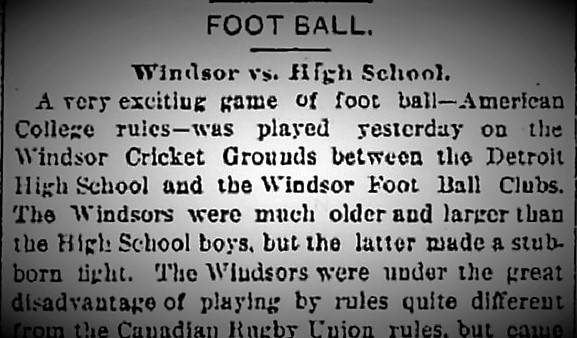
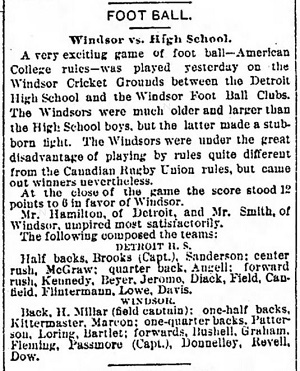
The following day’s paper provides only a few more details. The game was played on the Windsor Cricket Grounds. Despite the great disadvantage of playing under “American Football rules … quite different from the Canadian Rugby Union rules …” the “older and larger” Windsors won the contest, 12-6. Rosters for each squad were provided.
 Under American rules of the time, a touchdown was worth four points, with a conversion kick following a touchdown worth two additional points. At the time, a field goal counted for five points and a safety was worth two. The teams, however, may have agreed to a different scoring system before the contest.
Was this the first football game for a Michigan high school? That’s unlikely, but it is certainly among the earliest published accounts involving a prep game in the state.
It’s a fair assumption that foot ball, or some version of the game, was being played in neighborhoods before that time, at least based on the following statement found in the Jackson Citizen Patriot, dated June 18, 1867. Only days before, Dorrance & Goodwin’s, a store on Main Street in Jackson, had placed advertisements in the newspaper’s classifieds noting the pending arrival of this new product.
“Foot Ball – The pastime was inaugurated on our streets yesterday. Three or four balls were kept in motion all day on Main street alone. It affords no little amusement to the little boys, and is certainly a healthy exercise for the larger ones. It’s all right as long as no windows are broken or horses scared. Both calamities were barely escaped scores of times during the day.”
Rutgers and Princeton are credited with playing the first college football game in 1869. A decade later, in 1879, the University of Michigan established a football team.
Detroit High School played a number of games in 1888, besides the Windsor match, including a contest with the Tappen School from the Corktown area of Detroit. Played at the Detroit Athletic Club grounds on the afternoon of Thursday November 15, a final score was not mentioned in the following day’s Free Press.
For those unfamiliar with the sport, an account of the University of Michigan versus Detroit Athletic Club contest that appeared in the November 18 Free Press served as a fine introduction to the game, and the determination behind securing “possession of a leather-covered foot ball.”
“It was very interesting to see one speedy young man, after a desperate struggle in which the spectators fully expected to see him lose an arm or a leg, get away from his captors and start like a deer, with eight or ten of the opposite side in full pursuit. He is overtaken and the leader of the pursuing party springs upon the back of the man with the inflated trophy, bearing him to the ground with a dull thud … It is also an inspiring sight to see a fleet-footed player seize the ball and run at full speed in the direction of the goal of his opponents. Then a wing-footed opponent cuts across to intercept him, makes a flying leap, grasps the fugitive around the neck or waist and both go to grass with a suddenness and velocity that transforms them into human wheels …
 “While one unaccustomed to foot ball will naturally be startled by some of the acrobatic feats, still it is impossible to watch the game for any length of time without a tingling of the blood and holding of the breath. It is most intensely exciting, continuous in action and replete with fine points of play.
“It may be explained that the goals in a foot ball game are set at a distance of 330 feet from each other. The goal is made by placing two pieces of scantling twenty feet long upright in the ground, eighteen and one-half feet apart. Another piece runs midway horizontally between the uprights, and the ball must go over the horizontal piece and between the uprights to count a goal. There are eleven men on each side and the object is, of course, to get the ball through the goal of the other. The time of game is an hour and a half each side playing forty-five minutes from each goal, with an intermission of ten minutes between halves.”
A player who ran over an opponent’s goal line, “with the ball and touched it down” was then entitled to “bring the ball in front of the goal and attempt to kick it through”…
Among those playing for the Athletic Club squad that day was “little Hugh Brooks (captain) of the high school team.” Eligibility rules for players would evolve over time.
On Saturday, November 24, Detroit High School squared off for the first of two contests with Ann Arbor High School, this one at the Detroit Athletic Club grounds. Admission to the 2:45 p.m. contests was 25 cents. A crowd of around 300 watched “an exciting illustration of how Rugby foot ball is played. The exhibition by the Ann Arbor boys was considerably better than that of the Detroiters,” noted the Free Press, “the result of that being that Detroit’s banners have been kicked into the dust.”
Ann Arbor returned home with a 12-0 victory.
A second game with Ann Arbor was quickly scheduled.
In between, on Thursday, November 29, the Detroit High School squad played the Athletic Club before a crowd of about 200.
 “While the Athletics won by 12 to 0, still their playing was very loose, probably the result of over confidence. The Athletics will have to rid themselves of this by Saturday or the Albions will make short work of them.”
A large crowd gathered in the drizzling rain in Ann Arbor on Saturday, December 8, for what appears to be the final contest of the 1888 season for the high school teams of Detroit and Ann Arbor.
“It was a fine game. (Captain) Brooks, McGraw and Wisner, for Detroit, and Jewett, Diggert, Dupont, and Rathbone for Ann Arbor, made fine plays for their respective sides.” The result was an 8 to 2 win, and redemption, for the Detroit squad.
Today, 129 years later, “football” has seen wild expansion, numerous rule changes, and huge advancement in equipment worn when compared to those pioneer days of the sport. In 2017, more than 1 million individuals will suit up for high school teams across the United States. In Michigan alone, more than 36,000 participate in prep football.
And our state’s original programs live on. On Friday, Detroit Central opened its season with a win over Detroit Loyola. Ann Arbor High School, renamed Ann Arbor Pioneer in the late 1960s, fell in its Friday opener to Muskegon.
Welcome to another season of America’s favorite pastime.
 Ron Pesch has taken an active role in researching the history of MHSAA events since 1985 and began writing for MHSAA Finals programs in 1986, adding additional features and "flashbacks" in 1992. He inherited the title of MHSAA historian from the late Dick Kishpaugh following the 1993-94 school year, and resides in Muskegon. Contact him at [email protected] with ideas for historical articles.
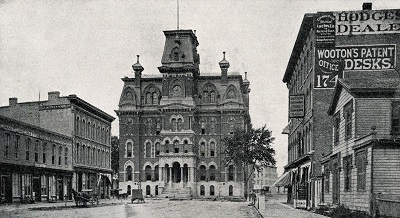
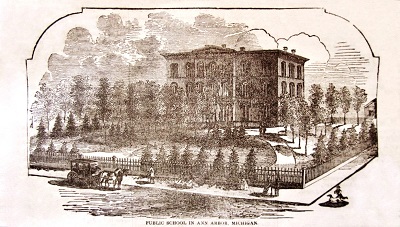
PHOTOS: (Top) The Detroit Free Press included brief coverage of the first "reported" game on Oct. 28, 1888. (Middle) When Michigan’s state government moved from Detroit to Lansing in 1847, the old Capitol building was re-opened as the Detroit’s first city high school in 1863. To better accommodate Detroit’s growing population, the old two-story structure was remodeled into a four-story building, unrecognizable to most. The school served the city well until January 1893, when it burned to the ground. (Below) Erected in 1856 at the cost of $27,000, Ann Arbor High School at State and Huron (now site of the North Quad of the University of Michigan) was destroyed by fire in 1904. (Photos courtesy of Ron Pesch.)