

Wassink, Sailors Take Back Championship
November 28, 2014
By Geoff Kimmerly
Second Half editor
DETROIT – The first time Jon Wassink led Grand Rapids South Christian to Ford Field, he spent the 2012 MHSAA Division 4 Final on the sideline with a broken collarbone as his back-up took the team the rest of the way to a title.
Wassink brought the Sailors back to Detroit in 2013 – but they couldn’t keep pace with Marine City despite his three touchdown passes and two scoring runs.
Friday night against Lansing Sexton was Wassink’s last chance to be part of an MHSAA football champion – and play a physical part in a championship game win.
And he didn’t let it slip by. The Sailors' senior quarterback threw for 179 yards and three touchdowns and ran for 122 and another score as South Christian edged Sexton 28-27 for its second Division 4 title in three seasons.
Oh, and Wassink also had four tackles and an interception from his defensive back spot and averaged 39.8 yards on six punts.
“Two years ago when we won it, I was just happy for the team and the community. Part of me obviously wanted to play too, so that was really disappointing but (I was) really happy at the same time,” said Wassink, who was injured in the Semifinal win that season.
“(Last year) was the driving force behind our whole season. We just didn’t want to end our season like we did last year.”
But Sexton came so close to sending Wassink to Western Michigan University with another runner-up finish instead.
The Big Reds (13-1), undefeated on the way to their first MHSAA Final appearance, scored on the game’s opening drive, 2 minutes and 22 seconds into the first quarter.
South Christian (12-2) scored the next two touchdowns, and Sexton then answered. The Sailors took a 21-13 lead into halftime after a Wassink touchdown pass with seven seconds to go before the break and extended the advantage on his 68-yard touchdown run 13 seconds into the third quarter. But the Big Reds battled back with two more scores to pull within a point of the lead with 10:43 to play.
“They’re a scary team. They have all of those great athletes and big bodies,” South Christian coach Mark Tamminga said. “We knew going in they scored a lot of points during the second half and wear you down with all of those big bodies. Our kids just stepped up and made plays when they had to.”
 The first set of offensive plays didn’t result in a score – but burned 5:16 off the clock to give the Big Reds only 5:25 to work with as it drove to take the lead.
The second set of difference-making maneuvers actually came on the same play – and on defense. Sexton had a new set of downs at its 38-yard line when senior linebacker Sam Heyboer burst into the Big Reds' backfield for a 12-year sack. In the process he helped cause a fumble that was recovered by another senior linebacker, Nick Bosch.
But again, South Christian didn’t score – yet took an additional 2:13 off the clock before Wassink was stopped short on a fourth down run by Big Reds senior lineman Isaiah Brown. Only 1:35 remained, and Sexton could advance only 32 yards to its 39-yard-line before the clock ran out.
“Our defense had a heck of a goalline stand down there, and I’m proud of my kids. They fought hard against a really good football team,” Sexton coach Dan Boggan said. “We’re an outstanding football team ourselves, and it could’ve gone either way. I’m disappointed, but I’m not broken.”
Sexton allowed only 63 more second-half yards after Wassink’s long scoring run during the first half-minute of the third quarter. But Sexton also had three turnovers total, while the Sailors never turned over the ball, and missed an extra point after its final touchdown that would’ve tied the score. The Sailors also held a Sexton rushing attack featuring two 1,000-yard rushers to only 101.
Big Reds quarterback Malik Mack finished an outstanding varsity career with 224 yards and two touchdowns passing and another score on the ground. Both of his touchdown passes went to sophomore tight end Kahari Foy-Walton, and senior Rayshawn Wilborn added eight catches for 84 yards and eight tackles at linebacker.
Junior lineman Marshaun Blake had a game-high nine tackles and his teammates combined for six tackles for losses and three sacks. “They were one of the best, if not the best we played all year,” Wassink said. “Fast, physical, just really tough.”
Heyboer finished with two of his team’s three sacks and also caught one of Wassink’s three touchdown passes. Seniors Ryan Veenstra and Eric VanVoorst caught the others, and senior Geff Plasman finished his career with 80 more rushing yards to end up with 1,300 for this fall.
Wassink’s final numbers for his final season set the bar high for those who follow. Adding in his Ford Field heroics, Wassink finished with 1,426 yards and 18 touchdowns rushing and 2,494 yards and 28 touchdowns passing.
And he'll graduate as a two-time MHSAA champion – this time having had something to say about the final result.
“He’s been driven all year. This is what he wanted,” Tamminga said. “He felt he didn’t play the best here last year, and he wanted to go out with a state championship.
“What a tremendous athlete.”
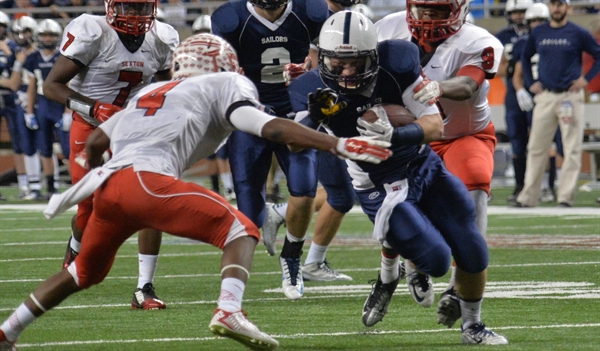
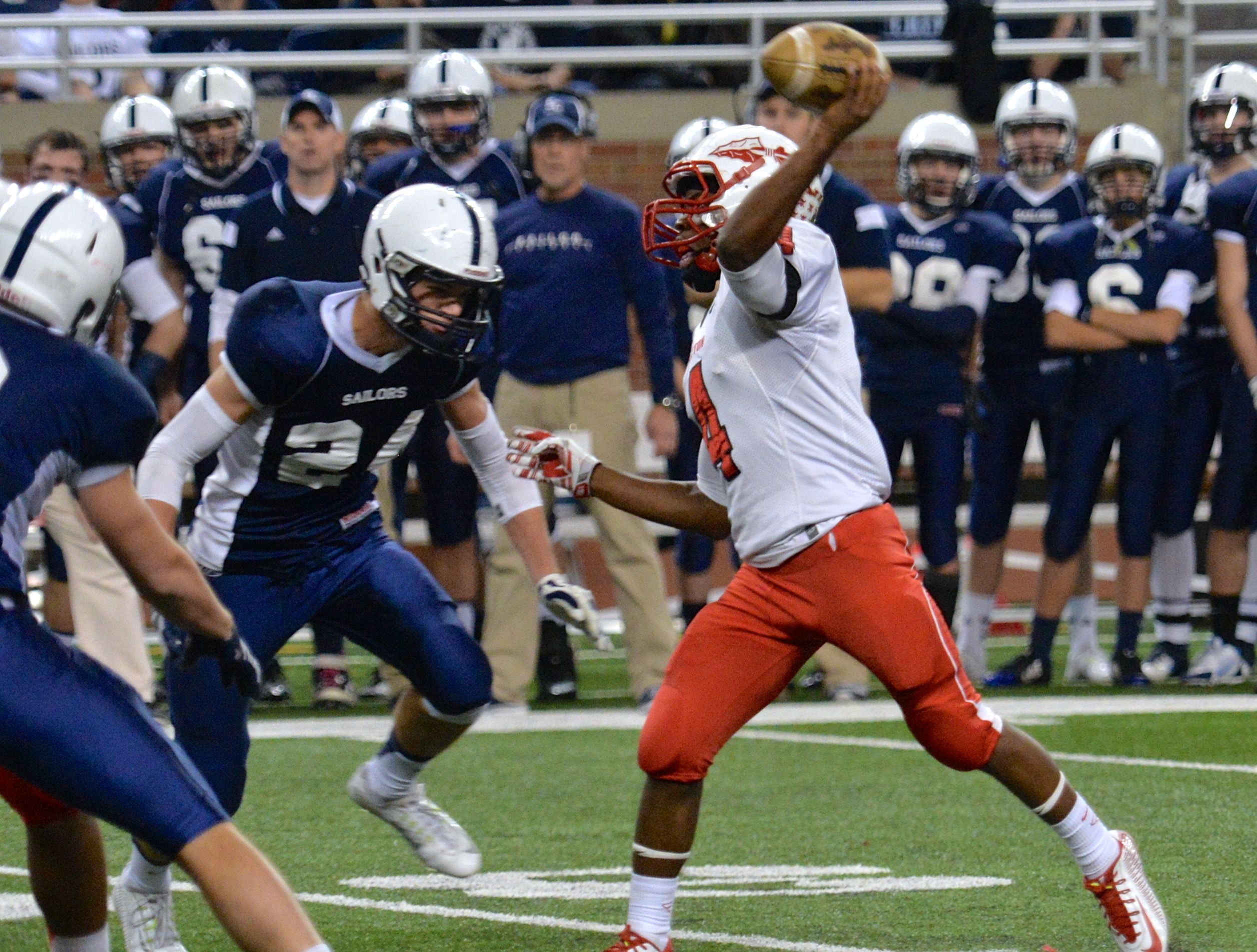
PHOTOS: (Top) Lansing Sexton’s Malik Mack (4) and Ardis Davis (9) work to wrap up a South Christian ball carrier Friday night. (Middle) Mack prepares to unload a pass with the Sailors’ Jake Wierenga applying pressure. (Click for action photos and team photos from Hockey Weekly Action Photos.)
VIDEO HIGHLIGHTS:
WASSINK'S OFF TO THE RACES - Grand Rapids South Christian scored touchdowns on its last possession of the first half and its first of the second half against Lansing Sexton. Here's the second TD, a 68-yard run by quarterback Jon Wassink. The TD and extra point that followed turned out to be the winning scoring sequence in a 28-27 Sailors win.
SEXTON TIGHTENS IT UP - Early in the fourth period, Lansing Sexton pulled within a point of Grand Rapids South Christian on a 29-yard pitch/catch/run play from Malik Mack to Kahari Foy-Walton. It was the second time the duo connected for a score in the game.
Watch the entire game and order DVDs by Clicking Here.
Finals Four: Ithaca Adds to Title Streak
November 29, 2013
By Geoff Kimmerly
Second Half editor
DETROIT – As the final seconds ticked down in Friday’s Division 6 Final, Ithaca’s players predictably began throwing four fingers into the air – signifying their fourth straight MHSAA title.
But the Yellowjackets could’ve chosen instead to press a thumb and fingertip together and form a zero – as in how many times they’ve lost during this greatest run in state football history.
Ithaca re-claimed a tie with Iowa City Regina (Iowa) for the nation’s longest active winning streak of 56 straight by climbing back from an early deficit to beat Clinton 41-22 at Ford Field.
The Yellowjackets’ run of perfection also is the longest in MHSAA history to occur entirely during the playoff era. Only Hudson, with 72 straight wins between 1968-75, put together a longer streak – and the Tigers’ included only one playoff win before they fell in the first-ever MHSAA Class C Final.
Also, only two teams have won more consecutive titles than Ithaca; East Grand Rapids and Farmington Hills Harrison achieved five straight apiece.
“We have a huge target on our back, and we all know that. As a team, we handle it pretty well,” said Ithaca senior quarterback Travis Smith, who finished his career 41-0 as a starter and as the only player who dressed for all four Finals wins.
“We left the whole winning streak for our community to play with. We don’t really think about it too much. We just focus on the task at hand, which is what our coaching staff says all the time. And I’m just so proud of my team and my friends.”
Despite the convincing final score, Ithaca did trail Clinton into the third quarter. Amazingly, the Yellowjackets trailed in all of the final four playoff games this fall.
Coach Terry Hessbrook, in his 10th season running the program and a former Ithaca standout himself, called three of the running backs his team faced during the run – Maple City Glen Lake’s Trevor Apsey, Negaunee’s Tyler LaJoie and Clinton junior Collin Poore – among the best Ithaca has ever faced. Then there was the more sizable Montrose, which provided the season’s greatest scare before falling to the Yellowjackets by a point in the Semifinal.
 “We’ve been behind four playoff weeks in a row. It just does not seem to faze them,” Hessbrook said of his players. “With the big heavy weight, burden, on their shoulders and the bulls eye and the winning streak and all that kind of stuff, I’ve got to believe that a lot of high school kids would crumble under that kind of pressure.
“These guys are going to go on to do amazing things in life because they’re special people.”
But it was Clinton (13-1) that appeared early to be special enough to end Ithaca’s streak. The Redskins capped their best season ever by making their first MHSAA Final.
“I came last year to watch Ithaca play. Just coming to play the game is totally different,” Clinton senior quarterback T.J. Baker said. “I knew I was nervous right when I stepped on the first. It was just crazy to play in this game. But at the same time, it was fun. Our community has never been here before, and it was just a fun game to play in.”
After Ithaca jumped to a 14-0 lead, Clinton bounced back with a Poore 18-yard touchdown run and an 86-yard punt return score by sophomore Mathew Sexton.
That seemed to nudge Ithaca’s offense – which finished this season with 710 points, third most in MHSAA history. Smith threw the second of his four touchdown passes to give Ithaca back the lead heading into halftime, and followed another Poore score at the start of the third quarter with two more scoring passes and a scoring run.
Smith also returned an interception 30 yards for a touchdown during the first quarter, giving him a hand in all six Ithaca scores. He finished his high school career with an MHSAA record 104 touchdown passes, and in this game 123 yards rushing and 247 passing.
“He lived up to his billing,” Clinton coach Scott McNitt said. “We did the best we could against him. And for two and a half quarters, we felt we were right there. And then it just got away from us a bit, and the momentum changed.
“I couldn’t be more proud of a group of young men who overcame a lot of adversity. To make it to the state finals, it’s unheard of where we come from.”
Hessbrook said everything he feared about Clinton seemed to go wrong for his team during the first half. Poore finished with 125 yards rushing and the team as a whole had 254, taking advantage of its perimeter speed to get around the corner on pitch sweeps and other similar runs for 208 of those yards during the first half.
But the Yellowjackets made the necessary adjustments during the third quarter, taking away that edge while bringing more pressure – Ithaca finished with 13 tackles for losses including seven sacks.
Senior Josh Hafner caught two of the scoring passes from Smith, and senior Eli Villalobos had six catches for 82 yards and a score. Senior Logan Hessbrook also had six catches, for 93 yards and a score, to follow last season’s performance when he stepped in for an injured Smith at quarterback and led the team to the title.
“You’re playing with your best friends you’ve grown up with your whole life. It’s the best group of friends I’ve ever had and could ask for,” said Hessbrook, who also is the coach’s nephew. “And the coaching staff and the community, it’s amazing.
“Ithaca’s a special place. Coach says that; everyone says that. And when I get out of college, I’m going to try to come right back to Ithaca, because it’s amazing to live there.”
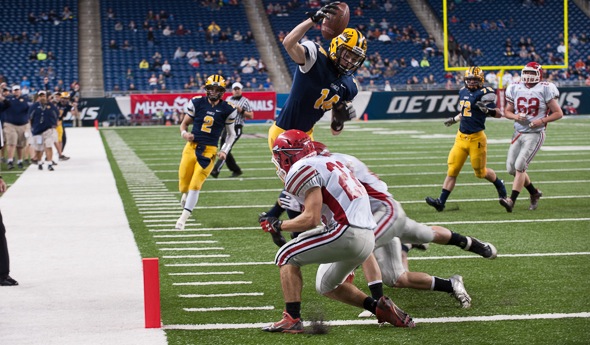
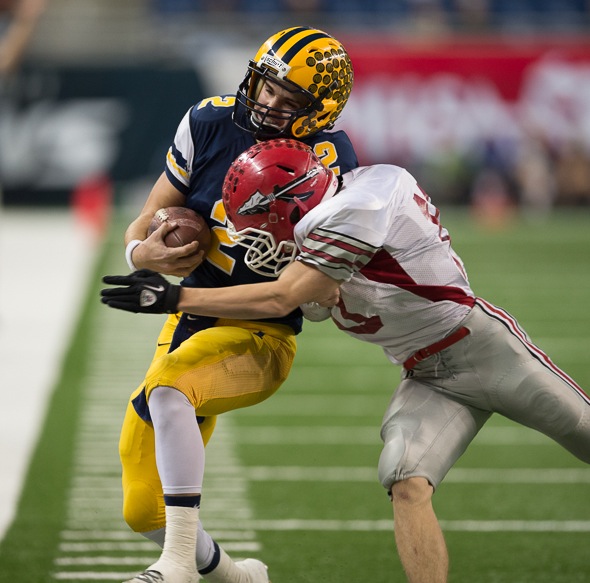
PHOTOS: (Top) Ithaca senior Josh Hafner (14) leaps over two Clinton defenders on the way to one of his two touchdowns. (Middle) Ithaca quarterback Travis Smith holds tight to the ball after a big hit from Clinton’s Mathew Sexton. (Click to see more from Terry McNamara Photography.)