

Wassink, Sailors Take Back Championship
November 28, 2014
By Geoff Kimmerly
Second Half editor
DETROIT – The first time Jon Wassink led Grand Rapids South Christian to Ford Field, he spent the 2012 MHSAA Division 4 Final on the sideline with a broken collarbone as his back-up took the team the rest of the way to a title.
Wassink brought the Sailors back to Detroit in 2013 – but they couldn’t keep pace with Marine City despite his three touchdown passes and two scoring runs.
Friday night against Lansing Sexton was Wassink’s last chance to be part of an MHSAA football champion – and play a physical part in a championship game win.
And he didn’t let it slip by. The Sailors' senior quarterback threw for 179 yards and three touchdowns and ran for 122 and another score as South Christian edged Sexton 28-27 for its second Division 4 title in three seasons.
Oh, and Wassink also had four tackles and an interception from his defensive back spot and averaged 39.8 yards on six punts.
“Two years ago when we won it, I was just happy for the team and the community. Part of me obviously wanted to play too, so that was really disappointing but (I was) really happy at the same time,” said Wassink, who was injured in the Semifinal win that season.
“(Last year) was the driving force behind our whole season. We just didn’t want to end our season like we did last year.”
But Sexton came so close to sending Wassink to Western Michigan University with another runner-up finish instead.
The Big Reds (13-1), undefeated on the way to their first MHSAA Final appearance, scored on the game’s opening drive, 2 minutes and 22 seconds into the first quarter.
South Christian (12-2) scored the next two touchdowns, and Sexton then answered. The Sailors took a 21-13 lead into halftime after a Wassink touchdown pass with seven seconds to go before the break and extended the advantage on his 68-yard touchdown run 13 seconds into the third quarter. But the Big Reds battled back with two more scores to pull within a point of the lead with 10:43 to play.
“They’re a scary team. They have all of those great athletes and big bodies,” South Christian coach Mark Tamminga said. “We knew going in they scored a lot of points during the second half and wear you down with all of those big bodies. Our kids just stepped up and made plays when they had to.”
 The first set of offensive plays didn’t result in a score – but burned 5:16 off the clock to give the Big Reds only 5:25 to work with as it drove to take the lead.
The second set of difference-making maneuvers actually came on the same play – and on defense. Sexton had a new set of downs at its 38-yard line when senior linebacker Sam Heyboer burst into the Big Reds' backfield for a 12-year sack. In the process he helped cause a fumble that was recovered by another senior linebacker, Nick Bosch.
But again, South Christian didn’t score – yet took an additional 2:13 off the clock before Wassink was stopped short on a fourth down run by Big Reds senior lineman Isaiah Brown. Only 1:35 remained, and Sexton could advance only 32 yards to its 39-yard-line before the clock ran out.
“Our defense had a heck of a goalline stand down there, and I’m proud of my kids. They fought hard against a really good football team,” Sexton coach Dan Boggan said. “We’re an outstanding football team ourselves, and it could’ve gone either way. I’m disappointed, but I’m not broken.”
Sexton allowed only 63 more second-half yards after Wassink’s long scoring run during the first half-minute of the third quarter. But Sexton also had three turnovers total, while the Sailors never turned over the ball, and missed an extra point after its final touchdown that would’ve tied the score. The Sailors also held a Sexton rushing attack featuring two 1,000-yard rushers to only 101.
Big Reds quarterback Malik Mack finished an outstanding varsity career with 224 yards and two touchdowns passing and another score on the ground. Both of his touchdown passes went to sophomore tight end Kahari Foy-Walton, and senior Rayshawn Wilborn added eight catches for 84 yards and eight tackles at linebacker.
Junior lineman Marshaun Blake had a game-high nine tackles and his teammates combined for six tackles for losses and three sacks. “They were one of the best, if not the best we played all year,” Wassink said. “Fast, physical, just really tough.”
Heyboer finished with two of his team’s three sacks and also caught one of Wassink’s three touchdown passes. Seniors Ryan Veenstra and Eric VanVoorst caught the others, and senior Geff Plasman finished his career with 80 more rushing yards to end up with 1,300 for this fall.
Wassink’s final numbers for his final season set the bar high for those who follow. Adding in his Ford Field heroics, Wassink finished with 1,426 yards and 18 touchdowns rushing and 2,494 yards and 28 touchdowns passing.
And he'll graduate as a two-time MHSAA champion – this time having had something to say about the final result.
“He’s been driven all year. This is what he wanted,” Tamminga said. “He felt he didn’t play the best here last year, and he wanted to go out with a state championship.
“What a tremendous athlete.”
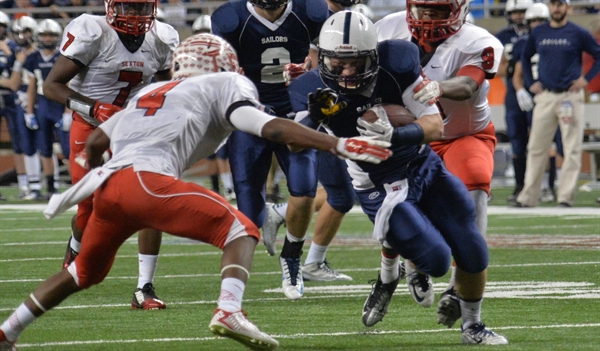
PHOTOS: (Top) Lansing Sexton’s Malik Mack (4) and Ardis Davis (9) work to wrap up a South Christian ball carrier Friday night. (Middle) Mack prepares to unload a pass with the Sailors’ Jake Wierenga applying pressure. (Click for action photos and team photos from Hockey Weekly Action Photos.)
VIDEO HIGHLIGHTS:
WASSINK'S OFF TO THE RACES - Grand Rapids South Christian scored touchdowns on its last possession of the first half and its first of the second half against Lansing Sexton. Here's the second TD, a 68-yard run by quarterback Jon Wassink. The TD and extra point that followed turned out to be the winning scoring sequence in a 28-27 Sailors win.
SEXTON TIGHTENS IT UP - Early in the fourth period, Lansing Sexton pulled within a point of Grand Rapids South Christian on a 29-yard pitch/catch/run play from Malik Mack to Kahari Foy-Walton. It was the second time the duo connected for a score in the game.
Watch the entire game and order DVDs by Clicking Here.
Drive for Detroit: Playoff R1 in Review
October 31, 2016
By Geoff Kimmerly
Second Half editor
Arguably the greatest comeback season in MHSAA football history came to an end during the first round of the playoffs this weekend.
But although Breckenridge's turnaround celebration is over, courtesy of Saginaw Nouvel, there are plenty of others that extended rebound runs for at least another week.
Redford Union, Adrian, Kent City and Norway are just a few which have experienced similar climbs this fall. Read about their latest steps and many more from the first week as we look at some of the most intriguing results from all nine divisions.
Division 1
Rockford 24, Hudsonville 7
The Rams (7-3) avenged their Week 9 loss to Hudsonville that cost Rockford the Ottawa-Kent Conference Red title outright and awarded the Eagles (8-2) a share. Rockford now plays Grandville – the third team to earn a share of the league title with the Week 9 result – in a District Final this week. Click for more from the Grand Rapids Press.
Also noted:
West Bloomfield 31, Bloomfield Hills 14 – The Lakers (6-4) just made the playoffs with an at-large bid but ended a dream season for Bloomfield Hills (9-1), which was undefeated during the regular season after going 1-8 in 2015.
Southfield Arts & Technology 24, Warren Mott 23 – The first-year Warriors (7-3) have added a first playoff win to a shared Oakland Activities Association Red title, while ending Mott’s best season in the last three at 7-3.
Clarkston 45, Lapeer 21 – The Wolves beat Lapeer 28-7 in Week 1 at Michigan Stadium and ended up responsible for two of three losses for the Lightning (7-3) this fall.
Detroit Cass Tech 35, Dearborn Fordson 7 – These teams had one loss between them coming in, but Cass Tech (10-0) will play for a seventh straight District title after handing Fordson (8-2) its second loss in three weeks.
Division 2
Traverse City Central 13, Traverse City West 12
A pair of field goals and the go-ahead extra point by Central kicker Gabe Pickett were difference makers as West wasn’t able to succeed in similar circumstances in the first playoff matchup ever between these rivals. The Trojans (9-1) scored their lone touchdown midway through the fourth quarter to add this victory to a 10-8 win over West (6-4) in Week 3. Click for more from the Traverse City Record-Eagle.
Also noted:
Fenton 49, Flint Carman-Ainsworth 19 – The Flint Metro League champ Tigers (8-2) won this matchup of title winners over the Saginaw Valley League Blue champ Cavaliers (6-4).
Oak Park 26, Detroit U-D Jesuit 17 – The Knights (7-3) bounced back from a Week 9 loss to hand the Cubs (6-3) their second defeat in three weeks.
Pinckney 28, Walled Lake Northern 17 – The Pirates (8-2) downed Northern (6-4) for the second straight week, this time to guarantee their best record since 1989.
Birmingham Brother Rice 35, Warren Cousino 16 – The Warriors (7-3) won their fourth straight and second in three weeks over a league champion, but the Patriots (8-2) can celebrate their best record since 2007 to go with the Macomb Area Conference Blue title.
Division 3
Redford Union 41, Warren Fitzgerald 34
This continues to be a banner season for Redford Union (7-3), which has its most wins since 2005, made its first playoff appearance since 2006, and now has its first playoff win in program history. Union scored the winning points with less than two minutes to play to add to its first winning season since 2007. Fitzgerald finished 8-2, its best record since 2008, and with its only other loss by two points to Madison Heights Madison in Week 7. Click for more from the Observer & Eccentric.
Also noted:
Coldwater 35, Battle Creek Harper Creek 14 – Harper Creek (7-3) may have won a share of the Interstate 8 Athletic Conference title, but in the end third-place league finisher Coldwater (8-2) took two games off the Beavers and will play for a District title.
Mason 35, Fowlerville 28 – What was supposed to be a rebuilding year for the Bulldogs (9-1) has turned into its most successful since 2011, while Fowlerville (7-3) enjoyed its best record since 2009.
Romulus 40, Trenton 14 – The Eagles (9-1) have made the playoffs three straight seasons, but this was their first playoff win since 1999; Trenton ended its third straight playoff season at 6-4.
Grand Rapids Christian 35, Zeeland West 32 – This was the kind of finish expected from traditional west side powers, with the Eagles (9-1) winning a ninth game for the first time since 2012 and West (7-3) suffering its earliest season end since not qualifying for the postseason in 2009.
Division 4
Marysville 46, St. Clair Shores South Lake 38
The Vikings (10-0) are enjoying their first double-digit wins season since 2000, but will continue to face also-undefeated Detroit Country Day this weekend only because they survived the pesky Cavaliers. South Lake (7-3), which claimed a share of the MAC Silver title this fall, stayed close throughout – but the MAC Gold champions hung on to earn a second District title game berth in three seasons. Click for more from the Port Huron Times Herald.
Also noted:
Escanaba 48, Whitehall 27 – The Eskymos (8-2) earned their first playoff win, since 2011 to give them eight total for the first time since 2009, while leaving Whitehall at 6-4 for the second straight season.
Allendale 35, Wyoming Kelloggsville 19 – The Falcons (8-2) have enjoyed a momentous two weeks, first earning a share of the O-K Blue title with a Week 9 win and this weekend downing O-K Silver champion Kelloggsville (8-2).
Flint Powers Catholic 20, Lake Fenton 19 – Powers (6-4) scored during the final seconds to move on to a third straight District Final and end Genesee Area Conference Red champion Lake Fenton’s season at 8-2, its best record since 2013.
Adrian 27, Grosse Ile 20 (OT) – The Maples (6-4) have enjoyed one of the state’s best rebound seasons as well, with this playoff victory adding to their first winning season since 2011; Grosse Ile also bounced back from 4-5 a year ago to finish 8-2, their best since 2012.
Division 5
Almont 28, Richmond 27
The upset of the week statewide arguably came in this Blue Water Area Conference rematch, as the Raiders avenged a 34-21 Week 6 loss to the champion Blue Devils. Almont (7-3) has advanced to a District Final three years in a row and now will face Algonac, the BWAC runner-up which beat the Raiders 14-7 in Week 2. Richmond (8-2) hadn’t lost since falling to Marysville on opening night. Click for more from the Port Huron Times Herald.
Also noted:
Remus Chippewa Hills 32, Clare 27 – The Warriors (9-1) made their third straight District Final (and earned a rematch with rival Reed City) by edging the Jack Pine Conference champion Pioneers (8-2).
Grand Rapids West Catholic 28, Lansing Catholic 6 – The reigning Division 5 champion Falcons (8-2) are on the road to start this playoffs, but didn’t seem to mind traveling to down Lansing Catholic (8-2) for the fourth straight postseason.
Dowagiac 28, Buchanan 25 – The Chieftains (7-3) guaranteed their best record since 2013 and will play for their first District title since 2011 after handing Buchanan (5-4) its second loss in three weeks.
Southfield Bradford 38, Brooklyn Columbia Central 33 – In their first playoff game ever, the Bulldogs (8-2) earned their first postseason win as well, ending the Golden Eagles’ second straight playoff run at 7-3.
Division 6
Kent City 20, Montague 19
The Eagles’ turnaround season just keeps getting better as well. They’ve gone from 1-8 in 2015 to 8-2 with their first playoff berth and win since 2001 after also clinching a shared Central State Activities Association Silver championship. Montague (7-3) ended its season with three losses by a combined 12 points after finishing second in the West Michigan Conference. Click for more from the Local Sports Journal.
Also noted:
Calumet 42, Boyne City 8 – The Copper Kings (9-1) added a ninth win for the first time since 2009 by holding Boyne City (6-4) to only 159 yards.
Montrose 52, Laingsburg 21 – The Rams (7-3) secured their most wins since 2013 by earning their fourth straight while handing Laingsburg (8-2) only its second defeat.
Napoleon 25, Michigan Center 24 – The Pirates stayed alive in their first playoff run since 2005 by edging Michigan Center (6-4) for their first playoff win since 2000.
Detroit Central Collegiate 12, Byron 7 – The Trail Blazers have bounced back from a 1-4 start to move to 6-4 for the fourth time in five seasons; Byron finished its fifth playoff season over the last six at 7-3.
Division 7
Gobles 50, Lawton 12
Count Gobles among the handful that have battled back from a regular-season loss to claim a playoff rematch. The Tigers (8-2) had fallen to Lawton 31-21 in Week 5 and actually had dropped four straight to the Blue Devils (8-2). Gobles now will play for its first District title since 2005.
Also noted:
Iron Mountain 46, Gwinn 32 – The Mountaineers (8-2) continued their best season since 2011 by ending the best for Gwinn (6-4) since 1999.
Unionville-Sebewaing 18, Cass City 14 – The Patriots have built from 1-8 in 2014 to 5-5 last fall and now 9-1 after defeating Cass City (6-4) for the second time this season by four or fewer points.
Concord 21, Springport 14 – A Week 6 loss to Springport cost Concord (8-2) the outright Big 8 Conference title, but this avenging ended the Spartans’ best season since 2011 at 7-3.
Detroit Loyola 45, Madison Heights Madison 12 – The Bulldogs (8-2) firmed up further their status as favorite on their side of the Division 7 bracket by eliminating the MAC Silver co-champ Eagles (6-4).
Division 8
Saginaw Nouvel 21, Breckenridge 6
The greatest turnaround in MHSAA playoff era history came to an end with Nouvel’s ousting of Breckenridge, which finished 9-1 and was undefeated during the regular season after not winning a game in 2015. No team dating to at least the first playoff season of 1975 had accomplished a winless-to-undefeated turnaround. The Panthers (7-3) held the Huskies to their fewest points this fall. Click for more from the Saginaw News.
Also noted:
Royal Oak Shrine 21, Fowler 14 – Shrine (8-2) earned a chance at its first District title since 2008 by handing Fowler (6-4) its first playoff-opening loss since 2010.
Clarkston Everest Collegiate 22, Waterford Our Lady 21 – Everest (8-2) set a program record for wins by avenging a three-point Week 6 loss to Our Lady (6-4).
Newberry 16, Gaylord St. Mary 14 – The Indians (8-2) held on for their first playoff win since 2004, ending St Mary’s first playoff season since 2009 at 6-4.
Norway 15, Iron River West Iron County 14 – The Knights (8-2) continued to put last year’s 2-7 into distant memory with their first playoff win since 2006.
8-Player
Engadine 38, Cedarville 30 (OT)
Their Week 7 meeting – a 52-42 Engadine win – was one of the top 8-player games statewide this season. So it made sense they’d follow with a classic. Engadine moved to 10-0 for the first time as an 11 or 8-player program after trailing by 14 points during the fourth quarter, and the Eagles also are now 3-1 against Cedarville (6-4) in playoff games over the last six seasons. Click for more from 9&10 News.
Also noted:
Portland St. Patrick 34, Camden-Frontier 28 – The Shamrocks (10-0) have won only two games by single digits this season, and becoming the latest opponent to make that push was not a bad way for Camden-Frontier (8-2) to end its first season of 8-player.
New Haven Merritt 52, Owendale-Gagetown 14 – Merritt (10-0) continued the best season of its five-year history with its first playoff win; the Mustangs handed Owendale-Gagetown (8-2) both of its losses this fall.
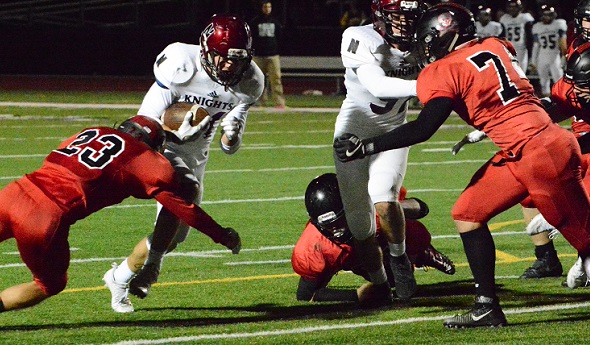
PHOTO: Pinckney defenders close in on a Walled Lake Northern ball carrier during Friday's Pirates win. (Photo by John Johnson.)