

Wassink, Sailors Take Back Championship
November 28, 2014
By Geoff Kimmerly
Second Half editor
DETROIT – The first time Jon Wassink led Grand Rapids South Christian to Ford Field, he spent the 2012 MHSAA Division 4 Final on the sideline with a broken collarbone as his back-up took the team the rest of the way to a title.
Wassink brought the Sailors back to Detroit in 2013 – but they couldn’t keep pace with Marine City despite his three touchdown passes and two scoring runs.
Friday night against Lansing Sexton was Wassink’s last chance to be part of an MHSAA football champion – and play a physical part in a championship game win.
And he didn’t let it slip by. The Sailors' senior quarterback threw for 179 yards and three touchdowns and ran for 122 and another score as South Christian edged Sexton 28-27 for its second Division 4 title in three seasons.
Oh, and Wassink also had four tackles and an interception from his defensive back spot and averaged 39.8 yards on six punts.
“Two years ago when we won it, I was just happy for the team and the community. Part of me obviously wanted to play too, so that was really disappointing but (I was) really happy at the same time,” said Wassink, who was injured in the Semifinal win that season.
“(Last year) was the driving force behind our whole season. We just didn’t want to end our season like we did last year.”
But Sexton came so close to sending Wassink to Western Michigan University with another runner-up finish instead.
The Big Reds (13-1), undefeated on the way to their first MHSAA Final appearance, scored on the game’s opening drive, 2 minutes and 22 seconds into the first quarter.
South Christian (12-2) scored the next two touchdowns, and Sexton then answered. The Sailors took a 21-13 lead into halftime after a Wassink touchdown pass with seven seconds to go before the break and extended the advantage on his 68-yard touchdown run 13 seconds into the third quarter. But the Big Reds battled back with two more scores to pull within a point of the lead with 10:43 to play.
“They’re a scary team. They have all of those great athletes and big bodies,” South Christian coach Mark Tamminga said. “We knew going in they scored a lot of points during the second half and wear you down with all of those big bodies. Our kids just stepped up and made plays when they had to.”
 The first set of offensive plays didn’t result in a score – but burned 5:16 off the clock to give the Big Reds only 5:25 to work with as it drove to take the lead.
The second set of difference-making maneuvers actually came on the same play – and on defense. Sexton had a new set of downs at its 38-yard line when senior linebacker Sam Heyboer burst into the Big Reds' backfield for a 12-year sack. In the process he helped cause a fumble that was recovered by another senior linebacker, Nick Bosch.
But again, South Christian didn’t score – yet took an additional 2:13 off the clock before Wassink was stopped short on a fourth down run by Big Reds senior lineman Isaiah Brown. Only 1:35 remained, and Sexton could advance only 32 yards to its 39-yard-line before the clock ran out.
“Our defense had a heck of a goalline stand down there, and I’m proud of my kids. They fought hard against a really good football team,” Sexton coach Dan Boggan said. “We’re an outstanding football team ourselves, and it could’ve gone either way. I’m disappointed, but I’m not broken.”
Sexton allowed only 63 more second-half yards after Wassink’s long scoring run during the first half-minute of the third quarter. But Sexton also had three turnovers total, while the Sailors never turned over the ball, and missed an extra point after its final touchdown that would’ve tied the score. The Sailors also held a Sexton rushing attack featuring two 1,000-yard rushers to only 101.
Big Reds quarterback Malik Mack finished an outstanding varsity career with 224 yards and two touchdowns passing and another score on the ground. Both of his touchdown passes went to sophomore tight end Kahari Foy-Walton, and senior Rayshawn Wilborn added eight catches for 84 yards and eight tackles at linebacker.
Junior lineman Marshaun Blake had a game-high nine tackles and his teammates combined for six tackles for losses and three sacks. “They were one of the best, if not the best we played all year,” Wassink said. “Fast, physical, just really tough.”
Heyboer finished with two of his team’s three sacks and also caught one of Wassink’s three touchdown passes. Seniors Ryan Veenstra and Eric VanVoorst caught the others, and senior Geff Plasman finished his career with 80 more rushing yards to end up with 1,300 for this fall.
Wassink’s final numbers for his final season set the bar high for those who follow. Adding in his Ford Field heroics, Wassink finished with 1,426 yards and 18 touchdowns rushing and 2,494 yards and 28 touchdowns passing.
And he'll graduate as a two-time MHSAA champion – this time having had something to say about the final result.
“He’s been driven all year. This is what he wanted,” Tamminga said. “He felt he didn’t play the best here last year, and he wanted to go out with a state championship.
“What a tremendous athlete.”
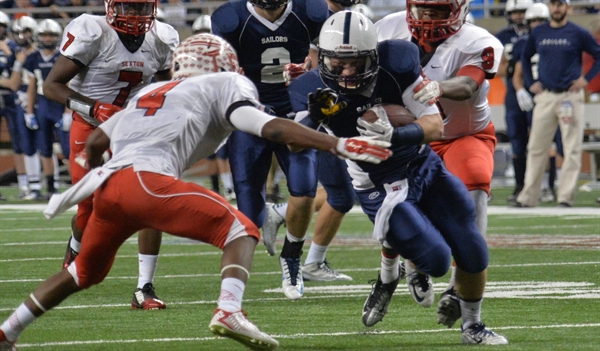
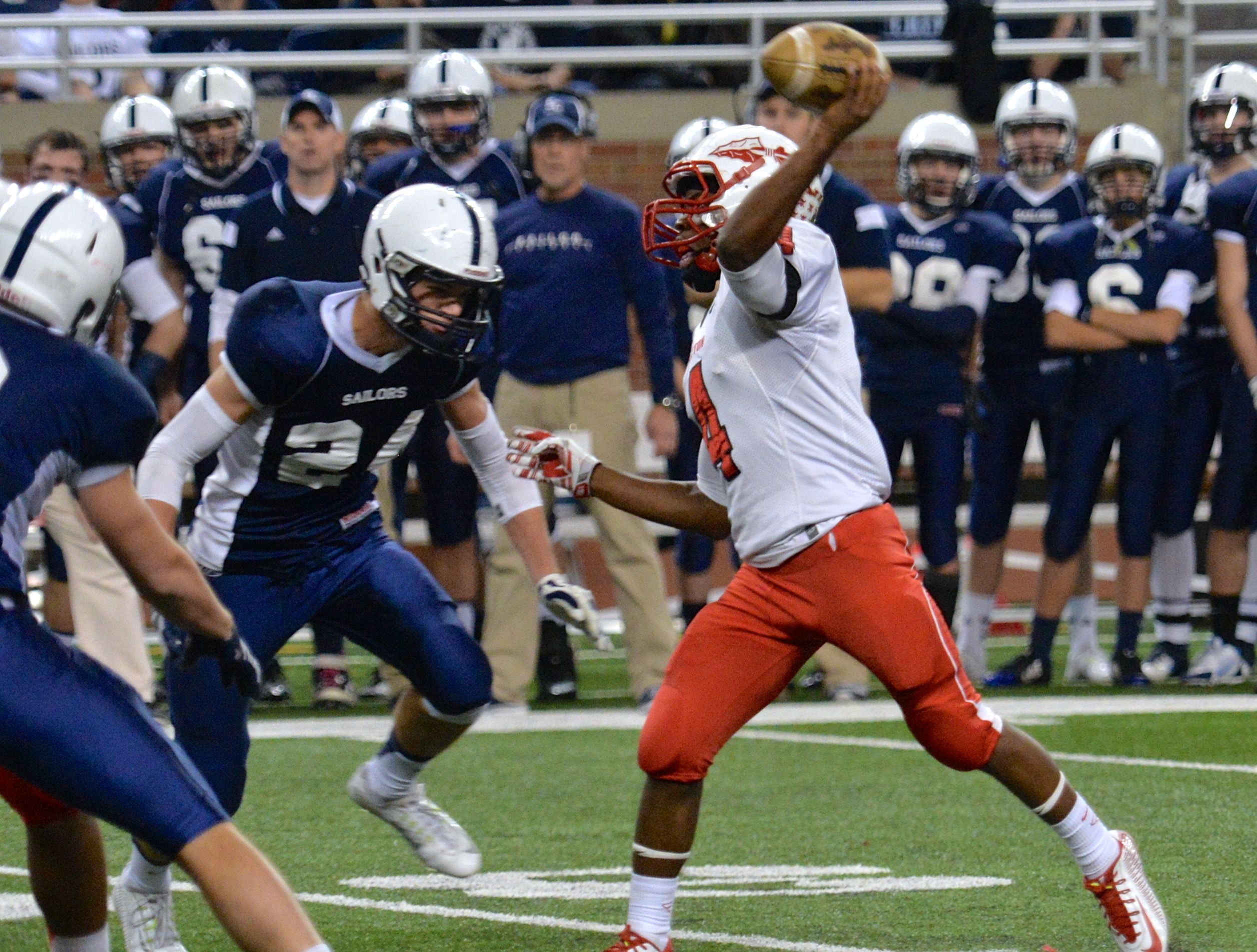
PHOTOS: (Top) Lansing Sexton’s Malik Mack (4) and Ardis Davis (9) work to wrap up a South Christian ball carrier Friday night. (Middle) Mack prepares to unload a pass with the Sailors’ Jake Wierenga applying pressure. (Click for action photos and team photos from Hockey Weekly Action Photos.)
VIDEO HIGHLIGHTS:
WASSINK'S OFF TO THE RACES - Grand Rapids South Christian scored touchdowns on its last possession of the first half and its first of the second half against Lansing Sexton. Here's the second TD, a 68-yard run by quarterback Jon Wassink. The TD and extra point that followed turned out to be the winning scoring sequence in a 28-27 Sailors win.
SEXTON TIGHTENS IT UP - Early in the fourth period, Lansing Sexton pulled within a point of Grand Rapids South Christian on a 29-yard pitch/catch/run play from Malik Mack to Kahari Foy-Walton. It was the second time the duo connected for a score in the game.
Watch the entire game and order DVDs by Clicking Here.
Dow Charged to Make Deep Playoff Run
November 10, 2015
By Bill Khan
Special for Second Half
MIDLAND — When Midland Dow football players looked at the playoff accomplishments of past Chargers teams, it felt like they were getting a lesson in ancient history.
 There was the 1976 team that won the MHSAA Class A championship back when there were only two rounds in the playoffs. There was the 1997 squad that reached the Class A title game, winning three times in the postseason before losing to Farmington Hills Harrison at the Pontiac Silverdome.
And that's it.
For a program as consistently solid as Dow, it seems strange that only two teams in school history were able to win more than one playoff game.
"Sometimes it's matchups, sometimes it's getting a couple breaks to go your way," Dow coach Jason Watkins said. "When you get to this round of the playoffs, all the teams are going to be good."
So far, none of the teams in their path have been better than the Chargers.
They have made a task that has been difficult for past Dow teams look easy, winning 42-7 over crosstown rival Midland in the first round before beating Fenton, 41-14, in the District championship game.
"It's a big win for the development of the program," Watkins said after eliminating Fenton for the second time in three years. "Since 2010, this is our fourth trip to this round; we came away empty each time. It's nice to be able to finish that and get that District championship. It's a good landmark for us. Let's try to grow the program."
The 10th-ranked Chargers (10-1) will travel to second-ranked Walled Lake Western (11-0) on Saturday to play for the Regional championship.
"It's awesome," Dow junior quarterback Bruce Mann said. "We're gonna be on the board for a long time. People are going to be able to see us and remember us."
It hasn't been a lack of opportunities that has made this season's achievement so rare for Dow. Beginning with the unbeaten 1976 MHSAA championship team, Dow has 30 winning seasons in the last 40. The Chargers have made the playoffs nine times in the last 19 years.
They won their playoff opener each of the past two years and in three of the previous five years, but had their seasons end in the second round.
"It feels great," Dow senior receiver Justin Cook said. "I've been on two losing teams in the District Finals the past two years. The third time's the charm, I guess. It feels really good to finally get the (second-round) win. We're clicking at the right time. We're getting better each week."
Those currently wearing the green and gold of Dow are mindful of those who went before them, laying the foundation for such a strong program.
"It's huge for everyone that is involved, all of the past classes who didn't make it this far or got beat at this step," senior receiver Mike Robb said. "It's a big deal."
 The season didn't begin like one that was shaping up to be special. The Chargers lost their opener to Mount Pleasant, 34-20. Not that there's any shame in that — the Oilers are 9-2 and still alive in Division 3.
In that game, Mann had only 26 yards of offense in the first half, as Dow fell behind 21-0 by halftime. He had 281 yards in the second half — and hasn't slowed up since.
It was Mann's first game in a Dow uniform after playing varsity as a freshman and sophomore for Bay City Western, where his dad, also Bruce Mann, formerly was the coach.
Led by Mann, the Chargers have scored at least 41 points in each of the last five games. Over that span, he is 81 for 109 (74.3 percent) passing for 1,451 yards and 24 touchdowns. For the season, he has 35 touchdown passes and only four interceptions in leading Dow to 10 consecutive victories.
"Coming into Dow, I had a bunch of friends, so it didn't take long to jell," Mann said. "It was just me calming down and realizing I'm not the only player and I have 10 other teammates behind me helping me succeed."
Mann has spread the wealth, throwing 11 touchdown passes to Robb, and nine apiece to Cook and Devontae Stine.
"Bruce has been picking up the offense each week," Cook said. "He's playing out of his mind. Every week, he's getting better. You can tell by the way he plays. He doesn't turn the ball over anymore."
Robb, the team's most dangerous receiving weapon, has become a dual threat in recent weeks.
Watkins moved him to defense for the regular-season finale against Midland. In that game, Robb returned an interception for a touchdown, in addition to catching four touchdown passes. In the playoff rematch a week later, Robb had two interceptions, returning one for a touchdown. Robb's hot streak continued against Fenton, as he caught two touchdown passes, blocked a punt and grabbed his fourth interception in three games.
"Right time, right place," Robb said of his newfound knack for picking off passes. "I love playing football. Wherever coach wants to put me, that's where I'll play."
"He's always been a special teams and offensive player for us," Watkins said. "We only moved him up to defense two weeks ago. It's something we saw in the scheme of things and the teams we were playing against. There was an opportunity to use his athleticism and some of his natural instincts. He's been on a pretty good little run the last couple weeks."
The same could be said for the Chargers as a whole, as they attempt to further enhance their legacy.
Years from now, perhaps 2015 will be spoken of with the same sense of awe as 1976 and 1997.
 Bill Khan served as a sportswriter at The Flint Journal from 1981-2011 and currently contributes to the State Champs! Sports Network. He can be reached at [email protected] with story ideas for Genesee, Lapeer, St. Clair, Sanilac, Huron, Tuscola, Saginaw, Bay, Arenac, Midland and Gladwin counties.
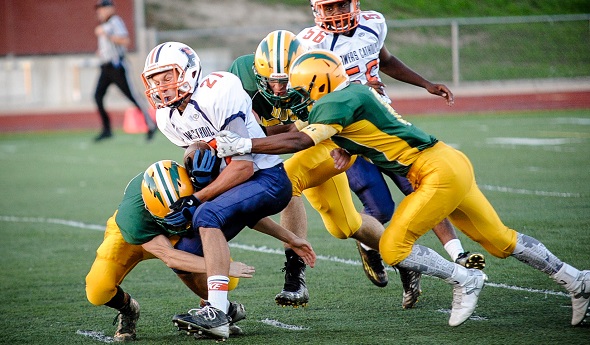
PHOTOS: (Top) A collection of Dow defenders makes a tackle during a win this season against Flint Powers Catholic. (Middle) Chargers quarterback Bruce Mann has thrown 35 touchdown passes this fall. (Click for more from HighSchoolSportsScene.com.)