

Wassink, Sailors Take Back Championship
November 28, 2014
By Geoff Kimmerly
Second Half editor
DETROIT – The first time Jon Wassink led Grand Rapids South Christian to Ford Field, he spent the 2012 MHSAA Division 4 Final on the sideline with a broken collarbone as his back-up took the team the rest of the way to a title.
Wassink brought the Sailors back to Detroit in 2013 – but they couldn’t keep pace with Marine City despite his three touchdown passes and two scoring runs.
Friday night against Lansing Sexton was Wassink’s last chance to be part of an MHSAA football champion – and play a physical part in a championship game win.
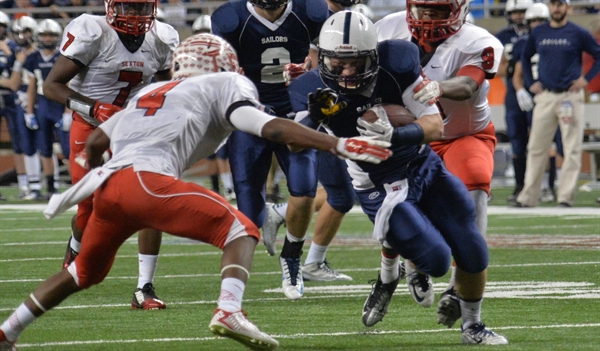
And he didn’t let it slip by. The Sailors' senior quarterback threw for 179 yards and three touchdowns and ran for 122 and another score as South Christian edged Sexton 28-27 for its second Division 4 title in three seasons.
Oh, and Wassink also had four tackles and an interception from his defensive back spot and averaged 39.8 yards on six punts.
“Two years ago when we won it, I was just happy for the team and the community. Part of me obviously wanted to play too, so that was really disappointing but (I was) really happy at the same time,” said Wassink, who was injured in the Semifinal win that season.
“(Last year) was the driving force behind our whole season. We just didn’t want to end our season like we did last year.”
But Sexton came so close to sending Wassink to Western Michigan University with another runner-up finish instead.
The Big Reds (13-1), undefeated on the way to their first MHSAA Final appearance, scored on the game’s opening drive, 2 minutes and 22 seconds into the first quarter.
South Christian (12-2) scored the next two touchdowns, and Sexton then answered. The Sailors took a 21-13 lead into halftime after a Wassink touchdown pass with seven seconds to go before the break and extended the advantage on his 68-yard touchdown run 13 seconds into the third quarter. But the Big Reds battled back with two more scores to pull within a point of the lead with 10:43 to play.
“They’re a scary team. They have all of those great athletes and big bodies,” South Christian coach Mark Tamminga said. “We knew going in they scored a lot of points during the second half and wear you down with all of those big bodies. Our kids just stepped up and made plays when they had to.”
 The first set of offensive plays didn’t result in a score – but burned 5:16 off the clock to give the Big Reds only 5:25 to work with as it drove to take the lead.
The second set of difference-making maneuvers actually came on the same play – and on defense. Sexton had a new set of downs at its 38-yard line when senior linebacker Sam Heyboer burst into the Big Reds' backfield for a 12-year sack. In the process he helped cause a fumble that was recovered by another senior linebacker, Nick Bosch.
But again, South Christian didn’t score – yet took an additional 2:13 off the clock before Wassink was stopped short on a fourth down run by Big Reds senior lineman Isaiah Brown. Only 1:35 remained, and Sexton could advance only 32 yards to its 39-yard-line before the clock ran out.
“Our defense had a heck of a goalline stand down there, and I’m proud of my kids. They fought hard against a really good football team,” Sexton coach Dan Boggan said. “We’re an outstanding football team ourselves, and it could’ve gone either way. I’m disappointed, but I’m not broken.”
Sexton allowed only 63 more second-half yards after Wassink’s long scoring run during the first half-minute of the third quarter. But Sexton also had three turnovers total, while the Sailors never turned over the ball, and missed an extra point after its final touchdown that would’ve tied the score. The Sailors also held a Sexton rushing attack featuring two 1,000-yard rushers to only 101.
Big Reds quarterback Malik Mack finished an outstanding varsity career with 224 yards and two touchdowns passing and another score on the ground. Both of his touchdown passes went to sophomore tight end Kahari Foy-Walton, and senior Rayshawn Wilborn added eight catches for 84 yards and eight tackles at linebacker.
Junior lineman Marshaun Blake had a game-high nine tackles and his teammates combined for six tackles for losses and three sacks. “They were one of the best, if not the best we played all year,” Wassink said. “Fast, physical, just really tough.”
Heyboer finished with two of his team’s three sacks and also caught one of Wassink’s three touchdown passes. Seniors Ryan Veenstra and Eric VanVoorst caught the others, and senior Geff Plasman finished his career with 80 more rushing yards to end up with 1,300 for this fall.
Wassink’s final numbers for his final season set the bar high for those who follow. Adding in his Ford Field heroics, Wassink finished with 1,426 yards and 18 touchdowns rushing and 2,494 yards and 28 touchdowns passing.
And he'll graduate as a two-time MHSAA champion – this time having had something to say about the final result.
“He’s been driven all year. This is what he wanted,” Tamminga said. “He felt he didn’t play the best here last year, and he wanted to go out with a state championship.
“What a tremendous athlete.”
PHOTOS: (Top) Lansing Sexton’s Malik Mack (4) and Ardis Davis (9) work to wrap up a South Christian ball carrier Friday night. (Middle) Mack prepares to unload a pass with the Sailors’ Jake Wierenga applying pressure. (Click for action photos and team photos from Hockey Weekly Action Photos.)
VIDEO HIGHLIGHTS:
WASSINK'S OFF TO THE RACES - Grand Rapids South Christian scored touchdowns on its last possession of the first half and its first of the second half against Lansing Sexton. Here's the second TD, a 68-yard run by quarterback Jon Wassink. The TD and extra point that followed turned out to be the winning scoring sequence in a 28-27 Sailors win.
SEXTON TIGHTENS IT UP - Early in the fourth period, Lansing Sexton pulled within a point of Grand Rapids South Christian on a 29-yard pitch/catch/run play from Malik Mack to Kahari Foy-Walton. It was the second time the duo connected for a score in the game.
Watch the entire game and order DVDs by Clicking Here.
Drive for Detroit: Week 8 in Review
October 19, 2015
By Geoff Kimmerly
Second Half editor
One point can mean one win and change an entire season. More than a few teams are feeling that impact after a nail-biting Week 8.
Michigan high school teams played nine one-point games last week. And those games resulted in the naming of two league champions, two more teams not winning a share of league titles, two teams earning playoff spots and three more keeping playoff hopes alive, and two more seeing their playoff hopes dashed.
See more on most of those games in this week's report below.
Bay & Thumb
Richmond 15, Algonac 14
This still has been a dream season for Algonac (7-1) – but the Muskrats were forced to share some of it with perennial power Richmond (7-1) after the Blue Devils held them scoreless over the second half of their Blue Water Area Conference title-deciding contest. Richmond gets a share of the title – its second in three seasons – with its lone league loss by one to Almont. Algonac’s share was its first league title since 1972 and came after a 1-8 finish only a year ago. Click for more from the Port Huron Times-Herald.
Also noted:
Montrose 7, Flint Beecher 6 – For the first time in a long time, this didn’t have Genesee Area Conference Red title implications for both, but Montrose (5-3) needed a win to stay alive for an automatic playoff berth and in the process kept Beecher (5-2) from claiming a share of the title.
New Lothrop 49, Flint Hamady 0 – Hamady (6-2) had a chance to make the GAC Blue title also a three-team share, but New Lothrop (8-0) held on for the outright championship for the sixth straight season.
Croswell-Lexington 28, Almont 27 – Back to the BWAC, Croswell-Lexington (6-2) earned a playoff berth for the first time since 2012 with its first win over Almont (6-2) since that fall.
Birch Run 21, Essexville Garber 15 – The Panthers (5-3) stayed alive for a second straight playoff berth, while Garber (4-4) will need a win and good fortune to extend a three-year postseason streak.
Greater Detroit
Macomb Dakota 35, Sterling Heights Stevenson 28 (OT)
A wild Macomb Area Conference Red race finally is sorted out, with Dakota (6-2) – which suffered its only league loss all the way back in Week 3 – emerging as champion for the fourth straight season. Stevenson (6-2), Clinton Township Chippewa Valley and Utica Eisenhower all finished a game back and Warren Mott was two win out – and Eisenhower and Mott can join the other three with automatic playoff berths if they win this week. Click for more from the Macomb Daily.
Also noted:
Harper Woods Chandler Park 28, Warren Michigan Collegiate 18 – Chandler Park (6-2) has put together a pair of streaks that remain under the radar; the Eagles have made the playoffs all seven seasons they’ve played a full schedule, and this win over Michigan Collegiate (5-3) made them 40-0 in Charter School Conference play all-time.
Madison Heights Madison 56, St. Clair Shores South Lake 42 – Madison (7-1) won its 19th straight MAC Silver game and fourth straight league title while handing South Lake (7-1) its first loss this fall – which is still one to celebrate after South Lake's 2-7 finish in 2014.
Waterford Our Lady 36, Bloomfield Hills Cranbrook Kingswood 10 – The Detroit Catholic League C-D title came down to two undefeated teams, but Our Lady (8-0) emerged with its third straight championship although the Cranes are still enjoying their best season since at least 2005.
Warren Cousino 35, Grosse Pointe North 34 – Another one-pointer meant a shared MAC Blue title between these two after Cousino (5-3) beat North (4-4) by three last season to claim the championship outright.
Mid-Michigan
Pewamo-Westphalia 34, Fowler 7
The 50th game between these rivals extended a pattern of the teams trading victories to seven seasons. The Pirates (8-0) also kept a streak alive of giving up no more than seven points, which they've done seven straight weeks after giving up 25 in a win over Madison Heights Madison on opening night. Most importantly, P-W linched an outright Central Michigan Athletic Conference title. Fowler, last season’s champion, finished third but remains playoff-ready at 6-2. Click for more from the Ionia Sentinel-Standard.
Also noted:
Grand Ledge 31, East Lansing 21 – The Trojans (4-4) put a scare into Grand Ledge (8-0) nearly to the end, but the Comets emerged with a share of the Capital Area Activities Conference Blue title and a chance to win it outright this week against second-place Holt.
Fowlerville 24, Lake Odessa Lakewood 21 – Not only did the Gladiators (4-4) hand Lakewood (7-1) its first loss this fall, they stayed in the running for an at-large playoff bid that would return them to the postseason for the first time since 2010.
Lansing Everett 33, Lansing Sexton 32 – With nothing to play for but city pride, these two enjoyed another nail-biting classic, with Everett (3-5) breaking a two-season winning streak by the Big Reds (1-7) – who lost their fifth game by a touchdown or less and third by a point.
Haslett 28, Williamston 7 – The Vikings (5-3) remain alive for an automatic playoff berth after missing last season, and Williamston (4-4) might have a shot at an at-large bid with a win this week over Lake Fenton.
Northern Lower Peninsula
Frankfort 20, Charlevoix 0
Frankfort clinched its first league title since 2008 and avenged Charlevoix’s win in this matchup a year ago. By moving to 7-1, the Panthers also guaranteed their best finish since at least 2011 and like Fowler, kept alive a streak of giving up no more than seven points in a game since opening night. In fact, the Panthers have given up only 42 all fall. Charlevoix (5-3) still can clinch a playoff spot this week against Harbor Springs. Click for more from the Traverse City Record-Eagle.
Also noted:
Traverse City West 35, Gaylord 14 – After an 0-4 start, the Titans (4-4) have stormed back and have a chance at an at-large bid with their best win yet over solid Gaylord (5-3).
Lake City 41, Lincoln Alcona 34 – The Trojans (4-4) got a giant boost to their at-large hopes by downing a Tigers team that is 5-3 and could clinch an automatic berth this week.
Kingsley 27, Maple City Glen Lake 6 – The Stags (5-3) still face undefeated Traverse City St. Francis, but put themselves in position to earn an automatic bid or make a play for an at-large invitation by downing Glen Lake (4-4).
Whittemore-Prescott 38, Hillman 14 – The North Star Big Dipper champion Cardinals (5-3) won this battle of league title winners by downing Little Dipper champ Hillman (6-2).
Southeast & Border
Manchester 29, Vandercook Lake 7
The Dutchmen (7-1) claimed the Cascades Conference championship outright by slowing a team that had scored at least 27 points in every game and averaged 41 points per heading into the contest. The title was Manchester’s fourth straight. Vandercook Lake (7-1) is still enjoying its best season since 1996. Click for more from the Jackson Citizen-Patriot.
Also noted:
Jackson 63, Holt 41 – The Vikings (6-2), 1-8 a year ago, clinched their first playoff berth of the coach Scott Farley era and first at all since 2009 by downing similar playoff hopeful Holt (5-3).
Chelsea 9, Ann Arbor Pioneer 7 – The Bulldogs (7-1) showed again they’ll be dangerous in the playoffs by dealing a close loss to much larger Ann Arbor Pioneer (6-2).
Ida 20, Hillsdale 17 (OT) – The Bluestreaks (8-0) made sure they were at least partial Lenawee County Athletic Association champions, earning a share of the league title with Hillsdale (5-3) attempting to create a three-way tie at the top.
Homer 40, Union City 34 – The Trojans (7-1) already had claimed a share of the Big 8 Conference title, but reigning champ Union City (4-4) didn’t let the outright championship come easily.
Southwest Corridor
Buchanan 21, Berrien Springs 19
The renewing of this rivalry played out as competitively as one would expect from a pair of undefeated teams contending for a league title. After a three-season break, the pair met for the Berrien-Cass-St. Joseph Conference White championship – and Buchanan (8-0) earned it in part by blocking an extra-point try and stopping a two-point conversion attempt. The Bucks this week will play for their first perfect regular season since 1988, while Berrien Springs (7-1) still is headed for its best regular-season finish since 2005. Click for more from the Niles Daily Star.
Also noted:
Kalamazoo Central 33, Benton Harbor 18 – The Maroon Giants (3-5) made playoff hopes much dimmer for Benton Harbor (4-4), but also gave themselves a chance at their best record since 2011.
Bridgman 34, Niles Brandywine 26 – The Bees (7-1) clinched the BCS Blue title for the second straight season and after two straight losses to Brandywine (5-3).
Dowagiac 36, Otsego 34 – The Chiefs (5-3) moved a win closer to returning to the playoffs after missing last season at 3-6.
St. Joseph 45, Battle Creek Lakeview 21 – The Bears (7-1) have secured a playoff berth after missing last season, but Lakeview (5-3) must win this week to do the same despite claiming a share of its league title.
Upper Peninsula
Ishpeming 20, St. Ignace 14
This meeting of league champions was another that met expectations, with Mid-Peninsula Athletic Conference champion Ishpeming (7-0) winning its 26th straight regular-season game and handing Ski Valley champ St. Ignace (7-1) its first regular season loss after 16 straight wins. Ishpeming held the Saints to their season-low points but scored their second fewest of the fall. Click for more from the Sault Ste. Marie Evening News.
Also noted:
Crystal Falls Forest Park 34, Munising 8 – The Trojans (5-2) are making what might be their final season of 11-player football count, this time downing reigning Division 8 runner-up Munising (6-2) to qualify for the playoffs and clinch a share of the Mid-Eastern Football Conference title.
Escanaba 34, Sault Ste. Marie 8 – An upset of the Blue Devils (5-3) gave the Eskymos (4-4) their most wins since 2012 and the chance to play for an at-large playoff bid.
Iron Mountain 28, Hurley, Wis. 13 – The Mountaineers (5-3) look much better to earn a playoff spot this week against two-win Norway after doubling up always-tough Hurley (7-2).
Menominee 40, DeWitt 35 – The Maroons’ 30-game regular-season winning streak has included its share of impressive victories, but moving to 8-0 against an undefeated DeWitt team (7-1) loaded with speed should put additional fear into potential playoff opponents.
West Michigan
Muskegon Mona Shores 21, Muskegon 18
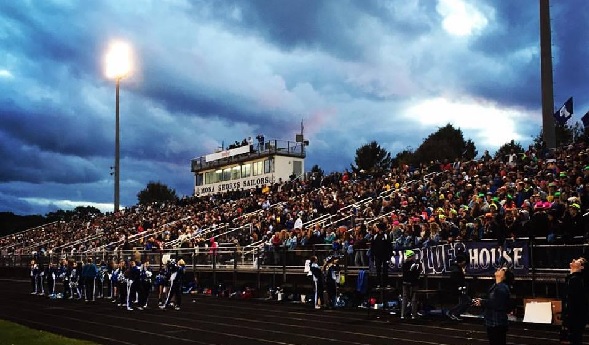
Statewide eyes turned toward this matchup of Muskegon rivals, and roughly 10,000 fans saw Mona Shores jump out to a 21-3 lead before withstanding a late Big Reds charge. Mona Shores moved to 8-0 for the first time in program history with its second straight win over Muskegon (6-2), which suffered its second three-point loss of the season. Click for more from the Muskegon Chronicle.
Also noted:
Ada Forest Hills Eastern 49, Cedar Springs 12 – The Hawks (8-0) guaranteed themselves a share of the O-K Bronze title and also set a program record for wins while forcing Cedar Springs (5-3) into a must-win position this week.
Grandville 38, Hudsonville 13 – The Bulldogs (5-3) turned the O-K Red into the best league race left by handing Hudsonville (6-2) its first league loss and creating a four-way tie at the top with one game to play and a guarantee of two champions.
Lowell 35, East Grand Rapids 13 – The Red Arrows (7-1) earned a share of a third straight league title in one of the state’s most competitive, while putting East Grand Rapids (5-3) in a must-win spot as well.
Montague 36, Muskegon Oakridge 29 (OT) – The West Michigan Conference title came down to overtime before Montague (8-0) prevailed over the reigning champion Eagles (6-2).
Reed City 26, Remus Chippewa Hills 7 – The Coyotes (8-0) claimed their fifth straight league title by downing second-place Chippewa Hills (6-2) to win the Central State Activities Association Gold.
8-Player
Onaway 62, Bellaire 14
Onaway pushed into the 16th spot with a week to play as it pursues its first playoff berth since 2012 in its first season of 8-player football. The Cardinals (5-3) must play another 5-3 team, Pickford, this week to try to hold on to the final spot in the field. Bellaire (4-4) has fallen in two straight as its pursued making the playoffs for the sixth straight season.
Also noted:
Deckerville 50, Peck 6 – The battle for the North Central Thumb 8-Man title didn’t turn into much of one, with Deckerville (7-1) breaking a three-game losing streak to the Pirates (6-2).
Powers North Central 82, Rapid River 20 – The Jets (8-0) gave up their most points this season, but also tied their highest output on offense while downing the Rockets (5-3).
Engadine 58, Stephenson 42 – This might have been the best game of the week in 8-player, featuring two teams that have taken great strides but with Engadine (6-2) striding just a little bit farther than Stephenson (5-3) at this point.
PHOTO: Muskegon Mona Shores welcomed a reported 10,000 fans for Friday's 21-18 victory over rival Muskegon.