

White Pigeon Building On 2018 Surge
By
Wes Morgan
Special for MHSAA.com
September 10, 2019
There won’t be any halftime ceremonies years from now celebrating the White Pigeon football team’s accomplishments in 2018. There’s no engraved award to display in the trophy case.
 But the Chiefs’ 7-3 season certainly rejuvenated the program and its supporters.
That it will spark prolonged success remains to be seen, admitted second-year head coach Shawn Strawser, who isn’t interested in making bold predictions. What he can say with certainty is his players are committed, disciplined, physical and hungry for another taste.
Leading up to last fall, White Pigeon had just one winning season (5-4 in 2014) since its last playoff appearance in 2009, a year that resulted in a 9-2 mark with a Division 7 Pre-District win over Decatur. Last year, the schedule paired the Chiefs with what would turn out to be the top two teams in the Southwest 10 Conference during the first three weeks of the season. Losses to Centreville (22-12) and Cassopolis (28-12) sandwiched a 38-8 victory over Marcellus. But White Pigeon went on to win its final six regular-season games to qualify for the postseason, a march which included the program’s first win over Mendon in 20 years (although the Hornets got revenge in the Division 8 Pre-District round with an 8-6 win over White Pigeon).
It all happened quickly from Strawser’s perspective. When Joseph Morsaw resigned as the head coach at the end of 2017, administrators turned to Strawser and Mike Gropp — a duo with past varsity experience who had spent recent years guiding the middle school program. Strawser was just about to leave for a vacation in St. Lucia and needed to think about whether he wanted to deal with everything that comes with the top spot at the varsity level.
“I called Mike and I was like, ‘We’re going to have to do this, aren’t we?’” Strawser said. “Mike was like, ‘Yep.’
“We had a nice group of seniors. I had actually coached those kids when they were in Rocket. I knew them all real well.”
Strawser also knew he needed to do a little recruiting, starting with then-junior Stone Kemp, who turned his focus as a freshman and sophomore to leading a Bible study after school rather than playing football.
 “He’s very persuasive, and so he got me back into it,” said Kemp, who finished with 398 rushing yards on 82 carries (4.9 per carry) and seven touchdowns as the Chiefs’ second back behind senior Carlos Castro in 2018. “I decided it would be a good place to be, and I think that’s where God wanted me.”
The benefits were twofold, Strawser said. It was obvious what Kemp brought to the team in terms of production, but Strawser noticed the positive impact Kemp had on his teammates as well.
“He’s a great athlete and an even better kid,” Strawser explained. “He is truly an all-around football player. Last year he played defensive end and outside linebacker. We stuck him out to cover one-on-one. This year we moved him back to safety. He has great hands and can pretty much do anything we ask him to do. He’s such a versatile player. He picked it up pretty fast for being out a couple years. He popped right back in like he didn’t miss a beat.”
To open the 2019 season, Kemp rushed for three touchdowns and returned the opening kickoff for a score in a 54-0 White Pigeon victory over Bloomingdale. He caught a touchdown pass in Week 2 in the Chiefs’ 14-8 win at Decatur, which required a goal-line stand during the final minute.
“It has been very enjoyable,” Strawser said of the program’s turnaround. “That was the whole point. On the bubble wasn’t good enough. We really wanted these kids to buy in, believe what we were doing and reap the rewards of their hard work. We preached every day mental toughness.
“Each time we had a successful game the confidence just grew. It has been a real fun ride. They were eager to do well. It paid off. We haven’t earned anything or proved anything this year yet, so we just have to keep grinding away.”
Though the Chiefs lost a ton of talent to graduation, people familiar with the program believed they could fill those voids. With 19 players on the roster, including three sophomores, the Chiefs have been able to do that, including a great effort from an offensive line that consists of a mix of experience and youth.
Captain and three-year starter Kobie DeBruine, a tackle who can play guard, sets the tone for a group that includes capable tight ends Dominick Pant – who has packed on 20 pounds of muscle since last season – and Chris Bontrager, guards Beau Freedline and Luke Gropp, and sophomore center Lane Esarey.
“That was the biggest question mark going into this season is that we were pretty young on the offensive line,” said Strawser, whose son, Lincoln Strawser, is back as a senior to guide the offense at quarterback. “They really got to work and made a lot of improvement from the scrimmage to Week 1.”
Now the Chiefs are after their first playoff victory since 2009 and fourth since 1990.
“We’re just looking for big things this year,” Kemp said. “This year I know it’s my last year to do it, so I just want to make the most out of every opportunity I get. I kind of like how people underrate us because it gives us a chance to show what we’ve got.”
 Wes Morgan has reported for the Kalamazoo Gazette, ESPN and ESPNChicago.com, 247Sports and Blue & Gold Illustrated over the last 12 years and is the publisher of JoeInsider.com. He can be reached at [email protected] with story ideas for Berrien, Cass, St. Joseph and Branch counties.
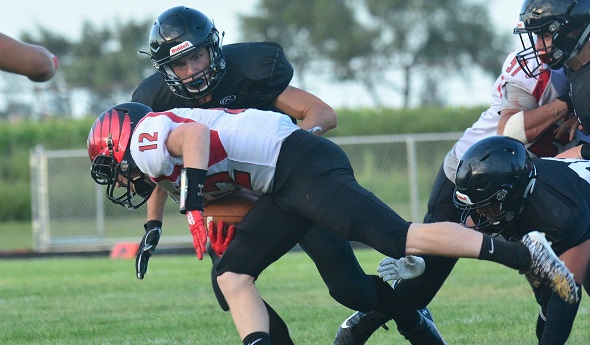
PHOTOS: (Top) White Pigeon defenders track down a ball carrier during their Week 1 win over Bloomingdale. (Middle) Stone Kemp breaks away on a long run. (Photos by John Gentry.)
1st & Goal: 2026 Week 4 Preview
By
Geoff Kimmerly
MHSAA.com senior editor
September 18, 2026
We’re just three weeks into the 2026 high school football season, and a great sign that Michigan teams are challenging themselves is that only 116 – or just under 20 percent – are still undefeated.

That total also is guaranteed to be reduced by 15 this weekend, and will likely fall well below the century mark with several high-powered matchups kicking off all over the state. Five of those games are among those featured below.
Games below are Friday unless noted. Tune in to the NFHS Network to watch the majority and follow the MHSAA Scores page for results as they’re submitted.
Bay & Thumb
Linden (3-0) at Holly (3-0)
Holly is 3-0 for the first time since 1984, and a 42-7 win over Pontiac Notre Dame Prep is notable even though the Fighting Irish are struggling early after finishing Division 5 runner-up last season. The Bronchos also haven’t defeated Linden since 2011 and fell last year 42-6. But a win would open up the Flint Metro League Stripes race significantly and provide a giant assist as Holly works to make the playoffs for the fourth time in five seasons.
Keep an eye on these FRIDAY North Branch (2-1) at Imlay City (3-0), Caro (3-0) at Millington (3-0), Montrose (2-1) at Chesaning (2-1), Shepherd (2-1) at Gladwin (2-1).
Greater Detroit
Clarkston (3-0) at Rochester Adams (2-1)
Even as Adams has reached Division 1 Semifinals the last two seasons, it hasn’t won the Oakland Activities Association Red since sharing the title with Clarkston and West Bloomfield in 2022. Clarkston won last year’s matchup on the way to the OAA Red championship. Both faced 2025 league champions to open this season, Adams falling to Romeo and Clarkston defeating South Lyon, and there’s always a chance this will be just the first of multiple meetings as they’ve seen each other in the playoffs as well two of the last four years.
Keep an eye on these FRIDAY Warren De La Salle Collegiate (2-1) at Detroit Catholic Central (3-0), Detroit Denby (2-1) at Detroit Cody (3-0), Romeo (3-0) at Macomb Dakota (2-1), Monroe Jefferson (3-0) at Riverview (3-0).
Mid-Michigan
McBain (2-1) at Beal City (3-0)
Beal City has only three Highland Conference losses since the start of 2019 – all to McBain, but with the most recent in 2024. The Aggies won last season’s meeting 42-7 and are coming off a major defeat last week of Springport plus have downed two more 2025 playoff teams in Ravenna and Manton. McBain’s only Highland loss since the start of 2024 came to Beal City, and the Ramblers’ defeat this season came to unbeaten Division 4 power Edwardsburg.
Keep an eye on these FRIDAY McBain (2-1) at Beal City (3-0), Traverse City Central (2-1) at Mount Pleasant (3-0), Birch Run (3-0) at New Lothrop (2-1), Brighton (2-1) at Hartland (2-1), Saginaw Michigan Lutheran Seminary (2-1) at Ithaca (3-0).
Northern Lower Peninsula
Grand Blanc (3-0) at Traverse City West (2-1)
Grand Blanc has dominated all four games of the recent series between these two, but there’s reason to believe this meeting might be closer. It may start with Grand Blanc having to travel much farther than usual – although the Bobcats also won at West in 2025. But the bigger positive for the Titans may not be 56 points put up in a win last week over Bay City Central but the 35 scored in a Week 1 loss to Howell. Grand Blanc has two straight shutouts but must be ready for another challenge on that side of the ball.
Keep an eye on these FRIDAY Kingsley (3-0) at Grayling (2-1), Midland Bullock Creek (2-1) at Ogemaw Heights (3-0), Johannesburg-Lewiston (2-1) at Frankfort (2-1), Traverse City St. Francis (1-2) at Maple City Glen Lake (2-1)
Southeast & Border
Tecumseh (3-0) at Chelsea (3-0)
Tecumseh has reached 40 points scored in all three of its games, which is more than it did either of the entire 2024 or 2025 seasons. A win over Chelsea would be a first since 2022, when Tecumseh put together a perfect regular season, and this is the team’s best start since that fall. Chelsea also has strung together an impressive first three weeks with the Bulldogs’ most recent win over Adrian a rematch of last year’s Southeastern Conference White title decider and the Week 1 victory over Harper Woods one that will be referenced all fall.
Keep an eye on these FRIDAY Jonesville (2-1) at Brooklyn Columbia Central (3-0), Saline (3-0) at Dexter (2-1), Adrian Madison (3-0) at Hudson (3-0), Ann Arbor Father Gabriel Richard (3-0) at Jackson Lumen Christi (3-0), Hanover-Horton (2-1) at Napoleon (3-0).
Southwest Corridor
Edwardsburg (3-0) at Paw Paw (3-0)
Paw Paw has won this Wolverine Conference rivalry game three straight seasons but also finished runner-up in the league to Niles the last three years. The Red Wolves downed Niles 42-14 last week, making them potential frontrunners in the conference unless Edwardsburg spoils that plan. Paw Paw has been impressive giving only 28 points total against teams that went a combined 21-10 a year ago. But the Eddies are ripping through yards again like during their best years, topping 50 points twice already after not doing so once all of last season.
Keep an eye on these FRIDAY Berrien Springs (3-0) at Buchanan (3-0), Battle Creek Harper Creek (3-0) at Marshall (3-0), Kalamazoo Central (2-1) at Portage Central (2-1), Constantine (2-1) at Schoolcraft (3-0), Quincy (3-0) at Union City (3-0).
Upper Peninsula
Calumet (3-0) at Menominee (3-0)
This game sets up identically as last season’s matchup, won by Menominee 25-15 on the way to claiming the Western Peninsula Athletic Conference Copper title. The Maroons have won their games by 54, 30 and 50 points so far, but Calumet should bring that average down especially after giving up only 24 points over its first three victories. A win over Menominee would be the Copper Kings’ first since the 2021 District Semifinals.
Keep an eye on these FRIDAY Negaunee (2-1) at Kingsford (3-0), Iron Mountain (1-2) at L’Anse (2-1), Petoskey (2-1) at Escanaba (1-2). SATURDAY Cadillac (2-1) at Marquette (1-2).
West Michigan
Ludington (2-1) at Fremont (3-0)
Fremont is staring down a potential first winning season since 2013 and after earning a combined three victories over the last two. They avenged last year’s 56-0 loss to Whitehall with a 32-19 win in Week 2 and with 24 more points will equal their scoring output for all of last year. Enter Ludington, which won the 2025 matchup 49-0 and the West Michigan Conference Lakes title during a perfect regular season. The Orioles graduated a significant senior class in the spring and opened with a loss to Coopersville, but have bounced back with a pair of close wins.
Keep an eye on these FRIDAY Grand Rapids West Catholic (2-1) at Ada Forest Hills Eastern (3-0), Grand Rapids South Christian (2-1) at Hudsonville Unity Christian (2-1), Middleville Thornapple Kellogg (3-0) at Holland Christian (2-1), East Kentwood (3-0) at Grand Haven (2-1).
8-Player
Mio (3-0) at Mendon (3-0)
Mio has strung together two straight playoff seasons and charged into this one impressively, already avenging one of its two 2025 losses by downing Hillman 30-16 in Week 2. The Thunderbolts now have the opportunity to test themselves against one of the annual elite, as Mendon is a combined 20-3 over the last two years and averaging 51 points per game during this early going despite replacing the leading scorer in MHSAA 8-player history.
Keep an eye on these FRIDAY Climax-Scotts (3-0) at Colon (3-0), Ishpeming (2-1) at Crystal Falls Forest Park (3-0), Pickford (3-0) at St. Ignace (3-0). SATURDAY Norway (3-0) at Lake Linden-Hubbell (3-0).
MHSAA.com's weekly “1st & Goal” previews and reviews are powered by MI Student Aid, a division within the Department of Lifelong Education, Advancement, and Potential (MiLEAP). MI Student Aid encourages students to pursue postsecondary education by providing access to student financial resources and information. MI Student Aid administers the state’s scholarship and grant programs that help make college Accessible, Affordable and Attainable for you. Click to connect with MI Student Aid and find more information on Facebook and Twitter @mistudentaid.
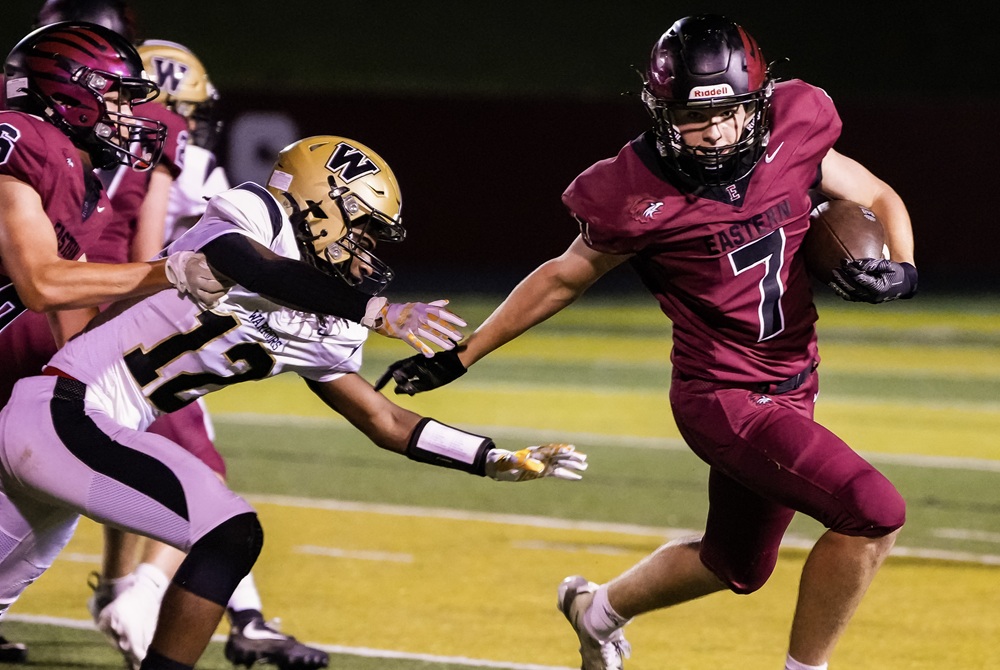
PHOTO An Ada Forest Hills Eastern ball carrier attempts to hold off a Flint Elite defender during FHE’s Week 3 win. (Photo by Michigan Sports Photo.)