

White Pigeon Building On 2018 Surge
By
Wes Morgan
Special for MHSAA.com
September 10, 2019
There won’t be any halftime ceremonies years from now celebrating the White Pigeon football team’s accomplishments in 2018. There’s no engraved award to display in the trophy case.
 But the Chiefs’ 7-3 season certainly rejuvenated the program and its supporters.
That it will spark prolonged success remains to be seen, admitted second-year head coach Shawn Strawser, who isn’t interested in making bold predictions. What he can say with certainty is his players are committed, disciplined, physical and hungry for another taste.
Leading up to last fall, White Pigeon had just one winning season (5-4 in 2014) since its last playoff appearance in 2009, a year that resulted in a 9-2 mark with a Division 7 Pre-District win over Decatur. Last year, the schedule paired the Chiefs with what would turn out to be the top two teams in the Southwest 10 Conference during the first three weeks of the season. Losses to Centreville (22-12) and Cassopolis (28-12) sandwiched a 38-8 victory over Marcellus. But White Pigeon went on to win its final six regular-season games to qualify for the postseason, a march which included the program’s first win over Mendon in 20 years (although the Hornets got revenge in the Division 8 Pre-District round with an 8-6 win over White Pigeon).
It all happened quickly from Strawser’s perspective. When Joseph Morsaw resigned as the head coach at the end of 2017, administrators turned to Strawser and Mike Gropp — a duo with past varsity experience who had spent recent years guiding the middle school program. Strawser was just about to leave for a vacation in St. Lucia and needed to think about whether he wanted to deal with everything that comes with the top spot at the varsity level.
“I called Mike and I was like, ‘We’re going to have to do this, aren’t we?’” Strawser said. “Mike was like, ‘Yep.’
“We had a nice group of seniors. I had actually coached those kids when they were in Rocket. I knew them all real well.”
Strawser also knew he needed to do a little recruiting, starting with then-junior Stone Kemp, who turned his focus as a freshman and sophomore to leading a Bible study after school rather than playing football.
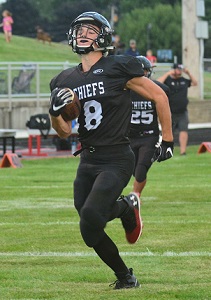 “He’s very persuasive, and so he got me back into it,” said Kemp, who finished with 398 rushing yards on 82 carries (4.9 per carry) and seven touchdowns as the Chiefs’ second back behind senior Carlos Castro in 2018. “I decided it would be a good place to be, and I think that’s where God wanted me.”
The benefits were twofold, Strawser said. It was obvious what Kemp brought to the team in terms of production, but Strawser noticed the positive impact Kemp had on his teammates as well.
“He’s a great athlete and an even better kid,” Strawser explained. “He is truly an all-around football player. Last year he played defensive end and outside linebacker. We stuck him out to cover one-on-one. This year we moved him back to safety. He has great hands and can pretty much do anything we ask him to do. He’s such a versatile player. He picked it up pretty fast for being out a couple years. He popped right back in like he didn’t miss a beat.”
To open the 2019 season, Kemp rushed for three touchdowns and returned the opening kickoff for a score in a 54-0 White Pigeon victory over Bloomingdale. He caught a touchdown pass in Week 2 in the Chiefs’ 14-8 win at Decatur, which required a goal-line stand during the final minute.
“It has been very enjoyable,” Strawser said of the program’s turnaround. “That was the whole point. On the bubble wasn’t good enough. We really wanted these kids to buy in, believe what we were doing and reap the rewards of their hard work. We preached every day mental toughness.
“Each time we had a successful game the confidence just grew. It has been a real fun ride. They were eager to do well. It paid off. We haven’t earned anything or proved anything this year yet, so we just have to keep grinding away.”
Though the Chiefs lost a ton of talent to graduation, people familiar with the program believed they could fill those voids. With 19 players on the roster, including three sophomores, the Chiefs have been able to do that, including a great effort from an offensive line that consists of a mix of experience and youth.
Captain and three-year starter Kobie DeBruine, a tackle who can play guard, sets the tone for a group that includes capable tight ends Dominick Pant – who has packed on 20 pounds of muscle since last season – and Chris Bontrager, guards Beau Freedline and Luke Gropp, and sophomore center Lane Esarey.
“That was the biggest question mark going into this season is that we were pretty young on the offensive line,” said Strawser, whose son, Lincoln Strawser, is back as a senior to guide the offense at quarterback. “They really got to work and made a lot of improvement from the scrimmage to Week 1.”
Now the Chiefs are after their first playoff victory since 2009 and fourth since 1990.
“We’re just looking for big things this year,” Kemp said. “This year I know it’s my last year to do it, so I just want to make the most out of every opportunity I get. I kind of like how people underrate us because it gives us a chance to show what we’ve got.”
 Wes Morgan has reported for the Kalamazoo Gazette, ESPN and ESPNChicago.com, 247Sports and Blue & Gold Illustrated over the last 12 years and is the publisher of JoeInsider.com. He can be reached at [email protected] with story ideas for Berrien, Cass, St. Joseph and Branch counties.
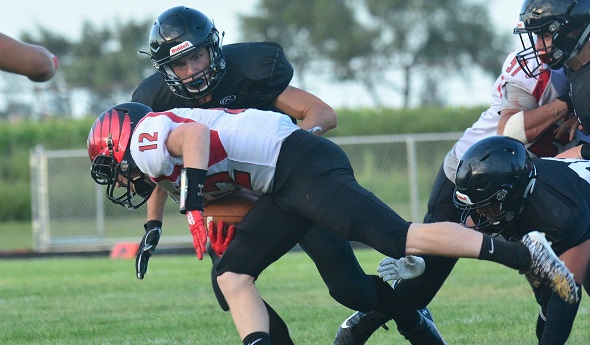
PHOTOS: (Top) White Pigeon defenders track down a ball carrier during their Week 1 win over Bloomingdale. (Middle) Stone Kemp breaks away on a long run. (Photos by John Gentry.)
Drive for Detroit: Week 6 Preview
October 3, 2019
By Geoff Kimmerly
Second Half editor
We’ve begun the second half of the football regular season, and predictably every week will include increasingly important games as league titles and playoff qualifiers are determined.
 We’ve highlighted a number of matchups below that could end up deciding league title races. Meanwhile, four teams qualified last week for the 11-player playoffs after starting 5-0 with eight-game schedules. Another 64 can join the field with a win this weekend.
A total of 28 games will be streamed live tonight on MHSAA.tv, including eight highlighted below. Click for the full schedule.
"Drive for Detroit" is sponsored by MI Student Aid.
Bay & Thumb
Goodrich (4-1) at Lake Fenton (3-2)
The winner earns a share of the inaugural Flint Metro League Lower division championship. Both joined the league this fall after previously playing in the Genesee Area Conference Red – Goodrich won that league’s final title in 2018 after Lake Fenton was the champ in 2016 and 2017. Don’t be shocked if this is close. The Martians have hung on after opening this season with a one-point loss to Flint Powers, claiming wins over Linden and Ortonville Brandon by a touchdown or less. Lake Fenton similarly knows how to navigate a close game. The Blue Devils opened with losses to Cadillac by 10 and Ida by six, but won their next three games by six, two and one point.
Keep an eye on these: FRIDAY Sanford Meridian (4-1) at Beaverton (5-0), Lapeer (4-1) at Grand Blanc (4-1), Essexville Garber (4-1) at Frankenmuth (5-0), North Branch (4-1) at Richmond (5-0).
Greater Detroit
Belleville (5-0) at Dearborn Fordson (5-0)
The annual meeting between these two – most recently in the Kensington Lakes Activities Association East – eventually has decided three straight league titles, and there’s a chance that will be the case again when all is said and done this fall. These two and Livonia Franklin are all undefeated and tied for first in the East. Belleville is seeking its third straight league title, and hence third straight win over Fordson after prevailing 29-26 a year ago. Both are piling up points again, each averaging more than 40 per game.
Keep an eye on these: FRIDAY Oak Park (4-1) at Birmingham Seaholm (4-1), Detroit Martin Luther King (3-2) at Detroit Denby (5-0), Southfield Arts & Technology (3-2) at Clarkston (2-3), Hartland (3-2) at Plymouth (5-0).
Mid-Michigan
Midland (5-0) at Mount Pleasant (5-0)
The winner will move into first place alone in the Saginaw Valley League Red. The reigning champion Oilers have won 19 of their last 20 games going back to midway through 2017 and last season beat Midland 40-20 in the game that eventually decided the league title. This time they couldn’t be much more numerically even – the Oilers have scored 200 points and given up 38, and the Chemics have a 203-39 combined scoring margin. Midland also has beaten the only other team in the league with an overall winning record, Saginaw Heritage (3-2).
Keep an eye on these: FRIDAY Mason (5-0) at Fowlerville (5-0), Holt (3-2) at East Lansing (4-1), Remus Chippewa Hills (2-3) at Central Montcalm (5-0), New Lothrop (5-0) at Durand (3-2).
Northern Lower Peninsula
Johannesburg-Lewiston (5-0) at Charlevoix (4-1)
While this matchup means nothing toward a league title, it should serve as a measuring stick for some of the best small-school teams just south of the Mackinac Bridge. Both are undefeated in their leagues – Charlevoix in the Northern Michigan Football League Leaders and the Cardinals in the NMFL Legacy. The Rayders should have a little extra incentive as well as they continue their best season since 2016 and lost to Johannesburg-Lewiston by a combined 62-7 over the last two years.
Keep an eye on these: FRIDAY Traverse City St. Francis (3-2) at Boyne City (2-3), Evart (3-2) at Houghton Lake (3-2), Oscoda (5-0) at Tawas (3-2), Frankfort (2-3) at Mancelona (3-2).
Southeast & Border
Hillsdale (5-0) at Blissfield (4-1)
This is another matchup of teams tied for first place in their league. Hillsdale is in a bit more familiar spot having shared the Lenawee County Athletic Association title last season with Brooklyn Columbia Central. But Blissfield already has beaten BCC (for the third straight season) and will try to continue its charge with a first win over the Hornets since 2016. Hillsdale won those last two meetings by 10 in 2018 and eight the year before.
Keep an eye on these: FRIDAY Springport (3-2) at Jonesville (4-1), Sand Creek (4-1) at Ottawa Lake Whiteford (3-2), Riverview (3-2) at Carleton Airport (4-1), Britton Deerfield (3-2) at Clinton (5-0).
Southwest Corridor
Cassopolis (5-0) at White Pigeon (5-0)
The co-leaders in the Southwest 10 Conference have taken vastly different paths on the way. Cassopolis is the reigning league champion and has clinched the conference titles three of the last four seasons. The 11 points Decatur scored last week were the first the Rangers have given up this fall. White Pigeon made the playoffs last year for the first time since 2009, which also was its first winning season since 2014. But the Chiefs have been similarly stellar on defense giving up only 40 points over five games, and the opportunity to take the league lead by breaking a nine-game losing streak to Cassopolis should further feed the team’s motivation.
Keep an eye on these: FRIDAY Schoolcraft (5-0) at Constantine (4-1), Gobles (3-2) at Lawton (5-0), Coldwater (4-1) at Marshall (3-2), St. Joseph (5-0) at Portage Central (3-2).
Upper Peninsula
Iron Mountain (5-0) at Calumet (5-0)
This is the first of four straight league games for both, and a title won’t be decided tonight. But this has been one of the most highly-anticipated matchups in the Upper Peninsula since Week 1. Calumet won last season’s Western Peninsula Athletic Conference Copper title, and steadily earned a share of first place so far this fall with wins over Ishpeming Westwood and Negaunee sticking out. The Mountaineers gave notice as contenders quickly with wins over Negaunee and Westwood as well the first two weeks, and they haven’t allowed a point over the last three. Last year’s meeting ended with a 24-0 Calumet win, but it’s fair to expect a closer and yet still low-scoring result in the rematch.
Keep an eye on these: FRIDAY Escanaba (4-1) at Menominee (4-1), Ishpeming Westwood (3-2) at Hancock (4-1), Negaunee (3-2) at L'Anse (4-1). SATURDAY West Iron County (4-1) at Lake Linden-Hubbell (3-2).
West Michigan
Hudsonville (4-1) at Grandville (5-0)
These two and Rockford are off to 2-0 starts in the Ottawa-Kent Conference Red. Hudsonville is a one-point Week 2 loss to Holt from undefeated and earned perhaps its best win so far last week, 28-16 over Jenison. Grandville hung on for a one-point win over East Kentwood last week, but its body of work continues to look better and better with Week 3 opponent Forest Hills Central a contender in the O-K White and Week 2 opponent East Lansing arguably the top team in the entire Lansing area this fall.
Keep an eye on these: FRIDAY Grand Rapids Forest Hills Central (4-1) at Cedar Springs (4-1), Ravenna (4-1) at Montague (4-1), Allendale (3-2) at Grand Rapids Catholic Central (4-1), Ludington (4-1) at Muskegon Orchard View (5-0).
8-Player
Martin (5-0) at Bridgman (5-0)
Just about everything about this is new. These two are both unbeaten in the first-year Southwest Michigan 8-Man Football League, both playing their first season of 8-player. They did play each other in 11-player last year for the first time, at least as far back as Michigan-Football.com tracks for Bridgman (1957), with Martin a 13-8 winner. The Clippers were 11-player playoff qualifiers last year, but the switch has really helped the Bees turn things around – they had gone a combined 1-16 over the last two seasons. Martin has played one more league game than Bridgman, so a win tonight would clinch the Clippers a share of the league title.
Keep an eye on these: FRIDAY Gaylord St. Mary (5-0) at Suttons Bay (5-0), Cedarville (3-2) at Pickford (4-1), Climax-Scotts (4-1) at Tekonsha (3-2). SATURDAY Crystal Falls Forest Park (4-1) at Powers North Central (5-0).
Second Half’s weekly “Drive for Detroit” previews are powered by MI Student Aid, a part of the Office of Postsecondary Financial Planning located within the Michigan Department of Treasury. MI Student Aid encourages students to pursue postsecondary education by providing access to student financial resources and information. MI Student Aid administers the state’s 529 college savings programs (MET/MESP), as well as scholarship and grant programs that help make college Accessible, Affordable and Attainable for you. Connect with MI Student Aid at www.michigan.gov/mistudentaid and find more information on Facebook and Twitter @mistudentaid.
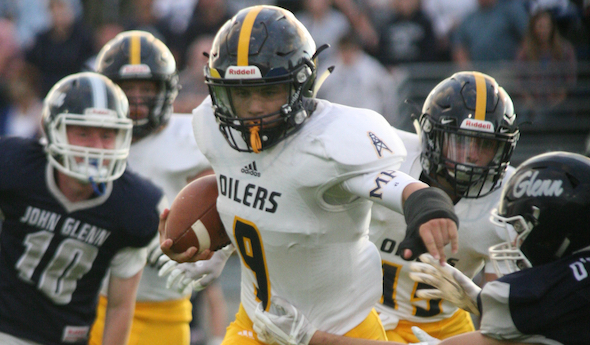
PHOTO: Mount Pleasant, here against Bay City John Glenn during a Week 3 win, is off to a 5-0 start and faces Midland in one of the state’s headlining games this weekend. (Click for more from HighSchoolSportsScene.com.)