

Whiteford Completes Championship Climb
December 15, 2017
By Geoff Kimmerly
Second Half editor
Ottawa Lake Whiteford football had been building toward this.
Coach Jason Mensing took over a program in 2012 that had gone 4-5 the previous fall, and immediately the Bobcats doubled their wins to finish 8-2. Next came seasons of 9-3, 7-4, 10-3 and program’s first MHSAA Semifinal in 2015, and 13-1 with its only loss in the Division 8 championship game a year ago.
 And yet, for the bulk of this season Whiteford still had to look up at a few others, relatively speaking. Reigning champion Muskegon Catholic Central was most people’s favorite to win the division again – until the Crusaders lost their District Final to Mendon, which became the new favorite.
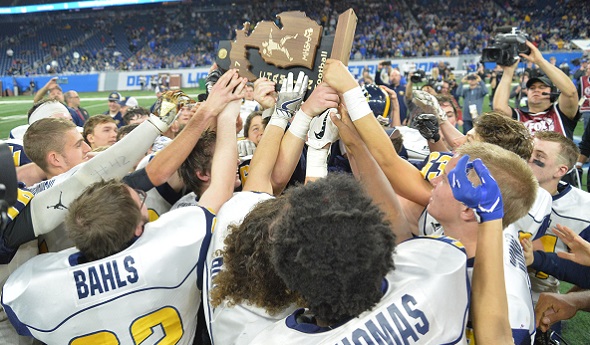
Meanwhile, Whiteford – the MHSAA/Applebee’s Team of the Month for November – bided its time until receiving its opportunity to make history. The Bobcats made the loudest statement with a 50-21 win over Mendon in their Semifinal on Nov. 17, and then assumed the top spot in Division 8 for the first time with a 42-21 championship game win over Saginaw Nouvel on Nov. 24 at Ford Field.
The Bobcats moving forward will still be looking up – but now at a championship banner to be hung and at a goal that certainly will seem more attainable now that they’ve achieved it for the first time.
“My hope is all the boys within our community and school see it and want to accomplish that for themselves,” said Mensing, also the school’s athletic director. “Obviously, it’s not realistic that it’s going to happen every year. But that aspiration for greatness and success … the idea that I can accomplish this, the idea I want this and I’m going to strive for it. Wherever you end up matters less (than) the pursuit of excellence.”
Whiteford pursued and attained excellence and dominance this fall on the way to a 14-0 record, starting with an offense that scored 737 points – tied for second most in MHSAA history, and an average of 52.6 per game.
Tri-County Conference rival Petersburg-Summerfield came within 16 points of catching the Bobcats in the District Final, Whiteford’s closest game of the entire fall as they won on average by nearly 40 points. During the playoffs alone, Whiteford outscored five opponents by an average of 50-18.
The Bobcats had fallen in the 2016 title game 35-6 to Muskegon Catholic Central, but certainly benefited from that first-time experience. Mensing sensed his team’s calm this time around, but also praised his players and coaches for staying focused week in and week out on improving and paying attention to details – no small tasks when everyone knew early on that Whiteford should be in the championship mix.
To win it all, teams generally must have size and speed, and Whiteford certainly had both, even as a school with roughly 240 students – but with nearly 50 on the roster for the championship game.
 Let’s start with size. Senior Lucas Tesznar (6-foot-5, 285 pounds) set the tone up front offensively and senior Jarret Atherton (6-1, 255) was an all-stater on both sides for the ball. Junior DeShaun Williams (6-5, 280) was an all-leaguer on defense.
Speed and skill? Senior quarterback Thomas Eitniear and junior running back Logan Murphy keyed a dynamic backfield – Eitniear throwing for 1,403 yards and 17 touchdowns and running for 919 yards more, while Murphy ran for 1,873 yards. Together they combined to set eight school records including Murphy’s for yards gained on the ground. Junior Braden Clark-Gilmore added another school record with 10 receiving touchdowns.
On a defense that gave up only 206 yards of offense and 13 points per game, junior Ty Eitniear set a school record with seven interceptions. Senior lineman Matthew Taylor, senior linebacker Eli Shelton and junior defensive backs Hunter Lake and Zack Bertz joined Atherton as all-state picks on that side of the ball.
Total, eight players secured some level of all-state recognition and 13 Bobcats earned first-team honors in the Tri-County Conference.
The Bobcats are turning their attention to other sports this school year and a future in football without 14 hard-working seniors who will graduate in the spring. But the memories of this fall surely will be lasting, even as the program is poised to continue making runs at top finishes.
“There have been a lot of well wishes, to our kids and our staff, and the school as a whole,” Mensing said. “There are so many people who invest in a football program at all schools, let alone one getting that deep into the playoffs. All of those people who have invested and worked at it have some pride and sense of accomplishment.”
Past Teams of the Month, 2017-18
October: Beaverton volleyball - Report
September: Shepherd girls golf - Report
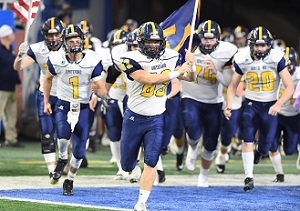
PHOTOS: (Top) Ottawa Lake Whiteford raises its Division 8 championship trophy at Ford Field last month. (Middle) Senior Eli Shelton leads the Bobcats onto the field.
Oakridge's Schugars Always To Be 'Coach'
April 26, 2013
By Geoff Kimmerly
Second Half editor
Jack Schugars led five Muskegon Oakridge teams to MHSAA football championship games during his 32 seasons running the program. He finished his high school coaching career in 2010 with a record of 262-78.
And of course, he impacted hundreds of lives in a community that, according to a former assistant, considers him a "saint."
Schugars was honored last week with the Duffy Daugherty Award for his outstanding achievements in high school football. Each spring, the Duffy Daugherty committee – made up of football supporters and media from the Lansing area – recognizes a high school coach along with a past or current college coach. The college award is among those recognized by the College Football Hall of Fame.
Among previous high school honorees present to congratulate Schugars during Thursday's banquet in East Lansing were Farmington Hills Harrison’s John Herrington, Birmingham Brother Rice’s Al Fracassa and former East Lansing coach Jeff Smith.
Schugars – now an assistant at Ferris State University – led his 1997, 2005 and 2008 teams to MHSAA titles, while his 1990 and 2003 teams finished MHSAA runners-up. He is a member of the Muskegon Sports Hall of Fame (class of 2009), the Michigan High School Coaches Association Hall of Fame (2008) and the Michigan High School Football Coaches Association Hall of Fame (1993). He received the MHSFCA’s highest honor, the Jim Crowley Award, in 2000.
The Schugars family is rooted in education. He also taught biology at the high school for 38 years, while his wife Julie taught English. Their daughter Amanda teaches in Battle Creek, and son Eric teaches and is the defensive coordinator at Traverse City Central.
Below are brief excerpts from the introduction of Schugars by his former football assistant and current Oakridge softball coach Joe Coletta, followed by Schugars' closing words of wisdom.
‘Faith, Family, Football’
(Coletta) “To Jack, those are not just words of hollow meaning. They are his compass.
 “Jack has won countless awards for his accomplishments on the football field. He absolutely refused to let anyone outwork him or his teams in preparation for a football game.
“But in my opinion, his strength as a football coach is his ability to take a kid that most people would give up on: a kid that some might label as no good, troublemaker, not worth the effort. He found a way to love the unlovable.
“He would give those kids direction; he would mentor them to be young men and young women and take them to where they could not possibly take themselves.
"When you can do that for a person, you let them see their worth as a human being and make a lasting impact so you can change the rest of their lives.
“That, to me, is what sets Jack apart from most coaches.”
What's most important
(Schugars) “The reason I'm on this Earth is to love the Lord your God with all my heart and soul and love your neighbors as yourself.
“So when I speak at clinics, when I talk to coaches, I tell them the greatest thing they can do for their team is to love their players.
“That is the greatest thing a coach can do. Love your players and be true role models each day.
“I could not ask for a better career than when ... a (former) player in the Navy Seal team calls me Coach. Lawyers, doctors, bankers, they call you Coach.
"Wow, that's a great word: Coach. That's what it's all about. Being a coach. Building relationships that will last a lifetime.
"I love the hundreds of players that are part of the Oakridge football family. And I hope I continue to build men out of boys, continue at the college level."
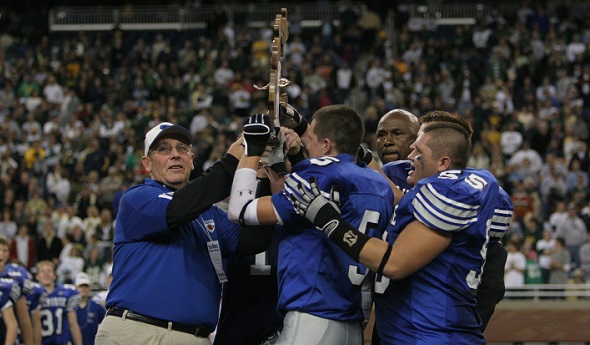
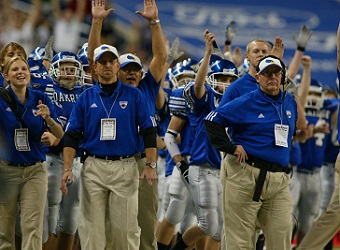
PHOTOS: (Top) Former Muskegon Oakridge football coach Jack Schugars holds up the 2005 Division 5 championship trophy with his players after their victory at Ford Field. (Middle) Schugars (right, with headset) monitors his team's play on the field against Jackson Lumen Christi.