

Whiteford Completes Championship Climb
December 15, 2017
By Geoff Kimmerly
Second Half editor
Ottawa Lake Whiteford football had been building toward this.
Coach Jason Mensing took over a program in 2012 that had gone 4-5 the previous fall, and immediately the Bobcats doubled their wins to finish 8-2. Next came seasons of 9-3, 7-4, 10-3 and program’s first MHSAA Semifinal in 2015, and 13-1 with its only loss in the Division 8 championship game a year ago.
 And yet, for the bulk of this season Whiteford still had to look up at a few others, relatively speaking. Reigning champion Muskegon Catholic Central was most people’s favorite to win the division again – until the Crusaders lost their District Final to Mendon, which became the new favorite.
Meanwhile, Whiteford – the MHSAA/Applebee’s Team of the Month for November – bided its time until receiving its opportunity to make history. The Bobcats made the loudest statement with a 50-21 win over Mendon in their Semifinal on Nov. 17, and then assumed the top spot in Division 8 for the first time with a 42-21 championship game win over Saginaw Nouvel on Nov. 24 at Ford Field.
The Bobcats moving forward will still be looking up – but now at a championship banner to be hung and at a goal that certainly will seem more attainable now that they’ve achieved it for the first time.
“My hope is all the boys within our community and school see it and want to accomplish that for themselves,” said Mensing, also the school’s athletic director. “Obviously, it’s not realistic that it’s going to happen every year. But that aspiration for greatness and success … the idea that I can accomplish this, the idea I want this and I’m going to strive for it. Wherever you end up matters less (than) the pursuit of excellence.”
Whiteford pursued and attained excellence and dominance this fall on the way to a 14-0 record, starting with an offense that scored 737 points – tied for second most in MHSAA history, and an average of 52.6 per game.
Tri-County Conference rival Petersburg-Summerfield came within 16 points of catching the Bobcats in the District Final, Whiteford’s closest game of the entire fall as they won on average by nearly 40 points. During the playoffs alone, Whiteford outscored five opponents by an average of 50-18.
The Bobcats had fallen in the 2016 title game 35-6 to Muskegon Catholic Central, but certainly benefited from that first-time experience. Mensing sensed his team’s calm this time around, but also praised his players and coaches for staying focused week in and week out on improving and paying attention to details – no small tasks when everyone knew early on that Whiteford should be in the championship mix.
To win it all, teams generally must have size and speed, and Whiteford certainly had both, even as a school with roughly 240 students – but with nearly 50 on the roster for the championship game.
 Let’s start with size. Senior Lucas Tesznar (6-foot-5, 285 pounds) set the tone up front offensively and senior Jarret Atherton (6-1, 255) was an all-stater on both sides for the ball. Junior DeShaun Williams (6-5, 280) was an all-leaguer on defense.
Speed and skill? Senior quarterback Thomas Eitniear and junior running back Logan Murphy keyed a dynamic backfield – Eitniear throwing for 1,403 yards and 17 touchdowns and running for 919 yards more, while Murphy ran for 1,873 yards. Together they combined to set eight school records including Murphy’s for yards gained on the ground. Junior Braden Clark-Gilmore added another school record with 10 receiving touchdowns.
On a defense that gave up only 206 yards of offense and 13 points per game, junior Ty Eitniear set a school record with seven interceptions. Senior lineman Matthew Taylor, senior linebacker Eli Shelton and junior defensive backs Hunter Lake and Zack Bertz joined Atherton as all-state picks on that side of the ball.
Total, eight players secured some level of all-state recognition and 13 Bobcats earned first-team honors in the Tri-County Conference.
The Bobcats are turning their attention to other sports this school year and a future in football without 14 hard-working seniors who will graduate in the spring. But the memories of this fall surely will be lasting, even as the program is poised to continue making runs at top finishes.
“There have been a lot of well wishes, to our kids and our staff, and the school as a whole,” Mensing said. “There are so many people who invest in a football program at all schools, let alone one getting that deep into the playoffs. All of those people who have invested and worked at it have some pride and sense of accomplishment.”
Past Teams of the Month, 2017-18
October: Beaverton volleyball - Report
September: Shepherd girls golf - Report
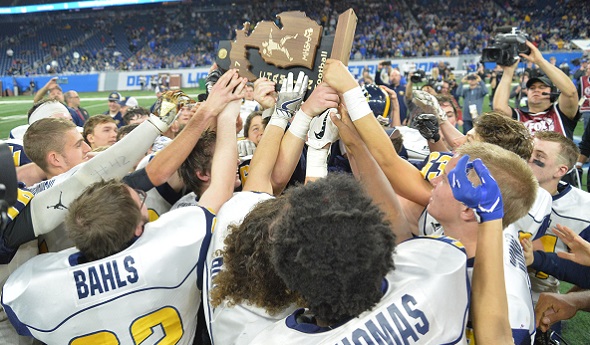
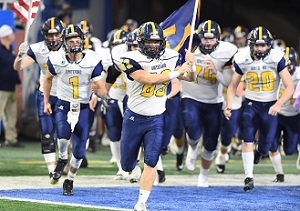
PHOTOS: (Top) Ottawa Lake Whiteford raises its Division 8 championship trophy at Ford Field last month. (Middle) Senior Eli Shelton leads the Bobcats onto the field.
'Gamer' Helps Shores Gut Out 1st Finals Win
By
Paul Costanzo
Special for MHSAA.com
November 29, 2019
DETROIT – Brady Rose walked into Ford Field on Friday carrying the backup quarterback tag.
After a performance that showed he was a backup in name only, the Muskegon Mona Shores junior walked out with the Division 2 Football championship.
Rose, who was starting in place of injured all-stater Caden Broersma, accounted for 212 total yards and four touchdowns as he led the Sailors to their first Finals title with a 35-26 win over Detroit Martin Luther King.
“He looked like an athlete,” King coach Ty Spencer said when asked if Rose looked like a backup. “He looked like a very good athlete that just helped his team win a state championship.”
A year after coming up one win short of the program’s first title, Mona Shores (12-2) pulled off what most considered to be an upset against a King team that featured three Division I college committed recruits and several other players who hold Division I and II offers. Not only were the Sailors without Broersma, but they had to replace nine defensive starters from a year ago.
They suffered a 53-0 loss in Week 8 to Division 3 finalist Muskegon and played two of their first three playoff games on the road. In the Semifinal victory over Walled Lake Western, Broersma injured his back on the first series, and the Sailors used a 2-point conversion in the final minute to pick up the win.
“People go back to our whoopin’ (against) Muskegon … I know it sounds crazy, but that was one of the best things that happened to us,” Mona Shores coach Matt Koziak said. “It obviously humbled us, made us dig a little deeper and understand that we might not be as good as we think we are without doing the little things. I understand that we were picked to lose, and we probably should have been picked to lose. But I told them after last game, I would never bet against them in anything – in life. They just find a way.”
There was no comeback needed Friday, as the Sailors not only never trailed, but were never tied after taking a 7-0 lead on their first drive. But they were certainly pushed, and responded with an 8-minute, 40-second drive in the fourth quarter that put the game away.
After King’s Peny Boone scored on a 66-yard run with 10:45 remaining, the Crusaders unsuccessfully went for two to try to tie the game at 28.
Mona Shores responded with a 14-play, 72-yard drive that was capped off by a two-yard touchdown run by Rose, his third of the game. The Sailors converted two third downs and a crucial 4th-and-1 at the King 12 to keep the drive alive and essentially put the game away.
“That last drive was 8:40, almost a 9-minute drive, when things weren’t going our way,” Koziak said. “King just kind of came out and was kind of like, ‘Bam. Bam.’ Kind of punched us in the mouth. (Rose) just didn’t get rattled by it. It’s almost like he’s playing on a middle school field; he doesn’t get caught up in the moment.”
 Rose was 8-of-11 passing for 122 yards and a touchdown and added 90 yards on 21 rushes.
“Coach has confidence in me being the backup quarterback, so he just did the same thing as we would be doing if Caden was quarterback,” Rose said. “We just chipped away – 3rd-and-1, first down. 3rd-and-1, first down. We just chipped the clock away.”
Broersma also had confidence that his teammate could get the job done.
“I’ve said before that Brady Rose is just a gamer,” Broersma said. “You can put him in any situation and he’ll handle it better than probably 90 percent of this Earth. There’s really no question having him play quarterback. There’s total belief in him, there’s total belief in every play call and the coaching he gets. I’m super happy to see him succeed.”
Broersma’s No. 4 did make its way onto the field, and made quite an impact, as teammate Kolbe Trovinger wore it and finished with seven tackles and the game-sealing interception with 36 seconds play.
The two interceptions and a fourth-down stop ultimately made the difference, as they were the stops the Crusaders were unable to get on the other side of the ball.
Also, it was the first time since 1993 and second time in Finals history that neither team punted.
“Really it just came down to getting the big stop,” Spencer said. “We had one of them, but then we turned the ball over on that drive. We had to get that big stop and make a play and I think it would have turned our way, but we didn’t.”
The Mona Shores offense was nearly unstoppable in the first half, scoring on all three of its drives. Rose had a pair of one-yard scores, while Tre’Shawn Hatcher – who rushed for 95 yards on the day – added an 18-yard touchdown. The Sailors rushed for 130 yards on 23 carries in the half and added just enough passing – Rose was 5-of-7 for 64 yards during the first two quarters – to keep King honest.
King’s balanced offensive attack kept it in the game. Justin Whyte scored on a 42-yard screen pass from Dante Moore on the Crusaders’ second drive, and Boone added a one-yard touchdown run in the final seconds of the first half. A missed extra point and failed 2-point conversion kept King two scores back at halftime, but the offense did manage 200 total yards – 81 on the ground and 119 from Moore’s arm – during the opening 24 minutes.
Even on its first possession King managed to get to the Mona Shores 24-yard line, but a Cam Sobich sack on fourth down ended the threat.
The King offense stayed hot to open the third quarter, marching 73 yards in five plays, and pulling within one of the Sailors following a nine-yard Boone touchdown run and 2-point conversion pass from Moore to Marshawn Lee.
A big fourth-down stop at its own 14 gave King momentum and the opportunity to take the lead, but Rose stepped up near midfield, intercepting Moore. Seven plays later, Rose hit Jaylen Hopson for a 17-yard touchdown on fourth down. The point after put the Sailors back up eight at 28-20 with 16 seconds remaining in the third quarter. Hopson finished with five catches for 103 yards.
Boone, who has committed to Maryland, finished with 198 yards rushing, while Moore was 15-of-29 for 209 yards. Joe Frazier and Jaylen Reed each had 11 tackles for King (11-3), while Rishad Hence had eight tackles, 1.5 tackles for loss and one forced fumble.
“I thought the team’s character was outstanding to go from 0-2 to battle back and play in the state championship game and put yourself in a position to win it,” Spencer said. “We came up short, but I’m proud of these guys, proud of the seniors, proud of the way (Moore) has played all year long.”
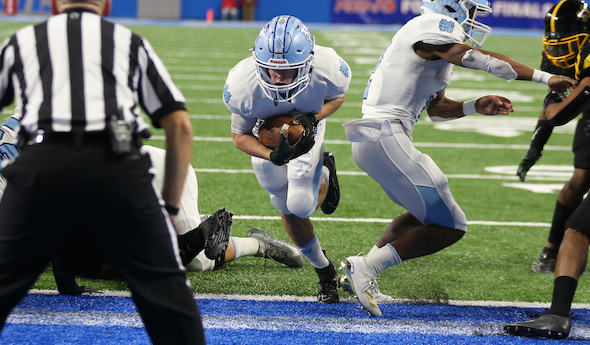
PHOTOS: (Top) Mona Shores’ Brady Rose follows a block by Tre’Shawn Hatcher into the end zone Saturday. (Middle) A Mona Shores defender gets an arm around King quarterback Dante Moore.