


The Whole Body of Work
June 27, 2016
From time to time over the years, criticism has been leveled at the Michigan High School Athletic Association because an MHSAA publication cover lacked a certain number of photos of females or minorities, or a certain balance of large schools or small schools or nonpublic schools ...
My response has always been, “Don’t base your opinion on one cover. Look at the whole body of work. Look at the covers across all sports and an entire year.”
So, when there was recent criticism that our football practice policy wasn’t progressive enough, that it allows (in theory only) too much time for contact drills, my response is: Look at the entire body of work.
The MHSAA was one of the first states in the nation to limit contact in football practice, both preseason and regular season. Some states still do not.
Some of the states which appear to have more restrictive practice policies in the fall also allow football practice in the spring, which actually increases exposure to injury. Michigan does not.
Some states which appear to have more restrictive practice policies in the fall also allow contact at out-of-season football camps, which actually increases exposure to injury. Michigan does not – never has allowed its players to participate in contact drills at football camps, a policy to which some states are returning because of the safety concerns we’ve always had in Michigan.
Some states allow students to participate in five, six or even eight quarters of football games in a single week. In Michigan, students can play in one game only during any five day period, never two, and never part or all of a JV game one day and part or all of a varsity game another day during the same week. That’s been Michigan’s rule for decades, and some states are finally moving in that direction.
-
The MHSAA is the first and only state to provide concussion care gap insurance at its own cost to assure all students have prompt and professional medical attention without the worry of unpaid medical expenses. This is for all students in all levels of all sports, practice and competition, grades 6 through 12.
-
The MHSAA conducts the nation’s largest high school association managed sideline concussion detection pilot program.
-
The MHSAA conducts the nation’s broadest and deepest high school association managed concussion reporting system.
There is still more to the whole body of work – but the point is made. Criticism of the MHSAA for lack of attention to participant safety – in football or any other sport – is wholly unjustified.
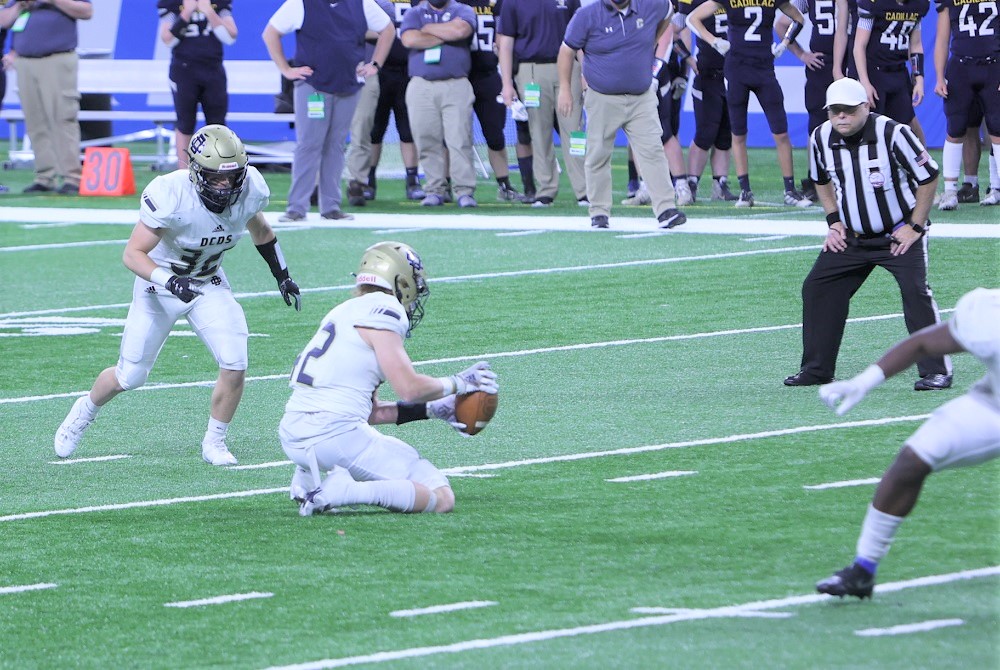
Be the Referee: Field Goal Falls Short
By
Sam Davis
MHSAA Director of Officials
September 30, 2021
Be The Referee is a series of short messages designed to help educate people on the rules of different sports, to help them better understand the art of officiating, and to recruit officials.
Below is this week's segment – Field Goal Falls Short - Listen
Three things can happen if a field goal attempt crosses the line of scrimmage but comes up short of the goal line. Do you know all three?
First, the ball can go out of bounds. If that happens, the ball is dead and on the change of possession, the team newly on offense takes over where the ball went out of bounds.
Second, the kicking team can be the first to touch the ball. When that happens, this is the first touching and again the team newly on offense takes over where the ball was downed.
And third, the receiving team can return the kick. And they would take over on offense after the returner has been tackled or goes out of bounds.
Think of a field goal attempt as a punt, and you’ll always know what’s possible if the kick comes up short of the goal line.
Previous editions
Sept. 23: Volleyball Obstruction - Listen
Sept. 16: Catch or No Catch - Listen
Sept. 9: Intentional Grounding – Listen
Sept. 2: Pass Interference – Listen
Aug. 26: Protocols and Mechanics – Listen