Young's Magic Will be Missed in Muskegon
By
Tom Kendra
Special for MHSAA.com
January 10, 2018
Muskegon High School’s historic Hackley Stadium was not an easy place for Gene Young to navigate in recent years, with his hulking 6-foot-6 frame slowed by neuropathy in both feet and worsened this past fall by a nasty infection on his left heel.
 But few people have ever been more positive than Young, a giant – literally and figuratively – in the Muskegon area sports, broadcasting and education communities who died on Jan. 2 at the age of 76.
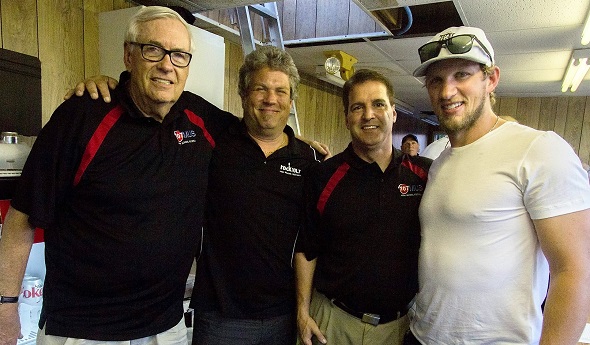
Young was determined to make it up to the Hackley Stadium press box back on that August day last fall, to broadcast the Big Reds’ opening game against Ann Arbor Pioneer with myself and play-by-play man Larry Taylor on Muskegon radio station WMUS-FM 107.9 – kicking off his 39th year as the voice of high school football on the lakeshore.
The first challenge was parking.
“Tommy, pull into that lot across from the gate. I know the people working there,” said Young, who seemingly knew everybody, everywhere.
Gene rolled down his window and I couldn’t hear his exact words, but I know he gave $10 instead of the $5 charge (the proceeds were going to help out Muskegon’s minor sports programs). He also put a smile on that parking lot attendant’s face and made him feel like the most important part of the entire game-day operation.
That’s the Gene Young magic.
The next hurdle was crossing Sanford Street and getting into the stadium.
Back in his heyday, Gene was a fantastic athlete, a standout big man and 1959 graduate of Muskegon Heights High School, who accepted a basketball scholarship to Central Michigan University and played on the varsity basketball team as a freshman. He transferred to Otero Junior College in Colorado for one year, before playing his final two years for Weber State University in Utah, coached by NBA legend Dick Motta.
But this past fall, crossing the street was getting to be a challenge.
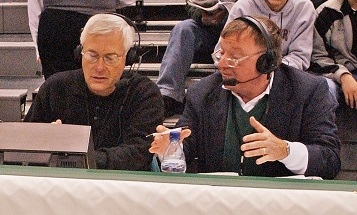 The gate attendant spotted him making his way slowly across Sanford with his cane and began undoing the padlocked gate. Young never needed to show a press credential in the Muskegon area, as he and his buddy Jim Moyes had been the voice and the spirit of Muskegon-area high school sports since they first started working together in 1978. The two filled their broadcasts with memories and insights brought in from their deep knowledge of Muskegon’s sports history.
As Gene and I were let in, many of the fans who still had to wait snickered a bit. Gene diffused the situation quickly, as only he could.
“We’re big time; we’re with ESPN,” he deadpanned.
The next part of the journey is walking down the dark tunnel and up a short ramp where you then experience that first glimpse of the hallowed ground at Hackley Stadium – it’s a moment that Muskegon locals would equate with going around “the curve” near Pere Marquette Park and seeing that first view of Lake Michigan, or an 8-year-old’s first visit to Disneyland. As he plopped down on the handicap bench up front to rest, no one knew it would be his final time to experience that thrill.
Shame on me for not appreciating that moment as I should have, because I was nervously scurrying up the bleachers to set up our radio equipment.
When I glanced down, Gene was holding court on that bench as a steady stream of folks stopped by to shake his hand.
 Some of them were old education friends like Roger Hoekenga, a retired Muskegon Public Schools administrator who stopped to talk about retirement. Gene began his teaching and coaching careers at Muskegon Reeths-Puffer, but is best known for his 26-year run as the Director of Community Education, Adult Education and Recreation at Fruitport. Upon his retirement, he specialized in helping school boards make good hires for superintendent and other administrative positions.
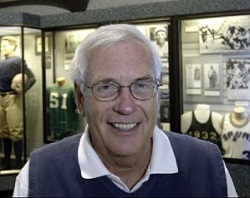
Terri Clock, the lone woman on the Muskegon Area Sports Hall of Fame board, then stopped to visit for a few moments. One of Gene’s crowning achievements had been his tireless work for the local sports hall, taking over as president in 1994 and serving in that role until his death.
“He is the hall of fame. When Dick Hedges (the first president of the MASHF) passed away, Gene took over and that was his baby,” said Moyes, who delivered a powerful eulogy at Young’s funeral service on Jan. 6. “He put hours and hours into making our hall of fame the best one. Everything was always first class with Gene.”
The equipment was all set up, and I had already done a test call with the station – and my partner was still sitting on that bench.
I just shook my head and smiled. His friends and family (and especially his wife, Sandy) were used to “Gene speed” – whether it was making his way past all of the characters at the bar to get to our table for lunch every Friday, or visiting with each of the workers on his way to the pool at the health club, or shaking everyone’s hand after church on Sunday.
 Muskegon head coach Shane Fairfield also stopped quickly to chat, thanking Gene for sending him a note of encouragement all four times his teams lost in MHSAA championship games (Fairfield told me at Gene’s visitation that he received another note this year after the Big Reds won the Division 3 title). Then, finally, Gene had a brief word with Muskegon star quarterback La’Darius Jefferson, who experienced Gene’s handshake grip, which he kept locked on until he was ready to let you go.
Only then did he start his trek up the 28 concrete rows to the Hackley Stadium press box, which included two or three more stops to rest/visit with Muskegon and Ann Arbor Pioneer fans, before he finally got to his spot at 6:25 p.m. – 5 minutes before air time.
“Tommy Kendra, I picked up some good information down there,” he said.
Those words struck me that day, and I learned a valuable lesson. As I sat there alone in the middle of the press box, sweating profusely, bored and isolated, poring over relatively meaningless stats that I already knew by heart, I realized that he was doing it the right way.
I’ve determined that the best way to honor and remember my dear friend and mentor is to never be in too big of a rush to get into the press box, to get a seat at the lunch table or a treadmill at the gym. Take it a little slower. Be interested in other people. Figure out a way to use your God-given gifts to help them. Brighten their day. And, in the process, learn a few things and gain a new perspective.
That’s the Gene Young magic.
 Tom Kendra worked 23 years at The Muskegon Chronicle, including five as assistant sports editor and the final six as sports editor through 2011. E-mail him at [email protected] with story ideas for Muskegon, Oceana, Mason, Lake, Oceola, Mecosta and Newaygo counties.
***
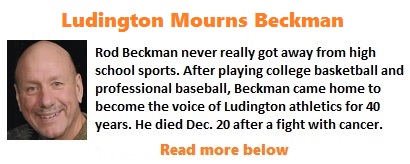
Ludington’s Beckman Came Home, Gave Back
Rod Beckman never really got away from high school sports.
Beckman, who died on Dec. 20 at the age of 69 after a five-year battle with cancer, is remembered as one of the best all-around athletes to ever come out of Shelby High School – good enough to earn a Division I basketball scholarship to Oklahoma State University and later shift gears and play three years of professional baseball in the Detroit Tigers organization.
Then Beckman went back to high school, in a way, as the voice of Ludington High School sports for 40 years, from 1972 to 2012, at radio station WKLA in Ludington, where he worked as a popular disc jockey by day.
Beckman also made an impact on high school sports as a well-known and respected baseball and softball umpire in Mason County for more than 25 years.
Ultimately, Beckman stayed involved in sports throughout his life as an outlet for his competitive nature and a way to spend quality time with family and friends. His passion for basketball and baseball later gave way to fast-pitch softball and golf, but he also did his share of bowling, hockey and racquetball. Beckman is a member of the Mason County Sports Hall of Fame.
Beckman used his popularity and name recognition to help others right up until his death.
In September, Beckman hosted the Rod Beckman Cancer Charity Golf Classic, which raised more than $70,000 for the Spectrum Health Ludington Hospital Cancer Patient Assistance Fund and The Optimist Childhood Cancer Campaign.
Beckman is survived by his wife of 21 years, Traci.
– Tom Kendra
PHOTOS: (Top) Gene Young, left, with his most recent broadcasting team of Larry Taylor (second from left) and Tom Kendra, and halftime guest Justin Abdelkader of the Detroit Red Wings, during a 2016 game. Young was working for iHeart Media station WMUS-107.9 FM in Muskegon. (Middle) The legendary broadcast duo of Young, left, and Jim Moyes, call the Class D championship game in 2002. (Below) Young poses in front of the Muskegon Area Sports Hall of Fame displays at the L.C. Walker Arena in downtown Muskegon. Young served as president of the MASHF for the past 24 years.
Students Make Championship Calls
By
John Johnson
MHSAA Communications Director emeritus
December 16, 2013
It’s a great thrill each Thanksgiving weekend for those schools that make the trip to the Finals of the MHSAA Football Playoffs at Ford Field.
For the players, they get to occupy the same space as some of their professional favorites did just hours earlier… names like Calvin Johnson and Matthew Stafford … Joe Buck, Troy Aikman and Pam Oliver.
Buck, Aikman and Oliver?!!?!?
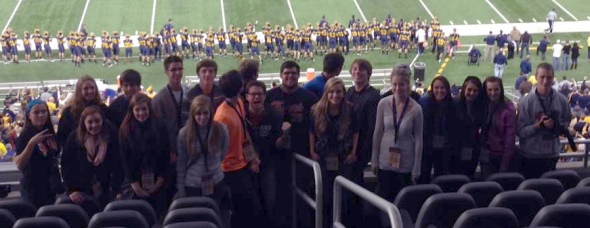
Joining the 16 schools playing the games this year were about 70 students from five other schools getting the experience of a lifetime on their own Ford Field trip as they got insights into the world of professional sports broadcasting.
The newly-founded Student Broadcast Foundation and the MHSAA partnered to provide the same kind of access the media covering the Finals get – and then some. Students visited various parts of Ford Field, including touring the Game Creek Video FX remote television facilities – the same production unit used for the Detroit Lions-Green Bay Packers contest on Thanksgiving Day, which will also originate FOX Sports’ Super Bowl XLVIII coverage at MetLife Stadium in East Rutherford, N.J., in February.
Some of the students were able to meet with media in attendance at the Finals to have their pictures taken and ask questions about careers in sports broadcasting and journalism.
Students, faculty advisors and parent-chaperones from the following schools took part in the experience: Cedar Springs, Davison, Detroit U- D Jesuit, Hillman, Warren DeLaSalle, Birmingham Brother Rice, Montrose and Detroit Catholic Central. Cedar Springs had the largest contingent with 28 students, with a parent covering the travel expenses for the group. Its experience is recapped in this embedded video.
"The whole experience at Ford Field was tremendous for our CSTV students,” said Justin Harnden, a teacher from Cedar Springs. “They were welcomed by the Student Broadcast Foundation, MHSAA, and Ford Field with open arms. Every student that attended had nothing but great things to say about everything. Seeing first-hand what it takes to put on such a big event will truly be beneficial to us as we all go forward in making our program better.”
Hillman had the second largest group with 17 students out of a student body of 151 from this school in Montmorency County, about 35 miles west of Alpena. “Absolutely outstanding job by your kids. You all made the best of your opportunity. Way to go! Your program just woke up a lot of people,” Hillman school board president Brad McLaren said in a text after the event to instructor Erin Brege.
Other videos were produced by students from Davison, Hillman and Montrose, and links to their productions are shown below. You can check out photos from the activities by visiting the Student Broadcasting Foundation’s Facebook page. Also, click to see videos shot by Davison and Montrose that now appear at MHSAA.TV.
“In the many years that Tom Skinner, Ken Kolb and I have been involved with broadcasting high school sports on radio and cable TV, this year’s Football Finals weekend was the most inspiring, satisfying, fun weekend working with these talented students and their dedicated instructors,” said Thom Lengyel, one of the founders of the Student Broadcast Foundation, a private non-profit organization.
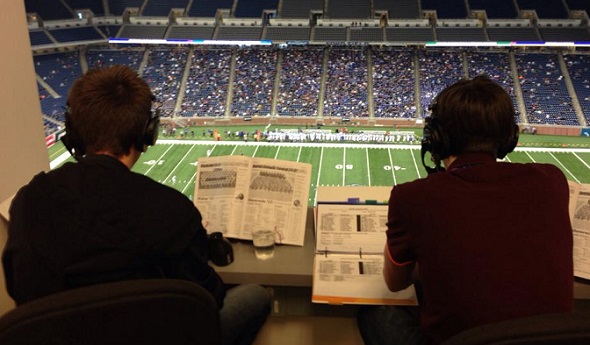
Students from the participating schools also took part in calling the action of the eight championship games on the MHSAANetwork.com website, where an average of 250 people clicked in per contest. Calling the games were:
- Cedar Springs - Kyle Maka, Kody Hall, Alex Hughes (Division 1)
- Davison - Shawn Bednard, Chris Jared, Brandon Snyder (Division 7)
- Detroit U-D Jesuit - Jack Sznewjas, Chris Houle (Division 8)
- Hillman – Mike Klein, Kyle McLaren, Noah Allen, Bubba Banks (Division 4)
- Warren DeLaSalle - Brendan Johnson, Jake O'Donnell (Division 2)
- Birmingham Brother Rice – Miles Hampton, Jeremy Otto - Mentor (Division 6)
- Detroit Catholic Central – Joesph Trojniak, Adam Abraham - Mentor (Division 5)
Several of the schools involved also are part of the MHSAA’s Student Broadcast Program, which produced nearly 1,000 events during the fall sports season for the MHSAA.TV Website.
Read more about Hillman's experience here in reports from the Alpena News and WBKB-TV. And read on for a report on Cedar Springs' experience by student reporter Kendra Coons.
C.S.T.V. Production Program “Hits it out of the park” at Ford Field
Change.
It’s a word that many people don’t deal with well. In this case, it was for the better at Cedar Springs High School.
In 2012, drama teacher, Justin Harnden took over the television program at CSHS. The second he took it over many changes were made to the C.S.T.V. program. The program bought brand new cameras, computers, TVs, and much more. He started working on getting his students to film sporting events, work on Public Service Announcements, capture the latest news in the school; and for the biggest change, start announcing play-by-play.
“We are here to put out more than just news for our school and community. We are doing sports, award shows, graduation, Red Flannel things, and much more. We are destined for great things,” expressed Harnden.
With one year under his belt, Harnden started to submit C.S.T.V.’s work to the MHSAA. After the fall season of 2013, Thom Lengyel and Ken Kolb, who are a part of the Student Broadcast Foundation, heard C.S.T.V. production students Kyle Maka and Kody Hall perform play-by-play for one of Cedar Springs’ football games. After listening to the both of them, Lengyel contacted Harnden and offered for Maka, Hall, and the rest of the class to come down to Ford Field. Lengyel explained to Harnden that the trip to Ford Field would give the class a chance to receive a behind-the-scenes look at what goes on during a broadcast and give Maka and Hall a chance to call the Division 1 championship high school football game.
On Saturday, Nov. 30 the C.S.T.V. Production program traveled out of their little town of Cedar Springs, Michigan, to face the big town of Detroit, Michigan. The day started out with the students boarding the bus at 8:15 am for a three-hour drive to the east side of the state. Once the students stepped off the bus they received their press passes. This gave them full access to walk out onto the field and sit in press row. Once the class arrived at Ford Field, they traveled up to the seventh floor to meet Lengyel. Lengyel then introduced the class to Kolb, showed them where Fox Sports does all of their announcing, and showed them where press row was located. After all of that was done, it was time for Maka and Hall to announce play-by-play for the Division 1 championship. Another member of C.S.T.V. also received a chance to announce play-by-play for the game, Alex Hughes.
Coming from a town with an estimated 3,500 people, the three boys were not used to a big stage. A lot of the community would annually attend our high school football games, but nothing to the caliber of what the three boys were about to announce.
“Doing the play-by-play was just amazing. I felt on top of the world. It was the best experience of my life,” commented Maka.
“It was honestly a feeling that I've never felt before ... It almost didn't seem real at first, but once I opened up (to) the environment I had an amazing time,” stated Hughes.
While the three boys were announcing play-by-play, the rest of the class received the opportunity to walk onto the field and sit in press row. After the game the students received the chance to walk through the Fox Sports trailers. These trailers are where all of the action happens. Being able to walk through these trailers was a once-in-a-lifetime experience for the C.S.T.V program.
“I thought looking around the Fox Sports Detroit mobile studio was eye opening. Seeing two of the three trucks that will handle all the production aspects of the Super Bowl was really great. We were able to see all that goes on in that setting, and we were amazed by it,” explains Harnden.
“Getting to tour Fox Sports was crazy because normally the behind the scenes work isn't seen at all, so that opportunity was perfect for the class,” said Hall.
After the students toured the buses, they all headed back up to the seventh floor to grab their things, say their goodbyes, and thank Lengyel and Kolb for the opportunity. Right before the class got ready to leave Lengyel had a few words to say to the class. He told the class how well they were behaved and how well the three boys did at calling the game.
“Getting those compliments from someone who has been in the business for so long was quite overwhelming, especially for myself not knowing much about football and (it) being the first time doing commentary,” said Hughes.
“(I had) a sense of joy and pride. I was so glad that somebody of his job caliber enjoyed how we did,” added Hall.
“When Thom gave us those compliments, I just could not stop smiling. When Thom said that we were just as good on our fourth game as those who have been calling games for four years, (it) just made me believe that this is something I can really do for the rest of my life. I hope that dream comes true,” commented Maka.
Not only did Lengyel and the rest of the class believe they did a great job, Maka, Hughes, and Hall’s teacher also believed they did exceptionally.
“I thought Kyle, Kody, and Alex did a great job. This was only the fourth game that they have called and they went above and beyond our expectations. Everyone involved with the production was impressed with what they did,” stated Harnden.
The students were able to take away many things from traveling to Ford Field. Going behind the scenes of Fox Sports is something not many people get a chance to say that they did. The class and Harden believe it was very beneficial to be able to participate in an experience like this.
“The students were exposed to a lot of aspects within media production. From press row, to the Fox Sports Detroit mobile studio, calling the game on the radio, and being allowed to see every aspect of a big stadium production really was eye opening,” explained Harnden.
The experience of traveling to Ford Field was definitely an experience that none of the class members will ever forget. Not only did they have a blast, but they learned a ton too.
“I definitely think that the trip benefited the class because we (were all able) to see things about professional broadcasting that most people can't. (Also) we (were able) to learn what it takes to make a professional broadcast,” says Maka.
The day after the program traveled to Ford Field, Lengyel emailed Harnden about C.S.T.V. Production and his view on their performance.
“... During the broadcast I knew that they were doing a good job,” expressed Thom. “So I wanted to listen to their broadcast when I got home. I could not put the mp3 player down. I did not pause it until halftime. For their fifth broadcast, listening to their preparation come out in the broadcast, changed my opinion to: THEY HIT IT OUT OF THE PARK.”
Lengyel has been in the business for many years. Having a compliment like that from a man with so much experience really hit home for the C.S.T.V. Production program.
If you would like to see what C.S.T.V. is all about, like us on Facebook, “CSTV”, follow us on Twitter “@CedarSpringsTV”, visit our website, “www.cedarspringstv.com” and make sure to watch our newscasts and listen for our play-by-play on MHSAA.TV.
C.S.T.V. Production truly wants to thank the Student Broadcast Foundation for the opportunity it was given. And a special thanks to Lengyel and Kolb for selecting C.S.T.V. and helping with advancing the program to the next level.
Hughes stated, “I can't thank the Student Broadcast Foundation and the MHSAA enough for letting our class have the opportunity to go to Ford Field and experience everything that we did. I would also like to thank our teacher Justin Harnden for turning around our TV Pro program. … Lastly, I would like to thank our class for always being there for one another and making this year memorable.”
PHOTOS: (Top) Two students call a game during the MHSAA Football Finals. (Below) Some of the students who visited Ford Field pose during a championship game. (Photos courtesy of the School Broadcast Foundation.)