


Zeeland West Puts 'T' in 3rd MHSAA Title
November 30, 2013
By Bill Khan
Special to Second Half
DETROIT — Danny Bauder would rather trade touches for trophies.
In most other offenses, a player of Bauder's ability would be a featured running back. What team wouldn't want to keep feeding the rock to a kid who ran for 1,796 yards and 28 touchdowns this season?
Bauder did all of that damage, despite the fact he shares the load in the shell game that is Zeeland West's run-oriented Wing-T offense.
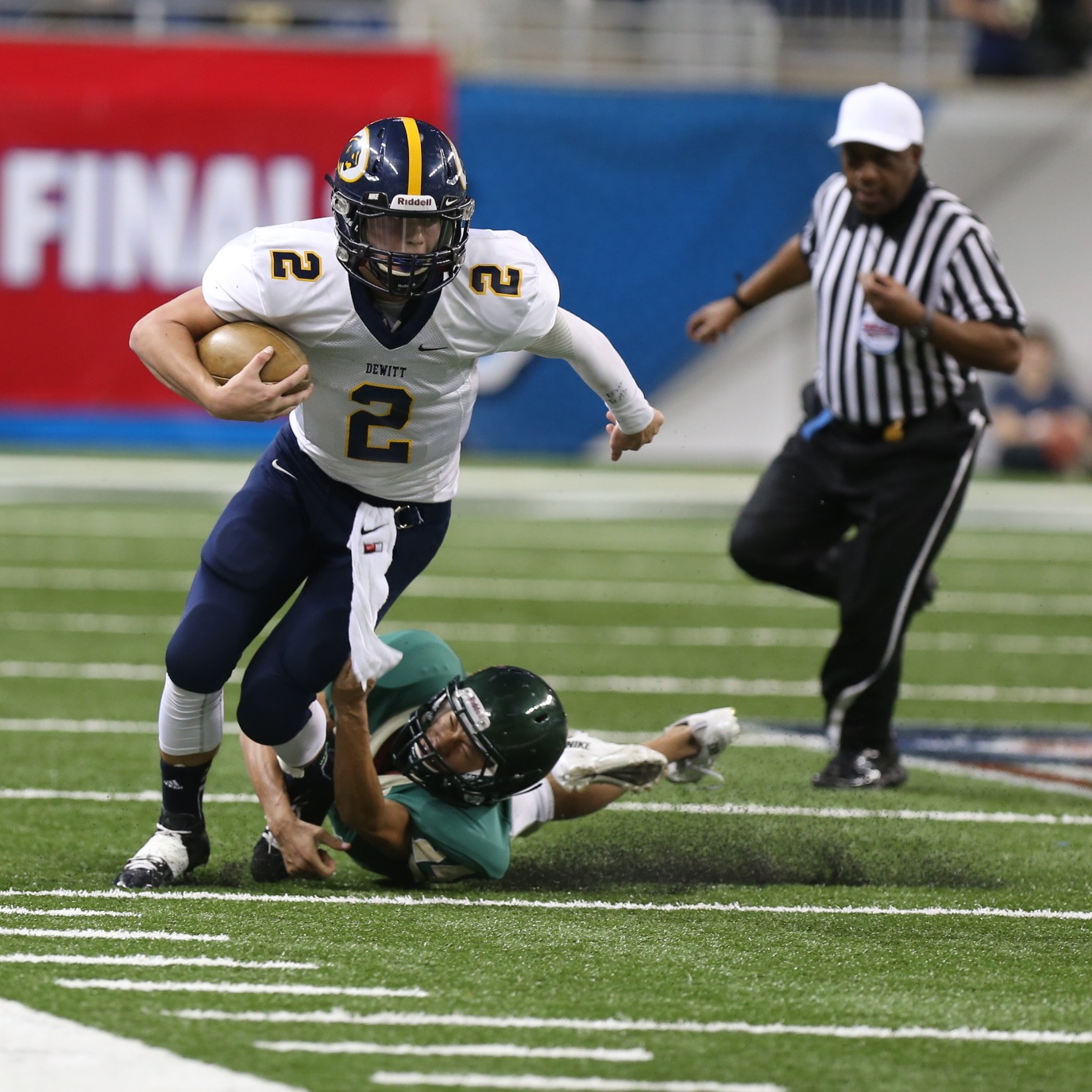
He once again had maximum impact on minimal carries, running eight times for 144 yards and a touchdown in West's 34-27 victory over DeWitt in the MHSAA Division 3 championship game Saturday at Ford Field.
Two teammates had more carries than Bauder, as the Dux rolled up 441 rushing yards on 66 carries. Cole Hession had 26 carries for 122 yards, quarterback Casey Brinks had 11 carries for 66 yards and Grant Postma had six carries for 71 yards and two touchdowns.
They all shared in the same accomplishment with their teammates — West's third MHSAA title in the nine-year history of the school. The Dux (13-1) were Division 4 champions in 2006 and 2011.
"I love (our offense), because everyone has a chance to get the ball," said Bauder, who got things rolling with an 80-yard touchdown run on the second play from scrimmage. "We have three backs. We rotate them like every other drive. It's a good team offense. It's a team. I don't mind, just as long as we win."
 Led by its ground attack, West appeared to be on the verge of running away with this one, building a 28-7 halftime lead.
The Panthers wouldn't allow the Dux to coast to the championship that easily, however.
A 56-yard touchdown run by Chris Ruby and a 29-yard scoring strike from Jake Johnson to Josh Borta in a 72-second span got DeWitt within 28-20 with 6:50 left in the third quarter.
West responded with a 25-yard touchdown run by Brinks with 2:57 to go in the third, but an offense that averaged 48.9 points per game coming into the contest wouldn't score again. Junior defensive back Ben Zamiara led DeWitt's defensive charge with a game-high 20 tackles, 11 more than anyone else on either team. The Panthers held West to 1-for-4 on fourth-down conversions.
"I'm pretty sore right now," Hession said. "This is one of the games I've come out of the most sore. I can feel it right now, and my adrenaline is still rushing. Props to them, because they came out and they had three or four series where they stopped us on fourth down. Not many teams can do that. They're just good."
DeWitt closed the deficit to seven points when Johnson rolled left and hit a wide-open Borta for a 75-yard touchdown with 4:25 left in the game.
The Panthers' offense would watch the rest of the game on the sidelines. The Dux milked some clock by getting two first downs before dropping back to punt from its own 48 for the only time in the game. Postma barely got off the punt, but was knocked to the ground when a DeWitt defender caught him on the leg while going for a block. West retained the ball, running out the remaining 32 seconds by taking a knee one time.
"Our punter was already hurt," West coach John Shillito said. "He was on one leg. So, it was a great effort by Grant to get the ball off and it was a break for us. We knew the game was over. You knew that all you had to do was take a knee."
DeWitt coach Rob Zimmerman said going for the block was a risk the Panthers had to take, given the time on the clock and the potential field position.
"If they punt and pin us down at the 10, that's a long way to go," Zimmerman said. "We went for it. Obviously, it didn't turn out in our favor. You have to take chances when you're in that situation."
DeWitt tried in vain to play catch-up all night after falling behind 8-0 when Bauder took the ball around the left side of the Dux line and broke into the clear for an 80-yard touchdown just 45 seconds into the game. West, which attempted (and missed) only one extra-point kick all year, got two points on a pass from Brinks to Zach Poppema.
West scored on four of its five possessions in the first half, failing only on its second series when a fourth-and-five run from the DeWitt 13 came up a yard short.
The Dux shook off that temporary setback and scored on a 7-yard pass from Brinks to Hession on the first play of the second quarter. Hession ran for the 2-point conversion to make it 16-0.
Following a fumble at the West 49, the Dux took a 22-0 lead on an 18-yard run up the middle by Postma with 6:45 left in the first half. Brinks' conversion run failed.
DeWitt (13-1) finally put a drive together and got back in the game on a 4-yard touchdown pass from Johnson to Justice Shankel with 3:15 left in the first half. Cameron West's extra point made it a 22-7 game.
The Dux didn't get away from their ground game with time winding down in the first half, throwing only one pass on a seven-play, 80-yard drive that yielded a 12-yard touchdown run by Postma with 1:04 to go in the half. Postma's 2-point run failed, resulting in a 28-7 halftime lead for West.
"We dug ourselves too deep a hole," Zimmerman said. "I felt if we got one more possession, we had a shot."
Johnson, a junior, was 15 for 24 passing for 289 yards, three touchdowns and two interceptions for DeWitt. Brinks was 3 for 5 for 35 yards and a touchdown for West.
Borta grabbed five passes for 183 yards and two touchdowns.
PHOTOS: (Top) Zeeland West running back Danny Bauder scampers ahead during Saturday's Division 3 Final. (Middle) DeWitt quarterback Jake Johnson tries to pull away from a Dux defender's grasp. (Photos by Hockey Weekly Action Photos).
Drive For Detroit: 11-Player Semis Review
November 19, 2018
By Geoff Kimmerly
Second Half editor
On Saturday, 16 football teams traded a long, relaxing Thanksgiving weekend for a work trip to Detroit.
 They’d have it no other way.
There’s much to tell about every team heading to Ford Field for this weekend’s MHSAA Finals, and we’ll get to that soon. (Check back Wednesday evening for previews of all eight championship games.)
Let’s start the week with a glance at all 16 Semifinals from Saturday, including video highlights all by State Champs Sports Network. “Drive for Detroit” is powered by MI Student Aid.
Division 1
Clarkston 21, Saline 3: The reigning Division 1 champion Wolves (11-2) prevailed by continuing a defensive effort that has now allowed only 16 points total over four playoff games. Saline (11-2) had 215 total yards and only 58 rushing on 20 carries. Click for more from the Oakland Press.
??VIDEO: Check out the highlights of the Clarkston (@ClarkstonWolves) vs. Saline - Division 1 Semifinal from this afternoon pic.twitter.com/A9ygMxuT8v
— STATE CHAMPS! (@statechampsnet) November 18, 2018
Clinton Township Chippewa Valley 28, Belleville 16: The Big Reds (13-0) moved on to the Finals for the first time since 2001 by handing the Tigers (12-1) their only loss. Chippewa Valley held Belleville to its second-fewest points in a game over the last two seasons. Click for more from the Macomb Daily.
??VIDEO: Check out the highlights of the Chippewa Valley (@CVBigReds - @ChippewaSports) vs. Belleville - Division 1 Semifinal from this afternoon pic.twitter.com/TTWZ1oMtaU
— STATE CHAMPS! (@statechampsnet) November 18, 2018
Division 2
Muskegon Mona Shores 49, Midland 28: After three seasons away, the Sailors are heading back to Ford Field for the second time seeking their first MHSAA title. Mona Shores (12-1) took the lead for good with 4:41 to play in the third quarter and then scored 22 points in the fourth to outlast the Chemics (9-4). Click for more from the Muskegon Chronicle.
??VIDEO: Check out the highlights of the Muskegon Mona Shores (@sailorathletics) vs. Midland - Division 2 Semifinal from Saturday afternoon pic.twitter.com/ozwtinyokJ
— STATE CHAMPS! (@statechampsnet) November 18, 2018
Warren DeLaSalle 28, Birmingham Groves 0: The reigning Division 2 champion will play for its third title in five seasons after handing Groves (10-3) its first shutout since 2013. DeLaSalle (11-2) scored the game’s first points late in the first half before pulling away during the second. Click for more from the Macomb Daily.
??VIDEO: Check out the highlights of the De La Salle (@delasallehs - @DLSBrozone) vs. Groves - Division 2 Semifinal from this afternoon pic.twitter.com/8EYyRqxYFv
— STATE CHAMPS! (@statechampsnet) November 18, 2018
Division 3
Muskegon 45, Zeeland East 22: The Big Reds (13-0) averaged 50 points per game entering the weekend, so by that comparison they were slowed a bit. But considering Zeeland East (11-2) was giving up only 19 per game, it’s fair to say the reigning champs are in Finals form coming off their 27th straight victory. Click for more from the Muskegon Chronicle.
??VIDEO: Check out the highlights of the Muskegon (@OnMuskegon) vs. Zeeland East - Division 3 Semifinal from Saturday afternoon pic.twitter.com/M5wFNrkvv1
— STATE CHAMPS! (@statechampsnet) November 18, 2018
Detroit Martin Luther King 34, DeWitt 21: DeWitt (12-1) pulled within six early in the third quarter before King scored 14 unanswered points to secure the win. The Crusaders (11-2) will be playing for their third title in four seasons after winning Division 2 in 2015 and 2016. Click for more from MLive-Detroit.
??VIDEO: Check out the highlights of the Detroit King (@DetKingFootball) vs. DeWitt - Division 3 Semifinal from Saturday afternoon pic.twitter.com/y9n1XHUvHt
— STATE CHAMPS! (@statechampsnet) November 18, 2018
Division 4
Edwardsburg 46, Grand Rapids Catholic Central 44 (OT): In arguably the most dramatic finish from the weekend, Edwardsburg won this rematch of the 2017 Division 4 Final. The Eddies (13-0) scored first in overtime and went up eight, then stopped GRCC (11-2) on a 2-point conversion try after the Cougars also found the end zone. Click for more from the Niles Daily Star.
??VIDEO: Check out the highlights of the Edwardsburg (@EddiesAthletics) vs. Grand Rapids Catholic Central - Division 4 Semifinal from Saturday afternoon pic.twitter.com/tmerwqOjTN
— STATE CHAMPS! (@statechampsnet) November 18, 2018
Chelsea 38, Williamston 13: The Panthers (10-3) are headed to their second MHSAA Finals in four years after knocking off a league champion for the second time this playoffs. Chelsea held Williamston (10-3) to season-low scoring while putting up the most points the Hornets had given up this fall. Click for more from the Sun Times News.
??VIDEO: Check out the highlights of the Chelsea (@ChelseaBulldogs) vs. Williamston - Division 4 Semifinal from Saturday afternoon pic.twitter.com/dFJA48ZS7E
— STATE CHAMPS! (@statechampsnet) November 18, 2018
Division 5
Hudsonville Unity Christian 14, Saginaw Swan Valley 7: This may have stunned some as Swan Valley (12-1) was the reigning Division 5 runner-up and rarely had been challenged. But Unity Christian’s defense had its most impressive game of the fall, holding a Vikings offense averaging 42 points per game to just a first-half score. The Crusaders (11-2) earned their first Finals berth and set a program record for wins in the process. Click for more from the Grand Rapids Press.
??VIDEO: Check out the highlights of the Unity Christian (@UCSaders) vs. Swan Valley - Division 5 Semifinal from Saturday afternoon pic.twitter.com/H6XGq6BkiO
— STATE CHAMPS! (@statechampsnet) November 18, 2018
Portland 35, Marine City 14: The Raiders (13-0) ran for five touchdowns and continued their streak of holding every opponent to 20 or fewer points to earn a trip to Ford Field for the first time since winning Division 5 in 2012. The Mariners (10-3) were on their longest playoff run since 2013, but scored their fewest points this season and tied their most given up. Click for more from the Lansing State Journal.
??VIDEO: Check out the highlights of the Portland (@RaidersPAA) vs. Marine City - Division 5 Semifinal from Saturday afternoon pic.twitter.com/0kMbjQ0weL
— STATE CHAMPS! (@statechampsnet) November 18, 2018
Division 6
Montague 14, Traverse City St. Francis 7: In a season of solid wins, it’s hard to argue this wasn’t the best for the Wildcats (11-2), who will head to the Finals for the first time since 2009 after handing St Francis (12-1) its only defeat. The Gladiators had been held to single-digit scoring only one other game over the last five seasons – in last year’s Semifinal. Click for more from the Local Sports Journal.
??VIDEO: Check out the highlights of the Montague (@Gue_Football) vs. Traverse City St. Francis - Division 6 Semifinal from Saturday afternoon pic.twitter.com/tj8FacmNDE
— STATE CHAMPS! (@statechampsnet) November 18, 2018
Jackson Lumen Christi 42, Montrose 20: The Titans (12-0) will get a chance to earn their third straight Division 6 championship after ending Montrose’s best run since making the Semifinals as well in 2013. After the Rams (10-3) took the lead twice during the first quarter, Lumen scored 34 unanswered points. Click for more from the Jackson Citizen Patriot.
??VIDEO: Check out the highlights of the Lumen Christi (@LumenChristiJxn) vs. Montrose - Division 6 Semifinal from this afternoon pic.twitter.com/BI57ULndjJ
— STATE CHAMPS! (@statechampsnet) November 18, 2018
Division 7
New Lothrop 51, Lake City 22: The Hornets (12-1) are headed to the Finals for the first time since 2006 after scoring 30 points during the first half and breaking away after Lake City cut the lead to eight early in the second. For the second straight season, the Trojans (12-1) ended with their lone loss in the Semifinals. Click for more from the Owosso Argus-Press.
??VIDEO: Check out the highlights of the New Lothrop (@NLAPS) vs. Lake City - Division 7 Semifinal from Saturday afternoon pic.twitter.com/JvQ6soXHUo
— STATE CHAMPS! (@statechampsnet) November 18, 2018
Madison Heights Madison 37, Cassopolis 34: Madison (13-0) will play in its second Final after denying Cassopolis the opportunity to reach its first. The Rangers (12-1) trailed by one at halftime and two at the end of the third quarter but couldn’t catch completely up. Cassopolis had given up only 52 points this season heading into the game, and Madison hadn’t allowed more than 20 to any opponent. Click for more from the Oakland Press.
??VIDEO: Check out the highlights of the Madison Heights Madison vs. Cassopolis - Division 7 Semifinal from this afternoon @Ab44Brown pic.twitter.com/fu3OwkbmZF
— STATE CHAMPS! (@statechampsnet) November 18, 2018
Division 8
Breckenridge 12, Harbor Beach 0: Since going 0-9 in 2015, Breckenridge is a combined 32-3 including 13-0 this fall – and the Huskies will next play in their first MHSAA Final. The Huskies posted their eighth shutout (on the field, not counting a forfeit win) and second of the playoffs to stop the Pirates (11-2). Click for more from the Mount Pleasant Morning Sun.
??VIDEO: Check out the highlights of the Breckenridge vs. Harbor Beach - Division 8 Semifinal from Saturday afternoon pic.twitter.com/UrvDKDUCjf
— STATE CHAMPS! (@statechampsnet) November 18, 2018
Reading 38, Holton 0: The Rangers (13-0) also earned their first championship game berth with a shutout, their seventh this season. Holton was one of only three teams this fall to hold Reading under 40 points, but the Red Devils (8-4) saw their longest playoff run end with a first trip to the Semifinals. Click for more from the Hillsdale Daily News.
??VIDEO: Check out the highlights of the Reading vs. Holton - Division 8 Semifinal from Saturday afternoon pic.twitter.com/v1rG4LdOUJ
— STATE CHAMPS! (@statechampsnet) November 18, 2018
Second Half’s weekly “Drive for Detroit” previews and reviews are powered by MI Student Aid, a part of the Student Financial Services Bureau located within the Michigan Department of Treasury. MI Student Aid encourages students to pursue postsecondary education by providing access to student financial resources and information, including various student financial assistance programs to help make college more affordable for Michigan students. MI Student Aid administers the state’s 529 savings programs (MET/MESP) and eight additional aid programs within its Student Scholarships and Grants division. Click for more information and connect with MI Student Aid on Facebook and Twitter @mistudentaid.
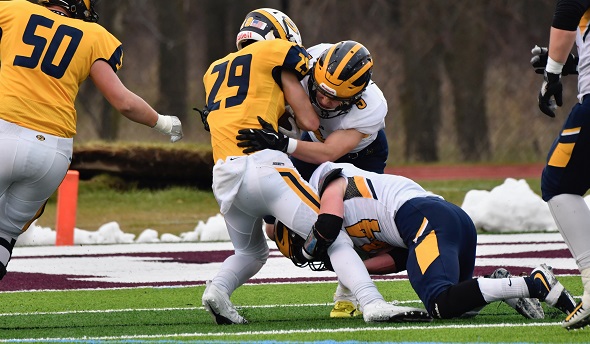
PHOTO: Clarkston's defense locks down a Saline ball carrier during the Wolves' Division 1 Semifinal win Saturday. (Photo by Terry Lyons.)