

Zeeland West Rumbles to Another Title
November 27, 2015
By Bill Khan
Special for Second Half
DETROIT — The Zeeland West offensive machine was in good hands the last three seasons with Casey Brinks directing the attack.
 The Dux’ senior quarterback brought two teams to Ford Field during his varsity career, and ended it Friday night helping hoist a second MHSAA championship trophy.
West scored its first of five touchdowns with 35 seconds left in the first quarter and didn't let up from there, pounding its way to a 40-14 victory over Flint Powers Catholic for a fourth championship in 10 years.
"That one (in 2013) was really fun, but this one to me is a lot better, just being a senior and it's my last year," Brinks said. "To end my football career playing on a state championship team in Ford Field is amazing."
Brinks was the starting quarterback as a sophomore when West won its last title, throwing for one touchdown and running for another in a 34-27 victory over DeWitt in the Division 3 championship game. He also led West to the Semifinal round a year ago.
Brinks was one of three Dux who played in the 2013 championship game, the others being running back Dakota Geurink and lineman Zach VanValkenburg. Geurink ran 14 times for 71 yards and a touchdown Friday. VanValkenburg had two sacks among three tackles for losses.
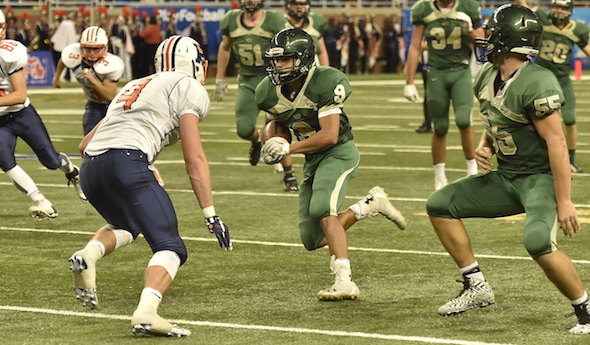
With his team facing fourth-and five near the end of the first quarter, fullback Darius Perisee scored on an 8-yard run for the opening touchdown and then added a 2-point conversion run. He was the top gainer for West's powerful T offense, finishing this season with 1,982 yards and 30 touchdowns rushing.
Brinks doesn't pass often but he was highly effective when he did. He finished 4 for 4 for 103 yards, with three straight completions on the team’s third possession. Tyler Thompson capped that drive with a 5-yard touchdown run, then added a 2-point run to make it 16-0 with 4:03 left in the second quarter.
Powers (11-3) drove to the West 18 late in the first half, only to be denied on the final play before halftime when Brinks picked off a pass in the end zone. He also had an interception in the third quarter, playing defense for only the second time this season.
"I played defense last week for the first time," said Brinks, who ran five times for 45 yards and a touchdown. "Otherwise, I didn't play defense. It was nice to play. Mostly in the playoffs, we've been playing running teams. We've played two passing teams the past two weeks."
 West came into the game running the ball 94 percent of the time and averaging 8.6 yards per carry. Even though Powers knew what was coming, the Chargers were unable to stop the Dux’ power-running attack.
Powers did get a huge stop when Reese Morgan caught Brinks for no gain on fourth-and-three from the Chargers' 5-yard line on the first series of the game, but West went on to score on its next five drives before running out the final 3:55 on its final possession.
"It's just a very deceiving offense they run," Morgan said. "It's hard to know who has the ball."
The Chargers nearly turned the momentum from that first defensive stop into a scoring drive of their own, marching down to West's 14-yard line on their first possession. On fourth-and-one, however, quarterback Noah Sargent came up inches short of a first down with 4:53 left in the first quarter.
"That was tough, but you can't say we lost the game on one play," said Sargent, who ran 17 times for 89 yards and a touchdown while going 12 for 19 for 158 yards, a touchdown and three interceptions through the air. "You've got to play the whole game."
Powers got on the board on the first possession of the second half, scoring on a 15-yard run by Sargent, but a 2-point run by Morgan was stopped by Riley Brinks. With West cashing in on all five of its 2-point conversion tries, the Chargers couldn't afford to miss theirs.
West (14-0) responded with a 13-play, 80-yard march that ended on a 4-yard run by Geurink with 3:14 to go in the third quarter. Following Casey Brinks' second interception, West built its lead to 32-6 on a 2-yard run by Thompson with 10:36 to go in the game.
Luke Brcic caught a 35-yard touchdown pass from Sargent and threw a 2-point conversion to Morgan with 7:28 remaining, getting Powers within 32-14, but Aaron Sleeman recovered the onside kick for the Dux.
Four plays later, West capped the scoring on a 39-yard run by Casey Brinks and Perisee's third 2-point run with 5:13 remaining.
Geurink picked off a pass with 3:55 remaining, and West was able to run out the rest of the clock and celebrate another championship.
"We've won four," West coach John Shillito said. "They're all different, but this one might have been the most complete on both sides of the ball. It's maybe not the deepest team, because we were playing a lot of guys two ways. I looked out there and we looked a little tired at times, because it's warm in here. It's maybe not the deepest (team), but the guys on the field were probably the best we've had."
West was able to score 40 points against a Powers team that had a school-record six shutouts, allowing only 21 points over its first four playoff games.
"I really just figured we had to score every time we had the ball, because no one has really stopped them all year," Powers coach Bob Buckel said. "Playing them, you start doing things you're uncomfortable doing, because you don't want to turn the ball over to them."
Thompson ran 16 times for 117 yards and two touchdowns to lead a West ground attack that had 318 yards and five touchdowns on 55 carries.
Matt Wiskur caught five passes for 70 yards, while Morgan ran 13 times for 61 yards for Powers. Both of them had brothers on the Chargers' 2011 Division 5 championship team.
The MHSAA Football Finals are sponsored by the Michigan National Guard.
PHOTOS: (Top) Darius Perisee breaks free for yardage in leading the Zeeland West rushing attack Friday. (Middle) The Dux hoist a championship trophy for the second time in three seasons.
A Game for Every Fan: Week 3
September 10, 2015
By Geoff Kimmerly
Second Half editor
League play begins this week for many teams across Michigan – and with favorites facing off immediately in games that eventually could decide who wins those conference titles.
The highlighted matchups below include a few of those, but mostly some of the last titanic nonleague battles we'll see this fall – at least, until we reach the MHSAA playoffs.
All games below are tonight unless noted. Follow all of the results as they come in at the MHSAA Score Center. And keep an eye on Muskegon vs. Grandville; with their next win, the Big Reds will become the first program in state history with 800 victories.
Bay & Thumb
Millington (2-0) at Essexville Garber (1-1)
This might not seem the caliber of a “best game of the week” from this area, but it’s been a sneaky-good matchup the last few years as Garber won in 2013 and Millington came back with a 28-19 victory on opening night in 2014. The Cardinals’ opening-night victory over Vassar this fall was a solid start, and the Dukes have scored 80 points total despite splitting their first two matchups.
Others that caught my eye: Marine City (1-1) at Marysville (1-1), Sandusky (2-0) at Bad Axe (1-1), Ortonville-Brandon (2-0) at Clio (2-0), Corunna (2-0) at Goodrich (1-1).
Greater Detroit
Detroit East English (2-0) at Detroit Martin Luther King (2-0)
King is expected by many to be the team to beat from the Detroit Public School League this season, and its first five opponents include reigning Division 2 champion Warren DeLaSalle (a 12-10 win), now East English and in two weeks rival Cass Tech. East English has opened with victories over 2014 playoff teams Walled Lake Central and Detroit Renaissance.
Others that caught my eye: Southfield (1-1) at Farmington (2-0), Lincoln Park (2-0) at Trenton (2-0), Clarkston (1-1) at West Bloomfield (2-0), Farmington Hills Harrison (1-1) at Oak Park (0-2).
Mid-Michigan
Grand Ledge (2-0) at Lansing Sexton (0-2)
While Grand Ledge looks early like possibly the Lansing area’s best team (Lansing Catholic is on the other side of that argument), the Comets can't look past an old rival. Sexton graduated a lot from last season’s Division 4 runner-up team, including the majority of its skill players on offense, but a new group is coming along – with the 0-2 start coming against two 2014 playoff teams.
Others that caught my eye: Lansing Catholic (2-0) at Williamston (2-0), Jackson (2-0) at East Lansing (0-2), Oscoda (1-1) at Vestaburg (2-0), Eaton Rapids (1-1) at Ionia (1-1).
Northern Lower Peninsula
Escanaba (2-0) at Gaylord (2-0)
There’s tons of excitement surrounding these programs as we head toward the middle of September. Escanaba is off to its first 2-0 start since 2011 and a win away from equaling its total from each of the last two seasons. Gaylord missed the playoffs a year ago and came back by starting this fall outscoring its first two opponents 94-6 – and won all three meetings the last time these teams had a series, from 2008-10.
Others that caught my eye: Lincoln Alcona (2-0) at Rogers City (2-0), Fife Lake Forest Area (1-1) at Indian River Inland Lakes (2-0), Grayling (1-1) at Maple City Glen Lake (2-0), Traverse City Central (2-0) at Traverse City West (0-2).
Southeast & Border
Saline (2-0) at Ann Arbor Skyline (2-0)
This might be the most highly-anticipated game in Michigan this weekend. Saline is playing like a team with arguably the state’s top quarterback (Josh Jackson) and coming off finishing runner-up in Division 1 – the Hornets then beat Rockford by 13 on opening night. And Skyline is playing like a team with two of the state’s most dynamic players in Daelin Hayes and Hunter Rison, opening with a pair of double-digit wins after entering the season with 12 straight losses.
Others that caught my eye: Morenci (2-0) at Petersburg-Summerfield (2-0), Hillsdale (1-1) at Brooklyn Columbia Central (2-0), Climax-Scotts (2-0) at Adrian Lenawee Christian (2-0), Homer (1-1) at Concord (2-0).
Southwest Corridor
Portage Central (2-0) at Stevensville Lakeshore (2-0)
These Southwest Michigan Athletic Conference West rivals again kick off the league schedule against each other after last season’s 20-17 Lakeshore win in Week 3 eventually decided the title. Five of their six meetings since joining the same SMAC division have been decided by 10 points or fewer – and those six meetings have resulted in three wins for each team.
Others that caught my eye: New Buffalo (1-1) at Cassopolis (2-0), Battle Creek Pennfield (1-1) at Coldwater (2-0), Paw Paw (2-0) at Sturgis (1-1), Kalamazoo Loy Norrix (1-1) at Kalamazoo Central (2-0), Battle Creek Lakeview (1-1) at Battle Creek Central (0-2).
Upper Peninsula
Negaunee (2-0) at Gladstone (2-0)
Gladstone likely was feeling similarly excited this time last fall when it ended a 22-game losing streak with a 3-0 start, only to drop its final six games. But the Braves have bounced back again and hope to follow last fall’s 24-19 win over Negaunee, which had to be considered an upset then and after as the Miners made the playoffs for the sixth time in seven seasons. They’re 2-0 after surviving a tough test last week from Calumet.
Others that caught my eye: Munising (2-0) at Felch North Dickinson (1-1), Ishpeming (2-0) at Calumet (1-1), Iron River West Iron County (2-0) at Iron Mountain (1-1), Marquette (0-2) at Sault Ste. Marie (1-1).
West Michigan
Rockford (1-1) at Muskegon Mona Shores (2-0)
The Rams are taking on their second 2014 MHSAA runner-up already this season, having fallen to Saline in Week 1 and now taking on the second-place team from Division 2. Rockford handed the Sailors their only pre-Ford Field loss in 2014, 10-7 in Week 3. But Mona Shores has had no problem putting points on the board despite replacing a Division I college quarterback – the Sailors have scored 55 in each of their first two games.
Others that caught my eye: East Grand Rapids (2-0) at Caledonia (2-0), Hudsonville (2-0) at Zeeland East (2-0), Grandville (2-0) at Muskegon (1-1), Scottville Mason County Central (2-0) at Whitehall (2-0).
8-Player
Rapid River (2-0) at Cedarville (2-0)
Together these two have played in three of the first four MHSAA 8-player Finals, and they’ll continue this growing rivalry game despite playing in different leagues for the first time since making the format switch. Cedarville's only regular-season losses of the last three years have come, twice, to the Rockets, who won 20-19 a year ago and haven’t lost a regular-season game since Week 9 of 2012.
Others that caught my eye: Peck (1-1) at Kinde-North Huron (1-1), Powers North Central (2-0) at Bellaire (2-0) (Sat.).
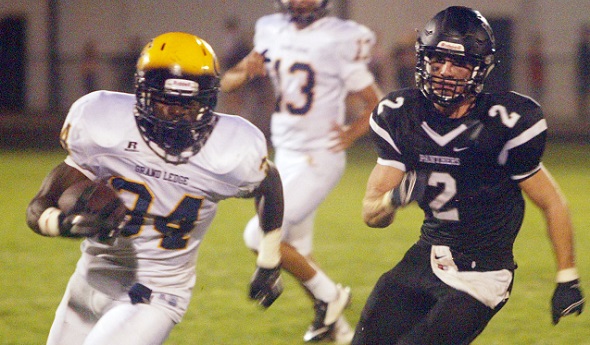
PHOTO: Grand Ledge’s 2-0 start included a 38-7 win over Holland West Ottawa in Week 2. (Click for more from HighSchoolSportsScene.com.)