

1st Miss Basketball Recalls Marvelous Rise
January 31, 2018
By Ron Pesch
Special for Second Half
In the eyes of Julie Swanson, she lived an idyllic childhood.
She grew up in Leland. Her family lived on a small lake, a mere half mile from Lake Michigan. “I was a tomboy,” said Swanson recently from her home in Charlottesville, Va.
Today, the mother of three, Swanson excitedly reminisced about those early days when she was known as Julie Polakowski. As a kid, she saw herself without borders. She could become an artist, or a writer, or a woodworker. As time passed and her interests grew, she thought she might become an engineer or a teacher.
Then basketball arrived in her life, and life changed. She added coach to the list of possibilities.
“Our school was little, and we had a really small class,” remembered Swanson. “In seventh grade, school sports were offered for the first time; basketball for the boys, and cheerleading for the girls. I was shy and unassertive and didn't want to have to make waves to be allowed to play on the boys' team, but being a cheerleader just wasn’t me. And luckily I didn't have to make waves.”
The 1977 Leland yearbook lists 15 students in Polakowski’s seventh grade class – seven boys and eight girls.
“Not all of the boys wanted to play basketball. But I wanted to be on the team,” she said. “So I went out with my classmate, Cindy Moore. I think everyone was aware of Title IX. I don’t recall really any resistance. Besides, they kind of needed us. What would happen if someone got sick, or couldn’t play? Everyone wanted sixth and seventh team members.
“You could see it was more of a weird thing for the other team,” she continued, describing the restlessness in the opponents’ huddle as the game was about to begin. “No one wanted to be the one who had to guard the girl. Sometimes they would be afraid of contact. Sometimes, they would play harder, because they were afraid that they might have a girl score on them. Either way, it made you a better player.”
Simultaneously, changes occurred at Leland that would alter the path of a number of girls from the little town in Leelanau County.
***
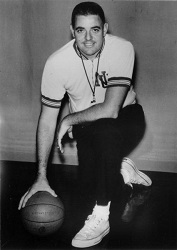
Larry Glass grew up in Beavercreek, Ohio, and graduated from the local high school in 1953. A four-sport star, he excelled in baseball and helped pitch the Beavers to the Class B state baseball championship as a junior and senior.
Glass earned a baseball scholarship to Miami of Ohio University, an hour from home. There he also played basketball, where he was a dependable sixth man. In 1956, he gave up a year of college eligibility to sign with the Cleveland Indians, and kicked around their minor league affiliates for a couple seasons before an arm injury ended his playing days.
 Following college and baseball, he taught a half year at Beavercreek, then taught English and coached a variety of sports for two years at Columbus Grove High School in Ohio.
In 1957, his old college basketball coach, William Rohr, became head basketball coach at Northwestern University. In 1960, Glass was asked to join the staff at the Big Ten school, first as freshman basketball coach, then as a varsity assistant. When Rohr left to become athletic director at Ohio University, the 28-year-old Glass was named Northwestern’s new varsity coach. He remained at the helm for six campaigns. In 1967, Glass earned National Coach of the Year votes, departing from the college coaching ranks following the 1968-69 season.
“There are people who are motivated by an intolerance to losing,” Glass told the Chicago Tribune. “It`s not so much they have to win, it`s that they can`t stand to lose. I don`t say that with any pride. It`s the way I operate. I hate to lose. When I got my big break, I got it at a place where you kind of have to get used to it. I couldn’t, and couldn’t see any way out of it. Ultimately, it got to the point where I didn`t have fun going to practice. The game simply wasn’t any fun anymore.”
He moved his family to northern Michigan, purchased the former Stier Motel on the west shore of upper Lake Leelanau, renamed it the “Glass House Motel” and then returned to the classroom, teaching seventh grade English at Leland. Life again changed when he was asked by his youngest daughters, Laurie and Rebecca, to take over the girls basketball program in 1977.
Traverse City Record-Eagle sports editor Dennis Chase recalled the story in 2012: “When the girls coach, Nancy Boynton Fisher, became pregnant, Glass felt some serious pressure to take over.” Larry and Dee Glass had three daughters and a son. When Dee asked her husband what he would do if his son had made the request for him to coach the boys team, Larry Glass, still running the motel, conceded, and took control of the girls team.
“OK,” he told his bride, “but I want you to understand, if I'm going to try to do this thing right, I'm not going to be home a lot." Glass would hook Polakowski and a host of girls at Leland on the game.
“Credit (for what came next) goes to our amazing coach, Mr. Glass,” said Swanson, admiringly. “He was our inspiration. “
The feeling, you could say, was mutual.
 “I find in my experiences that when you explain something to girls they listen,” said Glass to Detroit Free Press sports writer Mick McCabe in 1981. “There were always a few boys who were like Ford – they had a better idea. I guess some day it may get like that for girls, too.”
Girls basketball was played in the fall in Michigan at the time. Leland’s Comets went 13-6 in 1977 under Glass’ direction, then 18-3 in daughter Laurie’s senior year, falling in the District tournament to Maple City Glen Lake. The team finished with a 19-2 record the following year, also falling to Glen Lake in the postseason.
“They were our rival” recalled Swanson. “You know rivalries. You hate them. They’re the enemy.”
“In Polakowski’s first two years, Leland didn’t do much in the state tournament,” wrote McCabe, “mostly because of (Glen Lake’s) Laura Wiesen.” Another thorn was Kim Kaiser.
“We couldn't beat Glen Lake for three years,” Glass told Chase. “We finally beat them the fourth year when we started our run. We felt back then that the winner of the Leelanau District would be the state champion. We felt we were basically playing championship games at the District level. Glen Lake won one (state) title and should have won a second in that three-year span (1977-79).”
The Leland girls won the first of three consecutive MHSAA Class D titles in December of 1980 when Glass’ daughter Rebecca, his youngest, was a senior. It was Polakowski’s junior year.
In September of 1981, Coach Glass discussed the team’s success with McCabe, and explained why he returned to coach the girls after Rebecca had graduated.
“… I don’t feel I ought to leave the girls we have back for this team,” he said. “Julie averaged three hours a day practicing basketball this summer, and I like that kind of dedication.”
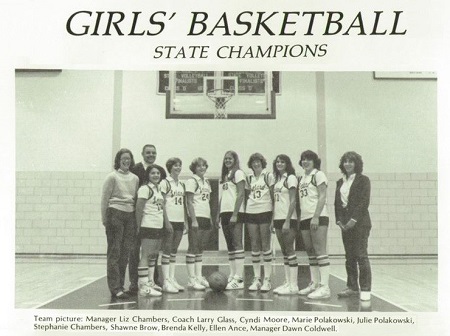
Leland's 1981 team posted a 28-0 record en route to the second consecutive MHSAA Class D title.
Polakowski finished her senior season with 812 points, a new single-season scoring mark, topping the 804 points scored by Evelyn Johnson of Lansing Everett in the fall of 1978. Polakowski’s career total of 2,109 points ranked second in Michigan history behind the 2,227 scored by Jackson’s Regina Pierce.
In late December, Polakowski and 19 others were named by the Detroit Free Press as first-team all-state selections. Glass, who would guide Leland to a third consecutive title in 1982, was honored as the state’s Coach of the Year. “Perhaps the best player in the state can be found among the Class D All Staters,” wrote McCabe alluding to the presence of both Polakowski and Wiesen on the honor team.
***
In the spring of 1981, the Michigan High School Basketball Coaches Association had presented Sam Vincent of Lansing Eastern with the first Hal Schram Mr. Basketball Award.
Similar honors were tradition in Indiana, California and other states. Now Michigan had one, to be presented to the state’s top senior male high school basketball player. Sponsored by the Detroit Free Press, the award was named after the highly-respected sports writer who had covered interscholastic athletics for the paper since 1945.
 In February 1982, two months after the announcement of the girls all-state teams, the Coaches Association announced the creation of a Miss Basketball Award to be presented to the state’s top senior female high school basketball player from the recently completed season.
Sponsored by the Lansing State Journal, it was styled after the Schram award. The winner of the honor would be announced in early April. Presentation of the award would come at the Coaches Association’s third annual All-Star Festival, hosted at Michigan State University’s Jenison Fieldhouse in late June.
Besides Polakowski, five other players from around the state were nominated for the honor. It was a talented bunch. Each would play in the first Girls East-West All-Star game, hosted by the Coaches Association.
• Lori Vettes of Addison, a 5-foot-7 guard named Class C first team all-state by the Free Press.
• Allison Geatches, an all-around sports star at Harper Woods Regina. A fourth team Parade All-American, she later played college ball at the University of Detroit before heading overseas to play a year of professional basketball in Belgium. Later, she spent a season with the Colorado Silver Bullets, an all-female baseball team that barnstormed the United States during the mid-1990s, squaring off against male counterparts. She went on to coach softball at Macomb Community College.
• Sal DeGraw, a four-year starter, three-time team Most Valuable Player and a Class B all-state selection at Marshall. DeGraw later starred as a softball player at Alma College. Marshall fell short of an MHSAA basketball title in DeGraw’s senior year, but in 2000, now as Sal Konkle, she took the reins of the girls basketball program at her old high school. In 2016, Konkle guided Marshall to an MHSAA championship game for the first time since 1981. This time, with her daughter on the team, Marshall emerged victorious.
• Denise Basford, a 5-foot-9 guard from Farmington Our Lady of Mercy, and honorary captain of the Free Press Class A all-state squad. She would go on to play at Notre Dame. A leader on the court, today she’s a lawyer and the mother of two college volleyball players.
• Kelly Belanger, a 5-foot-10 guard and forward at East Kentwood who earned Class A all-state honors. Following graduation, she would join Polakowski on the basketball court at Michigan State University. Today, she’s a professor of English at Valparaiso University and the author of Invisible Seasons – Title IX and the Fight for Equity in College Sports.
At least today, the absence of Wiesen from the ballot was surprising.
“Really?” said Swanson, 35 years later. “Laura was their best player. She was a better athlete than me. I thought she was great.
“Every year, Glen Lake’s boys coach Don Miller would host the Leelanau County basketball clinic,” remembered Swanson. “It had always been hosted at Glen Lake, but one year he had it come over to Leland, and then it alternated. Anyway, there we got to know each other, we got to befriend them. I got to know her, and I really liked her.”
“She was a very good player,” recalled Belanger. Wiesen went on to play at Northwestern, and then returned to Glen Lake, serving as assistant to her high school coach, Ted Swierad.
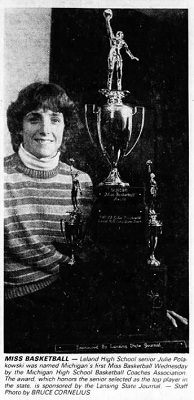 In early April, Polakowski was named the winner of the first Miss Basketball honor, but, unlike today, no vote totals were announced.
“It was a nice surprise for me,” she recalled.
In June 1982, a team of all-stars separated into squads representing the East and West sides of the state. For the first time, the All-Star Festival included a game for the girls. Before the contest, Polakowski was honored with the Miss Basketball Award.
“My jersey number was 1,” remembered Swanson. “It was kind of embarrassing.”
The West, made up of primarily Class C and D players, won 81-62, with Polakowski and Wiesen sharing the backcourt. The girls also shared top scoring honors with 17 points each. Wiesen was awarded the MVP award for the game.
Marveling at the list of candidates and recalling the all-star game, former Grand Rapids West Catholic and Aquinas College girls basketball coach – and spokesperson for the Coaches Association at the time of the first award – Patti Tibaldi spoke glowingly about the era and the efforts to honor the girls.
“I’m nostalgic for the time. Wow. It was a time of all kinds of change – wonderful, challenging times,” Tibaldi said. “These girls (from the era) were so grateful for the chance to play, so passionate. They would have run through a wall for their coaches.”
“I think I learned I was nominated from my high school coach at Regina, Diane Laffey,” said Geatches, who now lives in Florida. “I remember the (all-star) game at the fieldhouse at MSU and being in awe. We were treated very well. My mom was there. I can’t tell you how I did in the game, but I recall being really happy about getting a new pair of tennis shoes for the game. I came from a family of seven, so that was kind of a big deal.”
“I guess I learned of the award, but I don’t recall when,” said Belanger, trying to remember the event. “I did play in the all-star game. I remember we stayed in the dorms at MSU. It was a different time. Girls basketball wasn’t as celebrated as it is today, but it was fun. I remember wishing there was more. At least, I wanted more. I don’t think there was as much year-around play. There were some camps for those who could afford them.”
“The girls today have no idea what these women went through,” added Tibaldi. “And that’s a good thing. They shouldn’t have to think about being given the same opportunities. Do you know what I mean?”
Swanson graduated from MSU, then taught math and coached girls varsity basketball in Iowa. These were the days when high school teams in Iowa began the switch from 6-on-6 basketball, once the norm across the nation for girls, to the five-player game. Following her marriage to husband Steve, who has served as head coach of the University of Virginia women’s soccer team for the past 17 years, and the birth of their first child, Swanson became a stay-at-home mom and pursued life as a writer.
Today she is the author of middle grade and young adult novels, including Going for the Record.
“I might not have been the most athletic,” added Swanson, “or the best player in the state. But basketball was everything to me.
“I doubt anyone could have been more obsessed with, maybe even unbalanced by, the game than I was.”
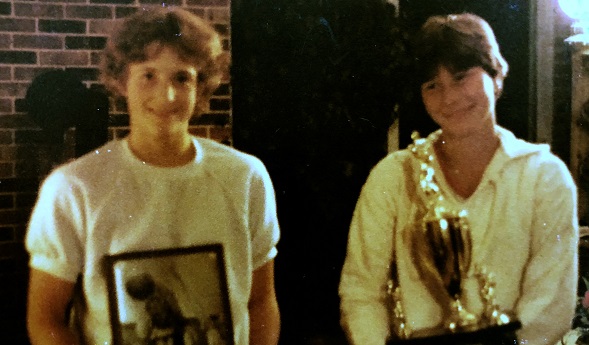
PHOTOS: (Top) Julie Polakowski (left with Miss Basketball plaque) and Laura Wiesen (right with her MVP trophy) following the Coaches Association All-Star game. (Top middle) Larry Glass, who coached the Northwestern University men’s basketball team and later the Leland girls basketball team. (Middle) The Glass House Motel, purchased and renamed by the Glass family after its move to northern Michigan. (Bottom middle) Leland’s 1981 team finished 28-0 in winning a second straight Class D title. (Below) Polakowski, with the Miss Basketball trophy. (Photos provided by Ron Pesch.)
D4 Preview: 2021 Champ Fowler Back Leading 2022 Title Charge
By
Geoff Kimmerly
MHSAA.com senior editor
March 16, 2022
The four remaining contenders for the MHSAA Division 4 girls basketball championship won’t be complete strangers when they arrive at Breslin Center for Thursday’s Semifinals.
All three opponents should have some knowledge of reigning champion Fowler, which returns three starters from last year’s title run. The Eagles also faced and defeated Plymouth Christian Academy this regular season, while PCA defeated Adrian Lenawee Christian just a month ago.
The lone outlier in this conversation is Baraga – the only Upper Peninsula team making the trip downstate this postseason. But the Vikings have seen their share of top competition too defeating two of the other three U.P. teams among the final top 20 by the MHSAA’s Michigan Power Ratings (MPR).
DIVISON 4 Semifinals – Thursday
Baraga (23-1) vs. Fowler (22-3), 5:30 p.m.
Adrian Lenawee Christian (19-6) vs. Plymouth Christian Academy (21-4), 7:30 p.m.
FINAL – Saturday – 10 a.m.
Tickets for this weekend’s games are $12 for both Semifinals and Finals and are available via the Breslin Center ticket office. All Semifinals will be broadcast and viewable with subscription to MHSAA.tv, and all four Finals will air live Saturday on Bally Sports Detroit’s primary channel as well as on the BSD website and app. Audio broadcasts of all Semifinals and Finals will be available free of charge from the MHSAA Network.
Here’s a look at the four Division 4 semifinals (with rankings by MPR and statistics through Regional Finals):
ADRIAN LENAWEE CHRISTIAN
Record/rank: 19-6, No. 4
League finish: Does not play in a league.
Coach: Jamie Salenbien, fifth season (104-16)
Championship history: Two MHSAA titles (most recent 2019), one runner-up finish.
Best wins: 36-27 (Regional Final) and 48-32 over Athens, 63-31 over Genesee Christian, 38-29 over Onsted.
Players to watch: Kylie Summer, 5-9 sr. G (11.3 ppg, 62 3-pointers); Lizzy Scharer, 5-4 sr. G (10.3 ppg, 2.8 apg, 2.7 spg); Avery Sluss, 5-8 jr. F (8.8 ppg, 42 3-pointers).
Outlook: After ending last season in the Division 3 Regional Semifinals, Lenawee Christian has added another impressive achievement to several over the last half-decade by earning this Semifinal trip after graduating four-time all-stater Bree Salenbien last spring. Four seniors start, and Scharer and forward Cara Anderson saw time during the 2019 championship game win over St. Ignace. Three of Lenawee Christian’s five in-state losses this winter came to opponents in larger-school divisions; the other two were to the top two teams in final Division 4 MPR (PCA and Portland St. Patrick).
BARAGA
Record/rank: 23-1, No. 10
League finish: First in Copper Mountain Conference Copper Country
Coach: Tyler Larson, first season (23-1)
Championship history: Has never played in an MHSAA Final.
Best wins: 57-40 over No. 7 Pickford in Quarterfinal, 61-47 over No. 14 Carney-Nadeau in Regional Final, 50-29 (Regional Semifinal) and 40-28 over Ontonagon.
Players to watch: Reide Osterman, 5-8 sr. G (16.1 ppg, 6.3 rpg, 3.8 apg, 6.7 spg); Cori Jahfetson, 5-3 sr. G (13.8 ppg, 62 3-pointers, 3.5 apg); Makenna Hendrickson, 5-4 soph. G (8.4 ppg).
Outlook: Baraga is making its first Semifinal trip since 1992, with its only loss this season to Division 2 No. 9 Houghton on Jan. 6. All but two wins came by double digits, including all five during the postseason. Larson coached at every level of the girls basketball program before taking over the varsity this winter, and he inherited a program that has now won four straight league titles and made the Quarterfinals in 2019. Osterman earned an all-state honorable mention last season.
FOWLER
Record/rank: 22-3, No. 3
League finish: Second in Central Michigan Athletic Conference
Coach: Nathan Goerge, 12th season (156-114)
Championship history: Two MHSAA titles (most recent 2021), two runner-up finishes.
Best wins: 58-26 over No. 8 Gaylord St. Mary in Quarterfinal, 52-42 (Regional Final) and 60-44 over No. 6 Saginaw Nouvel, 50-41 over No. 2 Portland St. Patrick in District Final, 43-35 over No. 1 Plymouth Christian Academy.
Players to watch: Mia Riley, sr. G; Emma Riley, 5-7 jr. G. (Statistics not submitted.)
Outlook: The Eagles avenged a pair of losses to league rival St. Patrick to win the District, and the only other defeat this winter was to 2021 Division 2 champ Portland High. Both Riley sisters made the all-state first team last season, and Mia was the Division 4 Player of the Year by The Associated Press and will continue at Ferris State. Junior guard Avery Koenigsknecht also started in last season’s championship game, and junior Grace Epkey supplied the second-most minutes off the bench and has joined the starting lineup this winter.
PLYMOUTH CHRISTIAN ACADEMY
Record/rank: 21-4, No. 1
League finish: First in Michigan Independent Athletic Conference Blue
Coach: Rod Windle, 17th season (191-174)
Championship history: Has never played in an MHSAA Final.
Best wins: 45-39 (OT – Regional Final), 35-29 and 34-25 over No. 11 Allen Park Inter-City Baptist, 58-56 over No. 4 Adrian Lenawee Christian, 51-36 over Division 3 No. 6 Schoolcraft, 65-49 over Detroit Country Day.
Players to watch: Anna Fernandez, 5-7 sr. G (17.1 ppg, 6.1 rpg, 3.3 apg, 3.6 spg); Morganne Houk, 5-7 jr. G (14.1 ppg, 6.5 rpg, 5.2 apg, 3.3 spg); Hailey Maulbetsch, 5-8 jr. F (12.6 ppg).
Outlook: PCA is making its first trip to the Semifinals since 2013 paced by returning all-state first-teamer Fernandez and honorable mention Houk. The Eagles loaded their schedule this winter; in addition to the wins above and loss to Fowler, PCA also lost to Division 3 top seed Ypsilanti Arbor Prep, Dearborn Divine Child and Wixom St. Catherine and defeated Genesee Christian during the regular season before also winning the rematch in Tuesday’s Quarterfinal. Fernandez is the only senior.
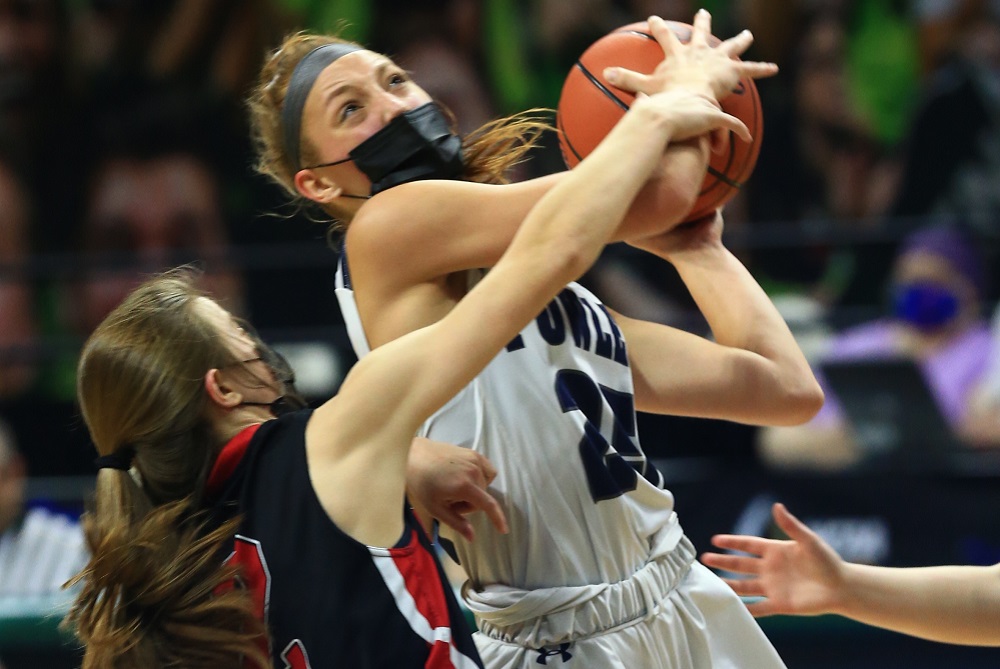
PHOTO Fowler’s Mia Riley (25) drives do the basket during last season’s Division 4 championship game win over Bellaire. (Photo by Hockey Weekly Action Photos.)