

All-Around Solid Play Sends Bellaire Into 1st Title Game
By
Steve Vedder
Special for MHSAA.com
April 7, 2021
GRAND RAPIDS – Patience explains much of why the Bellaire girls basketball team finds itself on the brink of history.
The Eagles charged into their first Division 4 championship game with a methodical 48-29 win over Petersburg Summerfield in Wednesday's Semifinal at Van Andel Arena.
Bellaire wasn't necessarily flashy, but used a hefty rebounding edge, a stingy defense that allowed just three second-half baskets and a balanced offense to earn the trip to Friday's 10 a.m. championship game at the Breslin Center against Fowler.
Doing a bit of everything right is why the Eagles will play for their first-ever Finals title, coach Brad Fischer said.
"We want to be patient offensively," he said. "It's hard to key on any one person for five or six passes. We like to work the ball around and keep the team concept. (Defensively) we've played against teams with 3-point shooters, and we don't want to let too many 3-pointers off."
Bellaire (17-3) never trailed after taking a 20-19 lead with 1:34 left in the first half. Summerfield cut a seven-point deficit to as little as 28-25 with 4:10 left in the third quarter, but Bellaire scored 12 of the next 13 points to lead 40-26 with six minutes left in the game.
The Eagles' defense was superb, allowing just two field goals in the final 11 minutes. Bellaire forced 15 turnovers while holding the Bulldogs (15-5) to just 24 percent shooting from the floor. Bellaire, meanwhile, shot 42 percent.
"We keep telling the girls defense, defense, defense," Fischer said. "It's a cliché, but it comes up again. It was kind of an odd game in that we didn't move our feet at times, and we were a little undisciplined. But the longer a game goes, the stronger the girls get in ratcheting it up."
 Senior guard Katie Decker and sophomore center Jacey Somers each scored 10 points with Madi Evans and Emersyn Koepke each adding eight. Decker added 11 rebounds as Bellaire held a 37-22 edge on the boards.
Senior Noel Mann, who chipped in six points, six assists, six rebounds and two steals, said the ability to overcome Summerfield's defense was a key.
"Their ability to anticipate, to extend our zone took us off guard," she said. "Once we got through that, it opened things up for us. Their defense was longer than we expected."
Summerfield coach Mickey Moody said the sagging rebounding number was mostly the result of Bellaire's aggressiveness.
"They outworked us, outrebounded us," Moody said. "They put more bodies on us, and we didn't attack the basket like we usually do. We pretty much went side to side. I thought we played pretty decent in the first half and got their best player in foul trouble, but we missed a lot of opportunities. We should have attacked a lot more. But in the first half we were fine, we just missed some opportunities."
Summerfield got nine points from Destanee Smith, while Grace Kalb and Breanna Smith each had six points.
"They were aggressive and put pressure on us," Kalb said. "It was a lot like our Regional Semifinal. When we'd drive on them, they weren't afraid to put a body on us."
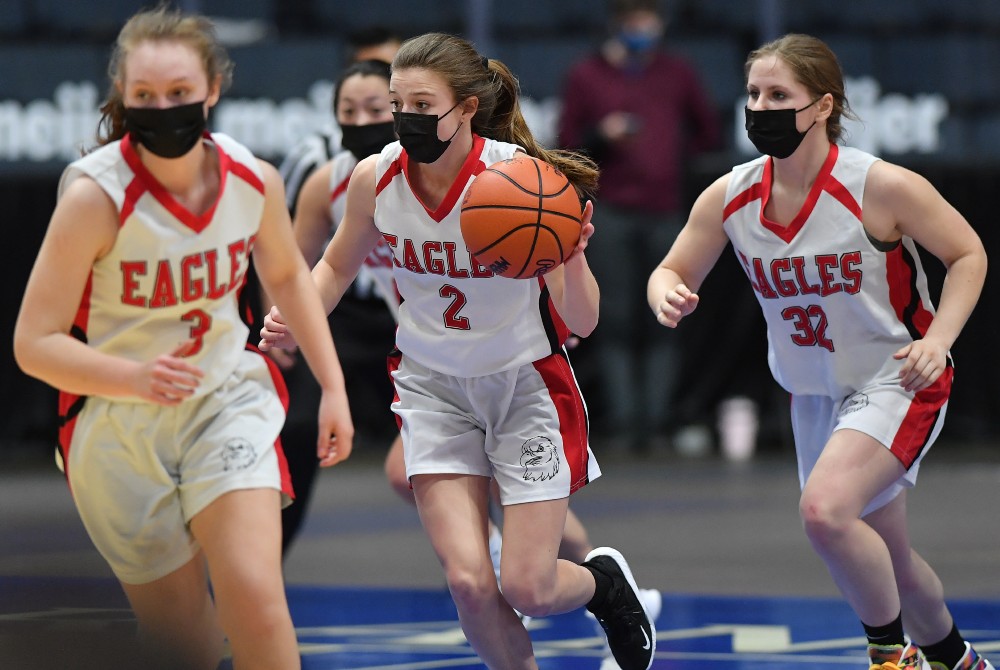
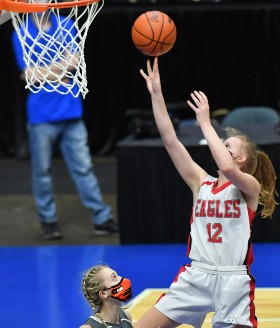
PHOTOS: (Top) Bellaire's Delaney Goodwin (2) brings the ball upcourt Wednesday with Madi Evans (32) and Katie Decker (3) also on the break. (Middle) Bellaire's Jacey Somers gets up a shot against Calumet. (Click for more from Hockey Weekly Action Photos.)
Edison Advances to 1st Hoops Final
March 16, 2017
By Geoff Kimmerly
Second Half editor
EAST LANSING – When Monique Brown heard voices as she walked past her players’ hotel rooms late Wednesday night, she was a little concerned.
Maybe she’d made a mistake bringing her young team to East Lansing the night before the biggest game in school history.
But as they have other times before, Detroit Edison Public School Academy’s players proved their coach wrong, coming out Thursday afternoon anything but sluggish in earning an even more memorable opportunity.
DEPSA – with nine freshman, a sophomore and two juniors on its roster – looked neither tired nor inexperienced in handing annual Breslin visitor Flint Hamady a 54-31 defeat in the day’s first Class C Semifinal.
“We got there late, and we couldn’t sleep. We were just talking about what we can do,” Pioneers sophomore guard Rickea Jackson said. “They came knocking on our doors … they took our phones. We couldn’t do anything but talk.”
DEPSA (20-5) will face Pewamo-Westphalia in Saturday’s Class C Final at 4 p.m. It will be the Pioneers' first appearance in an MHSAA girls basketball championship game.
As much as they had to discuss after midnight the evening before, Jackson and her teammates made a loud statement with their play to tip off this Finals weekend.
They held Hamady to 8.3-percent shooting from the floor during the first half in building a 28-8 lead. The Hawks did recover to shoot an improved 36 percent during the second half, but DEPSA made 49 percent of its shots for the game – and freshman Gabrielle Elliott had nine field goals, only one fewer than Hamady as a team.
Elliott finished with 24 points and Jackson had 16 and eight rebounds as they combined to drop 16 of 26 shots from the floor – not bad for a couple of underclassmen on the biggest stage for the first time.
 “We’ve never done that to a team like Flint Hamady, and I really commend my young group,” Brown said. “They’ve been preparing for this, we’ve talked about it, and as we’ve went through the season … I told them it was all in preparation for today. I always told them I don’t want to hear people say we’re talented; I want to hear them say how hard we play.”
Brown, also the school’s athletic director, had to know what she had coming this winter and scheduled appropriately. DEPSA opened 9-0, with a one-point win over Southfield Arts & Technology, a Class A semifinalist this weekend.
But the No. 5-ranked Pioneers then ran into a tough spot, losing three of its next five to Class A power Detroit Martin Luther King and Class B contenders Detroit Country Day and Ypsilanti Arbor Prep. Sandwiched among those defeats, however, was a 43-39 win over Hamady, which made its third Semifinal appearance of this decade Thursday and finished Class C runner-up in 2015.
That first Hawks loss to DEPSA on Jan. 31 was Hamady’s third straight after losing senior guard Krystal Rice for the season to a knee injury. Without Rice – who will continue her career at Indiana State University – the Hawks still managed to navigate a tournament run that included handing top-ranked Sandusky a 38-36 loss in the Regional Final.
“We didn’t give up on the season,” Hamady coach Keith Smith said. “We spent a lot of time watching film, spent a lot of time drilling on fundamentals, trying to tweak the little things we were not doing well and trying to be concerned on the details. (But) it caught up with us today to not have her, that extra senior who had played in a state final.”
Senior guard Deajah Cofield and freshman center Aryana Naylor both scored 10 points to lead Hamady, Cofield also totaling five steals and Naylor grabbing 10 rebounds.
With Rice out, Cofield was the only senior starter for Hamady, which finished the regular season unranked but ended up with a final record of 19-6.
Smith said he hadn't seen a team as talented as DEPSA with that many young players since his 2009 Class C championship team.
The Pioneers didn’t play like mostly underclassmen Thursday, just a team with a little bit of a chip on their collective shoulders and the talent to dominate the next two to three seasons as well.
“(People) said we’d lose to Sandusky, and they didn’t make it to us, and they said we’d lose to Blissfield by two,” Jackson said, noting the 16-point Quarterfinal win over the No. 10 Royals. “We’re just tired of people doubting us. We’re so young, we don’t have any seniors, and we just want to prove everyone wrong.”
The Girls Basketball Finals are presented by Sparrow Health System.
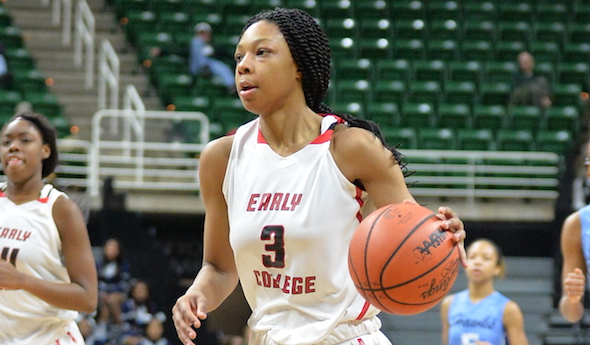
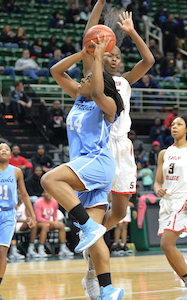
PHOTOS: (Top) DEPSA's Gabrielle Elliott pushes the ball upcourt during her team's Class C Semifinal win. (Middle) Rickea Jackson works to get a hand on a shot by Flint Hamady's Danielle Tipton.