

Arbor Prep Earns Another Title Game Trip
March 15, 2018
By Geoff Kimmerly
Second Half editor
GRAND RAPIDS – Ypsilanti Arbor Prep calls its championship pursuit a “4-mile run.” And the Gators got through about 3.9 a year ago.
They’ll get another chance to finish the final leg after a 53-35 Class C Semifinal win over Maple City Glen Lake on Thursday at Van Noord Arena.
The Gators, who won Class C in 2016 and then finished Class B runner-up a year ago, will face reigning Class C title winner Detroit Edison in Saturday’s 4 p.m. championship game.
Arbor Prep was the only team this season that defeated Edison, downing the Pioneers 54-49 on Jan. 11.
“Considering what happened with us last year, and the type of players we are and the type of team we have this year, we’re anxious that way,” Arbor Prep senior Jala Petree said. “We’re ambitious to get what we deserve. And I think we’re going to keep working. It isn’t over yet.”
Junior Mahri Petree – Jala and senior Lasha’s younger sister – said after she can feel “a different type of energy in our locker room and practices.”
Arbor Prep (21-5) came out with that drive, opening the Semifinal on a 12-1 run. Glen Lake (23-3) – a semifinalist last season as well – pulled to within four points with two minutes to go in the first half, but the Gators finished with another 7-0 surge.
“It’s like a roller coaster,” Glen Lake coach Jason Bradford said. “The first couple of buckets, (our) first two layups were in and out.
“We’ve been behind before, and the girls know how to work through the runs. We say it’s a roller coaster and just keep on fighting. We have confidence since these girls are used to fighting back, since freshman year, each tournament run … (they have) a lot of composure and a lot of heart.”
 The Lakers played Arbor Prep even in the third quarter – notable especially because senior forward Jennifer LaCross, who scored 10 points during the first half, didn’t play at all during the second because of a broken nose.
But the Gators got rolling again in the fourth quarter, closing on a 12-5 run to earn the third straight championship game berth.
Jala and Mahri Petree both scored 12 points, Mahri grabbing seven rebounds with five assists and three steals. Lasha Petree, a Miss Basketball Award finalist this season, had eight points, five assists, five steals and four blocks.
“Last year, losing, that pain is still in my heart,” Lasha Petree said. “I want to avenge it, and I’m ready for it and want to help my teammates do whatever to win.”
Freshman Hailey Helling led Glen Lake with 11 points and five rebounds. LaCross, despite not playing the second half, was the second-leading scorer. The Lakers’ 35 points total were 10 fewer than their previous season low.
Guard Savannah Peplinski and forward Allie Bonzelet joined LaCross finishing four-year careers that included two league titles and two Semifinal trips – and many more memorable moments.
“As a team, it’s just fun the memories we make – not even during the games, but like at the hotel (during Finals weekends),” LaCross said. “I’ll probably be thinking about it when I’m missing basketball the rest of my life.”
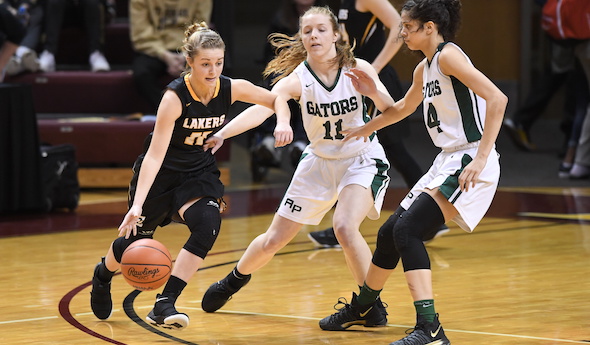
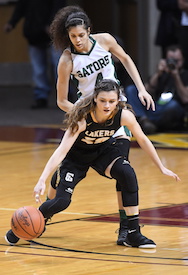
PHOTOS: (Top) Maple City Glen Lake’s Allie Bonzelet (11) works to get past Arbor Prep’s Karli Waddell (11) and Lasha Petree. (Middle) Petree defends against Savannah Peplinski.
Strong Finish Sends Forest Park to Final
March 13, 2014
By Geoff Kimmerly
Second Half editor
EAST LANSING – Lexi Gusset finally got to smile with about five seconds left in Friday’s last Class D Semifinal at the Breslin Center.
Her frustration melted, she yelled “Let’s go! One more game,” before being enveloped by a similarly relieved group of teammates.
Crystal Falls Forest Park and this season’s Miss Basketball Award winner were eight minutes from an eight-hour drive two days earlier than expected as they trailed Athens with a quarter to play.
But the Trojans showed they are more than just the best player in the state. And that superstar poured it on when needed most to help her team finish a 49-33 comeback over the Indians.
Gussert played the final 9 minutes and 31 seconds with four fouls – and despite Athens driving to draw the fifth – but managed to stay on the floor to score nine of her game-high 20 points during the fourth quarter.
“Obviously being a leader, you don’t want to be sitting on the bench in the Semifinal game,” Gussert said. “But I knew I had be there for my team. That’s the most I’ve sat all year, so I was a little pumped up.”
Top-ranked Forest Park (26-0) will face Mount Pleasant Sacred Heart (21-5) for the championship at 10 a.m. Saturday. Each is seeking its first MHSAA title.
The Trojans advanced to the 2012 Semifinals with Gussert a sophomore and fell to Athens that day 61-48 despite 34 points and 12 rebounds from the eventual Michigan State University recruit.
Forest Park’s rotation has included nine or 10 players most of this season, and they had the experience of beaten Iron Mountain 74-39 midseason without Gussert, who missed because she was ill. Generally that depth has allowed the Trojans to wear opponents down. This time it allowed them to hang on – while also turning up the pressure enough to hold Athens scoreless during the fourth quarter.
“The girls are comfortable with it, and I’m glad we have that experience. We have the best player in the state on our team, but we have a whole lot of other good players (too),” Forest Park coach Jeff Syrjanen said. “I trust my team enough that I have faith in all of them. … I just didn’t think they would crack. We don’t change what we do; we just don’t do it as well without Lexi on the floor with us.”
 Sophomore guard Maria Stankewicz did the main filling in on the offensive end, finishing with 10 points and five assists. Senior center Kendra Campbell added eight points and freshman guard Abby Nylund had six points and seven rebounds.
Stankewicz also played the role of yeller at Gussert to not foul when Athens got out on a few fast breaks headed her way.
“It was a lot different because I wasn’t used to it. But overall it wasn’t just me,” Stankewicz said. “I tried to take charge, tried to be a leader when she stepped off. But our posts played tougher and my other guard played tougher. We really were a team together.”
The Indians (22-4) did lead 33-32 heading into the final quarter. But in addition to not stopping Gussert’s final surge, they also struggled to find the hoop. The scoreless period included five turnovers and 11 missed shots.
This was Athens’ third straight trip to Breslin, and that no doubt helped the Indians stay calm when they trailed by 10 just more than six minutes into the game. But they couldn’t summon a final run.
“Sometimes during the season we had spells like that, and I think we started pressing it,” Athens coach Calvin Quist said. “When you start pressing it, it makes it more difficult for those shots to fall.
“We lost three senior starters from last year, and you don’t know what to expect,” he added. “Obviously we had high expectations. And these young ladies exceeded those expectations.”
Athens was ranked No. 5 entering the District tournament. Senior Audrey Oswalt finished with 15 points and 12 rebounds, and junior guard Allison Fuller added eight points.
She’s one of 10, including two starters, who will try to make it four straight trips to finish the season in East Lansing.
“I can’t dwell on this season. We had a great season, and I’m proud of my team, but we’ve got to get ready for next year as soon as possible,” Fuller said. “It comes up quick, and the more we prepare the better chance we’ll have to get here for the fourth time.”
Click for the full box score and video from the press conference.
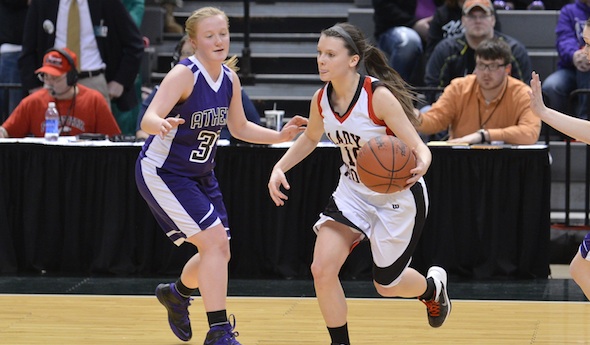
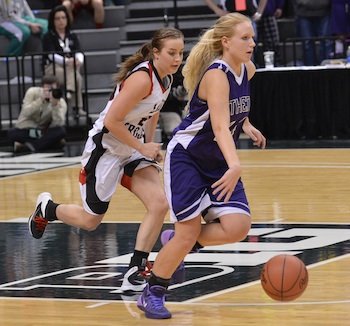
PHOTOS: (Top) Forest Park's Maria Stankewicz (10) tries to dribble past Athens' Allison Fuller on Friday. (Middle) Athens' Allysha Beal pushes the ball upcourt with Forest Park's Samantha Nylund giving chase.
HIGHLIGHTS: (1) Audrey Oswalt of Athens completes the long pass off the Crystal Falls miss to Allison Fuller late in the first half of the Class D Semifinal. Fuller finished with eight points. (2) Alexis Gussert starts a 17-0 fourth quarter for Forest Park with a jump shot en route to a 20-point performance. The Trojans won 49-33.