

'Blazer Basketball' Follows Coach's Lead
January 20, 2017
By Dennis Chase
Special for Second Half
KALKASKA – After upending previously unbeaten Traverse City St. Francis on the road last Saturday, Kalkaska basketball coach Dave Dalton treated his team to dinner at Buffalo Wild Wings.
 It’s a gesture that’s commonplace in the Blazers girls basketball program.
Whether he’s taking his players for ice cream after a summer workout, inviting them over to go tubing on the river near his home in Rapid City, or spending extra teaching time with them on the court, Dalton is all about team – team bonding, team building.
He’s a man, those in the program concur, who pours his heart and soul into his job.
The respect is apparent. So is the success.
“He puts his heart into everything he does,” senior forward Natalie Ryckman said. “We all care about him so much. We get into it at times, everybody does, but nothing is ever going to diminish the friendship we have with him.
“We’ve looked up to him since we were little – and look at where we are now.”
The Blazers are now 6-0 – and ascending. They are ranked No. 10 in this week’s Associated Press Class B poll.
Kalkaska is coming off a stretch in which it won three games in four nights. That stretch was sandwiched by the signature 61-51 triumph over St. Francis, last season’s MHSAA Class C runner-up. Ryckman scored 21 points in the win.
“Unreal – one of the best nights of my life,” the 17-year-old said.
This is one of the most experienced teams Dalton has had in his 22 years as head coach. Ryckman, along with sisters Micah and Sapphire Lajewski, are four-year varsity veterans. Junior McKenzie Wilkinson is in her third year on varsity.
“We’re experienced, and I think we’re a better team than we were last season,” Micah Lajewski said.
That’s saying a lot considering the Blazers finished 20-3 a year ago. Two of the losses were to St. Francis.
“That (expectation) puts pressure on us, but we handle pressure pretty well,” Ryckman said.
All six victories this season have been by double digits.
It’s a team with a lot of integral parts.
The athletic Wilkinson leads the Blazers in scoring (15.3 points per game), rebounding (8.0) and steals (6.5). Her back story? Her parents, Jeremy and Cheri (Golden), are two of the best athletes to come out of Kalkaska. Jeremy, a recent inductee into the Northern Michigan University Sports Hall of Fame, is the head football coach. Cheri coaches seventh grade girls basketball. Both played for Dalton when they were in school.
Now it’s McKenzie’s turn.
“He (Dalton) expects a lot, which I understand,” she said. “He pushes us to the point we need to be pushed and then it’s up to us to keep it going. I like to be pushed and challenged. It makes you better.”
Wilkinson, a state powerlifting qualifier, stars on the softball field, too. She owns the school’s career home run record (14) after just two seasons.
Ryckman also is averaging in double figures (14 ppg). She wears jersey 24, the same number her great uncle, Doug, wore as a Blazer. Dalton and Doug Ryckman, an all-state player who topped 1,000 points in his career, were high school teammates.
Micah Lajewski runs the attack from her point guard position. She hit a season-high 17 in a season-opening 52-41 win over McBain, but it was her press-breaking skills and defense that proved critical in the wins over St. Francis and Gaylord. The versatile 18-year-old placed ninth in the Michigan High School Power Lifting Association finals at 145 pounds last winter and played on the football team in the fall, scoring a touchdown in a win over Mancelona.
Sapphire Lajewski, a 5-foot-10 center, went off for 16 points in a 63-18 win over Boyne City last Friday. Lajewski, who contributes nearly five rebounds per game, battled foul trouble at St. Francis, but 5-11 senior Taylor Riddle came off the bench to provide valuable minutes and hit a critical 3-pointer. Sophomore Kayla Cavanaugh and senior Sadie Wilson are stepping up as well. Each scored nine points in Monday’s 67-35 win over Gaylord. Freshman Margaret Stosio chipped in eight. German exchange student Emilia Lehmann provides additional depth, but her minutes are limited by the talent in front of her.
The keys to success at Kalkaska never change.
“We have good kids and we work hard,” Dalton said. “We put the time in.”
It’s been that way for 22 years under Dalton, whose squads are 358-118. He currently has the sixth most wins among girls basketball coaches in the northern Lower Peninsula, trailing only Johannesburg-Lewiston’s Rick Guild (443), Maple City Glen Lake’s Ted Swierad (427), Ellsworth’s Ike Boss (409), Leland’s Larry Glass (388) and Manistee’s Todd Erickson (363).
“What I’m most proud of is our consistency,” Dalton said. “There have been schools in our area that have been more dominant over a certain period, but I think we probably have the best winning percentage (75 percent) over the last 22 years.”
The Blazers, known for their perimeter shooting, are averaging nearly 17 wins a season. In the last seven years, Kalkaska has won 20 or more games five times and captured the District six times.
Dalton, who started coaching in the system in 1977, took over the girls varsity program in the mid-1990s. His first three teams went 17-4, 19-2 and 20-3. Those teams were led by his daughter Leigh Ann, Sara Vergote, Patti Larson, Shannon Martin, Kacey Corcoran and Shandy Atwood.
“That was a special group,” Dalton said.
 Leigh Ann Dalton (now Roehm) went on to earn academic All-American honors at Northern Michigan University, where she is sixth in career 3-pointers despite playing just three seasons after transferring from Bowling Green. She was just named the middle school science Teacher of the Year by the Michigan Science Teachers Association and her JV team at Saline is 9-1. Vergote was a Mid-American Conference track champion in the 10K at the University of Toledo. She later became the head cross country and track coach at her alma mater and most recently was an assistant at Ohio State. Larson played at Ferris State, Martin at Cornerstone and Atwood and Corcoran at Aquinas.
All told, 16 former Blazers have gone on to play collegiately, Dalton said.
One player, Maria Kasza, came back to work as an assistant coach under Dalton for one season. She is now in her fifth season as an assistant coach at Michigan Tech, where she finished her playing career after transferring from Northern Michigan. Kasza, the school’s all-time leading scorer, led Kalkaska to its first MHSAA Regional title in more than 20 years back in 2001.
“When the players are going through the heat of the battle (they might not think about it), but when they get out of school that’s when they appreciate our program,” Blazers assistant coach Royce Thomas said. “I hear that all the time.”
Kasza will vouch for that.
“Mr. Dalton makes every player and every team feel special,” she said. “He genuinely values the relationships he builds with each team.”
Kasza said whenever she wanted to get in the gym and shoot, Dalton obliged.
“Whether that meant he had to pick me up at my house, come in before school, stay after school or work with me after softball practice, he never told me no,” Kasza recalled. “I have kids now (at Tech) who want to get into the gym, and it’s late at night, and I might not feel like going back in, but then I remember that I had a coach who never told me no and allowed me to be the player I was and the coach that I am now. I learned from him.”
Kasza has a special connection to the Dalton family. Leigh Ann, who is about six years older, was her role model.
“We have a great friendship,” she said. “When she would come home from college we would work out every day together. I wore 44 because that was Leigh Ann’s number. She even helped me make my college decision. A few weeks ago, over Christmas break, I was recruiting so I went down to see her. We have a special bond because of basketball.”
Kasza is currently coaching another former Blazer, Kelli Guy. Guy is a former all-state player, who is now in the midst of a stellar career at Tech. She was Kasza’s first recruit.
“The first thing I told my boss (head coach Kim Cameron) was that we had to go get Kelli Guy,” Kasza said.
Guy is another player Dalton spent countless hours working with, starting when she was in elementary school.
“I was an elementary PE teacher for 29 years,” Dalton said. “I got to know the kids, had the kids at (elementary basketball) camp and was able to encourage them. With Kelli Guy, I was in the gym with her since she was in third grade. She was coachable and willing (to learn).”
Even though he retired as a full-time teacher in 2010 after 33 years, Dalton still spends countless hours building ties with his players.
For a unique overnight getaway, he takes his teams to a rustic retreat lodge owned by Steve Brower, the Blazers’ announcer and a member of the Basketball Coaches Association of Michigan (BCAM) Hall of Honor.
At school, when his players are competing in other sports, Dalton’s there to show his support.
“That’s how much he’s into his program and his kids,” said Thomas, who’s been Dalton’s assistant for 20 years. “He’s a very caring person.”
That caring goes both ways. His players, past and present, have been there for him in times of personal sorrow, most recently when his 21-year-old stepson went missing after his kayak overturned in Lake Michigan near Platte Bay last September. His body has not been found. Dalton had previously lost a son unexpectedly in 2011.
The support he’s received from those he’s coached has been a comfort.
“It’s meant a lot to me,” he said.
Dalton often refers to his players as family. They are a big part of his life and he works to create special moments for them. Four years ago, his team played at The Palace of Auburn Hills, where it beat Oak Park after trailing by 14 at the half. This past November the Blazers scrimmaged Saline at the University of Michigan’s Crisler Arena. While in Ann Arbor, Dalton took his players to Sky Zone, an indoor trampoline park. His players still talk about it.
“He goes above and beyond,” Micah Lajewski said.
Thomas, a 1976 Kalkaska graduate, became good friends with Dalton through sports. Thomas still recalls traveling to Central Michigan University to watch Chippewa basketball games with Dalton.
“That’s when they had Dan Roundfield (a three-time NBA all-star),” he said. “Man, I had never seen anything like that. That was the greatest ever.”
 Thomas, whose daughter Kassie is a Blazers assistant coach and physical therapist, is vice president of operations for an oilfield company. He travels extensively, particularly to Pennsylvania, West Virginia and Ohio.
“Monday night I was on my way to Detroit for an 8 o’clock meeting (Tuesday morning) when they rescheduled it to noon,” he said. “I turned around and came back so I could be here for the (Gaylord) game.”
Thomas, who’s also in the BCAM Hall of Honor, was on the road and couldn’t attend Saturday’s showdown at St. Francis. But he was still able to be part of it.
“They had me on FaceTime so I could give a pep talk to the girls (before the game),” he said. “My daughter texted me during the game, telling me what was going on. Then she had me on the last two minutes, showing me our stall. That stall means so much to me because teams don’t protect leads like they should in high school basketball.”
Kalkaska had a good following at St. Francis, and Dalton believes it’s the best fan base in the Lake Michigan Conference, if not the north.
Before the Gaylord game, Dalton was pointing out all the loyal fans who attend every game when 98-year-old Willard Ryckman walked in.
“Here’s what Blazer Basketball is all about,” Dalton said.
Ryckman, a regular at home games, had just driven 17 miles to watch the Blazers on a night when freezing rain would cancel school the following day.
“It’s a lot of fun,” Ryckman said. “I enjoy doing it. I live alone and I love to see the kids play. Plus, I know the coach.”
“I’ve known Willard since I was 14,” the 61-year-old Dalton added. “He’s one of the classiest, nicest guys in the world.”
Kelli Guy’s family was also in the crowd Monday night. They still attend the games even though Kelli has been gone four years.
“They were at Saginaw Valley on Thursday to watch Kelli play,” Dalton said. “They drove up to Boyne City for our game Friday and then drove back down for Kelli’s game (at Wayne State) on Saturday. They were devastated they missed the (St. Francis) game. They are big supporters of our program.”
Community support has continued to build over the years.
“When I started coaching they only pulled out one side of the bleachers at the middle school,” Dalton said. “There were a few people there, mostly family and friends. By the end of that first year when we went 17-4 they had to pull out the other side. The fans kept coming and coming.”
Dalton appreciates the support and he makes sure his players do, too. The girls hand out signed, decorated miniature “gratitude” basketballs before each home game to people who are special to them.
“We’re one big happy family,” Sapphire Lajewski said. “On game nights, the spirit in the air is amazing.”
Dalton, who now teaches American history at the high school on a part-time basis, is a 1973 Kalkaska graduate. Longtime Blazers baseball coach Bill Vandergriff was his classmate. The two played Little League, middle school and high schools sports together. They were also roommates at Central Michigan University. Both retired from teaching fulltime in 2010, but kept coaching.
“Our lives have completely paralleled each other since kindergarten,” Dalton said. “We’ve been in the Kalkaska school district 55 years.”
And Dalton would not have wanted it any other way.
“I’ve been very blessed in my life,” he said. “Nobody has loved coaching more than I have. The connection you have in your heart for those kids, and that the kids have in their hearts for you, is something that you’ll always share. It never goes away. And what’s really special is that the kids become lifelong friends. And they wouldn’t have become such great friends if it wasn’t for basketball. I couldn’t have asked for a better career.”
 Dennis Chase worked 32 years as a sportswriter at the Traverse City Record-Eagle, including as sports editor from 2000-14. He can be reached at [email protected] with story ideas for Manistee, Wexford, Missaukee, Roscommon, Ogemaw, Iosco, Alcona, Oscoda, Crawford, Kalkaska, Grand Traverse, Benzie, Leelanau, Antrim, Otsego, Montmorency, Alpena, Presque Isle, Cheboygan, Charlevoix and Emmet counties.
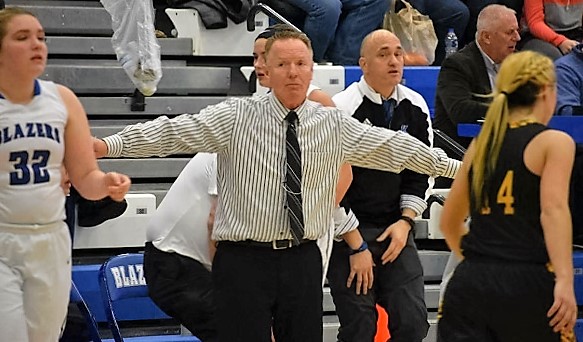
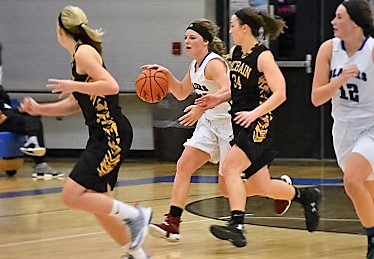
PHOTOS: (Top) Kalkaska coach Dave Dalton calls a timeout during this season’s win Dec. 2 over McBain. (Middle) Natalie Ryckman puts up a shot in the 52-41 opening-night victory. (Below) McKenzie Wilkinson brings the ball upcourt, as Sapphire Lajewski (12) moves toward her spot on offense. (Photos courtesy of the Kalkaska athletic department.)

Cancer Free, Haske Pulls Double Duty
March 3, 2016
By Dennis Chase
Special for Second Half
TRAVERSE CITY – Keith Haske calls coaching basketball “therapeutic.”
It’s a term that now holds more meaning for the 58-year-old Traverse City St. Francis basketball coach, who is recovering from a stage four throat cancer diagnosis two years ago.
“When you’re coaching you just kind of lose yourself,” he said. “You don’t think about how you’re feeling or what you went through.”
Coaching has been a major part of Haske’s life for 32 years – 13 at St. Johns, 13 at Charlevoix and six at St. Francis. Even when he felt weak and tired last season, Haske continued as the boys coach, using an amplified headset at practice to lessen the strain on his throat.
His health, he said, is continually improving. He’s cancer free. His energy and strength are returning – so much so that he added to his workload this season by taking on the girls varsity coaching duties, too.
“When you go through this stuff you almost have a renewed energy,” he said. “Your body fights so hard to beat the cancer, and you go through so much suffering, that when you come out the other side things really don’t faze you as much.”
This is a time of the year that will test Haske’s stamina because his schedule is busier than ever. He coached three doubleheaders last week. With the girls reaching Friday’s MHSAA Class C District Final, he’ll coach five games in five days this week. It could be a repeat next week if the boys and girls advance along the tournament trail.
“I can’t tell you how much fun that would be,” Haske said.
Another tough District matchup awaits, though. The girls team (21-1) played Elk Rapids (15-6) on Wednesday and will next face host Glen Lake (20-2). The boys (12-7) will face Johannesburg-Lewiston (16-2) – the team that knocked the Gladiators out last season– in their District opener Monday.
It’s a challenging schedule. But Haske, who’s taken four teams to the MHSAA Finals, is accustomed to challenges. None bigger than his battle with cancer.
The diagnosis came the day after Easter in 2014. Haske, who kept physically fit, couldn’t believe what the doctor was telling him.
“I said, ‘There’s no way,’” he recalled. “I never smoked, never chewed tobacco, things you would attribute (to throat cancer).”
He wasn’t the only one stunned.
 “Most of the team started breaking down crying,” senior Dylan Sheehy-Guiseppi remembered when Haske broke the news. “We were so shocked. We couldn’t understand how it happened to him.”
Neither could Haske’s close friends.
“Your first take is that it’s pretty devastating because you don’t know (what to expect),” Adam Wood, who played for and coached under Haske at Charlevoix, said. “Cancer can run the gamut as far as severity. The one thing I did know is that he would fight it as hard as he could.”
Haske took his fight to the MD Anderson Cancer Center in Houston. He, and his wife Barb, spent most of the summer there as Haske underwent radiation and chemotherapy treatment.
It was on a return trip to Houston a few months later – he still goes back every four months for scans – when he learned he was cancer free.
“When I left (in July) they were still worried about one of the lymph nodes, whether they got it or not,” Haske said. “Sometimes it gets inflamed from the radiation, and they can’t tell.”
Turns out, it was inflammation. No cancer was detected.
On the way home, Haske received a call from principal Eric Chittle, who then revealed the good news at a school assembly.
“The whole student body went crazy,” Haske said. “It was cool.”
For Haske, the dean of students at the high school, it was a big hurdle to clear. But there was a side effect – Haske’s throat was still inflamed, and he struggled to eat.
“When I came back I went six months without eating a single morsel of food,” he said. “I lived on Ensure and ice cream.”
He ended up losing 53 pounds – and at one point inquired about a feeding tube.
“He (doctor) said, ‘You don’t need it. You’ve been through the worst. You’ll be all right,’” Haske recalled. “He was right. A couple weeks later it started to turn around.”
After the boys basketball season concluded last March, and as Haske’s health improved, the girls basketball job opened up. Haske had coached girls basketball at Charlevoix for three seasons, leading the Rayders to a 27-1 record and a Finals appearance in 2004. He stepped down when the girls season was switched from fall to winter.
St. Francis athletic director Tom Hardy thought about the possibilities and approached Haske, a member of the Basketball Coaches Association of Michigan Hall of Fame, about adding a second coaching job. After consulting with Barb, who he said has been “unbelievable” in his recovery process, Haske accepted.
Wood, who is now the boys basketball coach and athletic director at Lake Michigan Conference rival Harbor Springs, was among the first to call his former coach.
“He asked, ‘Adam, am I crazy?’” Wood said laughing. “My response was ‘Yes.’ He said, ‘I’ve been getting a lot of that lately.’
“For him to take that on was beyond impressive. It was all about the kids.”
What about physically?
“When I saw him this year I told him he looked great,” Wood said. “He said he felt great. The difference between this year and last is quite dramatic.”
Haske – who is mentoring two young coaches in the system, Tyler Sanborn and Stephanie DeNoyelles – said the casual fan might not even realize what he’s been through.
 “If you were looking at me across the gym you wouldn’t have any idea,” Haske said. “If you get closer, I still have some swelling in my jaw, and I talk a little funny sometimes.”
But he’s enjoying every minute.
“The kids here are great, and that makes it so much easier,” he said. “You just don’t have many problems.”
The players are thankful to see their coach returning to his old self.
“He’s not only a basketball coach, he’s a mentor,” Sheehy-Guiseppi said. “He wants to make sure you’re taking care of stuff outside the game of basketball first. He really cares about you as a person, and he looks forward to helping you grow as a person.”
St. Francis officials adjusted Haske’s work schedule during the winter to accommodate his coaching, and Hardy had to work out arrangements with league members to schedule more varsity doubleheaders.
“All the schools were great about it,” Hardy said. “We have not had an issue with Keith having to be at two spots at the same time.”
Now comes the challenge of March Madness. And for the girls, that means a showdown with Glen Lake.
“They’re a lot like us,” Haske said, when asked about the Lakers. “They don’t have any one person you can key on. They have five or six girls that all share the ball and are dangerous. They’re tough in the paint and they can shoot. They’re very balanced, very sound.”
So are the Gladiators, who have won 19 in a row. Senior Annie Lyman is the leader, averaging 14 points, eight rebounds, five steals and five assists per game.
“She does it all,” Haske said. “She’s a tough, aggressive player.”
Juliana Phillips, a 6-foot-4 junior who has committed to play volleyball at St. Louis University, and 6-foot senior Lauren McDonnell also average in double figures.
Haske likes the growth he’s seen in his team.
“I think we’ve made great strides in understanding the system and what we’re trying to do,” he said. “We have some pretty talented kids. We have some size, some quickness, some kids who can shoot it. It’s a well-rounded team.”
The boys, meanwhile, are trying to find some consistency. Haske thought the Gladiators were turning the corner when Gabe Callery hit a mid-court shot at the buzzer to stun previously unbeaten East Jordan earlier this year. But St. Francis dropped three consecutive road games in February.
“A lot of it is shooting,” Haske said. “There are nights we just don’t shoot it well. When we do shoot it well, we’re a really good team.”
How good will be determined in March.
Dennis Chase worked 32 years as a sportswriter at the Traverse City Record-Eagle, including as sports editor from 2000-14. He can be reached at [email protected] with story ideas for Manistee, Wexford, Missaukee, Roscommon, Ogemaw, Iosco, Alcona, Oscoda, Crawford, Kalkaska, Grand Traverse, Benzie, Leelanau, Antrim, Otsego, Montmorency, Alpena, Presque Isle, Cheboygan, Charlevoix and Emmet counties.
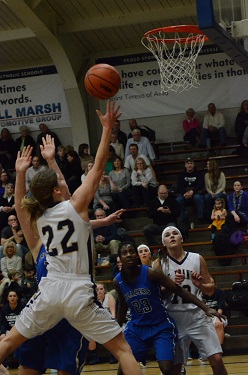
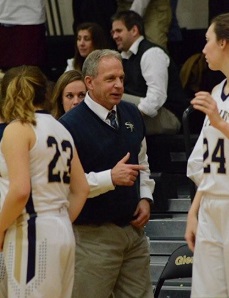
PHOTOS: (Top) Traverse City St. Francis coach Keith Haske huddles with his boys basketball team during a game against Grayling. (Middle) St. Francis' girls team, here against Kalkaska, will play for a District title Friday. (Below) Haske speaks with a few of his players during a District game against Grand Traverse Academy. (Photos by Julie English.)