

Breslin Bound: 2025-26 Girls Regional Preview
By
Geoff Kimmerly
MHSAA.com senior editor
March 9, 2026
After more than three months of working to get to this point, 128 girls basketball teams need to win only three more games to make it to MHSAA Finals weekend.

The next steps will come this week in Regionals, and we look closer at 12 of those below along with five District Finals among several that jumped off the page Friday.
Find everything you need to know this week about tickets, brackets and more as the tournament continues on the Girls Basketball page. To watch any of several games online, visit the NFHS Network. Host sites are in bold below.
“Breslin Bound” is powered by MI Student Aid and based on results and schedules posted for each school at MHSAA.com.
Week in Review
The countdown of last week’s five most intriguing results:
1. Muskegon 35, Rockford 27 The Big Reds (21-2) won their first Division 1 District title since 2023 and guaranteed Rockford (21-3) won’t play at Breslin Center this season for the first time since 2021.
2. Evart 45, McBain 37 The top two teams from the Highland Conference met one more time, and runner-up Evart (18-3) avenged losses of 24 and 11 points to the champion Ramblers (21-1) by handing them their lone defeat in this Division 3 District Final.
3. Jackson Lumen Christi 64, Grass Lake 53 The Titans (20-3) won this Division 3 matchup of league champions, downing Grass Lake (21-3) for the second-straight season in a District Final.
4. Petersburg Summerfield 37, Adrian Lenawee Christian 31 Two weeks after losing to Lenawee Christian (17-6) for the second time this season, Summerfield (18-6) avenged both defeats in a Division 4 District Final.
5. Livonia Stevenson 58, Farmington Hills Mercy 53 The Spartans (19-5) finished third behind perennial state powers Belleville and Wayne Memorial in the Kensington Lakes Activities Association East, but brought home a trophy by downing Mercy (19-5) in Division 1.
Regionals at a Glance
These could be among our most competitive brackets. Host sites are in bold:
DIVISION 1
Detroit Renaissance
Detroit Renaissance (19-2) vs. Livonia Stevenson (19-5)
Wayne Memorial (20-2) vs. Birmingham Groves (18-6)
Renaissance is coming off another Detroit Public School League championship, with both of its losses coming in December – the second to reigning Division 1 champion Belleville (23-1) and the first 55-33 to Wayne, its potential opponent Thursday. To set up that repeat of last year’s Regional Final – won by Wayne – the Phoenix must defeat a Groves team that has enjoyed one of the best turnaround seasons in the state after going 6-16 a year ago. The Zebras – who have lost only to Belleville this season – have defeated Stevenson by 15 and 22 but still must be wary of the familiar Spartans, who have added to their win total now five straight seasons.
Houghton Lake
Marquette (8-14) vs. Midland (19-5)
Saginaw Heritage (18-6) vs. Muskegon (21-2)
Muskegon has gone from 11-12 a year ago to losing this season to only Wayne Memorial (20-2) and Grand Haven (21-3) – and the District Final win over Rockford had statewide reverberations. Heritage and Midland finished first and second, respectively, in the Saginaw Valley League North and split during the regular season, with Midland winning the most recent meeting 46-41 on Jan. 30. Marquette is 6-5 over the second half of the season and coming off its first District title since 2020.
Northville
Saline (21-3) vs. South Lyon East (23-1)
Howell (23-1) vs. Belleville (23-1)
Howell’s 59-51 win over reigning Division 1 champion Belleville on Feb. 26 ended the Tigers’ 35-game winning streak and took this forecasted rematch to another level. But whichever team emerges from that side of the bracket will have to rev back up immediately as Saline and South Lyon East are both capable of moving on to next week as well. Saline’s losses all came to teams still alive – including 58-44 to South Lyon East on Dec. 12. East’s only loss was to Farmington Hills Mercy (19-5), and one more win will give the Cougars twice as many as a season ago.
DIVISION 2
Allendale
Grand Rapids West Catholic (18-5) vs. Spring Lake (15-7)
Sparta (6-18) vs. Grand Rapids Catholic Central (20-4)
An anticipated Regional Final between 2025 Division 2 runner-up West Catholic and Catholic Central makes this bracket jump off the page, as the Cougars won the Ottawa-Kent Conference White and West Catholic finished second in the Gold and won their Feb. 19 matchup 53-40. But the other two contenders this week definitely have earned some notice as well. Spring Lake finished third in the O-K Black but has won five of its last seven games (with a 47-38 loss to West Catholic mixed in) and dominated its District with 39 and 43-point victories. Sparta had one win since Jan. 2 before last week, but earned four and 27-point victories to advance.
Alma
Flint Powers Catholic (21-3) vs. Frankenmuth (16-8)
Alma (17-6) vs. Portland (20-4)
Powers is seeking its second Regional championship over the last three seasons and has lost only to Division 1 Detroit Renaissance, Midland and Utica Eisenhower while defeating several Division 1 opponents as well. The Chargers also downed Frankenmuth 69-45 on Dec. 15, but the Eagles have won 13 of their last 16 games after playing several more top teams from across the state. Alma finished third in the Tri-Valley Conference Red won by Frankenmuth, but defeated league runner-up Freeland on Friday to earn this Regional game on its home court. The Panthers have won 12 of their last 14. Portland won the Capital Area Activities Conference White with its only losses to Haslett, Frankenmuth and Division 1 Holt and East Lansing. The Frankenmuth defeat was by only two points in their season opener.
Tecumseh
Parma Western (17-7) vs. Ann Arbor Father Gabriel Richard (16-8)
Haslett (22-2) vs. Tecumseh (22-2)
Reigning Division 2 champion Tecumseh has hardly been slowed again this season, falling to West Catholic by two points on Jan. 3 and then to Ohio power program Cincinnati West Clermont on Jan. 19. But Haslett, playing in its third-straight Regional, should provide another challenge with its only losses this season to Division 1 DeWitt and Rockford. The Vikings’ run has included a 64-41 win over Parma Western in their regular-season finale. Western topped a strong Michigan Center team 56-42 to win its District last week and has faced several of the state’s best as well, and will take on a Father Gabriel Richard team that has navigated the same with three of its losses to Division 1 teams and two more to Division 3 contender Lumen Christi.
DIVISION 3
Bangor
Niles Brandywine (23-1) vs. Gobles (15-7)
Kalamazoo Christian (18-4) vs. Schoolcraft (16-7)
Brandywine has reached at least the Division 3 Semifinals the last two seasons and is a combined 50-2 over the last two with that lone loss this winter to Division 2 Otsego (19-2). The Bobcats’ schedule was filled with larger opponents and included a 73-14 win over Gobles from Jan. 6. The Tigers rebounded from three straight losses to end the regular season to win their District, and two of their defeats also game to Saugatuck (23-1) in Southwestern Athletic Conference Central play. K-Christian was first and Schoolcraft third in the SAC Valley, with Christian winning their games by 29 but then only two points Feb. 13. Schoolcraft impressively downed Centreville (18-5) and Union City (17-7) to win its District, while the Comets have won 11 of their last 12 games and surely have been circling this week after losing the Brandywine in Regional Finals the last two years.
Burton Bendle
Otisville LakeVille Memorial (19-5) vs. Cass City (17-5)
Sandusky (22-1) vs. Genesee (18-6)
The fact Otisville LakeVille finished only third in the Mid-Michigan Activities Conference speaks well to the strength of that league, and that no doubt prepared the Falcons well although they now must face a Cass City team that finished second in the Big Thumb Conference White but downed league champion Caro 61-37 in their District Final rematch. Sandusky defeated Cass City 49-32 in its regular-season finale just 11 days ago and won the BTC Black, with its only loss this winter to Division 2 Yale (21-3). Sandusky will see a somewhat familiar opponent in Genesee, which Sandusky defeated in last year’s Regional Final. But Genesee also is a league champion this winter, from the Genesee Area Conference Red, and is keyed by 2,000-point scorer Averie Zinn.
New Lothrop
Laingsburg (20-4) vs. Pewamo-Westphalia (22-2)
New Lothrop (22-2) vs. Stockbridge (18-6)
As noted above with Otisville LakeVille, the MMAC as a league was powerful especially at the top this season, and New Lothrop won it with a 16-0 record. The Hornets’ only losses were to Division 1 Midland and Division 2 Freeland. Stockbridge has made an impressive jump this season after going 11-13 a year ago, and the Panthers finished behind only Division 4 contender Concord (22-2) in the Big 8 Conference. On the other side of the bracket are representatives from another top league, the Central Michigan Athletic Conference, which has sent three teams into Regionals and was won by P-W with an 18-0 record including victories of 13 and 23 over Laingsburg. The Pirates certainly are being cautious seeing Laingsburg for the third time, as the Wolfpack finished third in the CMAC but defeated runner-up Bath (19-5) to win their District.
DIVISION 4
Akron-Fairgrove
Kingston (24-0) vs. Sterling Heights Parkway Christian (16-4)
Clarkston Everest Collegiate (17-5) vs. Deckerville (20-4)
A pair of 20-win teams from the BTC Blue could meet again in the Regional Final as league champ Kingston would be seeking to add to 19 and seven-point wins over runner-up Deckerville – which otherwise lost to only Division 2 Yale and Division 3 Cass City this winter. But neither should look ahead. Parkway Christian won the Michigan Independent Athletic Conference Red ahead of Southfield Christian, which is also still playing this week. Everest Collegiate won the Catholic High School League Intersectional #1 title and the St. Anne Tournament, and total has 15 victories over its last 16 games after opening this winter with four losses over the first month including three to Division 1 and 2 teams.
Fowler
Portland St. Patrick (19-5) vs. Climax-Scotts (17-6)
Muskegon Catholic Central (15-5) vs. Whitmore Lake (18-7)
Three of these teams finished fourth in their leagues during the regular season, and the fourth – Climax-Scotts – was a league runner-up. But they all emerged with trophies last week and one will claim another over the next four days. The Panthers have won 10 of their last 11 games after finishing second in the Southern Central Athletic Association West to Mendon, which is also playing this week. Muskegon Catholic Central emerged from the middle of the Alliance League to defeat both co-champions – Byron Center Zion Christian (17-4) and Wyoming Tri-unity Christian (15-6) – to win their District. Whitmore Lake was fourth in the MIAC Blue but repeated as a District champ, and St. Patrick was fourth in the CMAC but also is a repeat District winner and has lost to only Division 3 opponents from its league this winter.
Johannesburg-Lewiston
Buckley (20-4) vs. Gaylord St. Mary (23-1)
Mio (20-4) vs. Frankfort (15-7)
This Regional features three league champs and a team that finished one game out of first place, plus another of the all-time leading scorers in Michigan history. Buckley – which has made an impressive climb after finishing 9-15 just two seasons ago – shared the Northwest Conference title and will take on Ski Valley Conference champion Gaylord St. Mary, which lost to only Division 2 Petoskey (20-3) two months ago. St. Mary has reached at least the Regional Final the last four seasons and fell to Frankfort the last two. Frankfort finished third in the Northwest Conference but only a game off the lead with two and seven-point losses to Buckley. The Panthers will be next to attempt to slow down Mio and Mia McGregor, who is averaging more than 40 points per game. The Thunderbolts have won 11 of their last 12 games and are making their third-straight Regional appearance.
MHSAA.com's weekly “Breslin Bound” reports are powered by MI Student Aid, a division within the Department of Lifelong Education, Advancement, and Potential (MiLEAP). MI Student Aid encourages students to pursue postsecondary education by providing access to student financial resources and information. MI Student Aid administers the state’s scholarship and grant programs that help make college Accessible, Affordable and Attainable for you. Click to connect with MI Student Aid and find more information on Facebook and X @mistudentaid.
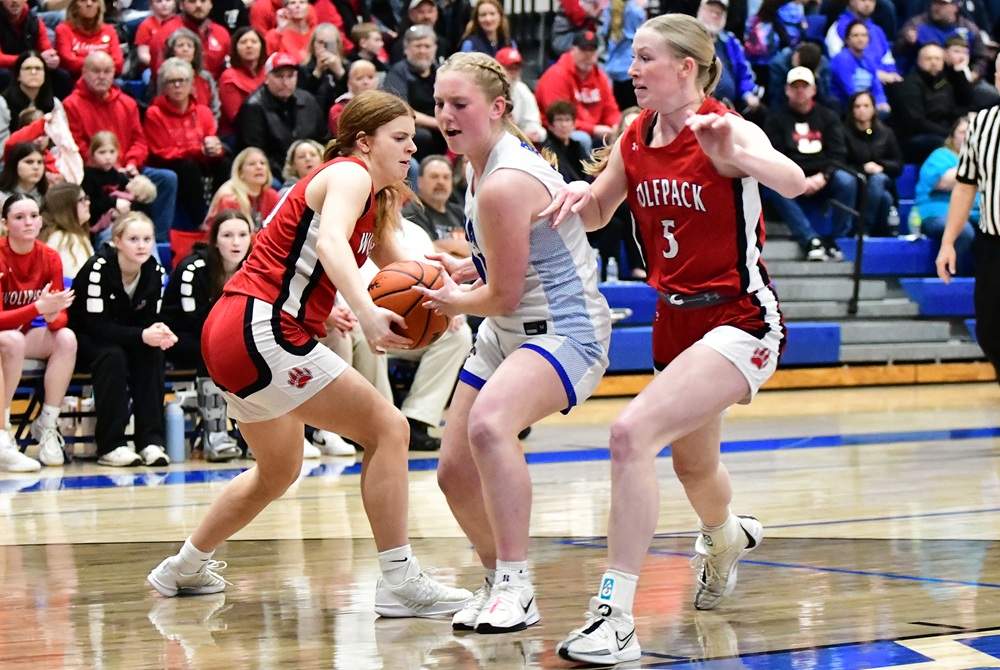
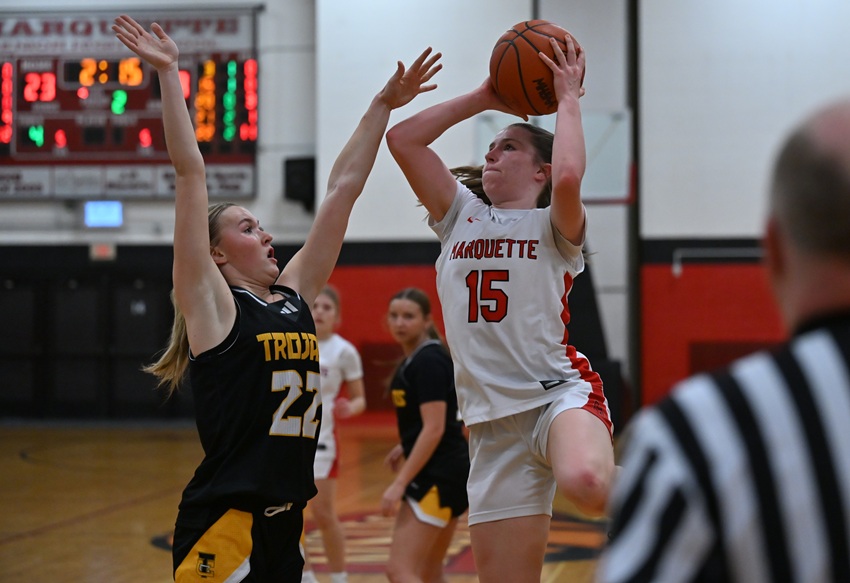
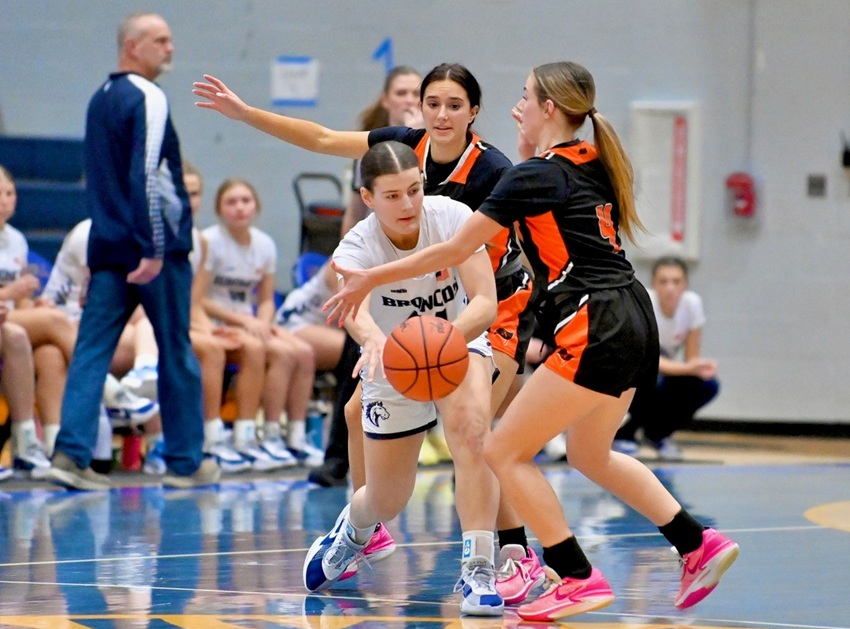
PHOTOS (Top) Laingsburg’s Mallory Woodbury (10) pulls away the ball and Harper Strouse (5) also defends during the Wolfpack’s 40-23 Division 3 District Final win over Bath on Friday. (Middle) Marquette's Avery Osborne goes up for a shot against Traverse City Central's Sienna Slack during the Sentinels’ 51-43 District Final victory in Division 1. (Below) A pair of Almont defenders block the passing lanes against North Branch during the Broncos' 47-44 Division 2 District win.(Laingsburg/Bath photo by John Johnson. Marquette/Traverse City Central photo by Cara Kamps. North Branch/Almont photo by Terry Lyons.)
Breslin Bound: Girls District Preview
February 29, 2016
By Geoff Kimmerly
Second Half editor
The girls basketball season starts over for every MHSAA team today as 128 Districts tip off all over the state.
Below is a look at four teams from each class that look good to be in the hunt when the final 16 converge on East Lansing in three weeks. Follow all of the scores and brackets in real time at MHSAA.com, and click for a glance at every team with three or fewer losses heading into the postseason.
Class A
Detroit Martin Luther King (17-1) – The Crusaders are annually in this conversation and defeated reigning champion Bloomfield Hills Marian last week to add a little more to the momentum. The only loss was in December to Detroit Renaissance, and King came back to beat Renaissance 68-66 in the Detroit Public School League Tournament championship game. King made the Class A Semifinals last season before falling the Marian.
Flushing (18-2) – It’s been a strong follow-up to last season’s 24-1 finish. After opening this season with losses to Saginaw Heritage and Midland Dow, Flushing hasn’t experienced defeat again – but has celebrated some significant victories including over Renaissance, Flint Carman-Ainsworth (15-5) and Class C Flint Hamady (18-1).
Saginaw Heritage (19-1) – The Hawks looked like strong favorites before losing sophomore forward Jaela Richardson to a season-ending knee injury two weeks ago, and then taking their only loss to Midland Dow right after. But Heritage has bounced back with four straight wins including over Carman-Ainsworth last week and still has plenty of talent and the experience of beating Flushing, Country Day, Dow (17-3) and making last season’s run to the Class A Semifinals.
Southfield Lathrup (17-3) – A loss or two more than the other favorites doesn’t mean much, considering the defeats came to Bay City John Glenn, Grand Rapids Catholic Central and Detroit Country Day, all mentioned among Class B favorites below. The Chargers have 10 wins against teams with at least 13 victories, and finished 21-2 last season losing to Marian during the Regional.
Class B
Bay City John Glenn (19-1) – Aside from a three-point loss to Ypsilanti Arbor Prep on Feb. 6, John Glenn has been unstoppable with only two more games in single digits (wins over Southfield Lathrup and Class C Saginaw Nouvel). Most of the Bobcats' toughest games came nonleague at the beginning of the year, but they finished up last week with Class A Saginaw Arthur Hill and a 13-point win over Nouvel (after beating the Panthers by only four Dec. 16).
Detroit Country Day (18-1) – The Yellowjackets have beaten their usual slate of strong teams including Arbor Prep, Haslett, Detroit Renaissance, Midland Dow and Marysville. The only loss was to Saginaw Heritage on Dec. 29, and the reigning Class B champions bounced back for a perfect 2016 so far.
Grand Rapids Catholic Central (17-2) – The Cougars closed the regular season by avenging an earlier loss to Grand Rapids South Christian, earning a shared Ottawa-Kent Conference Gold championship with the Sailors. GRCC also fell to Class A Grand Rapids Christian, but has 10 wins over Class A schools, including 69-62 over Southfield-Lathrup on Dec. 12.
Marshall (19-1) – One more win would give Marshall its second straight and third in four seasons with at least 20 victories, and the slate was anything but easy. After falling to Williamston (17-3) in their opener, the Redhawks rattled off 11 wins against teams with 10 or more victories, including Otsego (17-3), Battle Creek Harper Creek (15-5) twice and Class A Jackson Northwest (18-2) also twice to win a strong Interstate 8 Athletic Conference.
Class C
Calumet (20-0) – The reigning Class C champion has done two better, at least during the regular season, finishing undefeated by sweeping Class B Houghton – which beat Calumet twice a year ago. Total, the Copper Kings have 12 wins against teams with at least 10 victories, and only Houghton and Hancock (16-4) have come within single digits of catching them. Calumet starts District play tonight against Hancock on Hancock’s home floor.
Gobles (20-0) – The Tigers haven’t lost a regular-season game since Feb. 21, 2013, and made the Class C Semifinals in 2014 thanks in part to a strong group of now-seniors looking to return next month in their final try. Among the most impressive wins this fall were a sweep of Saugatuck (16-4) and a 10-point win over Class B Otsego.
Napoleon (20-0) – The Pirates took another step after last season’s 13-win and District title season by running through a Cascades Conference that had three more teams win at least 12 games. Napoleon hasn’t had a single-digit game since beating Manchester in overtime Dec. 15, and also picked up a nice win last week over Class B Brooklyn Columbia Central (17-3).
Ypsilanti Arbor Prep (18-2) – Arbor Prep gets the slight edge on Traverse City St. Francis as the only team not undefeated to be mentioned here because of a slightly tougher schedule (although the Gladiators’ was quite strong as well). Arbor Prep’s only losses were to Class A Ann Arbor Huron (15-4) and Country Day (18-1). And the Gators have six wins over Class A teams including Marian, plus beat Bay City John Glenn 50-47 on Feb. 6.
Class D
Bark River-Harris (19-1) – The Broncos have followed up last season’s 18-2 regular-season finish by going one win better, and now hope to build on that District title from a year ago. The only loss came to Munising – the team that eliminated Bark River-Harris in last season’s Regional Semifinal – and only two weeks ago. But the Broncos do have seven wins over teams with at least 11 victories, including beating Stephenson (18-2) in their only meeting and Crystal Falls Forest Park (16-4) twice.
Mount Pleasant Sacred Heart (18-1) – The Irish are seeking their second Class D championship in three seasons and have one of the top post players regardless of class in Averi Gamble. Sacred Heart plays Big Rapids Crossroads Academy (18-1) on Wednesday, but beat Crossroads 54-24 on Jan. 4 and owns impressive wins over Class C Beaverton, Morley Stanwood and Carson City-Crystal with the only loss to Saginaw Nouvel.
Newberry (19-1) – The Indians already are six wins better than last season, when they went out of the tournament in their first District game. Newberry also is on one of the strongest surges in the state thanks in large part to a 54-50 win over Class C contender St. Ignace on Feb. 18 that gave the Indians the Straits Area Conference title to go with an outright championship in the Eastern Upper Peninsula Conference. Newberry also swept Class B Sault Ste. Marie (15-5).
Pittsford (20-0) – After suffering its only loss last season, and in overtime, to St. Ignace in the Class D Final, Pittsford is the likely favorite after another dominating run. While the Wildcats played mostly Class D teams over a 16-game league schedule in the Southern Central Athletic Association, they also posted solid wins over Class A Belleville and Class C Manchester – and had only one game in single digits, a 71-62 win over Class C Grass Lake on Dec. 8.
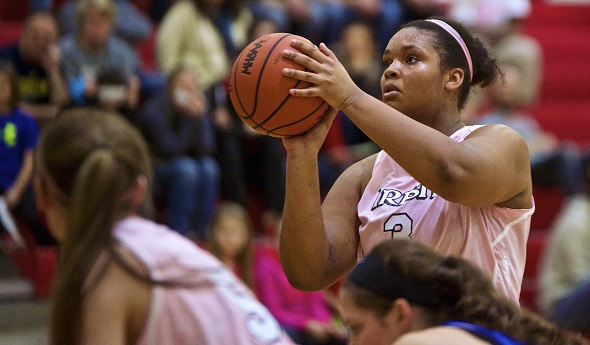
PHOTO: Mount Pleasant Sacred Heart’s Averi Gamble, here attempting a free throw, will lead one of the top teams in Class D into the tournament for the final time. (Click to see more at HighSchoolSportsScene.com.)