

Breslin Bound: Girls A-B Semis Preview
March 12, 2014
By Geoff Kimmerly
Second Half editor
The most fun angle to this weekend's Class A and B Girls Basketball Finals at the Breslin Center is that none of the eight teams still alive in those classes has won an MHSAA championship since at least 1998.
In fact, four of the eight have never played in an MHSAA championship game.
That's not to say this is new ground for all of the teams making the trip. Aside from reigning champion Goodrich, the rest of the 2013 Class B final four returns intact. And Detroit Catholic League rivals Farmington Hills Mercy and Bloomfield Hills Marian have six champioships between them – with the guarantee one will be playing Saturday for the Class A title.
Here's a look at Friday and Saturday's schedule (Class C and D teams were previewed in a separate story earlier Wednesday):
Semifinals - Friday
Class A
Canton (21-4) vs. Grand Ledge (24-2), 1 p.m.
Farmington Hills Mercy (25-1) vs. Bloomfield Hills Marian (23-2), 2:50 p.m.
Class B
Grand Rapids South Christian (25-0) vs. Midland Bullock Creek (24-1), 6 p.m.
Flint Powers Catholic (23-2) vs. Eaton Rapids (21-5), 7:50 p.m.
Finals - Saturday
Class A - Noon
Class B - 6 pm
Class C - 4 pm
Class D - 10 am
Tickets cost $8 per pair of Semifinals and $10 per two-game Finals session. All Semifinals will be streamed live on MHSAA.TV on a pay-per-view basis. All four Finals will be broadcast live on Fox Sports Detroit, the Class D and A title games on FOX Sports Detroit's primary channel and the Class C and B games on FOX Sports Detroit-PLUS. Free radio broadcasts of all weekend games will be available on MHSAANetwork.com.
Here's a look at all eight Class A and B teams playing this weekend:
Class A
BLOOMFIELD HILLS MARIAN
Record/rank: 23-2, No. 5
League finish: Tied for first in Detroit Catholic League Central
Coach: Mary Cicerone, 31st season (558-193)
Championship history: Four MHSAA titles (most recent 1998), one runner-up finish.
Best wins: 49-38 over honorable mention Canton, 57-54 over No. 3 Farmington Hills Mercy, 41-27 over No. 9 Farmington Hills Harrison in District Semifinal, 56-48 and 66-40 over Class B honorable mention Dearborn Divine Child.
Players to watch: Brittany Gray, 5-11 jr. F (10.1 ppg, 4.5 rpg); Kara Holinski, 5-9 jr. G (10 ppg).
Outlook: The Mustangs have returned to the Semifinals for the first time since 1998 despite only one senior. Marian has been engaged in a tug of war with Catholic League rival Mercy all season, also losing twice to the Marlins, and that continues Friday. Cicerone is the sixth-winningest coach in MHSAA girls basketball history and leads one of the most consistently successful programs with only three sub-.500 finishes since taking over in 1983. Individuals' stats don’t stick out, but balance is a strength – six players average between six and 10 points per game.
CANTON
Record/rank: 21-4, honorable mention
League finish: First in Kensington Lakes Activities Association South
Coach: Brian Samulski, ninth season (165-48)
Championship history: Has not played in an MHSAA Final.
Best wins: 42-33 over honorable mention Holly in Regional Semifinal, 31-28, 31-29 and 48-34 (District Final) over Plymouth, 36-25 over Class B honorable mention Dearborn Divine Child.
Players to watch: Paige Aresco, 5-10 sr. F (14.6 ppg, 4.6 rpg); Taylor Hunley, 5-1 sr. C (10 ppg, 7.4 rpg, 1.4 bpg).
Outlook: Canton has lost only twice more since opening with defeats to Marian and Mercy, and defensively has been incredible – the Chiefs are giving up an average of only 28 points per game and grabbing 11.6 steals per. They are seeking their first championship game berth, but missed advancing back-to-back in 2009 and 2010 falling by a total of four points.
FARMINGTON HILLS MERCY
Record/rank: 25-1, No. 3
League finish: Tied for first in Detroit Catholic League Central
Coach: Gary Morris, 10th season (164-73)
Championship history: Two MHSAA titles (most recent 1982), four runner-up finishes.
Best wins: 58-46 over No. 1 Detroit Martin Luther King in Regional Final, 73-60 over No. 2 Grosse Pointe South in Regional Semifinal, 55-54 and 40-38 over No. 5 Bloomfield Hills Marian, 37-33 over honorable mention Canton, 62-59 over Class B No. 2 Goodrich, 59-46 over Class B No. 8 Flint Powers Catholic.
Players to watch: Taylor Jones, 5-7 jr. G (12.5 ppg); Candice Leatherwood, 5-6 sr. G (10.3 ppg, 4.0 apg).
Outlook: Emerging from the most competitive Regional in any class in recent memory, Mercy looks like a strong favorite this weekend. That lone loss came to Marian, by four in overtime, and the Marlins have won 20 straight including beating both the No. 1 and 2-ranked teams by double digits last week. Balance is a strength of this team as well – nine players have scored 10 or more points in at least one game this winter.
GRAND LEDGE
Record/rank: 24-2, No. 4
League finish: First in Capital Area Activities Conference Blue
Coach: David Jones, fifth season (79-36)
Championship history: Has not played in an MHSAA Final.
Best wins: 45-44 over No. 7 Richland Gull Lake in District Final, 36-32 over No. 6 Haslett in Regional Final, 56-44 over honorable mention Kalamazoo Central in Regional Semifinal.
Players to watch: Hannah Orwat, 5-8 sr. G (15 ppg); Lindsay Orwat, 5-8 sr. G (13.4 ppg); Cori Crocker, 6-3, jr. C (10.7 ppg, 11.5 rpg, 2.6 bpg).
Outlook: The Comets came into this season with high expectations, then opened 2-2 losing to honorable mention DeWitt and No. 1 Detroit Martin Luther King in December (although Lindsay Orwat was injured for the DeWitt game). Grand Ledge has run off 22 straight wins since to advance past the Quarterfinals for the first time ever after falling to eventual champion Grand Haven in that round last season. Crocker, who has committed to play volleyball at the University of Michigan, is one of three 6-footers in the lineup.
Class B
EATON RAPIDS
Record/rank: 21-5, honorable mention
League finish: Second in Capital Area Activities Conference Gold
Coach: Willis Whitmyer, 15th season (210-122)
Championship history: Has not played in an MHSAA Final.
Best wins: 53-37 over No. 6 Ypsilanti Arbor Prep in Quarterfinal, 69-29 over No. 9 Olivet in District opener, 33-30, 45-23 (District Final) over honorable mention Jackson Northwest, 57-44 over Class A No. 6 Haslett, 43-38 over Class A No. 10 Southgate Anderson.
Players to watch: Allie Dittmer, 6-1 sr. C (14.6 ppg, 9.3 rpg, 1.6 bpg); Kathryn Mills, 5-11 sr. F (10 ppg, 4.8 rpg).
Outlook: This run has been a long time coming for the Greyhounds, who have won four District and three league titles over the last nine seasons but had never advanced to Finals weekend. Eaton Rapids has won all of its tournament games by at least 10 points and eight straight by double digits despite facing a tough road to Breslin. All five starters and a top sub are seniors.
FLINT POWERS CATHOLIC
Record/rank: 23-2, No. 8
League finish: First in Saginaw Valley Association South
Coach: Thom Staudacher, third season (52-22)
Championship history: Four MHSAA titles (most recent 2001), four runner-up finishes.
Best wins: 51-31 over No. 4 Detroit Country Day in Quarterfinal, 58-51 over No. 2 Goodrich in Regional Final, 57-37 over honorable mention Frankenmuth in District Final, 65-22 over honorable mention Flat Rock, 54-26 over Class A No. 8 Midland.
Players to watch: Michela Coury, 6-2 sr. F (11.3 ppg, 9.6 rpg, 2.9 bpg), Ally Haran, 5-9 sr. G (12.2 ppg, 5.9 rpg, 4.1 apg, 4.4 spg), Sara Ruhstorfer, 5-5 sr. G (10.3 ppg, 2.9 spg).
Outlook: The Chargers who made an unexpected run for a young team last season are much more seasoned coming into this weekend, and they reinforced that fact by eliminating two of the top four ranked teams over the last week. Three starters from last season’s championship game loss are among those leading the way. The only losses this winter were to Class A Quarterfinalist Farmington Hills Mercy and Class C Quarterfinalist Saginaw Nouvel.
GRAND RAPIDS SOUTH CHRISTIAN
Record/rank: 25-0, No. 1
League finish: First in O-K Gold
Coach: Jim DeBruyn, 25th season (439-131)
Championship history: Class B champion 1988, one runner-up finish.
Best wins: 34-31 and 44-38 (Regional Semifinal) over honorable mention Holland Christian, 40-36, 28-27 and 50-45 (Regional Final) over honorable mention Grand Rapids Catholic Central.
Players to watch: Cassidy Vredevoogd, 6-0 sr. C (9.4 ppg, 4.6 rpg), Renee Broekhuizen, 5-11 sr. F (8.7 ppg, 4.1 rpg).
Outlook: South Christian is hoping to put the crowning achievement on a five-year run that has seen the Sailors improve from 11 to 12 to 21 to 23 and now to 25 wins over the last five seasons. They’ve also won two league, three District and two Regional titles during that time and advanced to last season’s Semifinals. Vredevoogd, Broekhuizen and senior Morgan Torres all started during that run as well.
MIDLAND BULLOCK CREEK
Record/rank: 24-1, No. 3
League finish: First in Tri-Valley Conference Central
Coach: Justin Freeland, 12th season (218-56)
Championship history: Has not played in an MHSAA Final.
Best wins: 51-45 over honorable mention Bay City John Glenn in District Final, 66-32 over No. 5 Clare in Regional Semifinal, 44-32 over honorable mention Frankenmuth, 43-33 over Class C No. 10 Saginaw Nouvel.
Players to watch: Ellie Juengel, 5-8 jr. G (12.5 ppg, 5.1 rpg); Halee Nieman, 5-11 jr. F (12.9 ppg, 5.6 rpg, 3.3 spg); Hannah Heldt, 5-7 jr. G (10.9 ppg).
Outlook: After making both the Quarterfinals and Semifinals last season for the first time, Bullock Creek has done the same this winter while suffering its only loss against league co-runner-up Hemlock. Nieman, Juengel, Heldt and sophomore forward Alyssa Mudd all started last season when the Lancers fell in overtime to Flint Powers Catholic in the Semifinal. And they could take this Breslin run to three straight, with only two seniors and no starters graduating this spring.
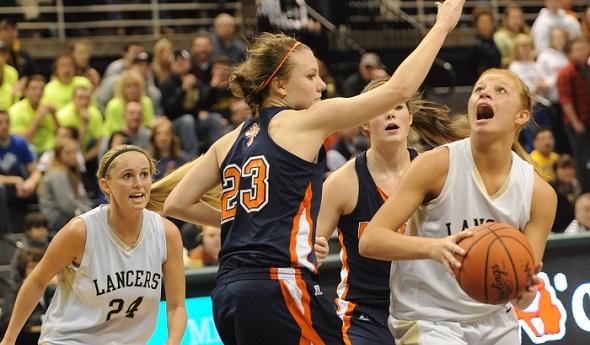
PHOTO: Bullock Creek's Halee Nieman works to get around Flint Powers' Ally Haran (23) while the Lancers' Ellie Juengel (24) anticipates the play during the teams' 2013 Semifinal.
DeBoer Looks to Steer Sailors to Breslin
February 18, 2016
By Dean Holzwarth
Special for Second Half
CUTLERVILLE – Jenn DeBoer remembers the thrill of playing in the MHSAA Class B Final when she was a sophomore.
 The South Christian standout would like nothing better than to revisit that feeling in her final season.
DeBoer, a 5-foot-7 point guard, is currently leading the Sailors toward what they hope is another extended postseason run.
South Christian is 16-1 with three games remaining in the regular season before Districts tip off in March.
“That was a lot of fun, and obviously it was different because I was a sophomore and I knew that I had two more years after that,” DeBoer said. “But this year it’s a big goal for all of us seniors. We’ve talked about how we want to get back there and end our senior season strong.”
Led by DeBoer and a cast of veteran senior teammates, the Sailors have displayed the potential to make some noise in the MHSAA tournament.
They’re seeking an Ottawa-Kent Conference Gold title and currently own a perfect 7-0 mark in league play. Their championship hopes hinge on upcoming showdowns with Wayland and Grand Rapids Catholic Central.
“It’s been a blast so far,” DeBoer said. “I couldn’t ask for a better senior season. Our team chemistry is so amazing, and the other seniors and I get along so well. Obviously, winning has been fun too, and it’s probably one of the best teams I’ve been on.”
DeBoer, a four-year varsity player who committed to Division II Grand Valley State University before her junior season, has been the floor general of this year’s squad.
She has contributed in every aspect of the game, averaging 16.8 points, 6.0 assists, 4.6 rebounds and 3.8 steals per contest.
First-year South Christian coach Kim Legge has watched DeBoer improve and mature throughout the past years.
“She has made strides because of her work ethic, and she always wants to learn,” said Legge, a longtime assistant under recently-retired coach Jim DeBruyn.
“She’s like a sponge, and she’s been to a point guard camp the past two summers. That has really helped with her decision-making and leadership skills.”
DeBoer recently established two new school records for her 3-point shooting prowess.
During a recent win over Hastings, she set a new mark for career 3-pointers that had stood since 2003 while also surpassing the single-season record.
DeBoer toppled Leah Pettinga’s career record of 93 3-pointers made. She currently has 45 on the season.
 “It’s a huge honor to have the record now,” DeBoer said. “I knew I was pretty close because I focus on shooting 3s. It’s my favorite thing to do, and that’s just what I do. I wasn’t sure if I would ever make it, so it is definitely really cool to know that I have the record now.”
Legge didn’t know DeBoer was approaching the milestone until a few weeks ago, but she wasn’t surprised by the accomplishment.
“Anything that girl puts her mind to she seems to get done,” Legge said. “I got clued in a couple games before that she was getting close, but she would have never said anything to me. That’s how she is. She is so humble. It was a goal of hers, but it never would’ve come out of her mouth.”
DeBoer said the transition from DeBruyn to Legge wasn’t a difficult one.
“They both have similar coaching styles, but coach Legge is a lot more centered on defense so our defense this year has really picked up,” she said. “We have done a lot of the same things we’ve been doing in the past.”
DeBoer’s early commitment to the Lakers has allowed her to enjoy a stress-free final two seasons. It’s allowed her to focus strictly on helping her team succeed instead of lamenting over which college to choose.
“The pressure has been off, and I’ve been able to focus on my last basketball season at South,” DeBoer said. “The last four years have gone by pretty fast, and it doesn’t feel like I’m a senior until I think about it and look at old pictures. In a couple months I will be graduating, but I’m trying to enjoy high school while I’m still here.”
DeBoer is anticipating the jump to college, but is committed to ending her career on a high note.
“I’m definitely looking forward to playing in college next year, but I would really like to have a good ending to this season,” DeBoer said. “If we keep working hard, then I think we will do pretty well in the postseason.”
Legge isn’t one to look ahead, but with a starting line-up consisting of all seniors, expectations are high for the remainder of the season.
“We have a hard road ahead of us the last week of conference (play) and I don’t feel like we have peaked,” she said. “I really focus on what my team needs to do to grow on a day-to-day basis. Every coach in the state hopes their team makes a tournament run, and at this point of the season, it’s a goal of ours.”
 Dean Holzwarth covered primarily high school sports for the Grand Rapids Press and MLive for 16 years and more recently served as sports editor of the Ionia Sentinel and as a sports photojournalist for WZZM. Contact him at [email protected] with story ideas for Allegan, Kent and Ottawa counties.
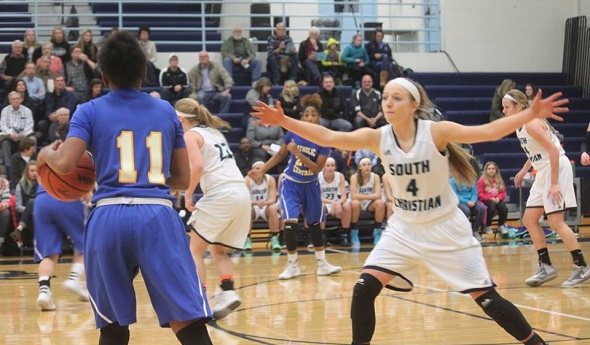
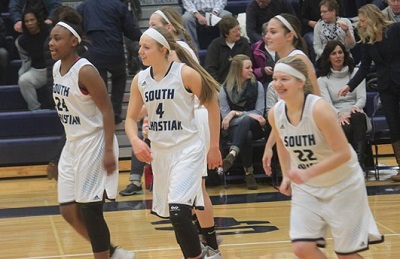
PHOTOS: (Top) Grand Rapids South Christian's Jenn DeBoer defends against Grand Rapids Catholic Central earlier this season. (Middle) DeBoer, 4, is one of a cast of experienced teammates hoping to finish with another Finals run; she takes the floor with Markayla Vander (24) and Sydney DeYoung (22). (Photos by Tracy DeYoung.)