

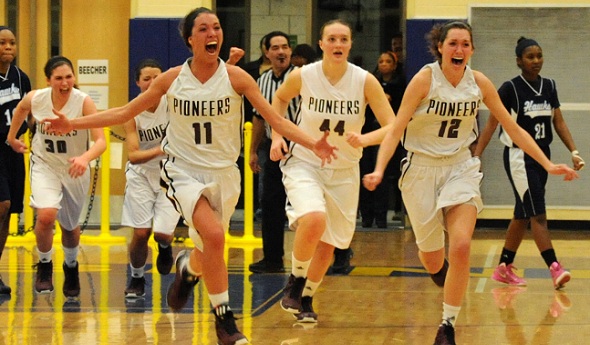
Breslin Bound: Girls C-D Semifinals Preview
March 13, 2013
By Geoff Kimmerly
Second Half
Flint Northern, from 1978-81 in Class A, is the only school in MHSAA history to win four straight Girls Basketball Finals championships.
Waterford Our Lady of the Lakes can become the next to achieve that feat by claiming the Class D title this weekend.
The Lakers' pursuit will be one of the most followed storylines at Michigan State University's Breslin Center. Class C and D Semifinals are Thursday, with all four championships games Saturday.
Semifinals - Thursday
Class C
Manchester (25-1) vs. Riverview Gabriel Richard (16-7), 1 p.m.
Saginaw Nouvel (24-2) vs. Houghton (23-2), 2:50 p.m.
Class D
St. Ignace (25-0) vs Climax-Scotts (20-5), 6 p.m.
Athens (22-3) vs Waterford Our Lady of the Lakes (20-4), 7:50 p.m.
Finals - Saturday
Class A - Noon
Class B - 6 pm
Class C - 4 pm
Class D - 10 am
Tickets cost $8 per pair of Semifinals and $10 per two-game Finals session. All Semifinals will be streamed live on MHSAA.tv and available on a pay-per-view basis for $3.95 per day, $6.95 for the weekend or $9.95 for all girls and boys Semifinals over the next two weekends. All four Finals will be broadcast live on Fox Sports Detroit. Free radio broadcasts of all weekend games will be available on MHSAANetwork.com.
And now, a look at the Semifinalists in Class C and D.
Class C
HOUGHTON
Record/rank: 23-2, tied for No. 7
League finish: First in Western Peninsula Athletic Conference
Coach: Julie Filpus, 14th season (307-34)
Championship history: Class C champion (2005).
Best wins: 61-47 and 64-62 over Calumet, 76-41 and 58-42 (District Final) over L’Anse, 67-36 over Ishpeming (Regional Final), 56-47 over Shelby (Quarterfinal).
Players to watch: Elisa Jurmu, 5-8 jr. F (19.9 ppg, 5.4 rpg); Blaire Zenner, 5-10 sr. F (8.0 ppg, 7.3 rpg).
Outlook: Houghton has made at least the Regional round all 14 of Filpus’ seasons and won league titles every one of the last 13. Although the Gremlins didn’t see ranked teams this season, they did split against Class A Marquette, which finished 18-4. Jurmu received all-state special mention from The Associated Press on Wednesday and is one of four starters shooting better than 50 percent from the floor this winter.
MANCHESTER
Record/rank: 25-1, No. 3
League finish: First in Cascades Conference
Coach: Cori Kastel, seventh season (95-63)
Championship history: Has not played in an MHSAA Final.
Best wins: 57-42 over honorable mention Ypsilanti Arbor Prep (District Final), 58-51 over honorable mention Adrian Madison (Regional Final), 67-43 over No. 2 Niles Brandywine (Quarterfinal).
Players to watch: McKenna Erkfritz, 6-1 sr. F (14.8 ppg, 7.2 rpg, 1.8 bpg); Jessie Manders, 5-6 soph. G (9.6 ppg, 2.9 apg); Taylor Manders, 5-5 sr. G (14.4 ppg, 4.5 rpg, 3.2 apg, 3.0 spg).
Outlook: The Jackson area is generally strong for girls basketball, and Manchester emerged champion of a league that included six teams with at least 11 wins and four that won 15 or more games. Erkfritz earned all-state special mention and teams with Taylor Manders and guard Jesse Coltre as the team’s lone seniors – although all three start.
RIVERVIEW GABRIEL RICHARD
Record/rank: 16-7, unranked
League finish: Tied for first in Detroit Catholic League AA
Coach: William Jones, second season (36-11)
Championship history: Has not played in an MHSAA Final.
Best wins: 52-48 over Pontiac Notre Dame Prep, 47-44 (OT) over honorable mention Flint Hamady (Quarterfinal).
Player to watch: Ashley Henderson, 5-8 sr. G (16.2 ppg, 4.8 rpg, 3.8 apg, 2.6 spg).
Outlook: Gabriel Richard has reached the Quarterfinals both seasons under coach Jones, but Tuesday’s win over Hamady still had to be considered a bit of an upset considering Hamady’s championship history. Henderson has proven she can find the basket when it's needed most, scoring 30 in the Regional Final and 31 in the Quarterfinal.
SAGINAW NOUVEL
Record/rank: 24-2, No. 4
League finish: Does not play in a league.
Coach: Kris Hengesbach, 12th season (252-54)
Championship history: Two MHSAA titles (2008), one runner-up finish.
Best wins: 47-45 over No. 1 Reese (Regional Semifinal), 55-34 over honorable mention Kent City (Regional Final), 60-50 and 57-48 (District Final) over No. 10 Saginaw Valley Lutheran, 58-47 over Class B No. 1 Freeland, 59-58 over Class B honorable mention Clare, 44-40 over Class B honorable mention Haslett, 51-22 over Class D No. 9 Waterford Our Lady.
Players to watch: Taylor Hengesbach, 5-10 G/F sr. (12.1 ppg, 5.0 rpg, 3.0 apg, 1.4 bpg); Rachel McInerny, 6-2 jr. C (14.9 ppg, 10.1 rpg, 1.4 bpg).
Outlook: Nouvel has beaten the top-ranked teams from two classes and the three-time reigning champion from a third. The Reese win avenged a 10-point loss from earlier this season, and Nouvel’s only other defeat came against No. 7 Carson City-Crystal. Taylor Hengesbach made the all-state team and McInerny earned honorable mention Wednesday as the leading scorers from a team that outscores its opponents on average 55-26.
Class D
ATHENS
Record/rank: 22-3, honorable mention
League finish: Second in Big 8 Conference
Coach: Calvin Quist, eighth season (145-50)
Championship history: Class D runner-up 2012.
Best wins: 41-33 over No. 7 Mendon (District Semifinal), 68-42 over No. 10 Hillsdale Academy (Regional Final), 55-44 over Climax-Scotts, 48-47 over Class C honorable mention Concord.
Players to watch: Audrey Oswalt, 5-9 jr. F (9.5 ppg, 7.0 rpg, 2.8 spg); Chantel Davenport, 5-9 sr. F (9.5 ppg, 4.0 rpg).
Outlook: Few teams can boast such scoring balance, with sophomore guard Allison Fuller (10.2 ppg) and junior guard Allysha Beal (9.8 ppg) the leading scorers and joining Oswalt and Davenport to give the team four players who average double figures or close. It’s tough to see how Athens couldn't crack the top 10 with its losses only to Mendon, Concord and Homer – all teams the Class D reigning runner-up eventually split with this winter.
CLIMAX-SCOTTS
Record/rank: 20-5, unranked
League finish: First in Southern Central Athletic Association
Coach: Dana Perrin, third season (61-12)
Championship history: Class D runner-up 1986.
Best wins: 42-40 over No. 8 Gaylord St. Mary (Quarterfinal), 52-48 over Class C honorable mention Concord.
Players to watch: Destiny Froberg, 5-7 sr. F (13.2 ppg, 4.1 rpg, 4.4 apg, 2.7 spg); Fallon Froberg, 5-8 sr. C (11.8 ppg, 6.4 rpg, 2.4 spg).
Outlook: Climax-Scotts has won at least 20 games all three seasons under Perrin, and will play Thursday for its first championship game berth in nearly three decades. Five seniors of seven total fill the starting line-up. Guard Stephanie Cochran joins the Froberg twins scoring in double figures averaging 10.5 points per game with 54 3-pointers through her first 24 games this season.
ST. IGNACE
Record/rank: 25-0, No. 1
League finish: First in Straits Area Conference
Coach: Dorene Ingalls, 14th season (289-57)
Championship history: Three MHSAA titles (most recently 2011), two runner-up finishes.
Best wins: 70-54 over No. 3 Crystal Falls Forest Park (Quarterfinal), 74-68 over No. 6 Posen (Regional Final), 70-21, 78-16 and 67-23 (Regional Semifinal) over honorable mention Pickford, 53-38 over Class A honorable mention Petoskey, 55-41 over Class A honorable mention Brighton.
Players to watch: Kelley Wright, 5-10 jr. G (19.3 ppg, 6.8 rpg, 5.3 apg, 6.8 spg); Sarah Cullip, 5-11 sr. G (13.4 ppg); Abbey Ostman, 5-8 fr. F (10.8 ppg, 9.9 rpg).
Outlook: The Saints are making their fourth-straight trip to Breslin Center but first of this run in Class D after playing in Class C previously. Wright, Cullip and junior guard Emily Hinsman also started last season, and senior guard Morgan LaVake played the most minutes off the bench during the Semifinal. Wright was named all-state Tuesday.
WATERFORD OUR LADY OF THE LAKES
Record/rank: 20-4, No. 9
League finish: First in Detroit Catholic League East
Coach: Steve Robak, sixth season (126-27)
Championship history: Three MHSAA titles (most recently 2012).
Best wins: 40-26 over No. 5 Lansing Christian (Regional Final), 28-24 (OT) over Mount Pleasant Sacred Heart (Quarterfinal), 45-25 over Riverview Gabriel Richard, 50-38 over Livonia Ladywood.
Players to watch: Ava Doetsch, 5-6 sr. G (14.5 ppg, 5.0 rpg, 2.7 apg, 2.8 spg); Lexie Robak, 5-9 sr. G (14.8 ppg, 4.0 rpg, 2.4 apg).
Outlook: The Lakers, and especially Doetsch and Lexie Robak, will attempt to add to an incredible run that’s included the last three Class D championships – and those two started on all three of those teams. Both were named to the all-state team this week and are dangerous from the perimeter – Robak had 67 3-pointers and Doetsch 37 heading into the week. Our Lady is 87-18 over their four seasons.
PHOTO: Riverview Gabriel Richard celebrates its Class C Quarterfinal win over Flint Hamady on Tuesday. (Photo courtesy of Anna Fedor/Riverview Gabriel Richard.)
Breslin Bound: Girls Report Week 12
February 22, 2016
By Geoff Kimmerly
Second Half editor
One week remains in the girls basketball regular season, and contenders are gearing up for District tournaments that begin a week from today.
Most weeks during the season, we check in with four teams from each class that have been especially impressive. After a bit of a hiatus, here’s a look at 16 more to remember when the tournament begins.
Class A
Allen Park (16-2) – After finishing second to Brownstown Woodhaven a season ago, Allen Park clinched the Downriver League championship Friday with a 56-20 win over Taylor Truman. The Jaguars’ only losses were to Woodhaven in their second meeting and Plymouth in the season opener.
Bloomfield Hills Marian (13-6) – The Mustangs have rebuilt quite a bit after winning last season’s Class A title, and finished only third in the Detroit Catholic League Central. But they beat second-place Warren Regina in the semifinal and then rival and league champion Farmington Hills Mercy 48-29 in Sunday’s A-B league tournament final.
Detroit Martin Luther King (16-1) – The Crusaders came back from their only loss this season – 68-65 to Renaissance on Dec. 17 – to beat Renaissance 68-66 and win their fifth straight Detroit Public School League Tournament title. King previously won the PSL East Division 1 title this winter.
Dexter (17-1) – The Dreadnaughts finished a perfect run in the Southeastern Conference White last week, defeating Ypsilanti Community 37-28, to win the league title outright after sharing the championship with Chelsea last season.
Class B
Bay City John Glenn (17-1) – The Bobcats bounced back from their lone loss this season, 50-47 two weeks ago to Ypsilanti Arbor Prep, to put 40-point wins on Tawas and Pinconning over the last two weeks and finish a dominating run through the North East Michigan Conference.
Detroit Country Day (18-1) – Since falling to Saginaw Heritage on Dec. 29, Country Day has won 14 straight. The slate has an argument for the state’s most impressive – wins over Detroit Renaissance, Haslett, Southfield-Lathrup and Ypsilanti Arbor Prep are among the brightest highlights.
Fruitport (17-1) – The Trojans haven’t fallen since Dec. 11 to Spring Lake and secured a share of the Lakes 8 Conference championship with a 46-19 win over Muskegon Catholic Central on Friday. Fruitport finished only fourth in the league a year ago.
Marysville (15-2) – The Vikings have won 13 straight since falling to Country Day on Dec. 17 and 12 straight league games to again claim the Macomb Area Conference Gold title outright after sharing the championship with Center Line last season.
Class C
Johannesburg-Lewiston (17-1) – The Cardinals wrapped up a share of the Ski Valley Conference title with a 60-57 win over Onaway on Thursday and can claim it outright by beating Pellston on Tuesday. They finished second to Bellaire last season, but split with Bellaire this winter.
Morley Stanwood (17-2) – The Mohawks claimed a share of the Central State Activities Association Silver title Friday with a 60-34 win over Holton, but they’ll need to beat reigning champion Kent City this week to win the title outright. Morley Stanwood was second last season but beat Kent City 55-41 in their first meeting, Jan. 22.
Negaunee (14-4) – The Miners can finish a perfect run through the Mid-Peninsula Athletic Conference with a win over Ishpeming this week, and also avenge one of their losses, to Marquette on Dec. 15. Negaunee tied for fourth in the league and finished only 9-13 a year ago.
Sandusky (16-2) – The second-place Redskins will need help in the Greater Thumb Conference East title race from third-place Brown City – which plays league leader Marlette this week in the final GTC game for those teams. But Sandusky’s only losses this season were to Marlette, by 12 and seven points.
Class D
Climax-Scotts (17-2) – The league-leading Panthers finished a season sweep last week of rival Battle Creek St. Philip, beating the Tigers 42-39 after finishing second to St. Philip in the Southern Central Athletic Association West a year ago.
Crystal Falls Forest Park (16-3) – The Trojans hold a half-win lead on Bark River-Harris in the Skyline Central Conference West standings thanks to Munising’s recent upset of the former league leader; Forest Park must beat Bark River-Harris this week to clinch the title after losing 51-25 in their first meeting Dec. 4.
Gaylord St. Mary (16-3) – Despite finishing second to Johannesburg-Lewiston in the Ski Valley Conference, the Snowbirds should be optimistic heading into the tournament riding five straight wins and with their only losses by a combined four points to the Cardinals.
Mendon (15-3) – The Hornets clinched the Berrien-Cass-St. Joseph Conference Blue title outright with a 46-27 win over Cassopolis on Friday and are already two wins better than last year’s team, which finished third in the old BCS East.
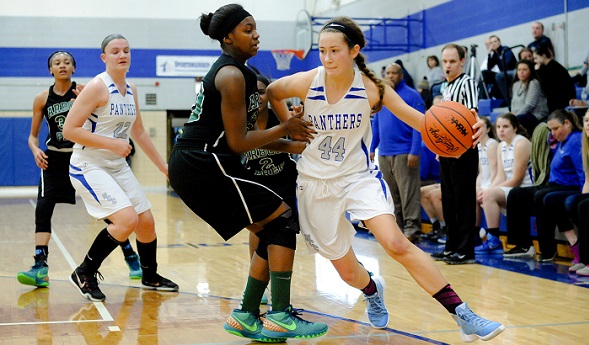
PHOTO: Ypsilanti Arbor Prep and Saginaw Nouvel are two teams expected to contend when the MHSAA Tournament begins next week. (Click for more from HighSchoolSportsScene.com.)