

Breslin Bound: Girls C-D Semis Preview
March 12, 2014
By Geoff Kimmerly
Second Half editor
There will be some who arrive for the MHSAA Class C and D Semifinals on Thursday already quite familiar with the Breslin Center.
Reigning Class D champion St. Ignace is back, this time in Class C. The reigning runner-up from that class, Saginaw Nouvel, also returns. So too does Athens, a Class D Semifinalist a year ago as well.
But the most discussed player will be the one preparing to make herself most at home. Crystal Falls Forest Park is back for the second time in three seasons and features Miss Basketball winner Alexis Gussert, who has signed with Michigan State University for next season.
All four Class C and D Semifinals will be played Thursday, with all four championship games Saturday.
Semifinals - Thursday
Class C
Saginaw Nouvel (20-4) vs. Gobles (26-0), 1 p.m.
Grosse Pointe Woods University Liggett (20-3) vs. St. Ignace (23-2), 2:50 p.m.
Class D
Mount Pleasant Sacred Heart (20-5) vs. Marine City Cardinal Mooney (19-5), 6 p.m.
Crystal Falls Forest Park (25-0) vs. Athens (22-3), 7:50 p.m.
Finals - Saturday
Class A - Noon
Class B - 6 pm
Class C - 4 pm
Class D - 10 am
Tickets cost $8 per pair of Semifinals and $10 per two-game Finals session. All Semifinals will be streamed live on MHSAA.TV on a pay-per-view basis. All four Finals will be broadcast live on Fox Sports Detroit, the Class D and A title games on FOX Sports Detroit's primary channel and the Class C and B games on FOX Sports Detroit-PLUS. Free radio broadcasts of all weekend games will be available on MHSAANetwork.com.
And now, a look at the Semifinalists in Class C and D.
Class C
GOBLES
Record/rank: 26-0, No. 6
League finish: First in Southwest Athletic Conference North
Coach: John Curtis, 12th season (183-91)
Championship history: Has not played in an MHSAA Final.
Best wins: 49-40 (Quarterfinal) and 39-35 over honorable mention Mendon, 56-52 over New Buffalo in Regional Final, 44-40 over Otsego.
Players to watch: Michaela DeKilder, 5-10 sr. F (15.2 ppg, 9.6 rpg, 3.2 spg); Ellen Doyle, 5-10 soph. G (12 ppg, 4.4 rpg, 5.3 apg).
Outlook: Gobles is making its first trip to the MHSAA Semifinals after its second Quarterfinal ever Tuesday. The Tigers dominated the SAC North, winning all of their league games by double digits. Gobles is 46-3 combined over the last two seasons, and DeKilder has been a force throughout. But she has plenty of help – all five starters average at least seven points per game.
GROSSE POINTE WOODS UNIVERSITY LIGGETT
Record/rank: 20-3, unranked
League finish: First in Michigan Independent Athletic Conference Blue
Coach: Omar Ahart, second season (42-6)
Championship history: Class C runner-up 2012 and 2011.
Best wins: 50-47 over No. 1 Blissfield in Quarterfinal, 48-25 over Class D No. 8 Birmingham Roeper.
Players to watch: Jessica Rotzoll, 5-8 jr. F (13.5 ppg, 4.4 rpg). Nia Ahart, 5-7 fr. G (11.6 ppg, 4.6 apg); Lauren Ristovski, 5-9 jr. G (9.8 ppg, 3.9 apg).
Outlook: Three starters return to Breslin after also playing on the 2012 team that finished runner-up, including the team’s lone senior, guard Angelina Evangelista. Sophomore forward Kendall McConico adds another 10.6 points per game to make this lineup full of scoring threats, especially from the perimeter as only one player is taller than 5-9. Rotzoll also had made 40 3-pointers heading into this week.
ST. IGNACE
Record/rank: 23-2, No. 9
League finish: First in Straits Area Conference
Coach: Dorene Ingalls, 15th season (314-59)
Championship history: Four MHSAA titles (most recent 2013), two runner-up finishes.
Best wins: 54-37 over honorable mention McBain in Quarterfinal, 68-34 over Class D No. 10 Brimley, 58-52 over Detroit Renaissance.
Players to watch: Kelley Wright, 5-10 sr. G (16.2 ppg, 7.9 rpg, 4.2 apg, 6.7 spg); Abbey Ostman, 5-9 soph. F (12.3 ppg, 7.5 rpg, 3.2 spg).
Outlook: The Saints are making their fifth straight trip to Breslin Center and are back in Class C after a one-season hiatus to Class D – where St. Ignace won last season’s championship. Wright was a starter the last two trips to East Lansing as well, and Ostman and senior guards Emily Hinsman (9.1 ppg) and Morgan LaVake (5.3 ppg) also started in that 2013 title game win. Wright is a returning all-stater.
SAGINAW NOUVEL
Record/rank: 20-4, No. 10
League finish: Does not play in a league.
Coach: Mary Jo Skiendziel, first season (8-0)
Championship history: Two MHSAA titles (most recent 2008), two runner-up finishes.
Best wins: 49-43 and 51-40 (Regional Semifinal) over No. 3 Reese, 47-35 over No. 5 Sandusky in Regional Final, 47-40 over honorable mention St. Louis in Quarterfinal, 57-37 over Class B No. 5 Clare, 53-47 over Class B No. 8 Flint Powers Catholic.
Players to watch: Rachel McInerny, 6-2 sr. C (11.7 ppg), Laurel Jacqmain, 5-7 soph. G (12.4 ppg)
Outlook: There have been some big changes in the Nouvel program since its last trip to Breslin, but plenty has stayed the same as well. Assistant coach Skiendziel was promoted to head coach last month and has kept the team rolling with three starters back from last season’s five-point loss to Manchester in the championship game. McInerney can be a force in the post, while Jacqmain and junior forward Nicole Buckingham also played big parts as starters during last season’s run.
Class D
ATHENS
Record/rank: 22-3, No. 5
League finish: First in Big 8 Conference
Coach: Calvin Quist, ninth season (166-53)
Championship history: Class D runner-up 2012.
Best wins: 42-39 over honorable mention St. Joseph Lake Michigan Catholic in Regional Semifinal, 38-20 over honorable mention Wyoming Potter’s House Christian in Regional Final, 38-30 over Concord.
Players to watch: Audrey Oswalt, 5-9 sr. F (12.1 ppg, 7.8 rpg, 3.6 spg); Allison Fuller, 5-7 jr. G (13.5 ppg, 3.5 spg).
Outlook: Athens has become a regular at Finals weekend, with this its third straight trip emerging from a competitive Big 8 Conference. Fuller was named an all-state honorable mention Tuesday. Senior guard Allysha Beal (9.3 ppg) joined Oswalt and Fuller in the starting lineup for last season’s Semifinal loss to Waterford Our Lady, and all three were among that team’s top scorers as well.
CRYSTAL FALLS FOREST PARK
Record/rank: 25-0, No. 1
League finish: First in Skyline Conference
Coach: Jeff Syrjanen, ninth season (169-37)
Championship history: Class D runner-up 1995.
Best wins: 69-56 over No. 2 Posen in Quarterfinal, 69-52 over No. 4 Eben Junction Superior Central in Regional Final, 56-21 over honorable mention Dollar Bay in Regional Semifinal, 82-38 (District Semifinal) and 61-28 over honorable mention Watersmeet.
Players to watch: Alexis Gussert, 6-0 sr. F (29.4 ppg, 7.7 apg, 11.9 rpg, 1.6 bpg, 4.0 spg); Maria Stankewicz, 5-5 soph. G (7.6 ppg, 2.8 apg).
Outlook: Forest Park is making one more run at its first MHSAA championship with one of the leading scorers in MHSAA history in Gussert, who was named Associated Press Class D Player of the Year on Monday. Gussert – who also led the Trojans to the Semifinals as a sophomore – broke a single-season MHSAA record with her 101st 3-pointer in the Quarterfinal. Senior center Kendra Campbell and junior guard Sierra Robarge join Stankewicz in adding 7.5 points per game.
MARINE CITY CARDINAL MOONEY
Record/rank: 19-5, No. 9
League finish: First in Detroit Catholic League East
Coach: Susan Everhart, 26th season (record N/A).
Championship history: Class D runner-up 2009.
Best wins: 39-20 over honorable mention Kingston in Regional Final, 43-34, 53-51 and 43-36 (Quarterfinal) over Clarkston Everest Collegiate, 49-34 over Class B No. 6 Ypsilanti Arbor Prep.
Players to watch: Katie Theut, 5-10 sr. G (20.1 ppg, 5.6 rpg, 4.3 apg, 1.4 bpg); Madison Southers, 6-0 sr. C (11 ppg, 10.8 rpg, 5.2 bpg).
Outlook: Cardinal Mooney is back at Breslin for the first time since that runner-up season of 2009 and with a starting lineup featuring four seniors. Theut was named all-state Tuesday and Southers received an honorable mention. The Cardinals feature further frontcourt strength with 5-9 senior forward Lauren Higgins, who averages 10.8 points, 7.1 rebounds and 1.4 blocks per game. Cardinal Mooney played a host of Class A, B and C schools as well, with four losses coming to those more sizable programs.
MOUNT PLEASANT SACRED HEART
Record/rank: 20-5, unranked
League finish: Tied for first in Mid-State Activities Conference
Coach: Damon Brown, sixth season (107-33)
Championship history: Class D runner-up 2008.
Best wins: 49-35 over No. 3 Frankfort in Quarterfinal, 55-40 and 46-34 (District Final) over honorable mention Big Rapids Crossroads Academy, 34-23 over Class C No. 8 Carson City-Crystal.
Players to watch: Sara Hansen, 5-6 sr. G (19.1 ppg, 3.1 apg, 5.4 spg); Averi Gamble, 6-3 soph. C (12.7 ppg 8.0 rpg, 2.3 bpg).
Outlook: The Irish were stopped in the Quarterfinals two of the last four seasons, but broke through with an upset Tuesday. Still, it can’t be considered a huge surprise, given Sacred Heart’s losses – one to Class C Quarterfinalist Saginaw Nouvel, another to Class C No. 8 Carson City Crystal and a third to Class B No. 5 Clare. Hansen is the lone senior, but gets additional help in the backcourt from junior Riley Terwilliger (9.3 ppg, 5.0 rpg, 3.7 apg.).
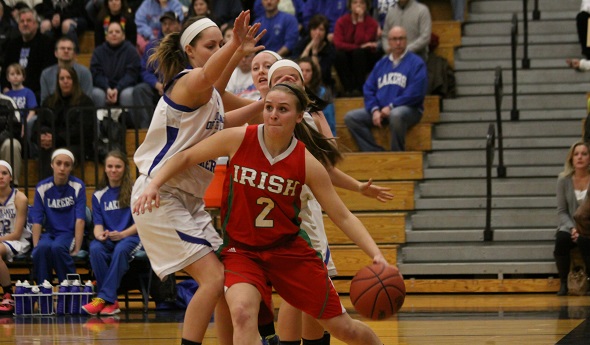
PHOTO: Mount Pleasant Sacred Heart's Sara Hansen (2) will lead the Irish in its first MHSAA Semifinal since 2008.
Breslin Bound: Girls District Preview
February 29, 2016
By Geoff Kimmerly
Second Half editor
The girls basketball season starts over for every MHSAA team today as 128 Districts tip off all over the state.
Below is a look at four teams from each class that look good to be in the hunt when the final 16 converge on East Lansing in three weeks. Follow all of the scores and brackets in real time at MHSAA.com, and click for a glance at every team with three or fewer losses heading into the postseason.
Class A
Detroit Martin Luther King (17-1) – The Crusaders are annually in this conversation and defeated reigning champion Bloomfield Hills Marian last week to add a little more to the momentum. The only loss was in December to Detroit Renaissance, and King came back to beat Renaissance 68-66 in the Detroit Public School League Tournament championship game. King made the Class A Semifinals last season before falling the Marian.
Flushing (18-2) – It’s been a strong follow-up to last season’s 24-1 finish. After opening this season with losses to Saginaw Heritage and Midland Dow, Flushing hasn’t experienced defeat again – but has celebrated some significant victories including over Renaissance, Flint Carman-Ainsworth (15-5) and Class C Flint Hamady (18-1).
Saginaw Heritage (19-1) – The Hawks looked like strong favorites before losing sophomore forward Jaela Richardson to a season-ending knee injury two weeks ago, and then taking their only loss to Midland Dow right after. But Heritage has bounced back with four straight wins including over Carman-Ainsworth last week and still has plenty of talent and the experience of beating Flushing, Country Day, Dow (17-3) and making last season’s run to the Class A Semifinals.
Southfield Lathrup (17-3) – A loss or two more than the other favorites doesn’t mean much, considering the defeats came to Bay City John Glenn, Grand Rapids Catholic Central and Detroit Country Day, all mentioned among Class B favorites below. The Chargers have 10 wins against teams with at least 13 victories, and finished 21-2 last season losing to Marian during the Regional.
Class B
Bay City John Glenn (19-1) – Aside from a three-point loss to Ypsilanti Arbor Prep on Feb. 6, John Glenn has been unstoppable with only two more games in single digits (wins over Southfield Lathrup and Class C Saginaw Nouvel). Most of the Bobcats' toughest games came nonleague at the beginning of the year, but they finished up last week with Class A Saginaw Arthur Hill and a 13-point win over Nouvel (after beating the Panthers by only four Dec. 16).
Detroit Country Day (18-1) – The Yellowjackets have beaten their usual slate of strong teams including Arbor Prep, Haslett, Detroit Renaissance, Midland Dow and Marysville. The only loss was to Saginaw Heritage on Dec. 29, and the reigning Class B champions bounced back for a perfect 2016 so far.
Grand Rapids Catholic Central (17-2) – The Cougars closed the regular season by avenging an earlier loss to Grand Rapids South Christian, earning a shared Ottawa-Kent Conference Gold championship with the Sailors. GRCC also fell to Class A Grand Rapids Christian, but has 10 wins over Class A schools, including 69-62 over Southfield-Lathrup on Dec. 12.
Marshall (19-1) – One more win would give Marshall its second straight and third in four seasons with at least 20 victories, and the slate was anything but easy. After falling to Williamston (17-3) in their opener, the Redhawks rattled off 11 wins against teams with 10 or more victories, including Otsego (17-3), Battle Creek Harper Creek (15-5) twice and Class A Jackson Northwest (18-2) also twice to win a strong Interstate 8 Athletic Conference.
Class C
Calumet (20-0) – The reigning Class C champion has done two better, at least during the regular season, finishing undefeated by sweeping Class B Houghton – which beat Calumet twice a year ago. Total, the Copper Kings have 12 wins against teams with at least 10 victories, and only Houghton and Hancock (16-4) have come within single digits of catching them. Calumet starts District play tonight against Hancock on Hancock’s home floor.
Gobles (20-0) – The Tigers haven’t lost a regular-season game since Feb. 21, 2013, and made the Class C Semifinals in 2014 thanks in part to a strong group of now-seniors looking to return next month in their final try. Among the most impressive wins this fall were a sweep of Saugatuck (16-4) and a 10-point win over Class B Otsego.
Napoleon (20-0) – The Pirates took another step after last season’s 13-win and District title season by running through a Cascades Conference that had three more teams win at least 12 games. Napoleon hasn’t had a single-digit game since beating Manchester in overtime Dec. 15, and also picked up a nice win last week over Class B Brooklyn Columbia Central (17-3).
Ypsilanti Arbor Prep (18-2) – Arbor Prep gets the slight edge on Traverse City St. Francis as the only team not undefeated to be mentioned here because of a slightly tougher schedule (although the Gladiators’ was quite strong as well). Arbor Prep’s only losses were to Class A Ann Arbor Huron (15-4) and Country Day (18-1). And the Gators have six wins over Class A teams including Marian, plus beat Bay City John Glenn 50-47 on Feb. 6.
Class D
Bark River-Harris (19-1) – The Broncos have followed up last season’s 18-2 regular-season finish by going one win better, and now hope to build on that District title from a year ago. The only loss came to Munising – the team that eliminated Bark River-Harris in last season’s Regional Semifinal – and only two weeks ago. But the Broncos do have seven wins over teams with at least 11 victories, including beating Stephenson (18-2) in their only meeting and Crystal Falls Forest Park (16-4) twice.
Mount Pleasant Sacred Heart (18-1) – The Irish are seeking their second Class D championship in three seasons and have one of the top post players regardless of class in Averi Gamble. Sacred Heart plays Big Rapids Crossroads Academy (18-1) on Wednesday, but beat Crossroads 54-24 on Jan. 4 and owns impressive wins over Class C Beaverton, Morley Stanwood and Carson City-Crystal with the only loss to Saginaw Nouvel.
Newberry (19-1) – The Indians already are six wins better than last season, when they went out of the tournament in their first District game. Newberry also is on one of the strongest surges in the state thanks in large part to a 54-50 win over Class C contender St. Ignace on Feb. 18 that gave the Indians the Straits Area Conference title to go with an outright championship in the Eastern Upper Peninsula Conference. Newberry also swept Class B Sault Ste. Marie (15-5).
Pittsford (20-0) – After suffering its only loss last season, and in overtime, to St. Ignace in the Class D Final, Pittsford is the likely favorite after another dominating run. While the Wildcats played mostly Class D teams over a 16-game league schedule in the Southern Central Athletic Association, they also posted solid wins over Class A Belleville and Class C Manchester – and had only one game in single digits, a 71-62 win over Class C Grass Lake on Dec. 8.
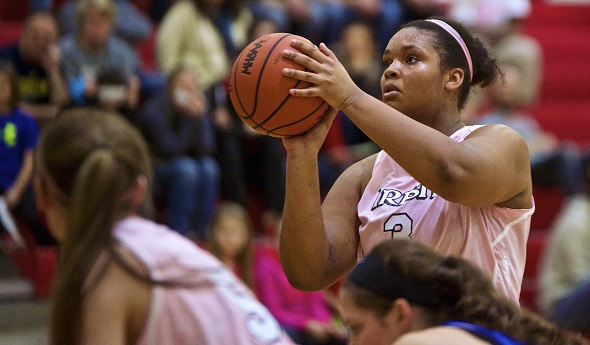
PHOTO: Mount Pleasant Sacred Heart’s Averi Gamble, here attempting a free throw, will lead one of the top teams in Class D into the tournament for the final time. (Click to see more at HighSchoolSportsScene.com.)