

Breslin Bound: Girls Quarterfinal Preview
March 11, 2014
By Geoff Kimmerly
Second Half editor
We've reached the final week of another MHSAA girls basketball season. And we're guaranteed to name at least three new champions when this week is done.
Only St. Ignace, last season's Class D winner, is still alive heading into tonight's Quarterfinals. And the Saints are playing in Class C this winter.
See below for brief previews of all 16 Quarterfinal games, and click for brackets and more to be updated as scores are reported tonight.
(NOTE: ppg=point per game, rpg=rebounds per game, apg=assists per game, spg=steals per game, bpg=blocks per game.)
Class A
Canton (20-4) vs. Flint Carman-Ainsworth (17-7) at Fenton
Canton is looking to return to Breslin for the first time since back-to-back trips in 2010 and 2011. The Chiefs can rely on a strong frontcourt including 5-10 senior forward Paige Aresco (14.7 ppg) and 6-1 senior Taylor Hunley (10 ppg). Carman-Ainsworth advanced with an overtime upset of Midland in the Regional Final and is having its best season under sixth-year coach Johnese Vaughn. Junior guard Sydnee McDonald leads three scorers averaging double figures with 18.5 points per game.
Grand Ledge (23-2) vs. Grand Rapids Christian (20-5) at DeWitt
The Comets are in the Quarterfinals for the second straight season and seeking their first trip to Finals weekend. Their losses came to DeWitt and Detroit Martin Luther King, both in December. Senior sisters Hannah and Lindsay Orwat lead the way scoring 15 and 13.4 points per game, respectively, and 6-3 junior center Cori Crocker averages 10.7 and has committed to play volleyball at the University of Michigan. Grand Rapids Christian has been a power for much longer, but is in its first Quarterfinal since 2003. Junior guard Kortney Deurloo is the leading scorer at 12.9 ppg and makes half of her shots from the floor.
Romulus (21-4) vs. Farmington Hills Mercy (24-1) at Ferndale
Mercy might look like a certain favorite in this game after eliminating previous favorite Detroit King by 12 in the Regional Final. But Romulus has only two losses in-state this winter, and both came to teams playing tonight as well (Detroit Country Day and Frankfort). Senior forward Cierra Bond averages 13.9 points and 6.8 rebounds per game to lead the team. Mercy’s only loss came in overtime to Bloomfield Hills Marian, a possible Breslin opponent. Junior guard Taylor Jones tops a balanced lineup at 12.5 ppg.
Port Huron Northern (19-6) vs. Bloomfield Hills Marian (22-2) at St. Clair Shores Lake Shore
Like with Mercy losing only to Marian, Marian’s only losses were both to Mercy – and the Mustangs surely are prepared for a rematch that could mean their first championship game berth since winning the title in 1998. Juniors Kara Holinski and Brittany Gray average 10 points per game to top a rotation with six players averaging at least 6.1 ppg. Northern has built every year under coach Mark Dickinson, increasing its win total each of the last six seasons. Similar to Marian, six average at least 5.1 ppg, led by juniors Becca Richards (10.4) and Riley Fealko (10.8).
Class B
Parchment (23-2) vs. Grand Rapids South Christian (24-0) at Wayland
A trio of senior starters have helped Parchment top 20 wins for the second time in three seasons, with two losses to Olivet by a combined three points all that has kept the team from perfection. Seniors Kendyl Hinton (12.9 ppg) and Meredith Stutz (12.7) are the leading scorers and rebounders and also top the team in assists and blocked shots. South Christian, with five senior starters, is back in the Quarterfinals for the second straight season with a balanced effort including seven who average at least four points per game but none more than 9.4.
Midland Bullock Creek (23-1) vs. Sparta (14-10) at Bay City Western
Three starters are back from Bullock Creek’s Semifinal run last season, including leading scorer and junior Halee Nieman (12.9 ppg). Two more juniors, Ellie Juengel (12.5) and Hannah Heldt (10.9), give the team multiple scoring threats. Sparta definitely is more of a surprise this week after beating Menominee in overtime in the Regional Final and handing Manistee its only loss, by four, in the Regional opener. But the Spartans have won three straight District titles. They are keyed by junior center Franchesca Buchanan (11.8 ppg, 7.2 rpg).
Detroit Country Day (22-1) vs. Flint Powers Catholic (22-2) at Imlay City
This is a rematch of last season’s Quarterfinal, a 20-point Powers win. A young Chargers team then has taken a few more steps, with its only losses to Farmington Hills Mercy and Saginaw Nouvel, Quarterfinalists in Class A and C, respectively. Three starters are back from last season’s championship game. Country Day’s only loss came in early February to Ypsilanti Arbor Prep, another Class B Quarterfinalist, and the Yellowjackets have won all of their games since by at least 18 points.
Ypsilanti Arbor Prep (22-3) vs. Eaton Rapids (20-5) at Brighton
Arbor Prep has grown to Class B this season after falling to eventual champion Manchester in Class C last season. The Gators haven’t lost this calendar year, with defeats to Class A Detroit Martin Luther King and Bloomfield Hills and reigning Class B champion Goodrich all coming before the new year. Eaton Rapids often has been overshadowed in a strong Lansing area, but has won 20 games for the second time in three seasons and its first Regional title under 15-year coach Willis Whitmyer. Senior 6-1 center Allie Dittmer leads an athletic and experienced lineup with 14.6 points and 9.3 rebounds per game.
Class C
Saginaw Nouvel (19-4) vs. St. Louis (20-4) at Reese
Nouvel is seeking its second straight championship game appearance after falling to Manchester by five in last season’s Class C Final. Senior forward Rachel McInerney (11.7 ppg) was a standout on that team and leads this one as well along with sophomore guard Laurel Jacqmain (12.4 ppg). St. Louis has made steady progress under coach Walter Berry, posting four straight winning seasons and its first championships of his 12-season tenure. Senior center Bri Alspaugh (10.7 ppg) leads seven players averaging at least five points per game.
Gobles (25-0) vs. Mendon (20-2) at Watervliet
Gobles has won 20 games for the second straight season and is on its best run during coach John Curtis’ 12 seasons – and beat Mendon by four only three weeks ago. Senior forward Michaela DeKilder leads the way with 15.2 points and 9.6 rebounds per game. Mendon won its fifth District title in six seasons last month, and senior guard Brooke Howard (18.9 ppg, 7.7 rpg) leads a group of eight seniors trying to finish with a few more wins this week.
Blissfield (21-0) vs. Grosse Pointe Woods University Liggett (19-3) at Whitmore Lake
The Royals dispatched of reigning champion Manchester in the Regional opener after winning their second straight District title. Senior forward Claire Denecker is menacing in the post averaging 16.2 points, 10.2 rebounds and 5.1 blocked shots per game. University Liggett can make it to Breslin for the second time in three seasons, now guided by former Detroit Consortium and Cass Tech coach Omar Ahart. Three of this season's starters played in the team’s Class C Final in 2012, including leading scorer and junior Jessica Rotzoll (13.5 ppg).
McBain (21-1) vs. St. Ignace (22-2) at Gaylord
Last season’s Class D champion, St. Ignace is back in Class C and lost only to strong Reese and Class A Marquette, both in December. Senior guard Kelley Wright has been a top player the last few seasons and averages 16.2 points, 4.2 assists and 6.7 steals per game. McBain is back for its fourth Quarterfinal in six seasons and beat an impressive group of teams the last two weeks to get here. Junior guard Meredith Hamlet makes nearly half of her shots and more than 40 percent from 3-point range in averaging 21.3 points per game, in addition to 8.1 rpg and 6.7 apg.
Class D
Mount Pleasant Sacred Heart (19-5) vs. Frankfort (23-1) at Cadillac
A 13-point defeat to one-loss Class B Manistee is all that’s kept Frankfort from perfection this winter, with sophomore guard Mackenna Kelly (13.8 ppg) the high scorer on a team with only one senior. Coincidentally, Sacred Heart has only one senior as well – point guard Sara Hansen, who paces the Irish with 19 points, 3.1 assists and 5.4 steals per game. Only one of Sacred Heart’s losses came to a Class D team.
Clarkston Everest Collegiate (18-6) vs. Marine City Cardinal Mooney (19-4) at Waterford Mott
This is the fourth time these two will play this season; Cardinal Mooney won the first two games by nine and three points (in double overtime), respectively, before Everest won by two in the Detroit Catholic League Tournament. Senior 6-0 forward Lucia Westrick leads the Mountaineers at 14 points per game, while senior guard Katie Theut leads three Cardinal Mooney players who average double digits scoring with 20.1 points and 4.3 assists per game.
Posen (25-0) vs. Crystal Falls Forest Park (24-0) at Sault Ste. Marie
Forest Park is making its last run with senior guard Lexi Gussert (29.4 ppg, 7.7 apg, 11.9 rpg) and hasn’t played anything resembling a close game aside from maybe the 17-point Regional Final win over Eben Junction Superior Central. She will play at Michigan State next season. Posen finally broke through to the final week after five straight District titles and four straight 20-plus win seasons, and has a big-time scorer as well. Senior 6-1 center Korynn Hincka averages 27.5 points and 11.5 rebounds per game.
Lansing Christian (11-11) vs. Athens (21-3) at Battle Creek Harper Creek
Athens is in its fourth straight Quarterfinal and made the Semifinals last season, and boasts a solid inside-out combination of junior guard Allison Fuller (13.5 ppg, 3.5 spg) and senior center Audrey Oswalt (12.1 ppg, 7.8 rpg). Lansing Christian’s record shouldn’t be taken at face value – the Pilgrims played a number of Class B and C teams this season and two teams still playing tonight. Six-foot senior Mikayla Terry (15.6 ppg, 11.9 rpg) will give Oswalt plenty of work in the paint.
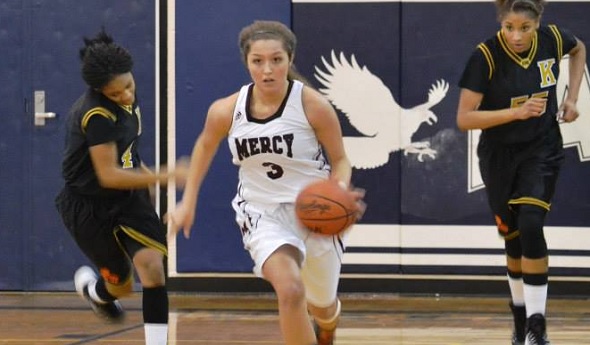
PHOTO: Farmington Hills Mercy's Sam Bauer (3) pushes the ball upcourt during her team's Regional Final win over Detroit Martin Luther King. (Photo courtesy of Detroit Public School League.)
Small Schools, Big Northern Lights Finish
By
John Vrancic
Special for MHSAA.com
February 29, 2016
HANNAHVILLE — Not too many high school conferences in Michigan have their own basketball tournament.
 The Northern Lights League in the Upper Peninsula, however, is one of the exceptions to the rule.
Each year the league’s eight schools meet at Hannahville for their annual tourney.
“This is such a great tournament for our conference,” said Maplewood Baptist boys coach Steve May. “What an opportunity for small schools. These are the types of things these kids will never forget. This is their chance to shine. They get to experience March Madness, although it comes a little early.”
The tournament, traditionally held in late February, showcases all the talent these schools have to offer.
This year’s girls tourney featured the league’s first all-U.P. player in senior Hannah May, a second-team selection a year ago.
“This is really a nice tournament,” Hannah said. “All the small schools come together and make some new friendships. This is the highlight of the year. This gives us something to shoot for.”
Hannah May showed why she’s all-U.P. in the championship game Feb. 20, sinking a buzzer-beating 20-foot jumpshot from the right wing to force overtime in Maplewood’s 79-70 triumph over Wilson Nah Tah Wahsh.
She scored 35 points, and classmate Harmony Bailey added 24.
“We enjoy this tournament,” said Maplewood girls assistant coach Caroline May. “We look forward to it every year.”
 Senior Selena Williams, looking to play ball at Gogebic Community College in Ironwood next season, led Hannahville with 26 points. Sophomore Cecilia Beaver added 23.
“I love our team,” said Beaver. “We all get along. We’re also real good friends with Maplewood Baptist, and we get along with the other teams. We’ve developed a lot of friendships.”
The Maplewood Baptist boys also captured the league tourney crown in a 73-54 conquest of Hannahville.
Senior Patrick Gomes scored 19 points for the Kinross-based school, which placed four in double-digits. Senior Cody Meshigaud paced the defending champs with 24.
The tournament provides plenty of opportunity for team bonding and camaraderie among all the teams.
“I like it and the kids enjoy it,” said Ojibwe Charter girls coach Ashley Bishop. “You see the upsets and victories. It’s nice to see all the teams get together. All the schools are very small, and I think the kids make better friends this way. At the motel we stayed at in Escanaba, we had kids and coaches from 4-5 schools hanging out together.”
Ojibwe boys coach Brandon Kerfoot believes the tournament is part of the learning process for a team with no seniors.
“I think being able to end the season with schools about our size is a big stepping stone for the kids,” he said. “It’s a different game once you hit the tournaments. Anything can happen once you reach this point.”
The Ojibwe boys started two juniors and a sophomore, freshman and eighth-grader in a 69-46 semifinal loss to Maplewood Baptist.
Ojibwe’s girls started two juniors, two sophomores and an eighth-grader in a 56-34 loss to Hannahville in the semifinals.
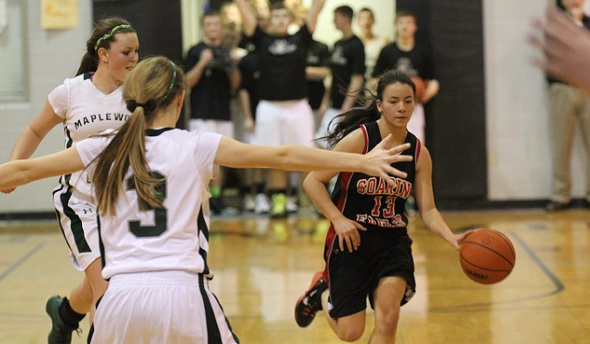
PHOTOS: (Top) A pair of Kinross Maplewood Baptist defenders surround a Wilson Nah Tah Wahsh player bringing the ball upcourt during the Northern Lights League Tournament. (Middle) A Maplewood defender works to wall off a Bay Mills Ojibwe Charter guard. (Photos by Paul Gerard.)