


Breslin Bound: Girls Report Week 1
December 8, 2014
By Geoff Kimmerly
Second Half editor
Some of our favorite stories from the beginning of each season are told when a team, after just a week, has already equaled its success from the previous season.
A few of those are highlighted in this week’s Breslin Bound girls hoops report to kick off 2014-15.
Each week, we’ll look at four teams from each class that stuck out over the previous seven days or the season to that point as we point toward the start of the MHSAA District tournaments March 2.
For schedules of each day’s games statewide and results as we receive them, plus links to each team’s full schedule, results and league standings, click here – and please help us by filling in missing scores or emailing them to [email protected].
Class A
Farmington Hills Mercy (2-0) – The Marlins, Class A semifinalists last season, are proving again already they can win close with 55-52 and 49-46 wins over Waterford Mott and Salem, respectively, to open 2014-15.
Flushing (2-0) – The Tigers improved two wins last season to 13-9, with two losses to Flint Powers Catholic; they beat the Chargers 56-23 on Friday to kick off a perfect first week.
Howell (2-0) – The Highlanders were solid to start coming off a 15-7 finish last season, but with an impressive performance to further generate excitement for the weeks to come; 6-foot-1 junior Erin Honkala had 19 points, 28 rebounds and eight blocked shots in Friday’s 47-30 win over Ann Arbor Skyline. The rebounds tied for 13th most for one game in MHSAA history.
Lapeer (2-1) – The former Lapeer East and West last season finished with a combined record of 13-29; the new schools created from a merger of the old kicked off last week with two wins before falling only 57-47 to always-strong Goodrich.
Class B
Adrian (2-1) – The Maples already have equaled their win total from last season’s 2-19 finish, with a 47-35 overtime victory over Monroe Jefferson among highlights.
Berrien Springs (2-0) – The Shamrocks didn’t win last season until February, but equaled last season’s win total with two victories to start including a 50-48 nail-biter over Cassopolis.
Grosse Ile (2-0) – The Red Devils are looking to build on last season’s 18-4 finish and kicked off this winter with a pair of wins over Detroit Catholic League teams including 42-41 over Livonia Ladywood on Friday.
Haslett (2-0) – The Vikings made the Class A Regional Finals last season finishing 23-2, but are back in Class B and opened with a 63-21 win over reigning Finals champion Eaton Rapids – one of two teams to beat Haslett in 2013-14.
Class C
Grass Lake (2-0) – Last season’s 9-12 finish included a 2-7 skid at the end; the Warriors ended it with a 61-52 win over Concord on opening night and then a 62-36 victory over Cascade Conference foe Hanover-Horton.
Hesperia (2-0) – One week in and Hesperia has guaranteed a better finish than last winter’s 1-18; the Panthers equaled it with a 34-28 win over Mason County Eastern in the opener and surpassed with a 42-30 victory over Kent City Algoma Christian on Thursday.
Lake City (2-0) – The Trojans also started strongly last winter with five straight victories before struggling down the stretch, but looked pretty tough beating Harrison by 15 and Mancelona by 36 last week.
Niles Brandywine (2-0) – The Bobcats have a streak worth statewide attention; they haven’t lost a regular-season game since Jan. 30, 2012, and opened this winter by beating Class A Kalamazoo Loy Norrix 53-46.
Class D
Baraga (2-0) – The Vikings won six games last season, with a 52-point loss to Houghton on opening night; they beat Houghton 33-24 to start this season and are on pace to equal last year’s win total by January.
Bark River-Harris (2-0) – Two of last season’s five losses (to go with 18 wins) were to Crystal Falls Forest Park, but Trojans’ star Lexi Gussert is at Michigan State University now and the Broncos got a hard-fought 36-34 win over Forest Park in their first Skyline Central Conference game.
Mount Pleasant Sacred Heart (2-0) – The Irish weren't considered a favorite before winning last season's Class D title; Sacred Heart won't sneak up on anyone this time and opened with their 14th and 15th-straight wins dating to last January.
Wakefield-Marenisco (2-0) – The Cardinals have been on a nice run since the middle of last season; after opening 2013-14 at 2-7, they finished 8-4 and added another pair of wins to open last week.
PHOTO: Mount Pleasant Sacred Heart’s Averi Gamble prepares to shoot in the reigning Class D champion’s 43-35 win over Shepherd on opening night. (Click to see more from HighSchoolSportsScene.com).
Breslin Bound: Girls Report Week 3
December 17, 2012
By Geoff Kimmerly
Second Half editor
As a general rule, basketball teams evolve plenty between the first games of December through the final regular-season contests in February.
But these pre-break matchups matter just as much in the win-loss columns. And a number of games are being played right now that will surely make a difference as this season draws to a close.
This week's report includes some of the teams that have came out on the winning ends of key December battles. (Results and records based on those reported to Score Center at MHSAA.com)
1. Inkster (4-0) – The Vikings are a regular at Breslin Center and made the Class A Semifinals last season, so another great start is hardly surprising. But it's proof why Inkster remains a force – last week’s wins were 51-45 over improved Detroit Mumford and 57-51 over always-powerful Detroit Pershing.
2. Waterford Our Lady (3-1) – The reigning Class D champion has bounced back quickly from an opening-night loss to West Bloomfield. Last week, Our Lady beat Livonia Ladywood 50-38 and Mount Pleasant Sacred Heart by the same score.
3. Detroit Martin Luther King (3-0) – This is another team always in the Class A mix, and it got a big win Saturday – 56-48 over returning Class A Semifinalist Ann Arbor Huron, which earlier in the week had defeated Detroit Country Day 65-58. King also beat Detroit East English 61-7.
4. Johannesburg-Lewiston (5-0) – The Cardinals lost only two regular-season games last season, both times to Ski Valley Conference rival Gaylord St. Mary. But they got a little bit of revenge last week with a 50-48 win over St. Mary after also beating East Jordan 57-43.
5. Holt (5-0) – The Rams are again setting up nicely to contend in the strong Capital Area Activities Conference Blue. They beat nonleague foe St. Johns 52-48 and then Lansing Everett 48-39 to keep early pace with other frontrunners Grand Ledge and East Lansing.
6. Napoleon (5-1) – Napoleon’s 15-7 finish in 2011-12 included splits against Michigan Center and Grass Lake. The Pirates got an early upper hand on both last week, beating Michigan Center 49-45 and Grass Lake 47-42.
7. Traverse City St. Francis (4-1) – The Gladiators opened last season 14-1, with that lone loss to Cadillac – which they beat last week 55-50. St. Francis also defeated Kalkaska 44-36 on Friday.
8. Pewamo-Westphalia (3-2) – The Pirates got off to a rough start with opening-week losses to Class B Williamston and Lakewood. But back in familiar territory in the Central Michigan Athletic Conference, they've won three straight – including 51-42 last week over returning Class D Semifinalist Portland St. Patrick.
9. North Farmington (3-1) – The Raiders are coming off a 10-12 season that included a pair of losses to Pontiac. But North Farmington earned the early edge this time with a 59-58 win over Pontiac, followed by a 58-48 win over West Bloomfield.
10. Powers North Central (5-1) – After opening with a 13-point loss to returning Class D Semifinalist Crystal Falls Forest Park, North Central hasn't fallen again. The Jets beat Stephenson 62-51 and Munising 50-22 to get nearly halfway to last season’s win total of 11.
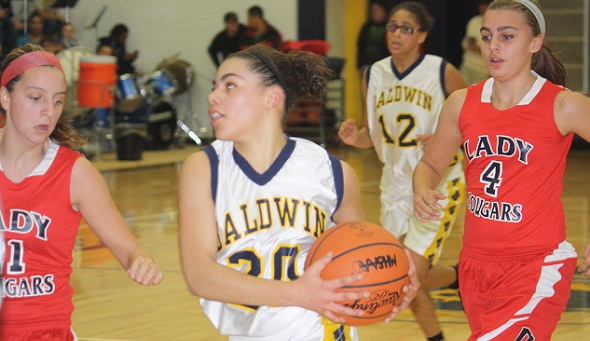
PHOTO: Big Rapids Crossroads (in red) defeated Baldwin on Thursday to move to 4-0 this season. (Click to see more at HighSchoolSportsScene.com.)