

Breslin Bound: Girls Report Week 1
December 7, 2015
By Geoff Kimmerly
Second Half editor
Girls basketball season tipped off last week, providing new beginnings for 721 teams all over our state.
And at least a few have to be excited about early – and perhaps unexpected – returns.
Each week during the regular season, we’ll glance at four teams from each class that have caught our attention. This week’s list includes a few already on the way to improving on their finishes from a year ago. (Results and records below are based on schedules posted at MHSAA.com.)
Class A
Grand Haven (2-0) – The Buccaneers’ comeback from 7-15 a year ago is underway. They started 1-5 last winter, but started erasing that memory with a 46-32 win over Traverse City West followed by a 61-44 win over Traverse City Central.
Haslett (2-0) – The Vikings graduated three four-year varsity players from last season’s Class B runner-up, which combined with the move into Class A might have made for lower expectations this winter. But wins over Eaton Rapids (54-40) and Okemos (64-27) were an impressive way to restart.
Macomb Dakota (1-0) – If the season opener is an indication, the Cougars could be lined up for a nice rebound from 5-16. They played only once last week, but earned a 54-45 win over Rochester Adams, which finished 15-7 a year ago.
Waterford Kettering (1-0) – Kettering’s 23-2 run last season came to an end with a 51-42 loss to Bloomfield Hills Marian, which went on to win the Class A title. The Captains should expect more good things this winter after beating Marian 36-34 in the opener.
Class B
Jonesville (2-0) – The Comets won the Michigan Center Furman Classic by sweeping the same opponents it split with at last year’s opening event. Jonesville, coming off a 12-10 finish, beat Detroit Allen 65-24 and then Michigan Center 54-45 after losing to the host a year ago.
Manistee (2-0) – Coach Todd Erickson retired after leading the team to a 23-2 finish in 2014-15, but Kenn Kott's second tenure with the program opened with a 63-34 win over Scottville Mason County Central and then a 51-43 victory over Traverse City St. Francis, which finished 22-3 last season.
Portland (2-0) – The Raiders’ finish of 13-10 a year ago was solid but down a few wins from Portland’s norm. There’s plenty of reason for optimism again after the Raiders opened by downing Grand Ledge 54-45 and Laingsburg 41-38 in overtime; the Comets were Class A semifinalists two seasons ago, and Laingsburg made the Semifinals in Class C last winter.
Reed City (1-1) – The Coyotes are the only team on this list that lost a game last week, but the opening night win was that important. Reed City’s 48-44 victory over Leroy Pine River was its first win since the 2013-14 season.
Class C
Hanover-Horton (2-0) – These Comets beat Concord 61-49 and Homer 47-34; those teams won 18 and 21 games last season, respectively, while Hanover-Horton was 5-15 and lost last season’s opener to Concord by 16.
Hart (1-0) – It’s early, of course, but one win might say a lot for the Pirates. They started 0-3 a year ago with a two-point loss to North Muskegon on the way to 9-12 overall, but beat North Muskegon 55-45 to open last week.
Napoleon (2-0) – The Pirates are building on a 16-7 finish and District title from a year ago, and a 31-29 win over Pewamo-Westphalia (17-4 last season) in the opener was a solid way to start. Napoleon followed that with a 52-37 victory over Battle Creek Pennfield.
St. Ignace (2-0) – The Saints are back in Class C after winning Class D last season, and returned with a pair of wins over Class A teams. St. Ignace opened the Petoskey Invitational with a 51-49 victory over Brighton and followed with a 49-46 overtime win over Marquette.
Class D
Bark River-Harris (1-0) – The Broncos’ 21-3 run last season included two two-point wins over annual Class D power Crystal Falls Forest Park, and they opened this season with a 51-25 win over the Trojans thanks in part to 17 steals. Bark River-Harris outscored Forest Park 19-3 during the second quarter.
Colon (2-0) – The Magi had plenty to celebrate last week. They won close – 37-34 over Union City and then 58-55 in overtime over Jackson Christian – and in doing so equaled their victory total from last season.
Fowler (2-0) – The Eagles were on the verge of a nice run last season, finishing 10-12 with seven losses by six points or fewer. Last week was a good start on taking the next step, as Fowler downed Beal City 58-40 and Ovid-Elsie 52-46.
Manistee Catholic Central (2-0) – The Sabers rebounded from a slow start last season to win 10 of their final 12 games and finish 13-9, and that momentum may have rolled into this winter. MCC opened with a 48-32 win over Walkerville and another, 47-33, over Custer Mason County Eastern.
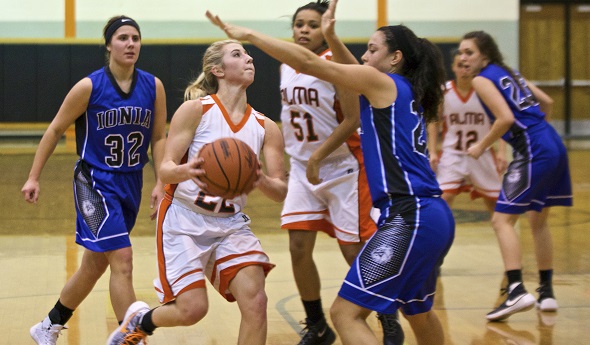
PHOTO: An Alma player drives to the basket while Ionia defends last week during the season opener for both teams. (Click for more from HighSchoolSportsScene.com.)
Breslin Bound: Girls Report Week 3
December 17, 2012
By Geoff Kimmerly
Second Half editor
As a general rule, basketball teams evolve plenty between the first games of December through the final regular-season contests in February.
But these pre-break matchups matter just as much in the win-loss columns. And a number of games are being played right now that will surely make a difference as this season draws to a close.
This week's report includes some of the teams that have came out on the winning ends of key December battles. (Results and records based on those reported to Score Center at MHSAA.com)
1. Inkster (4-0) – The Vikings are a regular at Breslin Center and made the Class A Semifinals last season, so another great start is hardly surprising. But it's proof why Inkster remains a force – last week’s wins were 51-45 over improved Detroit Mumford and 57-51 over always-powerful Detroit Pershing.
2. Waterford Our Lady (3-1) – The reigning Class D champion has bounced back quickly from an opening-night loss to West Bloomfield. Last week, Our Lady beat Livonia Ladywood 50-38 and Mount Pleasant Sacred Heart by the same score.
3. Detroit Martin Luther King (3-0) – This is another team always in the Class A mix, and it got a big win Saturday – 56-48 over returning Class A Semifinalist Ann Arbor Huron, which earlier in the week had defeated Detroit Country Day 65-58. King also beat Detroit East English 61-7.
4. Johannesburg-Lewiston (5-0) – The Cardinals lost only two regular-season games last season, both times to Ski Valley Conference rival Gaylord St. Mary. But they got a little bit of revenge last week with a 50-48 win over St. Mary after also beating East Jordan 57-43.
5. Holt (5-0) – The Rams are again setting up nicely to contend in the strong Capital Area Activities Conference Blue. They beat nonleague foe St. Johns 52-48 and then Lansing Everett 48-39 to keep early pace with other frontrunners Grand Ledge and East Lansing.
6. Napoleon (5-1) – Napoleon’s 15-7 finish in 2011-12 included splits against Michigan Center and Grass Lake. The Pirates got an early upper hand on both last week, beating Michigan Center 49-45 and Grass Lake 47-42.
7. Traverse City St. Francis (4-1) – The Gladiators opened last season 14-1, with that lone loss to Cadillac – which they beat last week 55-50. St. Francis also defeated Kalkaska 44-36 on Friday.
8. Pewamo-Westphalia (3-2) – The Pirates got off to a rough start with opening-week losses to Class B Williamston and Lakewood. But back in familiar territory in the Central Michigan Athletic Conference, they've won three straight – including 51-42 last week over returning Class D Semifinalist Portland St. Patrick.
9. North Farmington (3-1) – The Raiders are coming off a 10-12 season that included a pair of losses to Pontiac. But North Farmington earned the early edge this time with a 59-58 win over Pontiac, followed by a 58-48 win over West Bloomfield.
10. Powers North Central (5-1) – After opening with a 13-point loss to returning Class D Semifinalist Crystal Falls Forest Park, North Central hasn't fallen again. The Jets beat Stephenson 62-51 and Munising 50-22 to get nearly halfway to last season’s win total of 11.
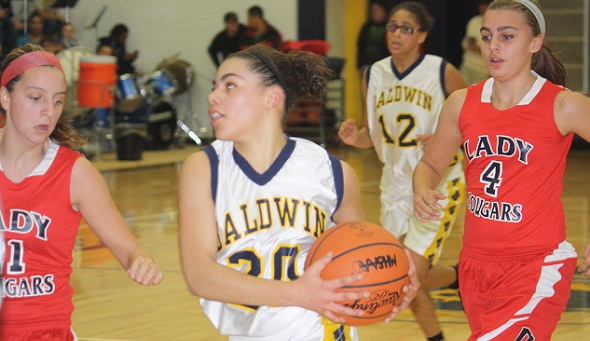
PHOTO: Big Rapids Crossroads (in red) defeated Baldwin on Thursday to move to 4-0 this season. (Click to see more at HighSchoolSportsScene.com.)