

Cancer Free, Haske Pulls Double Duty
March 3, 2016
By Dennis Chase
Special for Second Half
TRAVERSE CITY – Keith Haske calls coaching basketball “therapeutic.”
 It’s a term that now holds more meaning for the 58-year-old Traverse City St. Francis basketball coach, who is recovering from a stage four throat cancer diagnosis two years ago.
“When you’re coaching you just kind of lose yourself,” he said. “You don’t think about how you’re feeling or what you went through.”
Coaching has been a major part of Haske’s life for 32 years – 13 at St. Johns, 13 at Charlevoix and six at St. Francis. Even when he felt weak and tired last season, Haske continued as the boys coach, using an amplified headset at practice to lessen the strain on his throat.
His health, he said, is continually improving. He’s cancer free. His energy and strength are returning – so much so that he added to his workload this season by taking on the girls varsity coaching duties, too.
“When you go through this stuff you almost have a renewed energy,” he said. “Your body fights so hard to beat the cancer, and you go through so much suffering, that when you come out the other side things really don’t faze you as much.”
This is a time of the year that will test Haske’s stamina because his schedule is busier than ever. He coached three doubleheaders last week. With the girls reaching Friday’s MHSAA Class C District Final, he’ll coach five games in five days this week. It could be a repeat next week if the boys and girls advance along the tournament trail.
“I can’t tell you how much fun that would be,” Haske said.
Another tough District matchup awaits, though. The girls team (21-1) played Elk Rapids (15-6) on Wednesday and will next face host Glen Lake (20-2). The boys (12-7) will face Johannesburg-Lewiston (16-2) – the team that knocked the Gladiators out last season– in their District opener Monday.
It’s a challenging schedule. But Haske, who’s taken four teams to the MHSAA Finals, is accustomed to challenges. None bigger than his battle with cancer.
The diagnosis came the day after Easter in 2014. Haske, who kept physically fit, couldn’t believe what the doctor was telling him.
“I said, ‘There’s no way,’” he recalled. “I never smoked, never chewed tobacco, things you would attribute (to throat cancer).”
He wasn’t the only one stunned.
 “Most of the team started breaking down crying,” senior Dylan Sheehy-Guiseppi remembered when Haske broke the news. “We were so shocked. We couldn’t understand how it happened to him.”
Neither could Haske’s close friends.
“Your first take is that it’s pretty devastating because you don’t know (what to expect),” Adam Wood, who played for and coached under Haske at Charlevoix, said. “Cancer can run the gamut as far as severity. The one thing I did know is that he would fight it as hard as he could.”
Haske took his fight to the MD Anderson Cancer Center in Houston. He, and his wife Barb, spent most of the summer there as Haske underwent radiation and chemotherapy treatment.
It was on a return trip to Houston a few months later – he still goes back every four months for scans – when he learned he was cancer free.
“When I left (in July) they were still worried about one of the lymph nodes, whether they got it or not,” Haske said. “Sometimes it gets inflamed from the radiation, and they can’t tell.”
Turns out, it was inflammation. No cancer was detected.
On the way home, Haske received a call from principal Eric Chittle, who then revealed the good news at a school assembly.
“The whole student body went crazy,” Haske said. “It was cool.”
For Haske, the dean of students at the high school, it was a big hurdle to clear. But there was a side effect – Haske’s throat was still inflamed, and he struggled to eat.
“When I came back I went six months without eating a single morsel of food,” he said. “I lived on Ensure and ice cream.”
He ended up losing 53 pounds – and at one point inquired about a feeding tube.
“He (doctor) said, ‘You don’t need it. You’ve been through the worst. You’ll be all right,’” Haske recalled. “He was right. A couple weeks later it started to turn around.”
After the boys basketball season concluded last March, and as Haske’s health improved, the girls basketball job opened up. Haske had coached girls basketball at Charlevoix for three seasons, leading the Rayders to a 27-1 record and a Finals appearance in 2004. He stepped down when the girls season was switched from fall to winter.
St. Francis athletic director Tom Hardy thought about the possibilities and approached Haske, a member of the Basketball Coaches Association of Michigan Hall of Fame, about adding a second coaching job. After consulting with Barb, who he said has been “unbelievable” in his recovery process, Haske accepted.
Wood, who is now the boys basketball coach and athletic director at Lake Michigan Conference rival Harbor Springs, was among the first to call his former coach.
“He asked, ‘Adam, am I crazy?’” Wood said laughing. “My response was ‘Yes.’ He said, ‘I’ve been getting a lot of that lately.’
“For him to take that on was beyond impressive. It was all about the kids.”
What about physically?
“When I saw him this year I told him he looked great,” Wood said. “He said he felt great. The difference between this year and last is quite dramatic.”
Haske – who is mentoring two young coaches in the system, Tyler Sanborn and Stephanie DeNoyelles – said the casual fan might not even realize what he’s been through.
 “If you were looking at me across the gym you wouldn’t have any idea,” Haske said. “If you get closer, I still have some swelling in my jaw, and I talk a little funny sometimes.”
But he’s enjoying every minute.
“The kids here are great, and that makes it so much easier,” he said. “You just don’t have many problems.”
The players are thankful to see their coach returning to his old self.
“He’s not only a basketball coach, he’s a mentor,” Sheehy-Guiseppi said. “He wants to make sure you’re taking care of stuff outside the game of basketball first. He really cares about you as a person, and he looks forward to helping you grow as a person.”
St. Francis officials adjusted Haske’s work schedule during the winter to accommodate his coaching, and Hardy had to work out arrangements with league members to schedule more varsity doubleheaders.
“All the schools were great about it,” Hardy said. “We have not had an issue with Keith having to be at two spots at the same time.”
Now comes the challenge of March Madness. And for the girls, that means a showdown with Glen Lake.
“They’re a lot like us,” Haske said, when asked about the Lakers. “They don’t have any one person you can key on. They have five or six girls that all share the ball and are dangerous. They’re tough in the paint and they can shoot. They’re very balanced, very sound.”
So are the Gladiators, who have won 19 in a row. Senior Annie Lyman is the leader, averaging 14 points, eight rebounds, five steals and five assists per game.
“She does it all,” Haske said. “She’s a tough, aggressive player.”
Juliana Phillips, a 6-foot-4 junior who has committed to play volleyball at St. Louis University, and 6-foot senior Lauren McDonnell also average in double figures.
Haske likes the growth he’s seen in his team.
“I think we’ve made great strides in understanding the system and what we’re trying to do,” he said. “We have some pretty talented kids. We have some size, some quickness, some kids who can shoot it. It’s a well-rounded team.”
The boys, meanwhile, are trying to find some consistency. Haske thought the Gladiators were turning the corner when Gabe Callery hit a mid-court shot at the buzzer to stun previously unbeaten East Jordan earlier this year. But St. Francis dropped three consecutive road games in February.
“A lot of it is shooting,” Haske said. “There are nights we just don’t shoot it well. When we do shoot it well, we’re a really good team.”
How good will be determined in March.
 Dennis Chase worked 32 years as a sportswriter at the Traverse City Record-Eagle, including as sports editor from 2000-14. He can be reached at [email protected] with story ideas for Manistee, Wexford, Missaukee, Roscommon, Ogemaw, Iosco, Alcona, Oscoda, Crawford, Kalkaska, Grand Traverse, Benzie, Leelanau, Antrim, Otsego, Montmorency, Alpena, Presque Isle, Cheboygan, Charlevoix and Emmet counties.
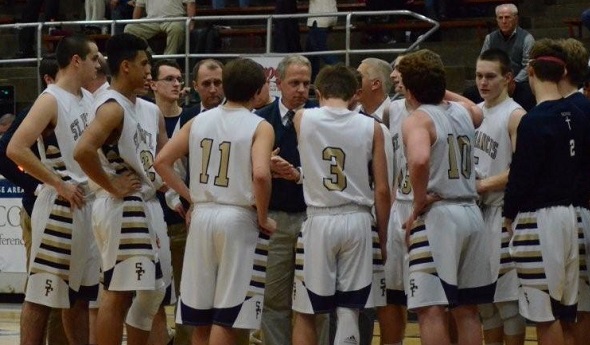
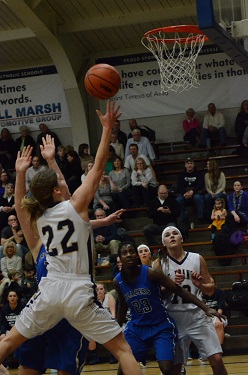
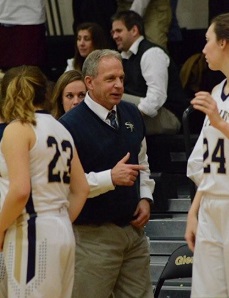
PHOTOS: (Top) Traverse City St. Francis coach Keith Haske huddles with his boys basketball team during a game against Grayling. (Middle) St. Francis' girls team, here against Kalkaska, will play for a District title Friday. (Below) Haske speaks with a few of his players during a District game against Grand Traverse Academy. (Photos by Julie English.)
D2 Preview: Past Powers, New Hopefuls Bring Stories to Breslin
By
Geoff Kimmerly
MHSAA.com senior editor
March 16, 2022
This weekend’s Division 2 Finals bracket might have the most pre-packaged storylines of any of the four divisions that will celebrate girls champions this weekend at Breslin Center.
Detroit Edison returns after the last two seasons were cut short, seeking to add a fourth title in six years with another Miss Basketball leading the way. Detroit Country Day owns the most Finals championships in girls basketball history and is seeking its first since 2018.
Grand Rapids West Catholic hopes to follow the Miss Basketball runner-up to its first championship in more than three decades. And Ludington, making its first appearance at Finals weekend, is looking to add more firsts to a historic run.
DIVISON 2 Semifinals – Friday
Grand Rapids West Catholic (24-1) vs. Detroit Country Day (14-7), 5:30 p.m.
Detroit Edison (17-3) vs. Ludington (20-5), 7:30 p.m.
FINAL – Saturday – 6:15 p.m.
Tickets for this weekend’s games are $12 for both Semifinals and Finals and are available via the Breslin Center ticket office. All Semifinals will be broadcast and viewable with subscription to MHSAA.tv, and all four Finals will air live Saturday on Bally Sports Detroit’s primary channel as well as on the BSD website and app. Audio broadcasts of all Semifinals and Finals will be available free of charge from the MHSAA Network.
Here’s a look at the four Division 2 semifinals (with rankings by MPR and statistics through Regional Finals):
DETROIT COUNTRY DAY
Record/rank: 13-7, No. 28
League finish: Does not play in a league.
Coach: Jerica Williams, second season (28-10)
Championship history: Thirteen MHSAA titles (most recent 2018), four runner-up finishes.
Best wins: 59-55 over Marysville in Quarterfinal, 54-39 over St. Clair Shores Lakeview, 47-45 over Division 4 No. 11 Allen Park Inter-City Baptist.
Players to watch: Jaidyn Elam, soph F (13.6 ppg, 6.8 rpg, 3.2 spg); Emma Arico, soph. G (8.9 ppg, 3.4 apg); Ari’Yana Wiggins, fr. F (9.7 ppg, 5.9 rpg).
Outlook: Four starters are back from the team that made last season’s Semifinals, with Elam and Arico joined by junior guard Aysia Yokely (8.6 ppg) and sophomore forward Peja Liles (4.8 ppg, 5.4 rpg). The Yellowjackets have all of that experience and still no seniors, with Elam also having made the all-state second team last season and Arico earning an honorable mention. Country Day saw its share of tough opponents, with six of its seven losses coming against teams that ended up with 14 or more wins.
DETROIT EDISON
Record/rank: 17-3, No. 1
League finish: Does not play in a league.
Coach: Monique Brown, 10th season (177-40)
Championship history: Three MHSAA titles (most recent 2019).
Best wins: 53-35 over No. 3 Portland in Quarterfinal, 85-43 over No. 2 Redford Westfield Prep, 67-44 over Division 1 No. 3 Farmington Hills Mercy, 60-32 over Division 1 No. 13 Bloomfield Hills Marian, 60-47 over Division 1 No. 11 Parma Western, 68-30 over Division 1 No. 14 East Lansing, 67-48 over Division 1 No. 1 Hudsonville, 60-52 over Division 3 No. 1 Ypsilanti Arbor Prep.
Players to watch: Ruby Whitehorn, 6-0 sr. G (23.9 ppg, 12.1 rpg, 3.9 apg, 4.5 spg, 2.1 bpg); NaKiya Bonner, 5-6 soph. G (8.2 ppg, 5.5 apg); Madisen Wardell, 6-1 sr. F (13.5 ppg, 6.1 rpg).
Outlook: After last season’s undefeated team was sidelined during Districts by COVID-19, Edison is back looking to add to its three straight Finals championships won from 2017-19. Whitehorn, who has signed with Clemson, gave her program its fourth-straight Miss Basketball Award winner earlier this week, and Wardell will continue her career at DePaul. Edison’s only losses were to Division 1 semifinalist West Bloomfield, Indiana state champion South Bend Washington and Illinois power Joliet West. All but one of the Pioneers’ in-state opponents finished with a winning record this winter.
GRAND RAPIDS WEST CATHOLIC
Record/rank: 24-1, No. 8
League finish: First in Ottawa-Kent Conference Blue
Coach: Jill VanderEnde, eighth season (119-69)
Championship history: Two MHSAA titles (most recent 1990), one runner-up finish.
Best wins: 82-27 over No. 6 Edwardsburg in Quarterfinal, 55-29 over No. 20 Newaygo in Regional Final, 55-43 over Grand Rapids Christian in Regional Semifinal, 64-29 over Grand Rapids Catholic Central in District Final, 63-23 over No. 13 Sparta.
Players to watch: Abbey Kimball, 5-10 sr. G (25.1 ppg, 97 3-pointers, 3.0 apg, 4.4 spg); Cadence Dykstra, 5-9 jr. G (8.2 ppg, 4.5 apg); Elisha Dykstra, 5-10 fr. F (8.3 ppg).
Outlook: West Catholic is returning to the Semifinals for the first time since 1995, when it finished Class B runner-up. Kimball was the Miss Basketball runner-up and added three more 3-pointers Tuesday – the Michigan State signee’s 100 are tied for second-most in a single season in MHSAA history and five off the record. Freshman guard Anna Ignatoski adds 7.8 points off the bench and was the team’s leading scorer in the Quarterfinal win over the Eddies. The team’s only loss was Dec. 23 to Division 1 semifinalist Rockford.
LUDINGTON
Record/rank: 20-5, No. 45
League finish: Tied for first in the Lakes 8 Activities Conference.
Coach: Warren Stowe, second season (34-10)
Championship history: Has never played in an MHSAA Final.
Best wins: 30-27 over No. 5 Frankenmuth in Quarterfinal, 34-31 over Negaunee in Regional Final, 54-36 over Standish-Sterling in Regional Semifinal, 38-33 over Muskegon Western Michigan Christian.
Players to watch: Keelyn Laird, 6-3 jr. F (10.7 ppg, 7.4 rpg, 3.2 apg); RyAnn Rohrer, 5-10 sr. F (10.7 ppg, 7.9 rpg, 3.2 apg, 3.3 spg); Abi Bandstra, 5-9 sr. G (4.5 ppg, 2.8 spg).
Outlook: Ludington will be playing in its first Semifinal since 2004 and has won 17 of its last 18 games. The Orioles avenged an early defeat to league rival WMC and also got good early prep in losses to eventual Division 1 semifinalists Hartland and West Bloomfield, and Muskegon Reeths-Puffer. Only one opponent has put up more than 40 points during the 18-game run – Cadillac, which scored 47 in handing Ludington the lone loss over that stretch. Junior forward Olivia Lynn adds 7.5 points off the bench.
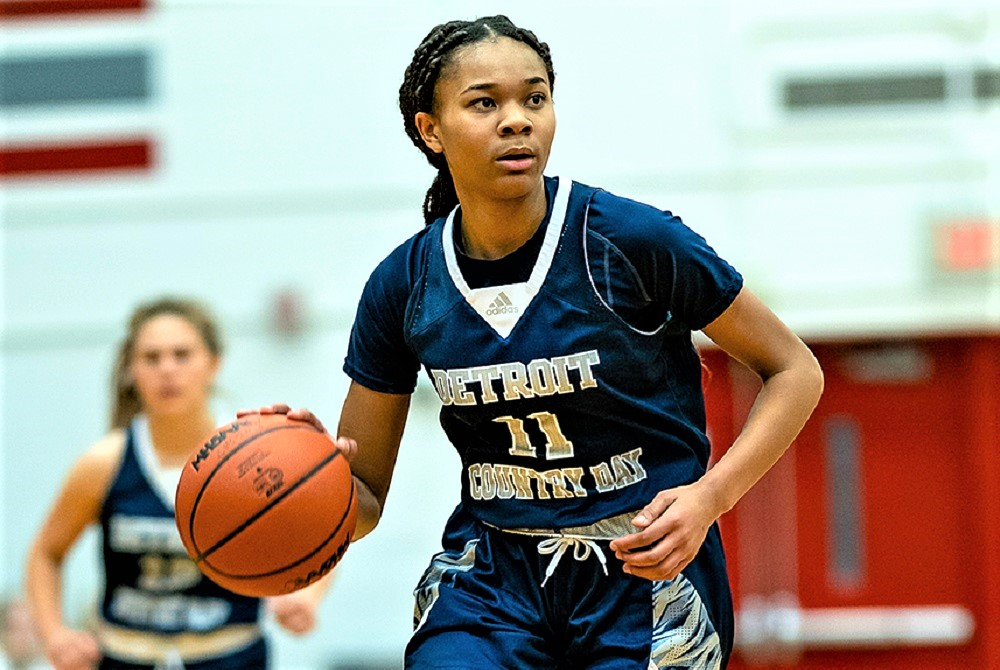
PHOTO Detroit Country Day’s Jaidyn Elam brings the ball upcourt during last week’s Regional Semifinal win over Livonia Clarenceville. (Photo by Douglas Bargerstock.)