


Canton Corrals Comets in Class A Semi
March 14, 2014
By Geoff Kimmerly
Second Half editor
EAST LANSING – The way Canton wins would be easy to overlook, if not for the key word in that statement.
It’s become impossible to ignore the defensive-minded Chiefs, who entered this postseason as only an honorable mention in the final Associated Press Class A poll – and advanced to their first MHSAA Final on Friday at the Breslin Center.
Canton prides itself on defense, giving up only 28 points per game this season.
And the Chiefs made that average stick in handing No. 4 Grand Ledge a 35-28 defeat to advance to Saturday’s championship game against Bloomfield Hills Marian.
“Sometimes we haven’t been thought of as a leading team or whatever, underestimated,” Canton senior center Taylor Hunley said. “It’s great to work so hard to make the final day of the season and be able to spend as much time with each other as possible.”
The Chiefs just missed advancing to the Class A championship games in both 2009 and 2010. But this team is different in that its run is a bit unexpected.
Canton’s only losses were to Marian, Mercy, and a couple more contenders in Grosse Pointe South and Waterford Mott. But it was lack of flashiness in their wins that maybe made this team easier to forget – and yet now, unforgettable.
“We always talk about playing on the last day. The first two (Canton) teams that came, that was sort’ve expected because they were ranked in the top three all year and there was a lot of pressure to get here,” Canton coach Brian Samulski said. “These guys have really been able to enjoy this run they’ve put us on. There’s no real pressure. No one talked about them. But we refuse to lose and keep plugging away, and go from there.”
The first few minutes Friday ended up a good indicator of what was to come; Grand Ledge scored the game’s first basket, but not until more than three minutes had been played.
The Comets entered the week with three players averaging double figures scoring – senior sisters Hannah (15 ppg) and Lindsay Orwat (13.4) and 6-foot-3 junior Cori Crocker (10.7). As a team, Grand Ledge averaged nearly 58 points per game before Friday.
But the trio combined for only 21 points, led by Lindsay Orwat’s nine.
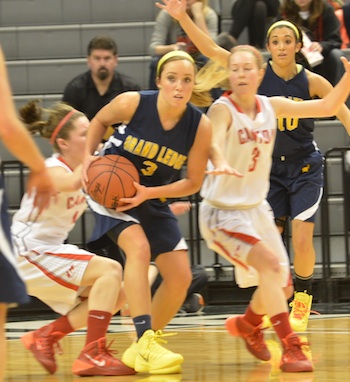 “Me and my sister love to shoot off ball screens, but they were right there in our faces,” Hannah Orwat said. “We’d dump it in to Cori, and there would be five girls on her. We couldn’t get in a flow.”
The teams identically took 39 shots, both making 11. But whereas Canton has been used to this kind of game, the Chiefs could sense by the second quarter that the Comets were getting frustrated.
They were knotted 19-19 heading into the fourth quarter before Hunley and senior Paige Aresco keyed an 8-0 run that seemingly put this low-scoring game out of reach for Grand Ledge.
“A lot of great teams are focused on offense, offense, offense. And then they come up against us,” Aresco said. “We’ve done a great job shutting them down, and it’s been kinda shocking for them, I think.”
The Comets, who will graduate six players, were in their first Semifinal appearance. They finished 24-3.
“This group of Grand Ledge girls has been going to school together their whole lives, and we kept focusing on that as the year went on,” Grand Ledge coach David Jones said. “Experiencing this together, being together, we’re proud of accomplishing getting this far. And a lot of the credit goes to this senior class.”
Click for a full box score and video from the press conference.
PHOTOS: (Top) Canton’s Paige Aresco (14) works to drive against Grand Ledge’s Hannah Orwat. (Middle) Orwat searches for an open teammate as two Chiefs converge.
HIGHLIGHTS: (1) Grand Ledge grabs a 17-15 third-quarter lead against Canton on a pull-up jumper by Lindsay Orwat. (2) Canton scored the first eight points of the fourth quarter to break the game open. This layup by Aresco starts the run.
Breslin Bound: Girls Report Week 3
December 17, 2012
By Geoff Kimmerly
Second Half editor
As a general rule, basketball teams evolve plenty between the first games of December through the final regular-season contests in February.
But these pre-break matchups matter just as much in the win-loss columns. And a number of games are being played right now that will surely make a difference as this season draws to a close.
This week's report includes some of the teams that have came out on the winning ends of key December battles. (Results and records based on those reported to Score Center at MHSAA.com)
1. Inkster (4-0) – The Vikings are a regular at Breslin Center and made the Class A Semifinals last season, so another great start is hardly surprising. But it's proof why Inkster remains a force – last week’s wins were 51-45 over improved Detroit Mumford and 57-51 over always-powerful Detroit Pershing.
2. Waterford Our Lady (3-1) – The reigning Class D champion has bounced back quickly from an opening-night loss to West Bloomfield. Last week, Our Lady beat Livonia Ladywood 50-38 and Mount Pleasant Sacred Heart by the same score.
3. Detroit Martin Luther King (3-0) – This is another team always in the Class A mix, and it got a big win Saturday – 56-48 over returning Class A Semifinalist Ann Arbor Huron, which earlier in the week had defeated Detroit Country Day 65-58. King also beat Detroit East English 61-7.
4. Johannesburg-Lewiston (5-0) – The Cardinals lost only two regular-season games last season, both times to Ski Valley Conference rival Gaylord St. Mary. But they got a little bit of revenge last week with a 50-48 win over St. Mary after also beating East Jordan 57-43.
5. Holt (5-0) – The Rams are again setting up nicely to contend in the strong Capital Area Activities Conference Blue. They beat nonleague foe St. Johns 52-48 and then Lansing Everett 48-39 to keep early pace with other frontrunners Grand Ledge and East Lansing.
6. Napoleon (5-1) – Napoleon’s 15-7 finish in 2011-12 included splits against Michigan Center and Grass Lake. The Pirates got an early upper hand on both last week, beating Michigan Center 49-45 and Grass Lake 47-42.
7. Traverse City St. Francis (4-1) – The Gladiators opened last season 14-1, with that lone loss to Cadillac – which they beat last week 55-50. St. Francis also defeated Kalkaska 44-36 on Friday.
8. Pewamo-Westphalia (3-2) – The Pirates got off to a rough start with opening-week losses to Class B Williamston and Lakewood. But back in familiar territory in the Central Michigan Athletic Conference, they've won three straight – including 51-42 last week over returning Class D Semifinalist Portland St. Patrick.
9. North Farmington (3-1) – The Raiders are coming off a 10-12 season that included a pair of losses to Pontiac. But North Farmington earned the early edge this time with a 59-58 win over Pontiac, followed by a 58-48 win over West Bloomfield.
10. Powers North Central (5-1) – After opening with a 13-point loss to returning Class D Semifinalist Crystal Falls Forest Park, North Central hasn't fallen again. The Jets beat Stephenson 62-51 and Munising 50-22 to get nearly halfway to last season’s win total of 11.
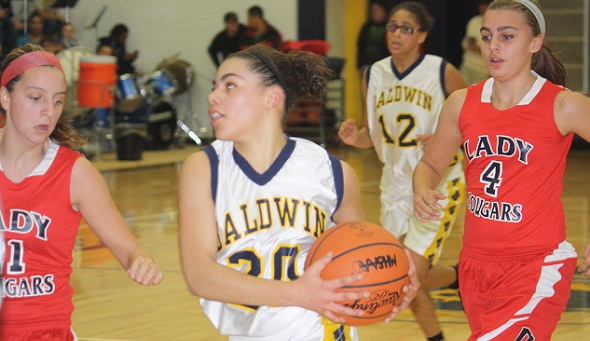
PHOTO: Big Rapids Crossroads (in red) defeated Baldwin on Thursday to move to 4-0 this season. (Click to see more at HighSchoolSportsScene.com.)