


Class A: Comeback Classic
March 17, 2012
EAST LANSING – Shar’Rae Davis had one thought when she received the ball with only a few seconds remaining and Grand Haven’s first championship on the line in Saturday’s MHSAA Class A Final.
She saw the rim on Breslin Center’s north basket. And she knew she had 12 seconds to reach it.
“I didn’t even see the rest of my team. So I was like, I’ve got to score,” Davis said. “That was my mentality.
Not only did Davis race the length of the court; she drove to finish the third-longest comeback in MHSAA Girls Basketball Finals history.
Davis completed her lay-up with six seconds to play. Grosse Pointe South couldn’t connect on its final last-second attempt. And the only thing Davis was a second late for was the start of the celebration: Grand Haven 54, Grosse Pointe South 53.
“When I made the basket, I thought it was tied or something. I was looking around for the timeout. Nothing was happening,” she said. “Then I saw Abby (Cole) jump, everyone run at me. I still didn’t believe it. I had to look at the score.”
Believe it: Grand Haven won its first MHSAA championship after surviving a harrowing double-overtime Quarterfinal against East Lansing, and a late rush by 2011 champion Inskter in Friday’s Semifinal.
But Saturday’s comeback topped them both.
Starting at the end of the first quarter, Grosse Pointe South led for 24 minutes, 5 seconds straight. The Blue Devils’ advantage reached 18 points with 1:51 to go in the third quarter.
“Obviously things weren’t looking good for us down 18. It was another nightmare,” Buccaneers coach Katie Kowalczyk-Fulmer said. “But there was a lot of time left on the clock. And we just talked about getting back into it one possession at a time. You can’t get it all at once. We couldn’t foul just to foul because we knew if the game was going to come down to free throws and we put them at the line, we wouldn’t have a chance.”
Instead, she directed her players to deliver the ball repeatedly to Cole.
The 6-foot-5 junior scored nine of her 18 points over the final 9:38 of the game, including seven straight free throws as the Devils tried to keep her from getting any closer to the hoop (she also had eight rebounds and eight blocks). Davis scored 14 of her game-high 19 points during that 27-10 run.
But those efforts still nearly weren’t enough.
Reeling a bit after giving up the big lead, Grosse Pointe South got a jolt of hope from freshman guard Cierra Rice. Grand Haven took its first lead in two quarters with 1:10 to play, and held a two-point advantage with 24 second to go when Rice dropped in a lay-up, was fouled, and made the free throw to give the Devils back a one-point edge.
But after Davis’ ensuing full-court scoring run, the last attempt by the Devils didn’t fall.
Only Farmington Our Lady of Mercy in 1982 (19 points) and Detroit Cass Tech in 1987 (20) made bigger championship game comebacks than Grand Haven – both to win Class A titles as well.
“We knew we could do anything because of that Quarterfinal game,” Grand Haven senior Alex Law said of the 42-40 win over East Lansing. “It was crazy, but that gave us so much confidence. I was like, ‘Let’s go, we can do this. We’ve got this. It’s our last game. Let’s do it right.’”
Grand Haven finished 27-1, losing only to East Kentwood – a loss the Buccaneers avenged later in the season. They were ranked No. 1 heading into the postseason.
Grosse Pointe South (23-4) was only an honorable mention heading into playoffs. But that didn’t make Saturday any less heart-breaking.
Four Blue Devils scored at least 10 points, led by Rice with 14 and junior Claire DeBoer with 13. Three grabbed at least 10 rebounds – Senior Caitlin Moore had 12 to go with her 12 points, and senior Catherine Palazzolo had 10 to go with her 10 points as Grosse Pointe South outrebounded the taller Buccaneers by 19.
But nine of the Blue Devils 19 turnovers also came during that final Grand Haven run, caused in large part by the Bucs’ “monster” press defense, as they call it. It produced monstrous – and championship – results.
“The past couple of games when the pressure got on, we haven’t always handled it well. And they making the adjustment and really going inside, throwing into the big girls, definitely hurt,” Blue Devils coach Kevin Richards said. “What can you say? We made plays all but right at the very end. We had a great effort and the gameplan worked. We just need to have a little bit better ball security.”
Click for the box score. Watch the game and both teams' postgame press conferences at MHSAA.tv.
PHOTOS: (Top) Grand Haven celebrates its first MHSAA championship. (Photo courtesy of Terry McNamara Photography.)
Breslin Bound: Girls Report Week 3
December 17, 2012
By Geoff Kimmerly
Second Half editor
As a general rule, basketball teams evolve plenty between the first games of December through the final regular-season contests in February.
But these pre-break matchups matter just as much in the win-loss columns. And a number of games are being played right now that will surely make a difference as this season draws to a close.
This week's report includes some of the teams that have came out on the winning ends of key December battles. (Results and records based on those reported to Score Center at MHSAA.com)
1. Inkster (4-0) – The Vikings are a regular at Breslin Center and made the Class A Semifinals last season, so another great start is hardly surprising. But it's proof why Inkster remains a force – last week’s wins were 51-45 over improved Detroit Mumford and 57-51 over always-powerful Detroit Pershing.
2. Waterford Our Lady (3-1) – The reigning Class D champion has bounced back quickly from an opening-night loss to West Bloomfield. Last week, Our Lady beat Livonia Ladywood 50-38 and Mount Pleasant Sacred Heart by the same score.
3. Detroit Martin Luther King (3-0) – This is another team always in the Class A mix, and it got a big win Saturday – 56-48 over returning Class A Semifinalist Ann Arbor Huron, which earlier in the week had defeated Detroit Country Day 65-58. King also beat Detroit East English 61-7.
4. Johannesburg-Lewiston (5-0) – The Cardinals lost only two regular-season games last season, both times to Ski Valley Conference rival Gaylord St. Mary. But they got a little bit of revenge last week with a 50-48 win over St. Mary after also beating East Jordan 57-43.
5. Holt (5-0) – The Rams are again setting up nicely to contend in the strong Capital Area Activities Conference Blue. They beat nonleague foe St. Johns 52-48 and then Lansing Everett 48-39 to keep early pace with other frontrunners Grand Ledge and East Lansing.
6. Napoleon (5-1) – Napoleon’s 15-7 finish in 2011-12 included splits against Michigan Center and Grass Lake. The Pirates got an early upper hand on both last week, beating Michigan Center 49-45 and Grass Lake 47-42.
7. Traverse City St. Francis (4-1) – The Gladiators opened last season 14-1, with that lone loss to Cadillac – which they beat last week 55-50. St. Francis also defeated Kalkaska 44-36 on Friday.
8. Pewamo-Westphalia (3-2) – The Pirates got off to a rough start with opening-week losses to Class B Williamston and Lakewood. But back in familiar territory in the Central Michigan Athletic Conference, they've won three straight – including 51-42 last week over returning Class D Semifinalist Portland St. Patrick.
9. North Farmington (3-1) – The Raiders are coming off a 10-12 season that included a pair of losses to Pontiac. But North Farmington earned the early edge this time with a 59-58 win over Pontiac, followed by a 58-48 win over West Bloomfield.
10. Powers North Central (5-1) – After opening with a 13-point loss to returning Class D Semifinalist Crystal Falls Forest Park, North Central hasn't fallen again. The Jets beat Stephenson 62-51 and Munising 50-22 to get nearly halfway to last season’s win total of 11.
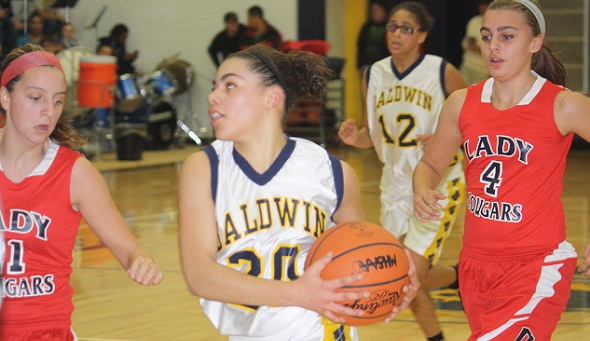
PHOTO: Big Rapids Crossroads (in red) defeated Baldwin on Thursday to move to 4-0 this season. (Click to see more at HighSchoolSportsScene.com.)