


Country Day Follows Freshman to Title
March 21, 2015
By Bill Khan
Special for Second Half
EAST LANSING — Detroit Country Day knew it had a potential star on its hands when Kaela Webb arrived as a freshman in the fall.
But regardless of her status as the latest prodigy for one of Michigan's most successful programs, Webb didn't receive preferential treatment.
She was treated just like any other ninth-grader, which meant knowing her place in the team's pecking order at the beginning of the season.
"It was weird, because freshmen had to get the water, and I just wasn't used to that," Webb said. "We had to get the jerseys and everything."
Freshman initiation didn't last long for Webb and Country Day's four other ninth-graders, who eventually blended seamlessly into the team and left their mark in the school's rich history.
Webb stepped into a leadership role on the biggest stage in the sport, scoring a game-high 20 points to lead Country Day to a 49-41 victory over Haslett in the MHSAA Class B girls basketball championship game Saturday night at the Breslin Center.
It was the 11th MHSAA title for Country Day (22-4), but its first since 2009. The Yellowjackets hadn't gone six years between titles since a similar drought between 1989 and 1995.
Some of the greatest players in Country Day history came and went without winning a championship since the 2009 title. The Yellowjackets restored their tradition by playing four freshmen, two sophomores, a junior and two seniors against Haslett.
"It's an honor to bring back the legacy after six years," senior Kristina Grace said. "It's an 'awe' moment. You wouldn't expect for a team like us who is so young to make it all the way. We were the underdogs and we did it; it's amazing."
After losing in the 2010 title game, Country Day was eliminated in the Quarterfinals each of the last five years, the first three by Goodrich, the last two by Flint Powers Catholic.
"The biggest joy of all is to see these young women be proud Lady Jackets and keep the legacy of our program," veteran Country Day coach Frank Orlando said. "I know we are so blessed to win a state championship. I don't care about the number; I care about these kids."
Country Day's all-stater is a sophomore, Destiny Pitts. She finished with 12 points, but was held to four in the second half. Webb came through with 11 points after halftime, going 6 for 6 from the line during the final 1:28 to put the game away.
"For a freshman, that's phenomenal, but for anybody that's phenomenal," Orlando said.
Haslett (22-6), which lost 57-43 to Country Day late in the regular season, was able to limit Pitts, but couldn't find an answer for Webb.
"(Webb) had a stellar night tonight," Haslett coach Bob Currier said. "Boy, for a freshman, what a nice player with quickness, control, good defense. She did a great job. They don't play like freshmen and sophomores, that's for sure, but they have such great physical attributes that it kind of makes up for that some."
Country Day broke away from a 10-10 tie after one quarter to take a 23-17 halftime lead. The Yellowjackets expanded that lead to 30-20 on a basket by Arika Tolbert with 3:02 left in the third quarter.
With the game possibly slipping away from them, the Vikings fought back to within striking distance. A layup by Kenzie DeCook off a turnover got Haslett within 37-35 with 2:52 remaining in the game. Haslett was again within two points when two free throws by DeCook made it 39-37 with 2:14 to go.
Country Day scored the next six points and went 12 for 14 from the line in the fourth quarter. Webb showed no signs of freshman jitters, hitting all six of her free throws.
"I just went up there confident I was going to make them," said Webb, a 77-percent free throw shooter who averages eight points a game. "My coaches said to stick 'em and make sure my wrist is straight. I believed them, and that's what I did."
Haslett may have worn down at the end, not using a player off the bench in the second half until DeCook fouled out with 1:28 left in the fourth quarter.
For DeCook, Makenna Ott and Adrianna Stolicker, it meant the end of four-year careers during which they helped Haslett post a 78-20 (.796) record and reach its first MHSAA Final. The Vikings' longest postseason run prior to this season was in 1995 when they lost in the Class B Semifinals. They made the 1975 and 1976 Class C Quarterfinals.
Haslett was 10-11 the season before those three arrived.
"Their record is wonderful for the four years we've had them," Currier said. "The three girls have done everything we've asked. They changed Haslett, I hope for good. I hope we're on that path. The work outside of practice, working on your game, the good attitude, the total teamwork — they brought all that to us."
Ott had 17 points and 10 rebounds, while DeCook had 17 points for Haslett.
Click for a full box score and video from the postgame press conference.
PHOTO: Detroit Country Day accepts is championship trophy to finish the girls basketball season Saturday night at the Breslin Center.
Breslin Bound: Girls Report Week 2
December 11, 2012
By Geoff Kimmerly
Second Half editor
We're only two weeks into this girls basketball season. But there are plenty of teams that already can take pride in strong starts that either are continuing on last season's success or showing a nice turnaround after a rough run.
Some of those are highlighted in this week's report. Remember, what's below isn't any sort of statewide ranking – merely a top-10 list of notables from last week.
Records and results are through Sunday and based on those found at MHSAA.com. Click on Score Center to follow scores throughout the week and enter those of the games you attend.
1. Concord (3-0) – Most of the key pieces to last season’s Class C Semifinalist team are back, and they earned a pair of close wins. Concord edged Michigan Center 36-32 – after also beating Michigan Center in overtime in the District opener last season – and then got past Homer 37-35.
2. L’Anse (4-0) – The Purple Hornets are again off to a nice start – with a bonus. According to the Houghton Daily Mining Gazette, L’Anse’s 60-56 win over Houghton gave Houghton its first loss to a team from the state’s four northernmost counties since Nov. 2, 1999. Click to read more from the Daily Mining Gazette.
3. Westland John Glenn (2-0) – The Rockets got off to a strong start with a 66-34 win over Grosse Pointe North and then a 63-56 victory over Dearborn Divine Child. Divine Child is coming off a trip to the Class B Semifinals.
4. Grand Rapids South Christian (3-0) – Two of the Sailors four losses last season came to Grand Rapids Catholic Central. They haven’t played GRCC yet, but did edge Grand Rapids Christian 50-46 just three days after the Eagles beat GRCC by six.
5. Marshall (3-1) – This returning Class B Quarterfinalist added a strong week to a solid start. First, Marshall topped Richland Gull Lake 48-44 – Gull Lake won its Class A District last year – and then the Redhawks finished the week with a 46-33 win over Battle Creek Central.
6. Pontiac (2-0) – The Phoenix were a .500 team last season, but are off to a quick start thanks to two close wins. Pontiac beat Waterford Mott 49-45 and then Harper Woods Chandler Park 57-55.
7. Manchester (4-0) – The Flying Dutchmen have beaten every opponent by at least 10 points this season, including Onsted 59-40 and Napoleon 64-34 last week. Napoleon entered 3-0.
8. Bloomfield Hills Marian (2-0) – Marian is off to a solid start after beating annual Class A power Canton 44-30. Marian opened by beating Grosse Pointe North two weeks ago.
9. Athens (3-0) – The reigning Class D runner-up is off to a fast start again. Athens opened last week by beating Climax-Scotts 55-44, then survived a close one against Reading, 37-31.
10. Saginaw Heritage (2-2) – The Hawks bounced back from two losses during the first week to even their record by beating Arthur Hill 54-35 and Bay City Western 51-14. Heritage lost to Arthur Hill by 17 in their game last season.
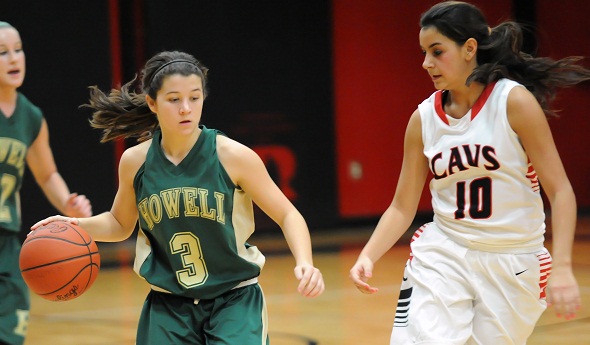
PHOTO: Howell junior Meredith Wood works to get around a defender as the Highlanders pushed toward their first win of the season, 60-48 over Carrollton on Thursday. (Click to see more at HighSchoolSportsScene.com.)