

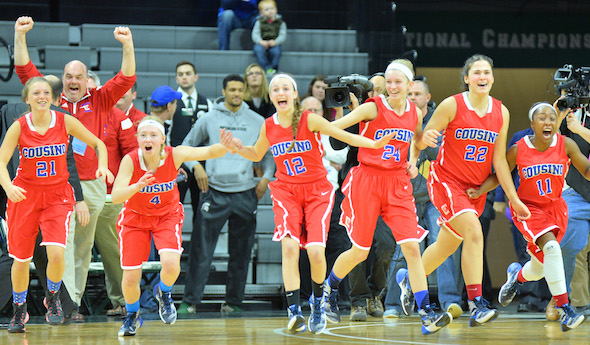
Cousino Ends Historic Run Atop Class A
March 19, 2016
By Bill Khan
Special for Second Half
EAST LANSING — Kierra Fletcher hit the floor with her body, one of the hazards when driving to the basket, then slapped it with her hands when she realized her shot had fallen.
 She got up and pumped her right fist in the air before going to the line and making the free throw.
These were just three of the 198 points she scored during Warren Cousino's eight-game run through the MHSAA Class A Girls Basketball Tournament, but they were arguably the most important.
A championship that seemed guaranteed when the Patriots held a 19-point third-quarter lead was slipping through the Patriots' grasp.
Detroit Martin Luther King had all of the momentum and a hot hand in senior guard Micaela Kelly, who virtually single-handedly willed the Crusaders back from the abyss.
A lead that had been chopped to five points was back to double figures at 57-47 when Fletcher made her 3-point play with 5:06 left in the Class A Final on Saturday at the Breslin Center. While King made one final push, coming back from double digits again was too much to ask of the Crusaders, who scored four points in the final seven seconds but ran out of time in a 67-65 loss to Cousino.
Fletcher, who had 27 points and averaged 28.4 over Cousino's last five games, picked up her fourth foul with 44.5 seconds left in the third quarter, then missed two free throws after her return. Her pent-up frustration was released when she made the huge momentum-stalling basket shortly after going 0 for 2 at the line.
"When I got my fourth foul, I was a little rattled," said Fletcher, a junior guard who is already being touted as a Miss Basketball favorite for next season. "Then I came back in the game and missed two free throws when it was crunch time. Once I got that and-one, it lifted my spirits up so we could go and win this game."
By holding off a furious rally by one of the state's most decorated programs, Cousino completed an unlikely championship run. The Patriots had been as far as the Regional Finals only once, losing 50-28 to Mount Clemens L'Anse Creuse North in 1979. They'd won only eight District titles before this season, going 1-8 in Regional games.
Their breakthrough moment came in the Regional championship game, where they beat two-time defending Class A champion Bloomfield Hills Marian, 43-39. Suddenly, Cousino girls basketball was on the radar.
"We figured, hey, if we can beat this team, we can beat any team," said forward Mackenzie Anderson, the team's only senior, after scoring 20 points Saturday. "Our defense was strong. We just didn't want to be done. We wanted one more day together."
Cousino (23-4) joined the 1999 Utica team as the only Class A champions from Macomb County in the 43-year history of the girls basketball tournament.
"Honestly, our team believed this was a realistic goal back in November," Fletcher said. "Our group message name was 'State champs, 2016.' I think at the time, even our parents didn't think we were going to be this far. We were the only ones who believed until we got to where we are today."
To earn their place in history, the Patriots had to knock off a King program that had more MHSAA Finals appearances (12) than Cousino had District titles (nine). King's last championship, its fifth, came in 2006.
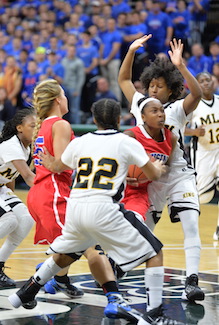 It was Cousino that looked like the program accustomed to the big stage, as the Patriots scored the first five points of the game and built a 31-12 lead with 5:05 left in the second quarter. They outrebounded King 16-3 in the first quarter, grabbing 13 of the game's first 14 boards.
"We played our game in the second half," 33rd-year King coach William Winfield said. "In the first half, not so good. We had some shots that did not fall and drives to the basket that did not go; that was about the size of it. They played an excellent game and were able to get the ball down the floor."
Cousino led 35-19 at halftime, with Fletcher scoring a relatively modest (by her standards) 12 points. Freshman Kate McArthur had nine points on three 3-pointers, while Anderson had eight to help the Patriots dominate the first half. In each of Cousino's previous four games, Fletcher scored more than half of the team's points, including 37 in a 60-45 Semifinal victory over Hudsonville on Friday.
"What's great about this victory is for the first half (Fletcher) played a big role, but there were other people who stepped up today, as well," Cousino coach Mike Lee said. "In a championship game, we said we needed people to step up, and they did. The sacrifice, the heart, the will and the belief — this team believed more than any other team. Once we got to a certain point in the Regionals, we felt good about at least giving this a good shot."
When Cousino began the second half by extending its lead back to 19 points three times, it looked like the fourth quarter would simply become a coronation ceremony for the Patriots.
Kelly had other ideas.
The DePaul-bound guard scored 11 points during the third quarter, as King (24-2) cut the lead to 50-40 heading into the fourth. Despite playing with four fouls, she kept it up in the fourth quarter, scoring 12 more points to finish with a game-high 34. Kelly's total tied the sixth-highest for an MHSAA championship game.
"Since I was supposed to be the leader, I just decided this is my time to put my team on my back before I leave," Kelly said. "I wanted to leave knowing I left it all on the floor."
Kelly, who was 11 for 11 from the line, hit two free throws with 5:53 left to put King back in the game at 52-47.
Fletcher held off the charge by making two free throws with 5:15 left, then making the three-point play with 5:06 to go. King got back to within five points with 1:11 left, but Aubrey Fetzer got a layup off a pass from Anderson on the press break with 1:02 to go.
A basket by King's Tia Tedford, who had 14 points, made it 66-61 with 46 seconds left. Anderson went 1 for 2 from the line with 22.6 seconds to go. King got two free throws from Erica Whitley-Jackson with 7 seconds on the clock to get within four. A shot at the buzzer made it a two-point final.
King was able to reverse the early rebounding discrepancy, trailing only 41-32 in that department by the end, but couldn't overcome its 5 for 31 shooting from 3-point range. Cousino attempted only nine shots from beyond the arc, with McArthur going 4 for 8 to finish with 13 points.
"Today we rushed our threes," Kelly said. "We didn't take our time."
The Girls Basketball Finals are presented by Sparrow Health System.
PHOTOS: (Top) The Warren Cousino bench erupts as the final seconds tick off the clock during the Class A Final on Saturday. (Middle) Mackenzie Cook works to get through the Martin Luther King defense on a drive to the hoop.
Hall Sisters' Daughters Giving Hartland Next-Generation Boost
By
Tim Robinson
Special for MHSAA.com
February 11, 2022
HARTLAND — Hartland girls basketball coach Don Palmer chuckles now when he talks about facing the Hall sisters 30 years ago, when they were at Walled Lake Western and he was at Milford.
 “I never could beat them,” he said, recalling facing Valerie, Dianne and Michelle Hall, all of them 6 feet tall or taller. “That in itself was a rarity, and they were so athletic. We played against the Halls when I had some of my best teams (at Milford). We never beat them, and they never cease to remind me of it.”
A little less than 20 years later, Val and Dianne and their families moved to Hartland about the time Palmer was taking over the Eagles program.
“Whitney was in the third or fourth grade,” Dianne Sollom recalled. “He was like, ‘Oh, the Hall girls! I could never beat you guys!’ And I said, ‘I have Whitney and another one coming in. They’ll be playing for you one day.’”
Whitney Sollom played four years for Palmer and is now a sophomore on the University of Michigan basketball team, a second-generation part of the program as Dianne also played for the Wolverines.
Whitney’s younger sister, Lauren, is a senior starter for the Eagles. One of her teammates is her cousin Sarah Rekowski, Val’s daughter.
“I played with my sister and now I’m playing with Sarah,” Lauren Sollom says. “I know my family is out there with me on the court going through the same thing I am. It’s very special to me.”
Lauren, who has signed to play at Saginaw Valley State, is a senior starter, while Sarah is a sophomore.
They are both from a college sports background. Lauren’s father, Ken, was a quarterback at Michigan and Sarah’s father, Stephen, was a defensive tackle for the Wolverines during the 1990s.
Dianne, who graduated from Western in 1989 and played basketball for Michigan State, met her husband when visiting Val at U-M.
“They grew up in it,” Dianne Sollom said. “If I’m not telling them, (Val) is telling them.”
Like their mothers, Lauren and Sarah are tall. Lauren is a 6-3 forward, while Sarah is a 6-2 post player for the Eagles.
Dianne says she’s 6 feet tall, “but I’m as tall as you want me to be,” she jokes. Val, a 1985 Western grad, was 6-4 in her playing days, as was their younger sister, Michelle.
Val played all four years at Michigan, and Dianne three years at Michigan State.
 “With my mom being a post player and my being a post, it helps me to know what to do in certain situations, and she gives me pointers,” Sarah said. "She’s always helping me with my game.”
But both moms have their limits.
“We do watch film together,” Val says of her time with Sarah, “but not a lot. I let Coach Palmer handle all that. I know Dianne and Ken have that ongoing conversation and try to help when they can. But you have to back off. A lot of the time they don’t want to hear you at all. You have to give them some time, that 24 hours or whatever.”
Sarah enjoys the physical portion of the game and showed her potential in the season opener, when she had 13 points and eight rebounds. Lauren will get inside for rebounds, but plays mostly on the perimeter, hoisting up 3-pointers, something Sarah hasn’t done yet.
“Coach Palmer has not given her the pass yet,” Lauren pronounced as both giggled.
“Coach Palmer would probably lose his mind,” Sarah said, grinning.
“He definitely would,’ Lauren said, to more laughter.
Sarah played on the JV team as a freshman last season, although her winter was interrupted by 10-day COVID-19 quarantines on a couple of occasions.
“She’s a little behind in her development,” Palmer said of Sarah, “but she really is a talented kid. She’s a big kid who, when she gets a rebound, it really is a rebound. We’re working on her constantly on her footwork.”
Sarah has been alternating with 6-4 senior Kate Jacobs in the post.
“It’s been up and down,” she says, “but I’ve gotten a lot of experience. I’m getting a decent amount of playing time.”
Lauren, meanwhile, is a team captain.
“Lauren’s a team-first player,” Palmer said. “She’s having a great year for us, she’s our leading scorer, leading rebounder and she’s having an MVP kind of year.
“They’re good kids,” Palmer said of the cousins. “They want to win, and they don’t care about how they do it. That’s the thing about this team. They’re all unselfish kids; you know, if they get 15 one night and get two the next and the team won both, they’re fine.”
In addition, Lauren’s fraternal twin brother, Brad, plays for the Hartland boys basketball team and will suit up at Concordia University in Ann Arbor next year, where he will play football.
For now, Lauren and Sarah are enjoying their year of varsity basketball together.
“We talk a lot,” Lauren said. “Basketball brings us together. Practices are fun, and I drive her to school in the morning and home in the evening. That’s good cousin time, family time.”
Speaking of family time, when Dianne (for MSU) and Michelle (U-M) played against each other in college, it was not unheard of for one sister to let the other have the occasional free lane to the basket, or for one to congratulate the other on a good shot while both were on the floor.
Once, castigated for complimenting her sister, Dianne said to her coach, “But she’s my sister!”
 Now, Dianne and Val sit in the stands at Hartland games, cheering their daughters on.
“I enjoy watching her play,” Val said. “We’ve been watching Whitney and Lauren since they were young, and Sarah’s coming along. It’s fun to watch the light bulb come on and everything starts clicking. It’s really great when it all comes together for them.”
“I was on the court my entire life,” Dianne said. “I want to sit in the stands and watch my daughter and son. My husband is in the same boat. We’ve done it. We don’t have to shine.”
Hartland has been one of the top teams in the state this season, and the Eagles are looking toward a long run in the MHSAA Tournament, not unlike last year, when they reached the Division 1 quarterfinals.
To do so, the Eagles (14-1) are combining talent with togetherness, with nine seniors, including Lauren Sollom, looking out for themselves and a big sophomore in Sarah Rekowski who could play a key role down the stretch.
“She’s a very hard worker in practice and always has a smile on her face, even when Palmer is yelling at her,” said Lauren, joining her cousin with more giggles in a postgame interview, another shared moment in a season that already has produced memories for a lifetime and a special bond within a bond.
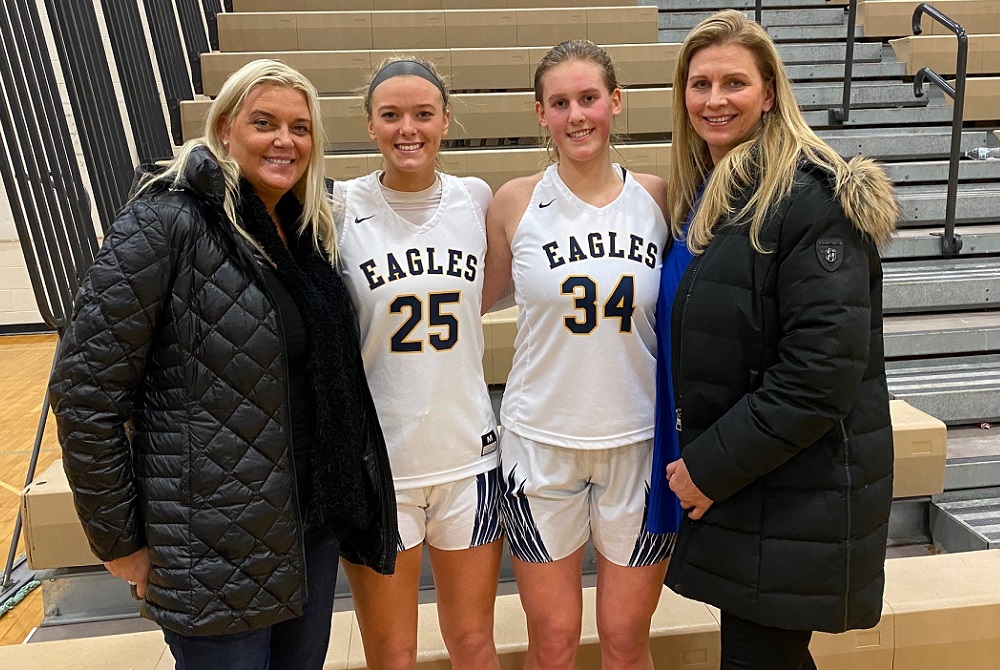
PHOTOS (Top) Dianne Sollom, far left, and Val Rekowski, far right, stand with daughters Lauren Sollom (25) and Sarah Rekowski (34) after a Hartland game. (Middle) Dianne Sollom, second-from-right, takes the opening jump against Canton while playing for Walled Lake Western. (Below) Val Hall (52) gets her hand on a shot while also starring for Walled Lake Western in this Novi-Walled Lake News clipping. (Top photo by Tim Robinson, middle and bottom photos provided by the Sollom and Rekowski families.)