

Cousino Ends Historic Run Atop Class A
March 19, 2016
By Bill Khan
Special for Second Half
EAST LANSING — Kierra Fletcher hit the floor with her body, one of the hazards when driving to the basket, then slapped it with her hands when she realized her shot had fallen.
 She got up and pumped her right fist in the air before going to the line and making the free throw.
These were just three of the 198 points she scored during Warren Cousino's eight-game run through the MHSAA Class A Girls Basketball Tournament, but they were arguably the most important.
A championship that seemed guaranteed when the Patriots held a 19-point third-quarter lead was slipping through the Patriots' grasp.
Detroit Martin Luther King had all of the momentum and a hot hand in senior guard Micaela Kelly, who virtually single-handedly willed the Crusaders back from the abyss.
A lead that had been chopped to five points was back to double figures at 57-47 when Fletcher made her 3-point play with 5:06 left in the Class A Final on Saturday at the Breslin Center. While King made one final push, coming back from double digits again was too much to ask of the Crusaders, who scored four points in the final seven seconds but ran out of time in a 67-65 loss to Cousino.
Fletcher, who had 27 points and averaged 28.4 over Cousino's last five games, picked up her fourth foul with 44.5 seconds left in the third quarter, then missed two free throws after her return. Her pent-up frustration was released when she made the huge momentum-stalling basket shortly after going 0 for 2 at the line.
"When I got my fourth foul, I was a little rattled," said Fletcher, a junior guard who is already being touted as a Miss Basketball favorite for next season. "Then I came back in the game and missed two free throws when it was crunch time. Once I got that and-one, it lifted my spirits up so we could go and win this game."
By holding off a furious rally by one of the state's most decorated programs, Cousino completed an unlikely championship run. The Patriots had been as far as the Regional Finals only once, losing 50-28 to Mount Clemens L'Anse Creuse North in 1979. They'd won only eight District titles before this season, going 1-8 in Regional games.
Their breakthrough moment came in the Regional championship game, where they beat two-time defending Class A champion Bloomfield Hills Marian, 43-39. Suddenly, Cousino girls basketball was on the radar.
"We figured, hey, if we can beat this team, we can beat any team," said forward Mackenzie Anderson, the team's only senior, after scoring 20 points Saturday. "Our defense was strong. We just didn't want to be done. We wanted one more day together."
Cousino (23-4) joined the 1999 Utica team as the only Class A champions from Macomb County in the 43-year history of the girls basketball tournament.
"Honestly, our team believed this was a realistic goal back in November," Fletcher said. "Our group message name was 'State champs, 2016.' I think at the time, even our parents didn't think we were going to be this far. We were the only ones who believed until we got to where we are today."
To earn their place in history, the Patriots had to knock off a King program that had more MHSAA Finals appearances (12) than Cousino had District titles (nine). King's last championship, its fifth, came in 2006.
 It was Cousino that looked like the program accustomed to the big stage, as the Patriots scored the first five points of the game and built a 31-12 lead with 5:05 left in the second quarter. They outrebounded King 16-3 in the first quarter, grabbing 13 of the game's first 14 boards.
"We played our game in the second half," 33rd-year King coach William Winfield said. "In the first half, not so good. We had some shots that did not fall and drives to the basket that did not go; that was about the size of it. They played an excellent game and were able to get the ball down the floor."
Cousino led 35-19 at halftime, with Fletcher scoring a relatively modest (by her standards) 12 points. Freshman Kate McArthur had nine points on three 3-pointers, while Anderson had eight to help the Patriots dominate the first half. In each of Cousino's previous four games, Fletcher scored more than half of the team's points, including 37 in a 60-45 Semifinal victory over Hudsonville on Friday.
"What's great about this victory is for the first half (Fletcher) played a big role, but there were other people who stepped up today, as well," Cousino coach Mike Lee said. "In a championship game, we said we needed people to step up, and they did. The sacrifice, the heart, the will and the belief — this team believed more than any other team. Once we got to a certain point in the Regionals, we felt good about at least giving this a good shot."
When Cousino began the second half by extending its lead back to 19 points three times, it looked like the fourth quarter would simply become a coronation ceremony for the Patriots.
Kelly had other ideas.
The DePaul-bound guard scored 11 points during the third quarter, as King (24-2) cut the lead to 50-40 heading into the fourth. Despite playing with four fouls, she kept it up in the fourth quarter, scoring 12 more points to finish with a game-high 34. Kelly's total tied the sixth-highest for an MHSAA championship game.
"Since I was supposed to be the leader, I just decided this is my time to put my team on my back before I leave," Kelly said. "I wanted to leave knowing I left it all on the floor."
Kelly, who was 11 for 11 from the line, hit two free throws with 5:53 left to put King back in the game at 52-47.
Fletcher held off the charge by making two free throws with 5:15 left, then making the three-point play with 5:06 to go. King got back to within five points with 1:11 left, but Aubrey Fetzer got a layup off a pass from Anderson on the press break with 1:02 to go.
A basket by King's Tia Tedford, who had 14 points, made it 66-61 with 46 seconds left. Anderson went 1 for 2 from the line with 22.6 seconds to go. King got two free throws from Erica Whitley-Jackson with 7 seconds on the clock to get within four. A shot at the buzzer made it a two-point final.
King was able to reverse the early rebounding discrepancy, trailing only 41-32 in that department by the end, but couldn't overcome its 5 for 31 shooting from 3-point range. Cousino attempted only nine shots from beyond the arc, with McArthur going 4 for 8 to finish with 13 points.
"Today we rushed our threes," Kelly said. "We didn't take our time."
The Girls Basketball Finals are presented by Sparrow Health System.
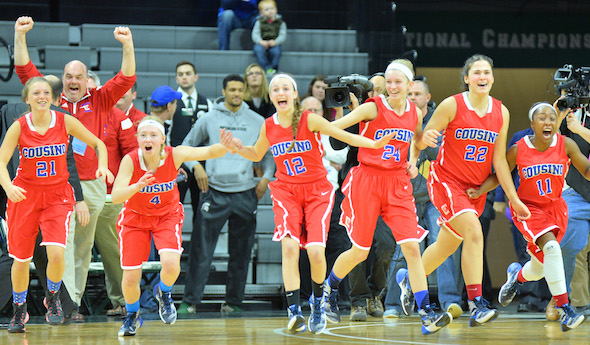
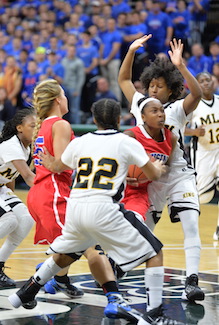
PHOTOS: (Top) The Warren Cousino bench erupts as the final seconds tick off the clock during the Class A Final on Saturday. (Middle) Mackenzie Cook works to get through the Martin Luther King defense on a drive to the hoop.
Breslin Bound: Girls Report Week 2
December 11, 2012
By Geoff Kimmerly
Second Half editor
We're only two weeks into this girls basketball season. But there are plenty of teams that already can take pride in strong starts that either are continuing on last season's success or showing a nice turnaround after a rough run.
Some of those are highlighted in this week's report. Remember, what's below isn't any sort of statewide ranking – merely a top-10 list of notables from last week.
Records and results are through Sunday and based on those found at MHSAA.com. Click on Score Center to follow scores throughout the week and enter those of the games you attend.
1. Concord (3-0) – Most of the key pieces to last season’s Class C Semifinalist team are back, and they earned a pair of close wins. Concord edged Michigan Center 36-32 – after also beating Michigan Center in overtime in the District opener last season – and then got past Homer 37-35.
2. L’Anse (4-0) – The Purple Hornets are again off to a nice start – with a bonus. According to the Houghton Daily Mining Gazette, L’Anse’s 60-56 win over Houghton gave Houghton its first loss to a team from the state’s four northernmost counties since Nov. 2, 1999. Click to read more from the Daily Mining Gazette.
3. Westland John Glenn (2-0) – The Rockets got off to a strong start with a 66-34 win over Grosse Pointe North and then a 63-56 victory over Dearborn Divine Child. Divine Child is coming off a trip to the Class B Semifinals.
4. Grand Rapids South Christian (3-0) – Two of the Sailors four losses last season came to Grand Rapids Catholic Central. They haven’t played GRCC yet, but did edge Grand Rapids Christian 50-46 just three days after the Eagles beat GRCC by six.
5. Marshall (3-1) – This returning Class B Quarterfinalist added a strong week to a solid start. First, Marshall topped Richland Gull Lake 48-44 – Gull Lake won its Class A District last year – and then the Redhawks finished the week with a 46-33 win over Battle Creek Central.
6. Pontiac (2-0) – The Phoenix were a .500 team last season, but are off to a quick start thanks to two close wins. Pontiac beat Waterford Mott 49-45 and then Harper Woods Chandler Park 57-55.
7. Manchester (4-0) – The Flying Dutchmen have beaten every opponent by at least 10 points this season, including Onsted 59-40 and Napoleon 64-34 last week. Napoleon entered 3-0.
8. Bloomfield Hills Marian (2-0) – Marian is off to a solid start after beating annual Class A power Canton 44-30. Marian opened by beating Grosse Pointe North two weeks ago.
9. Athens (3-0) – The reigning Class D runner-up is off to a fast start again. Athens opened last week by beating Climax-Scotts 55-44, then survived a close one against Reading, 37-31.
10. Saginaw Heritage (2-2) – The Hawks bounced back from two losses during the first week to even their record by beating Arthur Hill 54-35 and Bay City Western 51-14. Heritage lost to Arthur Hill by 17 in their game last season.
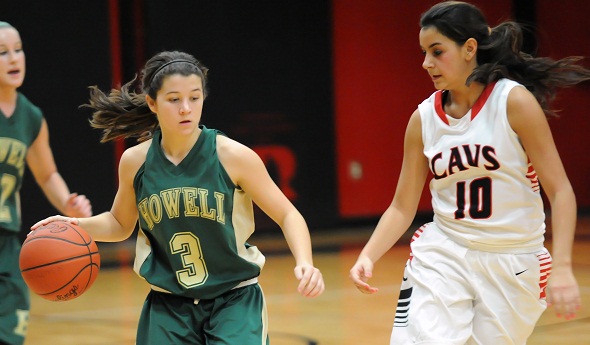
PHOTO: Howell junior Meredith Wood works to get around a defender as the Highlanders pushed toward their first win of the season, 60-48 over Carrollton on Thursday. (Click to see more at HighSchoolSportsScene.com.)