

Davis Adding to Pittsford Winning Ways
December 13, 2019
By Doug Donnelly
Special for Second Half
PITTSFORD – Aaron Davis doesn’t have to worry about rebuilding Pittsford girls basketball.
 While Davis is putting his own stamp on the program that has won two MHSAA Finals championships over the past five seasons, he knows the pieces already were in place when he was named the varsity head coach in June.
“There is a lot of ground work already in place at Pittsford,” said Davis. “It all starts with the youth level, and that’s already there. That is a blessing.”
Davis is in his first season at Pittsford and has the Wildcats off to a 3-0 start. He took over for Chris Hodos, who helped make Pittsford a household name in Class D girls basketball circles over the past decade.
“There are things that I do differently, but Chris and I shared a lot of the same philosophies about basketball,” said Davis, a 2007 graduate of North Adams-Jerome. “There are some things that we do that are from Chris. We still run some of the same presses.”
Davis was a three-sport athlete at North Adams-Jerome, playing basketball, football and baseball. He was a four-year varsity baseball player and spent a year on the Adrian College diamond, but an injury that dated back to his high school days cut his college career short.
“I tried it for a year, but it got to be too much stress on my body and arm,” he said.
Davis said that while growing up, his dad coached him in multiple sports. Davis also learned a lot from his high school coaches while playing at North Adams.
“My wife and I had always talked about me getting into coaching someday,” he said.
Davis got his start in coaching at his alma mater. He coached the junior varsity boys basketball team and had coached baseball with Hodos. In fact, when Hodos contacted him about coaching at Pittsford, Davis thought he was talking about baseball.
“After a few minutes, I was like, ‘Oh, you are talking about basketball,’” Davis said. “Chris was a great mentor. He helped me become a better coach.”
Davis spent three seasons as the Wildcats JV girls basketball coach. Hodos, he said, let him run the JV team as he wanted. That valuable experience has paid off in multiple ways early this winter.
Pittsford’s 3-0 start includes wins over Hudson (41-25), Tekonsha (50-12) and Waldron (68-15). Thus far, the Wildcats are giving up just 17.3 points a game. That’s by design.
“We’re real athletic, and we play good defense,” Davis said. “I have a lot of great defenders. Everything starts with our defense.”
Davis said the team presses, often full-court, and likes to create havoc for the other team as it works to just get the ball over the timeline.
 “We are built to run, pressure and play fast,” he said. “We do a lot of trapping and try and force the other team into making bad passes. We like to try and create our offense with our defense.”
The Wildcats have 11 players: five seniors, four juniors and two sophomores. Jordyn Cole has been the team’s top scorer through three games. Another senior, Sara Cole, is right behind her. The other seniors are MaKayla McDaniel, Sam Leggett and Brooke Campbell.
“Jordyn and Sara, I’d say, take the majority of our shots,” Davis said, “but we really don’t have just one girl who can score for us. We don’t have that one player we rely on. We have girls up and down the line who are comfortable shooting. We like to spread it out.”
One thing that has helped in his transition is that every girl on the varsity roster played for Davis for at least a season. They all are familiar with him and his systems. He also brought on Greg Mallar to coach the Pittsford JV team. Mallar is also familiar to the girls because he has been coaching in the Wildcats youth program.
“He’s actually helped develop a lot of the girls,” Davis said.
Pittsford became a state power under Hodos. In his seven seasons as the head coach, the Wildcats went 156-14, including five consecutive 20-0 regular seasons and the Class D titles in 2016 and 2017. They fell just shy of Michigan’s record of 78 consecutive wins during that time frame.
Pittsford athletic director Mike Burger said the program is in good hands.
"I think that the way that he approaches coaching girls basketball fits quite nicely with the overall small-school athletics philosophy we have here at Pittsford,” Burger said.
The Wildcats play in the Southern Central Athletic Association with North Adams-Jerome, Jackson Christian, Hillsdale Academy and Camden-Frontier. Camden-Frontier and Hillsdale Academy both return several players from quality teams and also will play in the same District as Pittsford.
“It’s still early,” Davis said. “We’ve struggled at times offensively, but I’m not worried about that at this point. If we play up to our potential, we can make a run. But, like I said, it’s early. We’ll see what happens.”
 Doug Donnelly has served as a sports and news reporter and city editor over 25 years, writing for the Daily Chief-Union in Upper Sandusky, Ohio from 1992-1995, the Monroe Evening News from 1995-2012 and the Adrian Daily Telegram since 2013. He's also written a book on high school basketball in Monroe County and compiles record books for various schools in southeast Michigan. E-mail him at [email protected] with story ideas for Jackson, Washtenaw, Hillsdale, Lenawee and Monroe counties.
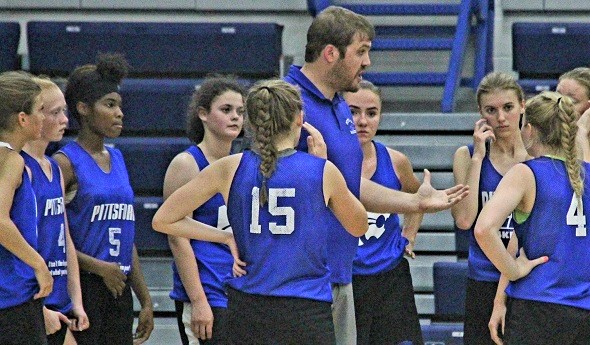
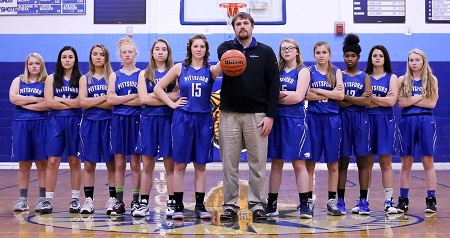
PHOTOS: (Top) First-year Pittsford varsity girls basketball coach Aaron Davis talks things over with his team during a practice this season. (Middle) Davis and his team are off to a 3-0 start. (Top photo courtesy of James Gensterblum; middle photo provided by Pittsford girls basketball program.)
A-B Preview: Return of the Champs
March 15, 2017
By Geoff Kimmerly
Second Half editor
Three 2016 MHSAA champions will take the floor for Friday’s Semifinals in Classes A and B.
Warren Cousino is back attempting to repeat in Class A, and Marshall is seeking to do the same in Class B. The third guarantees there will be a new Class C champion this weekend; Ypsilanti Arbor Prep won that title last year but is in Class B and earned the top ranking during the regular season.
All four Class A and B Semifinals will be played Friday, with all four championship games Saturday.
Semifinals - Friday
Class A
Warren Cousino (24-2) vs. Flushing (22-3), 1 p.m.
East Kentwood (25-1) vs. Southfield Arts & Technology (22-4), 2:50 p.m.
Class B
Detroit Country Day (24-1) vs. Marshall (23-2), 6 p.m.
Ypsilanti Arbor Prep (26-0) vs. Freeland (26-0), 7:50 p.m.
Finals - Saturday
Class A - Noon
Class B - 6 p.m.
Class C - 4 p.m.
Class D - 10 a.m.
Tickets cost $8 per pair of Semifinals and $10 per two-game Finals session. All Semifinals will be streamed live on MHSAA.tv on a pay-per-view basis. All four Finals will be broadcast live on Fox Sports Detroit, the Class D, A and C Finals on the network’s PLUS channel and Class B on the primary channel. Free radio broadcasts of all weekend games will be available on MHSAANetwork.com.
And now, a look at the semifinalists in Class A and Class B. Click on the name of the school to see that team’s full schedule and results from this season. (Statistics are through teams' Regional Finals, except Freeland’s are through the end of the regular season.) The Girls Basketball Finals are presented by Sparrow Health System.
Class A
EAST KENTWOOD
Record/rank: 25-1, No. 9
League finish: First in Ottawa-Kent Conference Red
Coach: Jimmy Carter, sixth season (79-57)
Championship history: Has never played in an MHSAA Final.
Best wins: 57-43 over No. 7 Muskegon Mona Shores in the Regional Semifinal, 59-45 and 63-46 over Grand Haven, 51-49 (District Final) and 52-43 over Grand Rapids Christian.
Players to watch: Lazurea Saunders, 6-0 jr. C (14 ppg, 7.0 rpg, 4.0 spg); Alona Blackwell, 5-10 soph. F (10 ppg, 3.0 apg);
Outlook: East Kentwood has its second 20-win season under Carter, but also has increased its win total each of the last four winters. The Falcons are 11 victories better than a year ago and won their first Regional title last week. The only loss was to Class B No. 4 Grand Rapids Catholic Central in East Kentwood’s second game. Eight players average at least five points per game; sophomore guard Mauriya Barnes (11.5 ppg) and junior center Corinne Jemison (10) add plenty of scoring off the bench.
FLUSHING
Record/rank: 22-3, unranked
League finish: First in Flint Metro League.
Coach: Larry Ford, 13th season (228-67)
Championship history: Has never played in an MHSAA Final.
Best wins: 45-39 over No. 4 Midland Dow in the Regional Final, 47-25 over Flint Hamady, 65-37 and 50-39 (District Final) over Flint Carman-Ainsworth.
Players to watch: Lauren Newman, 5-8 sr. G (11.3 ppg, 4.6 rpg); Shelby Morrow, 5-7 jr. G (10.9 ppg, 2.5 spg).
Outlook: Flushing has advanced to its first Semifinal since 1976 and won 21 of its last 22 games after opening 1-2 this winter. The Dow win in the Regional Final avenged one of those early losses, and the others were to No. 3 Saginaw Heritage and Class B top-ranked Arbor Prep. Only league rival Fenton (41) has scored more than 40 points against the Raiders since Dec. 6. Senior 6-foot center Bre Perry adds to a balanced attack with 8.6 points and 6.7 rebounds per game.
SOUTHFIELD ARTS & TECHNOLOGY
Record/rank: 22-4, No. 6
League finish: First in Oakland Activities Association Red
Coach: Michele Marshall, 22nd season (276-92)
Championship history: First season as a program.
Best wins: 55-51 over No. 1 Detroit Martin Luther King in the Regional Final, 68-52 over Detroit Renaissance in the District Final, 52-38 over Ann Arbor Huron in the Quarterfinal.
Players to watch: Deja Church, 5-10 sr. G (20.1 ppg, 8.5 rpg); Alexis Johnson, 5-10 soph. F (14.8 ppg, 7.0 rpg).
Outlook: Although Southfield A&T technically is a new program, Marshall formerly built Southfield Lathrup into a top program before that school and the former Southfield High merged last fall. Lathrup won the Class A title in 2005. Church was a Miss Basketball finalist and will continue at University of Michigan. Freshman guard Cheyenne McEvans adds another 10.3 points and six rebounds per game and with Church is among three who had at least 22 3-pointers this season entering the week.
WARREN COUSINO
Record/rank: 24-2, No. 2
League finish: First in Macomb Area Conference Red
Coach: Mike Lee, eighth season (150-43)
Championship history: Class A champion 2016.
Best wins: 47-41 over Farmington Hills Mercy in the Quarterfinal, 41-39 over Bloomfield Hills Marian in the Regional Final, 53-51, 52-34 and 66-45 over No. 7 Port Huron Northern.
Players to watch: Kierra Fletcher, 5-9 sr. G (22.7 ppg, 13 rpg, 6.2 apg, 5.2 spg, 2.1 bpg); Erin McArthur, 5-6 sr. G (13.7 ppg, 5.0 rpg, 5.4 apg, 4.1 spg, 65 3-pointers).
Outlook: Cousino was as big a surprise last season as a 23-win team could be – but definitely won’t be this weekend. Fletcher was a Miss Basketball finalist after starring in last season’s Finals, and she’ll continue her career at Georgia Tech. In addition to Fletcher and McArthur, senior Rachel Hayes and sophomore Mackenzie Cook also started in last season’s championship game and current starter senior Aubrey Fetzer played 21 minutes off the bench. Cousino also picked up two wins over league foe Macomb Dakota, which also made the Quarterfinals.
Class B
DETROIT COUNTRY DAY
Record/rank: 24-1, No. 2
League finish: Does not play in a league.
Coach: Frank Orlando, 36th season (757-113)
Championship history: Eleven MHSAA titles (most recent 2015), four runner-up finishes.
Best wins: 55-46 over Class A No. 1 Detroit Martin Luther King, 56-46 over Class A No. 4 Midland Dow, 60-51 over Class A No. 6 Southfield A&T, 53-35 over Ann Arbor Huron.
Players to watch: Destiny Pitts, 6-0 sr. G (22.7 ppg, 5.9 rpg, 3.3 apg, 71 3-pointers); Kaela Webb, 5-7 jr. G (14.8 ppg, 3.0 apg, 36 3-pointers).
Outlook: Country Day returned to the Semifinals last season and will try to send off Pitts with a second title in three seasons. She also was a Miss Basketball finalist and will continue at University of Minnesota. She was named Class B Player of the Year by The Associated Press, and Webb also made the all-state first team. In addition to an impressive Class A lineup and its Class B run, the Yellowjackets beat Class C semifinalists Detroit Edison PSA and Flint Hamady during the regular season.
FREELAND
Record/rank: 26-0, No. 5
League finish: First in Tri-Valley Conference Central.
Coach: Tom Zolinski, 10th season (198-45)
Championship history: Class C champion 1998.
Best wins: 68-45 over No. 9 Bay City John Glenn in the District Semifinal, 57-35 and 39-38 over Saginaw Swan Valley, 53-38 over Cadillac in the Quarterfinal.
Players to watch: Jenna Gregory, 5-10 sr. F (10 ppg, 5.3 rpg, 2.5 spg); Alyssa Argyle, 5-9 soph. F (9.7 ppg, 2.7 spg);
Outlook: The Falcons are back in the Semifinals for the first time since 2012 and with only two wins decided by fewer than 10 points. Freeland is 47-3 over the last two seasons and has dominated this one with a balanced lineup; five players average at least seven points per game, and five entered the postseason with at least 20 3-pointers. Bullock Creek was the other opponent to get within 10 points, and the Falcons beat the Lancers in the District Final by 40.
MARSHALL
Record/rank: 23-2, No. 6
League finish: First in Interstate Eight Athletic Conference.
Coach: Sal Konkle, 17th season (305-95)
Championship history: Class B champion 2016, runner-up 1981.
Best wins: 49-27 over No. 4 Grand Rapids Catholic Central in the Quarterfinal, 55-29 over Comstock in the District Semifinal, 41-40 and 50-29 over Jackson Northwest.
Players to watch: Nikki Tucker, 5-10 sr. F (15.1 ppg, 7.1 rpg); Jill Konkle, 5-6 sr. G (11.3 ppg, 43 3-pointers).
Outlook: The reigning Class B champion is surging again, avenging its second loss by beating GRCC in the Quarterfinal; the other defeat came to No. 3 Williamston on opening night. Four senior starters are back from last season’s Final. Balance and defense are again the names of Marshall’s game: six players score at least 4.8 ppg, and of the 23 wins, only that first over the league rival Mounties came by fewer than 10 points.
YPSILANTI ARBOR PREP
Record/rank: 26-0, No. 1
League finish: Does not play in a league.
Coach: Rod Wells, sixth season (129-17)
Championship history: Class C champion 2016.
Best wins: 41-39 over No. 3 Williamston in the Quarterfinal, 53-38 over No. 8 Ida in the Regional Semifinal, 38-28 over Flushing, 53-33 over Ann Arbor Huron, 72-31 over Detroit Mumford, 57-39 over Class A No. 7 Muskegon Mona Shores.
Players to watch: Adrienne Anderson, 5-7 sr. G (13.7 ppg, 4.2 spg); Ro’zhane Wells, 5-5 sr. G (10.6 ppg, 3.6 apg, 2.9 spg).
Outlook: Arbor Prep’s encore to last season’s Class C title has been to move to Class B and go undefeated. Senior forwards Cydney Williams (9.1 ppg) and Kayla Knight (4.8) joined Anderson and Wells starting in last season’s championship game, and 6-0 junior forward Lasha Petree adds another 10.4 ppg this winter. Only Williamston and Dearborn Heights Robichaud in the District Final have gotten closer than 10 points as the team has given up more than 40 only five times. Arbor Prep also downed Class C quarterfinalist Detroit PSA.
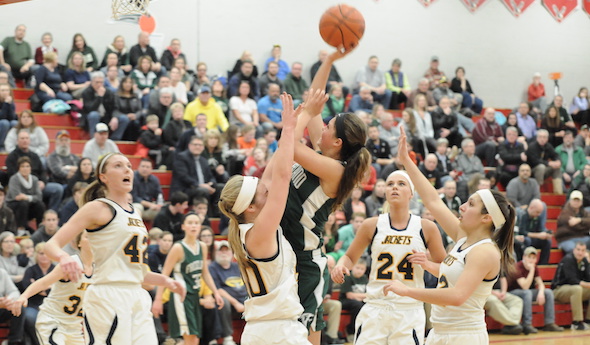
PHOTO: Freeland downed Ithaca last week to claim a Class B Regional title. Click to see more at HighSchoolSportsScene.com.)