

Davis Adding to Pittsford Winning Ways
December 13, 2019
By Doug Donnelly
Special for Second Half
PITTSFORD – Aaron Davis doesn’t have to worry about rebuilding Pittsford girls basketball.
 While Davis is putting his own stamp on the program that has won two MHSAA Finals championships over the past five seasons, he knows the pieces already were in place when he was named the varsity head coach in June.
“There is a lot of ground work already in place at Pittsford,” said Davis. “It all starts with the youth level, and that’s already there. That is a blessing.”
Davis is in his first season at Pittsford and has the Wildcats off to a 3-0 start. He took over for Chris Hodos, who helped make Pittsford a household name in Class D girls basketball circles over the past decade.
“There are things that I do differently, but Chris and I shared a lot of the same philosophies about basketball,” said Davis, a 2007 graduate of North Adams-Jerome. “There are some things that we do that are from Chris. We still run some of the same presses.”
Davis was a three-sport athlete at North Adams-Jerome, playing basketball, football and baseball. He was a four-year varsity baseball player and spent a year on the Adrian College diamond, but an injury that dated back to his high school days cut his college career short.
“I tried it for a year, but it got to be too much stress on my body and arm,” he said.
Davis said that while growing up, his dad coached him in multiple sports. Davis also learned a lot from his high school coaches while playing at North Adams.
“My wife and I had always talked about me getting into coaching someday,” he said.
Davis got his start in coaching at his alma mater. He coached the junior varsity boys basketball team and had coached baseball with Hodos. In fact, when Hodos contacted him about coaching at Pittsford, Davis thought he was talking about baseball.
“After a few minutes, I was like, ‘Oh, you are talking about basketball,’” Davis said. “Chris was a great mentor. He helped me become a better coach.”
Davis spent three seasons as the Wildcats JV girls basketball coach. Hodos, he said, let him run the JV team as he wanted. That valuable experience has paid off in multiple ways early this winter.
Pittsford’s 3-0 start includes wins over Hudson (41-25), Tekonsha (50-12) and Waldron (68-15). Thus far, the Wildcats are giving up just 17.3 points a game. That’s by design.
“We’re real athletic, and we play good defense,” Davis said. “I have a lot of great defenders. Everything starts with our defense.”
Davis said the team presses, often full-court, and likes to create havoc for the other team as it works to just get the ball over the timeline.
 “We are built to run, pressure and play fast,” he said. “We do a lot of trapping and try and force the other team into making bad passes. We like to try and create our offense with our defense.”
The Wildcats have 11 players: five seniors, four juniors and two sophomores. Jordyn Cole has been the team’s top scorer through three games. Another senior, Sara Cole, is right behind her. The other seniors are MaKayla McDaniel, Sam Leggett and Brooke Campbell.
“Jordyn and Sara, I’d say, take the majority of our shots,” Davis said, “but we really don’t have just one girl who can score for us. We don’t have that one player we rely on. We have girls up and down the line who are comfortable shooting. We like to spread it out.”
One thing that has helped in his transition is that every girl on the varsity roster played for Davis for at least a season. They all are familiar with him and his systems. He also brought on Greg Mallar to coach the Pittsford JV team. Mallar is also familiar to the girls because he has been coaching in the Wildcats youth program.
“He’s actually helped develop a lot of the girls,” Davis said.
Pittsford became a state power under Hodos. In his seven seasons as the head coach, the Wildcats went 156-14, including five consecutive 20-0 regular seasons and the Class D titles in 2016 and 2017. They fell just shy of Michigan’s record of 78 consecutive wins during that time frame.
Pittsford athletic director Mike Burger said the program is in good hands.
"I think that the way that he approaches coaching girls basketball fits quite nicely with the overall small-school athletics philosophy we have here at Pittsford,” Burger said.
The Wildcats play in the Southern Central Athletic Association with North Adams-Jerome, Jackson Christian, Hillsdale Academy and Camden-Frontier. Camden-Frontier and Hillsdale Academy both return several players from quality teams and also will play in the same District as Pittsford.
“It’s still early,” Davis said. “We’ve struggled at times offensively, but I’m not worried about that at this point. If we play up to our potential, we can make a run. But, like I said, it’s early. We’ll see what happens.”
 Doug Donnelly has served as a sports and news reporter and city editor over 25 years, writing for the Daily Chief-Union in Upper Sandusky, Ohio from 1992-1995, the Monroe Evening News from 1995-2012 and the Adrian Daily Telegram since 2013. He's also written a book on high school basketball in Monroe County and compiles record books for various schools in southeast Michigan. E-mail him at [email protected] with story ideas for Jackson, Washtenaw, Hillsdale, Lenawee and Monroe counties.
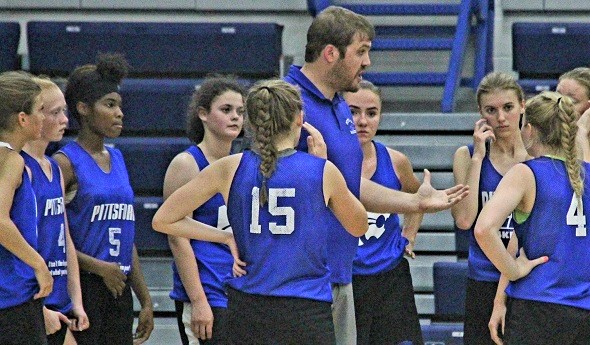
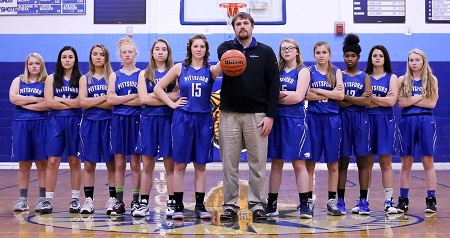
PHOTOS: (Top) First-year Pittsford varsity girls basketball coach Aaron Davis talks things over with his team during a practice this season. (Middle) Davis and his team are off to a 3-0 start. (Top photo courtesy of James Gensterblum; middle photo provided by Pittsford girls basketball program.)
Breslin Bound: Girls Report Week 3
December 17, 2012
By Geoff Kimmerly
Second Half editor
As a general rule, basketball teams evolve plenty between the first games of December through the final regular-season contests in February.
But these pre-break matchups matter just as much in the win-loss columns. And a number of games are being played right now that will surely make a difference as this season draws to a close.
This week's report includes some of the teams that have came out on the winning ends of key December battles. (Results and records based on those reported to Score Center at MHSAA.com)
1. Inkster (4-0) – The Vikings are a regular at Breslin Center and made the Class A Semifinals last season, so another great start is hardly surprising. But it's proof why Inkster remains a force – last week’s wins were 51-45 over improved Detroit Mumford and 57-51 over always-powerful Detroit Pershing.
2. Waterford Our Lady (3-1) – The reigning Class D champion has bounced back quickly from an opening-night loss to West Bloomfield. Last week, Our Lady beat Livonia Ladywood 50-38 and Mount Pleasant Sacred Heart by the same score.
3. Detroit Martin Luther King (3-0) – This is another team always in the Class A mix, and it got a big win Saturday – 56-48 over returning Class A Semifinalist Ann Arbor Huron, which earlier in the week had defeated Detroit Country Day 65-58. King also beat Detroit East English 61-7.
4. Johannesburg-Lewiston (5-0) – The Cardinals lost only two regular-season games last season, both times to Ski Valley Conference rival Gaylord St. Mary. But they got a little bit of revenge last week with a 50-48 win over St. Mary after also beating East Jordan 57-43.
5. Holt (5-0) – The Rams are again setting up nicely to contend in the strong Capital Area Activities Conference Blue. They beat nonleague foe St. Johns 52-48 and then Lansing Everett 48-39 to keep early pace with other frontrunners Grand Ledge and East Lansing.
6. Napoleon (5-1) – Napoleon’s 15-7 finish in 2011-12 included splits against Michigan Center and Grass Lake. The Pirates got an early upper hand on both last week, beating Michigan Center 49-45 and Grass Lake 47-42.
7. Traverse City St. Francis (4-1) – The Gladiators opened last season 14-1, with that lone loss to Cadillac – which they beat last week 55-50. St. Francis also defeated Kalkaska 44-36 on Friday.
8. Pewamo-Westphalia (3-2) – The Pirates got off to a rough start with opening-week losses to Class B Williamston and Lakewood. But back in familiar territory in the Central Michigan Athletic Conference, they've won three straight – including 51-42 last week over returning Class D Semifinalist Portland St. Patrick.
9. North Farmington (3-1) – The Raiders are coming off a 10-12 season that included a pair of losses to Pontiac. But North Farmington earned the early edge this time with a 59-58 win over Pontiac, followed by a 58-48 win over West Bloomfield.
10. Powers North Central (5-1) – After opening with a 13-point loss to returning Class D Semifinalist Crystal Falls Forest Park, North Central hasn't fallen again. The Jets beat Stephenson 62-51 and Munising 50-22 to get nearly halfway to last season’s win total of 11.
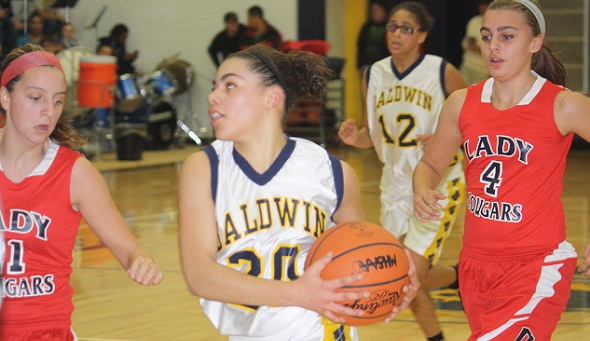
PHOTO: Big Rapids Crossroads (in red) defeated Baldwin on Thursday to move to 4-0 this season. (Click to see more at HighSchoolSportsScene.com.)