

Decade After Title Trips, 'Coach K' Just as Driven to Coach Up Grand Haven Contenders
By
Tom Kendra
Special for MHSAA.com
February 1, 2023
Katie Kowalczyk-Fulmer has experienced unforgettable highs and nightmarish lows during her 25 years as the girls basketball coach at Grand Haven.
 It’s now the 10-year anniversary of an amazing three-year stretch from 2011 to 2013, when “Coach K” guided the Buccaneers to a combined 81-2 record, three consecutive berths in the Class A Semifinals and back-to-back titles in 2012 and 2013.
The lows are harder to pick out, but the way Grand Haven lost at Hudsonville on Jan. 24 certainly qualifies.
The Bucs led 46-44 with time running out, when Haven was called for a shooting foul with one-tenth of a second remaining on a desperation half-court shot attempt. Hudsonville senior Maddie Peroelje then made all three free throws to pull out an improbable 47-46 win.
“That one was brutal,” said Kowalczyk-Fulmer, who was feeling much better Tuesday, one week later, after Haven downed visiting Zeeland West 44-33 for its third-straight victory.
“I love all of it, the great teams and big wins, but also the struggles and trying to stay strong and figure things out.”
Kowalczyk-Fulmer, 52, might be in the midst of the best coaching job in her 31-year career, guiding a team with no returning starters to a 10-4 start, including an impressive 5-2 record after the first rotation in the rugged Ottawa-Kent Conference Red.
She is doing it with a team that only goes about six or seven deep, has no one in that group taller than 6-foot and lost its starting point guard, junior Abbey Klumpel, to a season-ending knee injury during the summer.
How is she doing it?
“She teaches a team game of basketball,” explained ninth-year Grand Haven athletic director Scott Robertson, who has been involved in high school sports for 32 years. “She is more invested in her sport, her kids, her program than anyone I have ever seen.”
The defensive leader Tuesday was gritty senior guard Grace Harrison, who held Zeeland West’s top perimeter threat scoreless.
On offense, junior forward Emerson Berndt turned in a double-double with 23 points and 10 rebounds. She scored 14 of those points in the second half to help the Bucs put the game away.
Berndt had the hot hand Tuesday, but in other games this season sophomore guard Gillian Sorrelle or junior forward Maddie Schopf have carried the team from outside. The inside leader is 5-11 senior center Heidi Berkey, who held her own against ZW’s 6-4 senior center Kara Bartels.
Berndt, who leads the Bucs with 12 points and five rebounds per game, said this team has a special bond with its head coach.
“Coach has established such a close relationship with all of us, and she knows how to get us going,” said Berndt, who is one of the five Haven starters who all average at least six points per game. “She’s always joking around, but getting after it at the same time.”
 Haven, which is a surprising second in the O-K Red at the halfway point, starts the second half of the slate Friday at first-place and No. 3-ranked Rockford (13-1).
Kowalczyk-Fulmer, a standout player at Caledonia and then Hope College, began her coaching career at the age of 21 when she was still a senior at Hope – coaching the seventh-grade girls team at Caledonia.
She then worked five years at Hastings, including the final three as girls varsity head coach, before taking the job as a physical education teacher and varsity girls basketball coach at Grand Haven in 1997.
Kowalczyk-Fulmer and her husband, Paul, have one son, Drew, a 12-year-old sixth grader at Grand Haven who was just a toddler when the Buccaneers were enjoying their magical three-year run a decade ago.
Haven made its presence known on a statewide level in 2011, when 6-5 sophomore Abby Cole led the Bucs to a 26-1 record, with the only loss coming by a single point to Detroit Renaissance, 39-38, in a Class A Semifinal at Michigan State’s Breslin Center.
The Bucs took the final step in 2012, erasing an 18-point, third-quarter deficit as senior guard Shar’Rae Davis drove the length of the court for the game-winning layup with nine seconds remaining in a 54-53 victory over Grosse Pointe South. Haven finished 27-1, with its only loss coming early in the season against O-K Red rival East Kentwood.
GH did it again in 2013 with a perfect 28-0 record, which might have been the most impressive because the only returning starter was Cole, who would go on to an all-Big Ten volleyball career at Michigan. The Bucs committed a staggering 32 turnovers, but made up for it with 22-of-29 shooting (76 percent), in a 60-54 overtime victory over, once again, Grosse Pointe South.
“Those are the glory days, and here we are 10 years later and you realize just how special it was,” said Kowalczyk-Fulmer, who has also coached track at Grand Haven. “We always stayed humble and worked hard.
“Obviously, having someone like Abby Cole as the last line of defense is something special. But she had such great character and leadership, as well. I can still see her out there when things weren’t going well, and she would wrap her long arms around her teammates and tell them it was going to be OK. And it was.”
Kowalczyk-Fulmer has amassed 391 victories as a head coach, with six O-K Red titles, eight District and four Regional championships – along with the two Class A Finals wins.
“Those trophies are getting hard to come by – I’m thinking about buying one on eBay,” said Coach K, displaying the quick wit that her fellow coaches, referees and players know very well.
She works hard, but also has plenty of fun and laughs along the way, which is why she doesn’t plan on retiring any time soon – even though this school year marks her 30th year of teaching.
As Kowalczyk-Fulmer was finishing up her media obligations after the Zeeland West victory, her son – a sports junkie who has literally grown up in the Grand Haven bleachers and locker rooms – sat waiting in the hallway.
“I plan to be here until he graduates,” she said with a nod to her only child. “I love it. It’s my passion, and I’m really lucky. Grand Haven is such a great place to live and coach.
“I’m not ready to stop.”
 Tom Kendra worked 23 years at The Muskegon Chronicle, including five as assistant sports editor and the final six as sports editor through 2011. E-mail him at [email protected] with story ideas for Muskegon, Oceana, Mason, Lake, Oceola, Mecosta and Newaygo counties.
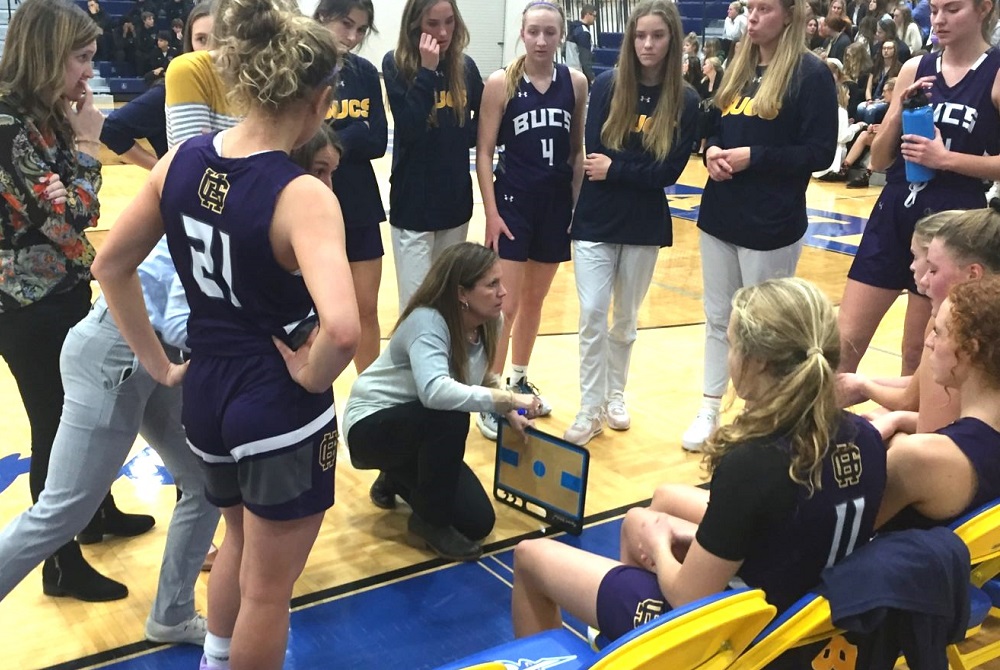
PHOTOS (Top) Grand Haven girls basketball coach Katie Kowalczyk-Fulmer talks things over with her team during a game earlier this decade. (Middle) Kowalczyk-Fulmer and son Drew accept the Class A championship trophy after the Bucs’ second-straight title win in 2013. (Top photo courtesy of the Local Sports Journal.)
Breslin Bound: Girls Report Week 3
December 17, 2012
By Geoff Kimmerly
Second Half editor
As a general rule, basketball teams evolve plenty between the first games of December through the final regular-season contests in February.
But these pre-break matchups matter just as much in the win-loss columns. And a number of games are being played right now that will surely make a difference as this season draws to a close.
This week's report includes some of the teams that have came out on the winning ends of key December battles. (Results and records based on those reported to Score Center at MHSAA.com)
1. Inkster (4-0) – The Vikings are a regular at Breslin Center and made the Class A Semifinals last season, so another great start is hardly surprising. But it's proof why Inkster remains a force – last week’s wins were 51-45 over improved Detroit Mumford and 57-51 over always-powerful Detroit Pershing.
2. Waterford Our Lady (3-1) – The reigning Class D champion has bounced back quickly from an opening-night loss to West Bloomfield. Last week, Our Lady beat Livonia Ladywood 50-38 and Mount Pleasant Sacred Heart by the same score.
3. Detroit Martin Luther King (3-0) – This is another team always in the Class A mix, and it got a big win Saturday – 56-48 over returning Class A Semifinalist Ann Arbor Huron, which earlier in the week had defeated Detroit Country Day 65-58. King also beat Detroit East English 61-7.
4. Johannesburg-Lewiston (5-0) – The Cardinals lost only two regular-season games last season, both times to Ski Valley Conference rival Gaylord St. Mary. But they got a little bit of revenge last week with a 50-48 win over St. Mary after also beating East Jordan 57-43.
5. Holt (5-0) – The Rams are again setting up nicely to contend in the strong Capital Area Activities Conference Blue. They beat nonleague foe St. Johns 52-48 and then Lansing Everett 48-39 to keep early pace with other frontrunners Grand Ledge and East Lansing.
6. Napoleon (5-1) – Napoleon’s 15-7 finish in 2011-12 included splits against Michigan Center and Grass Lake. The Pirates got an early upper hand on both last week, beating Michigan Center 49-45 and Grass Lake 47-42.
7. Traverse City St. Francis (4-1) – The Gladiators opened last season 14-1, with that lone loss to Cadillac – which they beat last week 55-50. St. Francis also defeated Kalkaska 44-36 on Friday.
8. Pewamo-Westphalia (3-2) – The Pirates got off to a rough start with opening-week losses to Class B Williamston and Lakewood. But back in familiar territory in the Central Michigan Athletic Conference, they've won three straight – including 51-42 last week over returning Class D Semifinalist Portland St. Patrick.
9. North Farmington (3-1) – The Raiders are coming off a 10-12 season that included a pair of losses to Pontiac. But North Farmington earned the early edge this time with a 59-58 win over Pontiac, followed by a 58-48 win over West Bloomfield.
10. Powers North Central (5-1) – After opening with a 13-point loss to returning Class D Semifinalist Crystal Falls Forest Park, North Central hasn't fallen again. The Jets beat Stephenson 62-51 and Munising 50-22 to get nearly halfway to last season’s win total of 11.
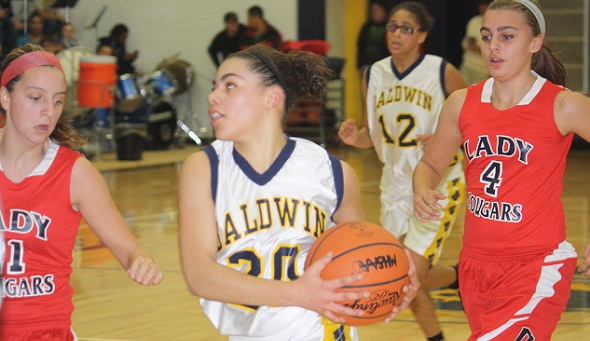
PHOTO: Big Rapids Crossroads (in red) defeated Baldwin on Thursday to move to 4-0 this season. (Click to see more at HighSchoolSportsScene.com.)