

Despite Torn ACL, Lapeer's Erla Drives On
By
Paul Costanzo
Special for MHSAA.com
February 26, 2020
Hannah Erla was so devastated by the diagnosis, she basically stopped listening.
 The Lapeer senior point guard had torn her ACL, which in her mind meant her final high school season was over after just four games. She wouldn’t be able to lead the Lightning to their first District title since her freshman year. She was done playing for coach Andrew Roberts. She would end her career about 100 points shy of 1,000.
As all this was swirling through Erla’s head, the good news came: she could still play.
“There was maybe a pause, then he said it after,” Erla said. “I was so upset, I wasn’t comprehending what he was saying.”
After Erla processed the news, her next decision was a simple one. She wouldn’t have surgery on her knee until after the season. She would wear a brace, and she would finish her high school career on the court. After talking with more doctors, getting the proper clearances and missing just two games, Erla was back in uniform leading the Lightning.
“What drives me to play is that it’s my last year of high school, and I’ll never be able to play with my friends again, or have Roberts coach me,” she said. “I just want to win a District with my team. … It was immediate. I decided right then that I was going to finish out the season and reach my goals to get 1,000 and try and win a District.”
Erla reached 1,000 points in the waning seconds of Lapeer’s game Feb. 7 against Grand Blanc. The District title is yet to be decided, and Erla still has some work to do to ensure she’s on the court to make that happen.
She has missed the Lightning’s past three games because the swelling in her knee has increased. She plans to be on the court, however, for the regular-season finale Friday at home against Bay City John Glenn, and the postseason which begins March 4 for Lapeer.
Betting against her seems unwise considering what Erla already has overcome. But either way, she’s already provided a shining example for the program.
“Hannah always wants to get into the gym,” Roberts said. “Hannah plays and works hard in the offseason. We ran a summer camp for kids, and I made sure that I stressed that she’s a four-year player because of her, because she has put this extra time in. When you have a walking, living example of that, it holds so much more water than just saying it.”
Roberts took over the Lapeer girls basketball program at the same time Erla was entering it. As a freshman, she wasn’t a starter, but she still managed to earn honorable mention all-Saginaw Valley League recognition. As a sophomore and junior, she earned first-team honors.
 Lapeer, which was 5-13 entering Tuesday’s game against Midland Dow, started this season 3-0, with all three wins coming by double digits. It was early in the fourth game, a 41-39 loss to Davison on Dec. 13, when the Lightning lost its leader. Erla ran toward a Davison player who was bobbling the ball, but as she planted her foot and tried to turn, her knee gave out. Erla said she didn’t hear the pop that players so often recall when tearing their ACL, and she was able to walk on it. The trainer told her she couldn’t return, however.
“Our trainer went out there and knew she was done for that game,” Roberts said. “When they say they’re done, and it’s a knee issue, you tend to think the worst.”
Erla’s tear was described as straight across, and not jagged, which allowed her to get the green light to play with a brace. She returned to action Jan. 7.
“I’m happy, selfishly, to have her,” Roberts said. “But I’ve never seen it done before, so I was pretty apprehensive, because the last thing I wanted to do was hurt her. I was excited to have her, but at the same time very, very nervous. When you start talking to people, there were other situations out there, which kind of eases your mind a little bit. You have to go by what the expert says, not what I think.”
Erla had to adjust to playing with her injury, as she had lost some of her signature explosiveness. Roberts said her strength as a shooter became more prominent.
“I just let things come more naturally rather than before when I tried to do most of the work,” she said. “This time, I just waited for my shot. At first, it was (frustrating) because I wasn’t expecting it. I was expecting to play how it used to be, but then I adjusted and I wasn’t frustrated anymore.”
In 14 games this season, Erla is averaging 12.6 points, three rebounds and 1.2 steals per game. She is also shooting 80 percent from the free throw line.
One of those free throws earned Erla her 1,000th point one month after she returned to action. She said the moment was made more special because of what she had to endure to get there.
“It was a lot of pressure; I was all worked up over it,” Erla said. “After I hit it, I was overwhelmed with emotion and so thankful to reach that goal. I was just beyond happy and overwhelmed with emotion. I didn’t know what to think. I was crying and hugging my teammates.”
After the season ends, and after spring break, Erla said she will have her surgery in early spring. She is still hoping to play basketball at the next level, and Roberts said she has been in contact with several NAIA programs. The most important quality Erla, who holds a 4.1 GPA, said she is looking for is a good engineering program.
Roberts says that whoever signs Erla will be bringing in a great asset.
“I would sign her because right now, she needs to score in high school for us to be successful,” he said. “It might take a year or so, but when you develop her into more of a point guard, you’re going to have a guard who can break a defender down and get into the paint – that's what she does. A healthy Hannah can get into the key at will.”
 Paul Costanzo served as a sportswriter at The Port Huron Times Herald from 2006-15, including three years as lead sportswriter, and prior to that as sports editor at the Hillsdale Daily News from 2005-06. He can be reached at [email protected] with story ideas for Genesee, Lapeer, St. Clair, Sanilac, Huron, Tuscola, Saginaw, Bay, Arenac, Midland and Gladwin counties.
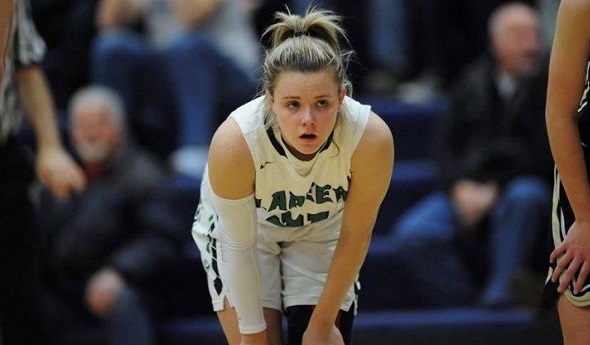
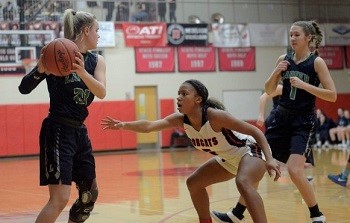
PHOTOS: (Top) Lapeer’s Hannah Erla lines up for a free throw against Bay City Western this season. (Middle) Erla prepares to make her move against Grand Blanc. (Photos by Ross Carithers, courtesy of Hannah Erla.)
Wilkinson Capping Record-Blazing Career
May 17, 2018
By Dennis Chase
Special for Second Half
KALKASKA – Rik Ponstein cuts to the chase when he talks about senior pitcher-centerfielder Makenzie Wilkinson.
 “She’s probably the best player I’ve ever coached,” he said.
It’s a telling statement considering Ponstein is in his 34th season coaching softball and – prior to Thursday’s doubleheader with Boyne City – is 11 wins shy of 700 in his career.
He’s coached several good teams, several good players.
Wilkinson pauses, searching for the right words, to respond to her coach’s assessment.
“That’s an honor,” the soon-to-be 18-year-old said. “It amazes me, really.”
Wilkinson is on the verge of becoming the school’s Female Athlete of the Year for the fourth time – the first time that’s happened here.
In basketball, the 5-foot-8 Wilkinson is a two-time all-state player and holds the school record in rebounds (696) and blocks (153). She tied the school mark for 3-pointers in a game (eight) and is fourth all-time in scoring (1,417 points).
In softball, she owns most of the school records, or will by the time the season ends.
“She’s a great competitor,” Dave Dalton, the longtime girls basketball coach, said. “She’s extremely skilled in both sports.”
The Blazers are currently 24-1 in softball, earning an honorable mention in this week’s Division 2 coaches poll.
It’s a veteran team; only two starters graduated off last year’s 37-5 squad that lost to Muskegon Oakridge in the Regionals.
Wilkinson, pitcher-shortstop MaKenzie Leach and rightfielder Taylor Kooistra are the leaders – four-year starters who have paced Kalkaska to a 125-23 record during that span. Wilkinson (60-15) and Leach (58-8) have been the winning pitchers in 118 of those triumphs.
“All three are outstanding,” Ponstein said. “They have melded together to help make this a very good team.”
On the mound, Wilkinson (12-1) and Leach (11-0) provide a formidable combination.
 “They’re different type of pitchers,” Ponstein said. “Makenzie Wilkinson is a power pitcher (441 career strikeouts) with a curve. MaKenzie Leach is more of a control pitcher with a good changeup. She’s only walked 70 batters in her career, just four this season. What’s made Makenzie Wilkinson tougher this year is that she’s only walked nine. I tell the girls if you don’t walk them, your teammates will make the plays behind you. The one time we didn’t make the plays, we lost. For the most part, though, we make the plays.”
At the plate, Wilkinson is hitting .545, Kooistra .529 and Leach .475. Wilkinson’s belted six home runs, Kooistra five. They rank one-two on the school’s career list for home runs with 29 and 17, respectively.
The trio are joined in the lineup by Angela Iott at first, Kayla Cavanaugh at second, Jaime Potter at third, Kayleigh Bunker in left and Ayla Gustafson behind the plate. Loren Schwab rotates between shortstop and centerfield, depending on who’s pitching. All are juniors, except Bunker, a senior.
“We’re experienced,” Wilkinson said. “We’ve been around each other a long time. We play well together.”
As for Wilkinson, she comes from an athletic family. Her father, Jeremy, was a football standout at Northern Michigan University and later inducted into the school’s Hall of Fame. He also served as Kalkaska’s football coach until stepping down last November. Makenzie’s mother, Cheri, was a four-sport standout (volleyball, basketball, softball and track) at Kalkaska, She played softball for Ponstein and JV basketball for Dalton. She ran track only her sophomore year, but set the school record in the 400 meters.
“Growing up they always taught me to go all out, give your best every second,” Makenzie said. “Mom always says that the sky’s the limit, to always put forth the effort and put in the extra time.”
“We had lots of conversations about that when she was in middle school,” Cheri said, laughing. “We knew she had gifts (athletically). We knew if she put in the time that later in life it would help her. Now, looking back, she realizes that and has thanked us for pushing her to work hard because it’s paid off.”
Wilkinson has signed to attend school and play basketball at Davenport University, which just transitioned to NCAA Division II. She’s also hoping to play softball.
Softball might be her best sport – and the one she thought she would play in college – but she did not receive many recruiting looks.
“It was a rough road,” Makenzie said. “Nothing really happened.
“It just didn’t pan out,” Cheri added. “Then, Rick Albro (Davenport’s women’s basketball coach) showed interest, and she connected with him. It fell into place. She’s still going to play travel softball this summer. She’s still trying to get her foot in the door at Davenport for softball. She’s been in contact with the coach. If it doesn’t work out, it doesn’t work out. She’s ready to play basketball. That’s her No. 1 priority.”
There’s a twist to the story. Jeremy Wilkinson is originally from Marlette, and that was one of the first stops on Albro’s coaching journey. Albro coached boys basketball at Marlette from 1974-78.
It promises to be a busy summer for Makenzie. In addition to playing travel softball with the Alpena Mystics, Wilkinson will be taking online classes through Davenport and working on her basketball skills, and lifting, almost daily. She’s currently working with coaches Chuck and Travis Schuba, who both played collegiately.
“I’m trying to get ready for the college level,” she said, “coming off screens quicker, shooting quicker, getting up to the speed of the game.”
Oh, by the way, she’s also working on a construction crew.
If she needs advice about playing at the next level, she can turn to her father.
“(Jeremy) knows what it takes to be a college athlete, and he’s already told her that you have to be ready or it’s going to be a tough road,” Cheri said. “He trained all the time when he was in school and during the summers. He was a kid who didn’t get a lot of attention, but he put the time in and succeeded.”
This past winter, Wilkinson led a small, inexperienced Blazers basketball team to a 17-6 record. She averaged 20.1 points, 9.8 rebounds and 4.4 steals a game.
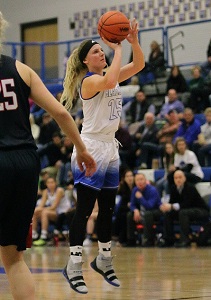 “I was surprised,” she admitted. “We did pretty well. I was proud of our team.”
The Blazers were ousted in the District by Kingsley, which reached the Class B Semifinals.
Wilkinson was Kalkaska’s go-to player.
“She has an incredible motor and knowledge (of the game),” Dalton said. “She’s strong, she’s fast, she’s super coordinated.”
The Blazers went 78-15 in her four years on varsity, winning three Districts and two Lake Michigan Conference crowns.
As a junior, she was selected to the Detroit Free Press Dream Team.
But those accolades do not define her.
“It’s not all about the recognition,” she said. “I’m not really a person who’s out there about my accomplishments. To me, it’s about giving it your all and having the heart to play.”
Cheri agrees.
“She’s a humble kid, very even-keeled,” she said. “She doesn’t let (awards) go to her head. She’s just a calm kid, who doesn’t talk much.”
Makenzie lets her determined play on the court and field do the talking.
Away from the action, she’s a member of the National Honor Society and in the fall was selected Homecoming queen.
“The students like her and respect her,” Dalton said.
“She’s not a cocky kid,” Cheri said. “She mingles with all the different cliques. She’s a very open kid. I really admire her for that. We’ve always told our kids to stand up for others.”
Right now, she’s having a little problem standing and moving around. She dropped a 25-pound weight on her foot during lifting class Tuesday. X-rays revealed that no bones were broken or fractured, but the foot is swollen and bruised.
“I was putting weight on the squat bar,” she said. “I put a 45 on – I was lucky I didn’t drop that one on my foot – and I went to grab the 25-pound weight off the rack to put on the barbell when I dropped it. I’m just glad it’s not broken or fractured. I’ll be ready to play later this week.”
Ponstein, meanwhile, has always set similar goals for his teams every season – win at least 20 games, and capture conference and District titles. This season, with a veteran cast returning, he added a Regional crown to the mix. The Blazers have never won a Regional under Ponstein.
If the rankings hold, that Regional in Gaylord could include No. 2 Escanaba and No. 8 Oakridge.
What would it mean to break the drought and win a Regional?
“It would be beyond exciting,” Wilkinson said. “It’s a new level when you get into Regionals. To be able to win at that level would be amazing.”
Time will soon tell.
 Dennis Chase worked 32 years as a sportswriter at the Traverse City Record-Eagle, including as sports editor from 2000-14. He can be reached at [email protected] with story ideas for Manistee, Wexford, Missaukee, Roscommon, Ogemaw, Iosco, Alcona, Oscoda, Crawford, Kalkaska, Grand Traverse, Benzie, Leelanau, Antrim, Otsego, Montmorency, Alpena, Presque Isle, Cheboygan, Charlevoix and Emmet counties.
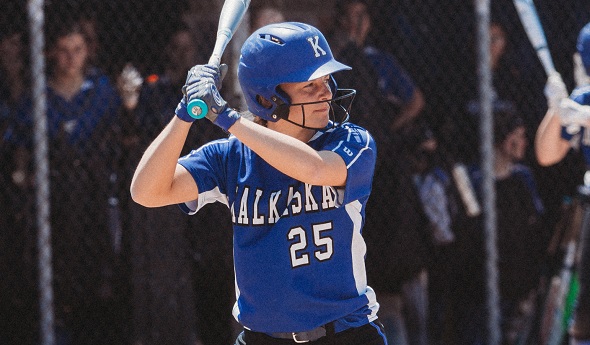
PHOTOS: (Top) Kalkaska’s Makenzie Wilkinson stands in during an at bat this season. (Middle) Wilkinson pulls up for a jumpshot this past winter. (Softball photo by Capture Me Photography; head shot by Patricia Golden; basketball photo by RD Sports Photo.)