

Edison Advances to 1st Hoops Final
March 16, 2017
By Geoff Kimmerly
Second Half editor
EAST LANSING – When Monique Brown heard voices as she walked past her players’ hotel rooms late Wednesday night, she was a little concerned.
Maybe she’d made a mistake bringing her young team to East Lansing the night before the biggest game in school history.
But as they have other times before, Detroit Edison Public School Academy’s players proved their coach wrong, coming out Thursday afternoon anything but sluggish in earning an even more memorable opportunity.
DEPSA – with nine freshman, a sophomore and two juniors on its roster – looked neither tired nor inexperienced in handing annual Breslin visitor Flint Hamady a 54-31 defeat in the day’s first Class C Semifinal.
“We got there late, and we couldn’t sleep. We were just talking about what we can do,” Pioneers sophomore guard Rickea Jackson said. “They came knocking on our doors … they took our phones. We couldn’t do anything but talk.”
DEPSA (20-5) will face Pewamo-Westphalia in Saturday’s Class C Final at 4 p.m. It will be the Pioneers' first appearance in an MHSAA girls basketball championship game.
As much as they had to discuss after midnight the evening before, Jackson and her teammates made a loud statement with their play to tip off this Finals weekend.
They held Hamady to 8.3-percent shooting from the floor during the first half in building a 28-8 lead. The Hawks did recover to shoot an improved 36 percent during the second half, but DEPSA made 49 percent of its shots for the game – and freshman Gabrielle Elliott had nine field goals, only one fewer than Hamady as a team.
Elliott finished with 24 points and Jackson had 16 and eight rebounds as they combined to drop 16 of 26 shots from the floor – not bad for a couple of underclassmen on the biggest stage for the first time.
 “We’ve never done that to a team like Flint Hamady, and I really commend my young group,” Brown said. “They’ve been preparing for this, we’ve talked about it, and as we’ve went through the season … I told them it was all in preparation for today. I always told them I don’t want to hear people say we’re talented; I want to hear them say how hard we play.”
Brown, also the school’s athletic director, had to know what she had coming this winter and scheduled appropriately. DEPSA opened 9-0, with a one-point win over Southfield Arts & Technology, a Class A semifinalist this weekend.
But the No. 5-ranked Pioneers then ran into a tough spot, losing three of its next five to Class A power Detroit Martin Luther King and Class B contenders Detroit Country Day and Ypsilanti Arbor Prep. Sandwiched among those defeats, however, was a 43-39 win over Hamady, which made its third Semifinal appearance of this decade Thursday and finished Class C runner-up in 2015.
That first Hawks loss to DEPSA on Jan. 31 was Hamady’s third straight after losing senior guard Krystal Rice for the season to a knee injury. Without Rice – who will continue her career at Indiana State University – the Hawks still managed to navigate a tournament run that included handing top-ranked Sandusky a 38-36 loss in the Regional Final.
“We didn’t give up on the season,” Hamady coach Keith Smith said. “We spent a lot of time watching film, spent a lot of time drilling on fundamentals, trying to tweak the little things we were not doing well and trying to be concerned on the details. (But) it caught up with us today to not have her, that extra senior who had played in a state final.”
Senior guard Deajah Cofield and freshman center Aryana Naylor both scored 10 points to lead Hamady, Cofield also totaling five steals and Naylor grabbing 10 rebounds.
With Rice out, Cofield was the only senior starter for Hamady, which finished the regular season unranked but ended up with a final record of 19-6.
Smith said he hadn't seen a team as talented as DEPSA with that many young players since his 2009 Class C championship team.
The Pioneers didn’t play like mostly underclassmen Thursday, just a team with a little bit of a chip on their collective shoulders and the talent to dominate the next two to three seasons as well.
“(People) said we’d lose to Sandusky, and they didn’t make it to us, and they said we’d lose to Blissfield by two,” Jackson said, noting the 16-point Quarterfinal win over the No. 10 Royals. “We’re just tired of people doubting us. We’re so young, we don’t have any seniors, and we just want to prove everyone wrong.”
The Girls Basketball Finals are presented by Sparrow Health System.
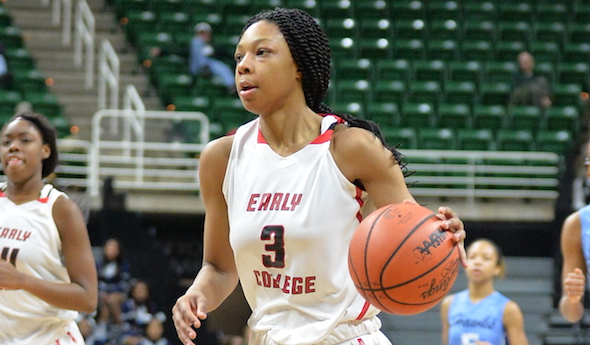
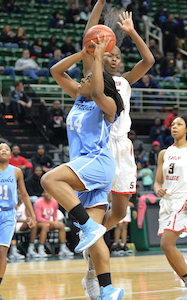
PHOTOS: (Top) DEPSA's Gabrielle Elliott pushes the ball upcourt during her team's Class C Semifinal win. (Middle) Rickea Jackson works to get a hand on a shot by Flint Hamady's Danielle Tipton.
Breslin Bound: Girls Report Week 3
December 17, 2012
By Geoff Kimmerly
Second Half editor
As a general rule, basketball teams evolve plenty between the first games of December through the final regular-season contests in February.
But these pre-break matchups matter just as much in the win-loss columns. And a number of games are being played right now that will surely make a difference as this season draws to a close.
This week's report includes some of the teams that have came out on the winning ends of key December battles. (Results and records based on those reported to Score Center at MHSAA.com)
1. Inkster (4-0) – The Vikings are a regular at Breslin Center and made the Class A Semifinals last season, so another great start is hardly surprising. But it's proof why Inkster remains a force – last week’s wins were 51-45 over improved Detroit Mumford and 57-51 over always-powerful Detroit Pershing.
2. Waterford Our Lady (3-1) – The reigning Class D champion has bounced back quickly from an opening-night loss to West Bloomfield. Last week, Our Lady beat Livonia Ladywood 50-38 and Mount Pleasant Sacred Heart by the same score.
3. Detroit Martin Luther King (3-0) – This is another team always in the Class A mix, and it got a big win Saturday – 56-48 over returning Class A Semifinalist Ann Arbor Huron, which earlier in the week had defeated Detroit Country Day 65-58. King also beat Detroit East English 61-7.
4. Johannesburg-Lewiston (5-0) – The Cardinals lost only two regular-season games last season, both times to Ski Valley Conference rival Gaylord St. Mary. But they got a little bit of revenge last week with a 50-48 win over St. Mary after also beating East Jordan 57-43.
5. Holt (5-0) – The Rams are again setting up nicely to contend in the strong Capital Area Activities Conference Blue. They beat nonleague foe St. Johns 52-48 and then Lansing Everett 48-39 to keep early pace with other frontrunners Grand Ledge and East Lansing.
6. Napoleon (5-1) – Napoleon’s 15-7 finish in 2011-12 included splits against Michigan Center and Grass Lake. The Pirates got an early upper hand on both last week, beating Michigan Center 49-45 and Grass Lake 47-42.
7. Traverse City St. Francis (4-1) – The Gladiators opened last season 14-1, with that lone loss to Cadillac – which they beat last week 55-50. St. Francis also defeated Kalkaska 44-36 on Friday.
8. Pewamo-Westphalia (3-2) – The Pirates got off to a rough start with opening-week losses to Class B Williamston and Lakewood. But back in familiar territory in the Central Michigan Athletic Conference, they've won three straight – including 51-42 last week over returning Class D Semifinalist Portland St. Patrick.
9. North Farmington (3-1) – The Raiders are coming off a 10-12 season that included a pair of losses to Pontiac. But North Farmington earned the early edge this time with a 59-58 win over Pontiac, followed by a 58-48 win over West Bloomfield.
10. Powers North Central (5-1) – After opening with a 13-point loss to returning Class D Semifinalist Crystal Falls Forest Park, North Central hasn't fallen again. The Jets beat Stephenson 62-51 and Munising 50-22 to get nearly halfway to last season’s win total of 11.
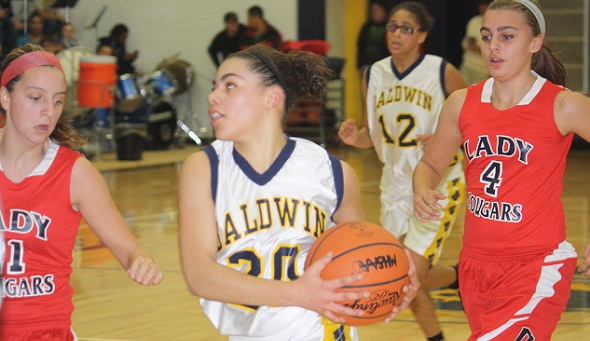
PHOTO: Big Rapids Crossroads (in red) defeated Baldwin on Thursday to move to 4-0 this season. (Click to see more at HighSchoolSportsScene.com.)