

'Fire & Ice' Sail Mona Shores into Regional
By
Tom Kendra
Special for MHSAA.com
March 6, 2017
Guard play is crucial in girls basketball.
Especially in March, and definitely in the second half of a District championship game against a crosstown rival.
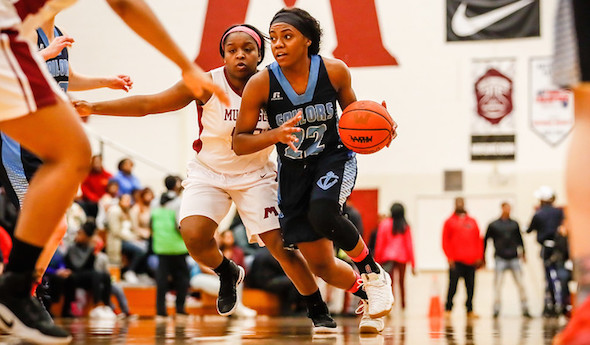
 Jordan Walker, a 5-foot-7 Miss Basketball finalist for Muskegon Mona Shores, took control the way a senior guard is supposed to – scoring the first eight points of the second half Friday, including hitting two big 3-pointers, and finishing with a game-high 21 points as the Sailors blew open a relatively close game and held on for a 50-43 victory over host Muskegon Reeths-Puffer for their third consecutive Class A District title.
“You can’t stop her,” Mona Shores coach Brad Kurth said amidst the postgame celebration. “You can slow her down, but she’s going to keep coming.”
Mona Shores, 19-3 and champion of the Ottawa-Kent Conference Black, advanced to face O-K Red champion East Kentwood (22-1) in Tuesday’s 6 p.m. Class A Regional opener at Zeeland East.
Walker, who has signed with Western Michigan University where she will play with her older sister, Jasmyn, has been driving hard toward a big finish all season long. She now has more than 1,500 career points after breaking the Mona Shores girls basketball scoring record in January, held for 22 years by another Miss Basketball finalist, Jamie Ahlgren, who went on to star at Oakland University. Walker scored 39 points in a win over Muskegon and notched a quadruple-double with 22 points, 14 rebounds, 14 steals and 10 assists in a win over Grand Rapid Union.
But as impressive as Walker has been, the reason the Sailors have been able to knock off teams with superior front lines like Reeths-Puffer is because Walker is not alone in the backcourt.
Joining Walker is 5-6 sophomore dynamo Alyza Winston, a duo Kurth has dubbed “Fire and Ice,” and opposing coaches have pulled their hair out trying to contain.
Walker is the “ice” – the refined, composed senior who never gets rattled despite constant double teams, box-and-ones and other gimmicks designed to throw her off her game.
Winston is the “fire” – the energetic, speedy sophomore who breaks down defenses off the dribble (and with an ankle-breaking crossover dribble) and steps up anytime the Sailors’ offense gets stagnant.
The way that dynamic duo interacts and conspires to frustrate opponents was on display in Friday’s District championship game.
Walker caught fire to open the second half, turning a 10-point halftime lead into a seemingly comfortable 31-13 advantage early in the third quarter. That’s when Reeths-Puffer coach Brandon Barry called a timeout and adjusted even more of the Rockets’ defense toward the task of slowing down Walker.
Enter Winston.
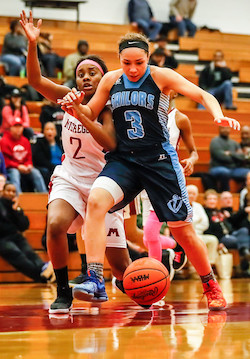 For much of the remainder of the game, Shores started its attack with the ball in the hands of Winston, whose dynamic ball-handling skills have brought her plenty of offers from Division I college programs, even though she still has two years of high school remaining. Winston, who finished with 13 points, repeatedly broke through fullcourt pressure and then either pulled it out to run off clock or dished it off inside to fellow underclassmen Nia Miskel, Ryleigh Wehler and Veronica Kastelic.
“Our guards were the difference,” said Walker, whose mother, Danielle Smith-Walker, is a counselor at Mona Shores and a varsity assistant coach. “People say that a basketball team will go only as far as the guards will take them, so we’ll see how far we can go.”
While the District title game was a classic matchup of Reeths-Puffer’s inside strength vs. Mona Shores’ guards, Tuesday’s Regional showdown with East Kentwood will feature two of the top backcourts in West Michigan.
Kentwood went undefeated in the O-K Red behind the guard trio of senior Anaya Powell, defensive stopper Amari Brown and Mauriya Barnes. How that threesome matches up with Walker and Winston could determine the outcome of the Regional showdown, but on Friday night, Kurth was just relieved to finally be playing an opponent outside of the Muskegon area.
Over the past two seasons, the lakeshore “big three” of Mona Shores, Reeths-Puffer and Muskegon High have battled during O-K Black and District action. Shores discovered how hard it is to beat a good team three times in one season Wednesday night, when it needed two clutch free throws from Kastelic in the waning seconds to edge Muskegon, 50-49. Then the Sailors had to turn around two nights later and fend off Reeths-Puffer, which had beaten them by nine points the last time they played at Puffer’s gym.
“I know it breaks their heart to lose this game,” Kurth said, speaking after Friday’s Reeths-Puffer game, though the same emotions applied to Wednesday’s win over Muskegon. “These rivalries have made us all better, and it has made Muskegon-area basketball better.”
Walker is the lone senior starter for Mona Shores, whose season ended last year in a Regional championship game loss to Hudsonville, 45-44.
Hudsonville faces Grand Rapids Forest Hills Northern in Tuesday’s second Regional game at Zeeland East.
 Tom Kendra worked 23 years at The Muskegon Chronicle, including five as assistant sports editor and the final six as sports editor through 2011. E-mail him at [email protected] with story ideas for Muskegon, Oceana, Mason, Lake, Oceola, Mecosta and Newaygo counties.
PHOTOS: (Top) Mona Shores' Jordan Walker (22) works to get past a Muskegon defender during a game earlier this season. (Middle) The Sailors' Alyza Winston (3) races for a loose ball. (Photos by Tim Reilly.)
Hartland Sets Sights on Unprecedented Heights
January 14, 2020
By Geoff Kimmerly
Second Half editor
This season isn’t half over for the Hartland girls basketball team. And as impressive as they’ve performed over the first six weeks, there are lessons from the last few seasons they must continue to recall with expectations high this winter.
 Take last week’s 50-40 win over Plymouth. The Eagles trailed early 14-1 – reinforcing coach Don Palmer’s message that every opponent is aiming to bring its best against a Hartland team with championship aspirations.
“I think a lot of times they’ve very focused and excited,” Palmer said of his team. “But … being teenagers, sometimes they’re complacent and take it for granted – and that’s just natural. That’s when we get upset, so we just kinda battle that a little bit.”
The hope is winning those prepares the Eagles for an unprecedented opportunity at the end of March.
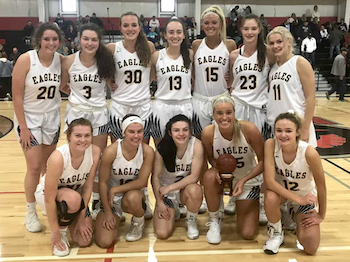
The Hartland girls basketball team is the MHSAA/Applebee’s “Team of the Month” for December, opening with four wins including victories over a pair of reigning MHSAA Finals champions – Division 4 Adrian Lenawee Christian (61-40) and Division 1 Saginaw Heritage (37-26) in the Eagles’ first two games. They closed the month with double-digit wins over Okemos and Bay City John Glenn, two more programs with high hopes this winter, and have since moved to 6-0 heading into Tuesday’s game against Howell.
Palmer has coached high school varsity basketball a combined 71 seasons, leading teams to 963 wins through Friday – the most in Michigan high school history. So when he says this season’s Hartland girls basketball team is the most talented he’s coached, that carries significant weight.
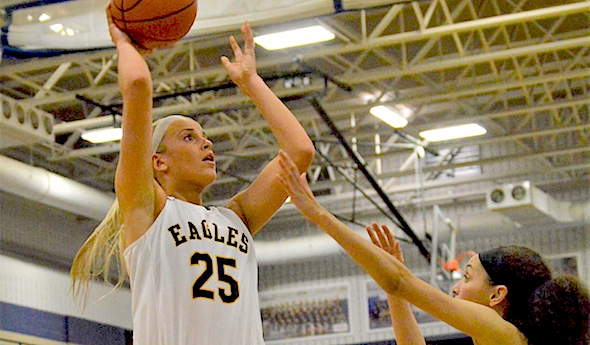
Palmer ranks seventh in MHSAA girls basketball history with a 616-311 record after leading Milford from 1977-2009 and then the Eagles since 2009-10. He quickly can recount the three athletes he sent on to Division I college athletics during those first three decades – before then offering context by describing how this Hartland team is led by University of Michigan recruit Whitney Sollom with at least five more players holding or on the verge of opportunities at the next level.
 So talent isn’t a question. But will this also turn out to be Palmer’s best team?
Hartland has made the Class A/Division 1 Quarterfinals the last two seasons, finishing 22-4 a year ago. Sollom, a 6-foot-3 post, has been on varsity all four of her seasons, with the team a combined 70-12 during that time.
A likely Miss Basketball candidate, Sollom was averaging 11.4 points and 12 rebounds per game entering last Friday’s 44-point win over Salem. Leading the team in scoring is Nikki Dompierre at 12.6 ppg, while Madi Moyer adds 8.2 and 7.4 rebounds per game. All three are senior captains.
Junior Syd Caddell and sophomore Amanda Roach also are back as the team returned its entire starting lineup this winter.
The challenges will start locally. Undefeated Brighton and the one-loss Highlanders also both play in the Kensington Lakes Activities Association West. Howell also is in Hartland’s District.
Palmer said his team’s unselfishness and support of one another have impressed him most. But of course there’s a long way to go this season – and the team is hoping to build to a big finish as it seeks its first MHSAA Finals championship in this sport.
“We’re really in a great cycle,” Palmer said. “When I got the job at Hartland, I had been in the same league at Milford, and we were beating their varsity by 1-2 points. But the lower levels, we could just seeing it coming. My comment to my staff is we’ll have no excuses for not winning.
“I’m very happy and thrilled about the success, but I also knew we’d have players.”
Past Teams of the Month, 2019-20
November: Bridgman girls cross country - Report
October: Allegan boys tennis - Report
September: Ishpeming Westwood girls tennis - Report
PHOTOS: (Top) Hartland's Whitney Sollom puts up a shot during a December win over Okemos. (Middle) The Eagles celebrate with a team photo after the win over Bay City John Glenn. (Top photo courtesy of State Champs Sports Network; middle photo courtesy of the Hartland girls basketball program.)